Smart phone users in the United Kingdom make calls more often than feature phone users. Some 81 percent of smart phone owners surveyed on behalf of Ofcom, the U.K. communications regulator, reported using their smart phones to make calls every day, compared to 53 percent of feature phone users.
So one might be tempted to think that there is something about smart phone owners that makes their behavior different. Ofcom suggests a more prosaic answer. The differences in usage can be explained by the different types of contracts smart phone and feature phone owners tend to buy.
Contract phone users make calls significantly more often than pay-as-you-go users overall. This has been confirmed by analyzing the research results, isolating the feature mobile phone users on contracts and comparing them with smart phone users on contracts, says Ofcom.
When looked at that way, call frequency profiles are similar for both, with one exception.
But there are differences between regular and smartphone pay-as-you-go users; Smart phone users on pay-as-you-go service plans also make calls more frequently.
The same pattern holds for use of text messaging. Seventy-nine percent of smart phone owners claim to make and receive SMS texts on their mobile every day, compared to 50 percent of regular phone users. This difference, again, can partly be explained by contract type, with higher numbers of smart phone users being on a contract.
When isolating regular mobile phone users on contracts and comparing them with smart phone users on contracts, their text messaging frequency profiles are very similar. However, there are differences between regular and smart phone casual-use customers. Smart phone users send and receive significantly higher levels of text messages than feature phone users on similar plans.
Tuesday, August 9, 2011
In U.K., Smart Phone Owners Make More Calls. Why?

 Gary Kim was cited as a global "Power Mobile Influencer" by Forbes, ranked second in the world for coverage of the mobile business, and as a "top 10" telecom analyst. He is a member of Mensa, the international organization for people with IQs in the top two percent.
U.K. Innovation Rates Accelerate
One easy observation one might make about the latest report from Ofcom, the U.K. communications regulator, is that the pace of innovation is increasing in the U.K. part of the communications industry.
That has been true in virtually every market over the past couple of decades as well, but the latest U.K. data illustrates the solidity of the trend.
As recently as a few decades ago, a new communications service might have taken 10 years to reach penetration of about 50 percent of households in a market. Read more here.
In the United Kingdom, both mobile phones and multichannel television both took more than a decade to reach 50 percentration, for example. In the last decade, popular and important innovations such as social networks and online TV reached 50 percent penetration within four to five years.
Analysts expect smartphones to reach the same landmark equally quickly as well. Rates of change that fast are hard for larger enterprises of all sorts to cope with, which helps explain why most innovation (not all) comes from smaller firms.
The big recent exception is the impact Apple has had in the mobile markets. In that case, it took a well-heeled, substantial firm to force a big and disruptive market change.
Read more here.
That has been true in virtually every market over the past couple of decades as well, but the latest U.K. data illustrates the solidity of the trend.
As recently as a few decades ago, a new communications service might have taken 10 years to reach penetration of about 50 percent of households in a market. Read more here.
In the United Kingdom, both mobile phones and multichannel television both took more than a decade to reach 50 percentration, for example. In the last decade, popular and important innovations such as social networks and online TV reached 50 percent penetration within four to five years.
Analysts expect smartphones to reach the same landmark equally quickly as well. Rates of change that fast are hard for larger enterprises of all sorts to cope with, which helps explain why most innovation (not all) comes from smaller firms.
The big recent exception is the impact Apple has had in the mobile markets. In that case, it took a well-heeled, substantial firm to force a big and disruptive market change.
Read more here.
Gary Kim was cited as a global "Power Mobile Influencer" by Forbes, ranked second in the world for coverage of the mobile business, and as a "top 10" telecom analyst. He is a member of Mensa, the international organization for people with IQs in the top two percent.
Health Care a Prime Area of M2M Interest
The health vertical is among a relative handful of industry verticals where mobile service providers tend to believe there are important opportunities for revenue growth, particularly in the area of remote telemetry. Though mobile service providers are understandably optimistic about prospects for machine-to-machine communications, health care is interesting because of its large role in many economies, rapidly rising healthcare spending and accompanying pressures to contain costs using technology.
Read more about Sprint's Health Vertical Perspectives
Frost & Sullivan recently published a whitepaper looking at the strengths and drawbacks of four major mobile device types – smartphones, tablets, push-to-talk communication devices, and machine-to-machine (M2M) remote medical monitoring devices. Each device category is evaluated for application in three environments, including the hospital, physician’s office, and the patient’s home. Read more here.
Gary Kim was cited as a global "Power Mobile Influencer" by Forbes, ranked second in the world for coverage of the mobile business, and as a "top 10" telecom analyst. He is a member of Mensa, the international organization for people with IQs in the top two percent.
U.S. Consumers Would Forego Many Things to Keep Their Mobiles
U.S. consumers are willing to give up some of life's greatest pleasures before they will part with their mobile devices and service, a new survey conducted on behalf of TeleNav has found.
Apple iPhone users, for example, were more likely than their Android or BlackBerry counterparts to spend a week without their significant other, exercise or shoes—rather than go a week without their phone.

While 22 percent of all respondents said they would rather give up their toothbrush than their phone for a week, this number jumped to a whopping 40 percent among iPhone users.
Nearly half of all respondents said they sleep with their phone next to them, including 38 percent of feature phone users and 66 percent of smartphone users.
About 55 percent of respondents would be more willing to give up caffeine for a week than their mobile phone, while 63 percent would be more willing to give up chocolate, and 70 percent would be willing to forego alcohol.
One in five respondents are more willing to go shoeless than phoneless for a week.
U.S. Consumers Love Their Mobile Phones
Gary Kim was cited as a global "Power Mobile Influencer" by Forbes, ranked second in the world for coverage of the mobile business, and as a "top 10" telecom analyst. He is a member of Mensa, the international organization for people with IQs in the top two percent.
EU Cookie Laws Will Affect User Experience
New privacy rules going into effect for members of the European Community, under the auspices of the European Commission, will have some negative implications for content publishers. Basically, the new EU rules on use of cookies will impose an opt-in environment for tracking "cookies" often used in e-commerce and online advertising applications.
That is going to lead to re-working of many websites and undoubtedly some clumsy attempts to comply with the new opt-in rules. The new rules also highlight the inherent tension between "privacy" and "personalized" experiences.
Gary Kim was cited as a global "Power Mobile Influencer" by Forbes, ranked second in the world for coverage of the mobile business, and as a "top 10" telecom analyst. He is a member of Mensa, the international organization for people with IQs in the top two percent.
Implications of Exploding Media Voices and Channels
With some caveats, especially the observation that "not all media are created equal," media voices have multiplied quite significantly over the last half century, in ways that are important for brand and end user "voices" in media.
Cable TV and online e-zines further reduced the ratio of content creators and content consumers to something like 10,000 to one. And now, when it's easy to have a blog, or an Youtube account or to push your ideas to the world through social media, the ratio might be 100:1, Godin says.
Fifty years ago, the ratio of content consumers to creators was something on the order of a million to one, Seth Godin estimates, using the metric of network news anchors to TV viewers.
The explosion of magazines brought the ratio down to 100,000:1. There was one magazine writer for every reader.
The explosion of magazines brought the ratio down to 100,000:1. There was one magazine writer for every reader.
Cable TV and online e-zines further reduced the ratio of content creators and content consumers to something like 10,000 to one. And now, when it's easy to have a blog, or an Youtube account or to push your ideas to the world through social media, the ratio might be 100:1, Godin says.
Granted, a single consumer blogging about a favorite restaurant, or tweeting their views or checking in to a retail location is not really in the same category of media influence as the Wall Street Journal or ESPN. But you get the point: there has been a dramatic explosion of "media" content over the last 50 years. At the same time, there has been a significant change in experience, with less-linear formats growing most, allowing content consumers to reply, comment and participate.
Some say stories now often are shaped by content consumers in new ways, as the replies and comments lead conversations in new directions. The other big change is the growing importance of social media in shaping the volume and speed with which stories are discovered on the Internet.
Offline content does not have to be designed for easy sharing. Virtually all online content (except professional entertainment video and audio, where "sharing" might be a violation of copyright laws), on the other hand, should typically be built, from the ground up, for sharing.
Gary Kim was cited as a global "Power Mobile Influencer" by Forbes, ranked second in the world for coverage of the mobile business, and as a "top 10" telecom analyst. He is a member of Mensa, the international organization for people with IQs in the top two percent.
Monday, August 8, 2011
How Social Media Has Changed the Restaurant Industry
A decade ago, much restaurant content was driven by professional reviews. Once every couple of months a food critic would come along and a kitchen would cook its best food and await the review in the newspaper.
What is important for restaurants is to recognize that reviews can happen with almost every customer interaction, since mostly every diner has a mobile, and over time, virtually all those devices will be smart phones capable of uploading reviews and photos on the spot. Nor can a restaurant owner assume that there are only a few places any such reviews will be posted. They will be "all over the place."
Then restaurant review sites came along and changed all that. These days, reviews can be completed while a diner is still in the restaurant. That has many implications, largely around the velocity of information and the extensiveness of information.
What is important for restaurants is to recognize that reviews can happen with almost every customer interaction, since mostly every diner has a mobile, and over time, virtually all those devices will be smart phones capable of uploading reviews and photos on the spot. Nor can a restaurant owner assume that there are only a few places any such reviews will be posted. They will be "all over the place."
The practical implication for restaurants is that content marketing of any sort is going to have to contend with a tidal wave of potential content posted lots of places by its own customers. And it is fair to say that there is only so much any particular brand can do about managing content, under such circumstances.
The best way to fend off bad reviews is of course to cook amazing food and provide superb service and the upside is that restaurants doing that will benefit from massively powerful word of mouth like never before.
Gary Kim was cited as a global "Power Mobile Influencer" by Forbes, ranked second in the world for coverage of the mobile business, and as a "top 10" telecom analyst. He is a member of Mensa, the international organization for people with IQs in the top two percent.
Do Small Businesses Understand "Word of Mouth" and "Social Media?"
 Uptake of social media marketing among small and medium-sized businesses has become widespread, according to eMarketer. Small business owners and managers tend to see it as a cost-effective, easy-to-use marketing channel that can boost customer acquisition as well as fulfill other marketing goals.
 But it might also be fair to say that most small businesses still don’t see social media as a necessity. On the other hand, at least half of small business executives surveyed on behalf of insurance provider Hiscox said they used social media for business purposes, but a plurality also declared that it wasn’t necessary to their business. Just 12 percent considered it a “must” activity
At the same time, 50 percent of respondents said the marketing tool they could not do without was word-of-mouth. Just four percent said the same about social media, even though the goal of most social media marketing efforts is to create word-of-mouth.
 As with most other important new innovations, it takes a while for people to adjust to new tools and understand their value. Social media is all about word of mouth. It appears people just don't widely appreciate that fact.
Gary Kim was cited as a global "Power Mobile Influencer" by Forbes, ranked second in the world for coverage of the mobile business, and as a "top 10" telecom analyst. He is a member of Mensa, the international organization for people with IQs in the top two percent.
As with most other important new innovations, it takes a while for people to adjust to new tools and understand their value. Social media is all about word of mouth. It appears people just don't widely appreciate that fact.
Gary Kim was cited as a global "Power Mobile Influencer" by Forbes, ranked second in the world for coverage of the mobile business, and as a "top 10" telecom analyst. He is a member of Mensa, the international organization for people with IQs in the top two percent.
"Growth is Everything," says Eric Schmidt
"Growth is everything," says Eric Schmidt, and he's not talking about Google. Interviewed by Neil Cavuto on Fox Business, Schmidt pointed out that the view in Asia is that the United States represents the past, in part because the Asian expectation is that annual growth should be in the six percent to eight percent range, not the one percent rate the U.S. economy now exhibits, and not the three percent rate that would make just about everybody much happier. It would be harder to speak more truthful words.
Gary Kim was cited as a global "Power Mobile Influencer" by Forbes, ranked second in the world for coverage of the mobile business, and as a "top 10" telecom analyst. He is a member of Mensa, the international organization for people with IQs in the top two percent.
How Content Maps With Phases of a Buying Process
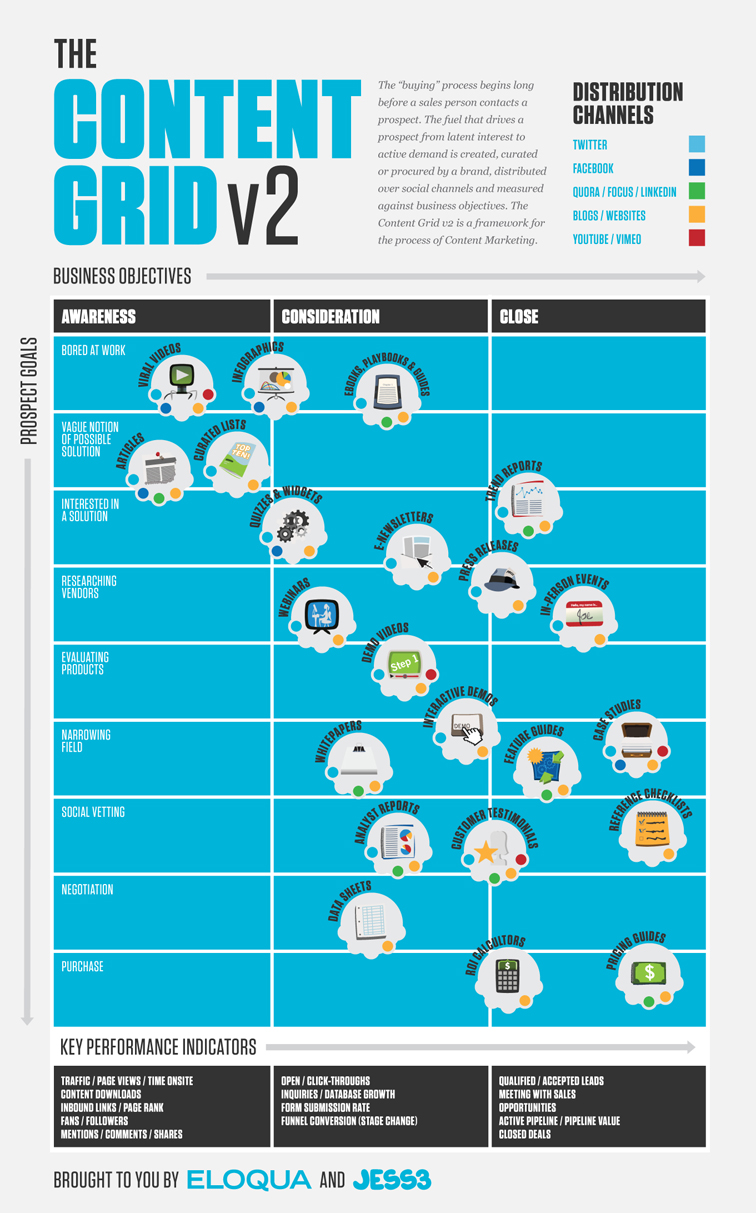
Certain types of content, and certain types of media, arguably are "best" in various phases of a customer buying cycle. Articles, videos, infographics and other general sorts of content are best early in the cycle, before prospects actually begin an active buying process.
Webinars and white papers arguably will be more useful a bit further into the process, when users are actively conducting research.
Case studies and analyst studies probably get used when prospects are actively researching particular suppliers.
JESS3 partnered with Eloqua one year ago to create the "Content Grid," a depiction of how content types match up with phases of a buying cycle.
The latest grid illustrates the role content plays in helping brands meet business objectives and buyers reach their individual goals.
The latest version of the grid outlines the connection between content type and distribution channels, matching content to the buyer’s stage in the purchase process, equipping marketers with key performance indicators for each type of content.
Gary Kim was cited as a global "Power Mobile Influencer" by Forbes, ranked second in the world for coverage of the mobile business, and as a "top 10" telecom analyst. He is a member of Mensa, the international organization for people with IQs in the top two percent.
Mobile Ad Intermediaries Must, and Will Consolidate
"The real pain point in mobile advertising is removing the friction in spending the way that brands want to spend," says Eric Litman, Medialets CEO and chairman. A major reason there is friction is that there is so much market fragmentation.
So you know what's coming: a massive consolidation wave that will create a relative handful of market intermediaries that take friction out of the market.
Marketers say device fragmentation and lack of standardized metrics and ad formats are among mobile advertising's biggest challenges, according to the Interactive Advertising Bureau's recent survey of 300 U.S. marketers that use mobile advertising.
Pervasive systems for serving, measuring and creating mobile display ads will require both standards and firm consolidation, with the latter arguably more significant than the former.
Pervasive systems for serving, measuring and creating mobile display ads will require both standards and firm consolidation, with the latter arguably more significant than the former.
Right now, there are too many isolated solutions that work for specific ad networks, apps or devices. The infrastructure to make one ad, then run it many places, with easy measurement, remains to be created.
Gary Kim was cited as a global "Power Mobile Influencer" by Forbes, ranked second in the world for coverage of the mobile business, and as a "top 10" telecom analyst. He is a member of Mensa, the international organization for people with IQs in the top two percent.
Several Mobile Payments Revenue Models Exist
There are at least a half dozen (and possibly more) business models suitable to a mobile payment services or applications. But that’s just about where the similarities end. Here are four of the broad models, as seen by Alistar Fairweather, Digital Platforms Manager for the Mail & Guardian Online.
The first approach is to enable mobile phones as payment terminals. That’s what Square does,
allowing smart phones to accept credit card payments, anywhere, at any time.
A related approach is to use stored value or prepaid accounts of some sort for retail payments. The analogy is a gift card, which is pre-loaded with a certain amount of money a user can spend, so long as the retailer is equipped to handle the transaction. It will be quite familiar to most consumers who now buy prepaid airtime for their mobile devices, for example.
Fairweather doesn’t specifically mention it as a “payment” system, but one other obvious revenue model is linking a mobile payment system to mobile advertising and promotion, loyalty accounts or offers of various types. The revenue then does not flow directly from the payment transaction, but from the value of advertising, marketing, incremental retail traffic or continued customer loyalty that results in incremental purchases.
http://memeburn.com/2011/06/4-very-different-mobile-payment-services/
The first approach is to enable mobile phones as payment terminals. That’s what Square does,
allowing smart phones to accept credit card payments, anywhere, at any time.
Another approach is to use a mobile as a replacement for a credit card or debit cards. Much of the hope revolves around use of near field communications to allow mobiles to communicate with payment terminals, but there are perhaps dozens of other possible communication methods. Whether the mobile service account is the source of stored value or whether the mobile is linked to a user’s debit, credit or bank accounts, this is the way most people tend to view “mobile payments.”
But not all mobile payments interest is focused on what users can do when paying for goods or services at a retail location. There is a large, and apparently growing need to transfer money between people, using only a mobile device, or allowing people to use their mobiles to pay bills, such as utility bills, transportation or education bills. That is what drives growing launches of mobile peer-to-peer mobile payments services such as M-Pesa.
A related approach is to use stored value or prepaid accounts of some sort for retail payments. The analogy is a gift card, which is pre-loaded with a certain amount of money a user can spend, so long as the retailer is equipped to handle the transaction. It will be quite familiar to most consumers who now buy prepaid airtime for their mobile devices, for example.
Fairweather doesn’t specifically mention it as a “payment” system, but one other obvious revenue model is linking a mobile payment system to mobile advertising and promotion, loyalty accounts or offers of various types. The revenue then does not flow directly from the payment transaction, but from the value of advertising, marketing, incremental retail traffic or continued customer loyalty that results in incremental purchases.
http://memeburn.com/2011/06/4-very-different-mobile-payment-services/
Gary Kim was cited as a global "Power Mobile Influencer" by Forbes, ranked second in the world for coverage of the mobile business, and as a "top 10" telecom analyst. He is a member of Mensa, the international organization for people with IQs in the top two percent.
Google is Winning
"I would point out one thing. In tech, whenever you see companies teaming up and forming partnerships and alliances against one company, it always means the same thing: that company is winning," says Dan Lyons.
In some ways, that is quite a turn-about from the situation of just a few months ago, when people were speculating about whether Google had gotten too big to innovate effectively.
Gary Kim was cited as a global "Power Mobile Influencer" by Forbes, ranked second in the world for coverage of the mobile business, and as a "top 10" telecom analyst. He is a member of Mensa, the international organization for people with IQs in the top two percent.
Mark Cuban Says "End all Software and Process Patents"
Mark Cuban thinks the patent system is so out of whack that the only rational solution is to abolish the ability to file a "process" patent, or software patents.
"End all software patents," he says. "Don’t make them shorter, eliminate them."
"I have no problem with software being copyrightable just as it always has been," But process patents should be abolished. Some of you who have read such patents probably will agree.
"End all software patents," he says. "Don’t make them shorter, eliminate them."
"I have no problem with software being copyrightable just as it always has been," But process patents should be abolished. Some of you who have read such patents probably will agree.
Gary Kim was cited as a global "Power Mobile Influencer" by Forbes, ranked second in the world for coverage of the mobile business, and as a "top 10" telecom analyst. He is a member of Mensa, the international organization for people with IQs in the top two percent.
"I’m Quitting Phone Calls," TechCrunch Writer Says
Not too many people who work will have the precise set of work issues and tasks that lead TechCrunch writer James Altucher to detest work-related phone calls. His job requires intense scanning of content related to technology, and most phone calls are interruptions. He also points out a problem many others see, namely that text-based communications are easier to handle. He also is a non-native-English speaker who has to deal with lots of English content, so that is a factor as well.
"Barring some absolutely necessary phone calls, which will boil down to only a couple per month, if that all voice-based communication for professional purposes is out of the question, including Skype, Viber, mobile and landline calls," he says. "You can call me crazy, but I’m pretty sure it will be awesome, although, to be fair, it’s a fairly easy decision for me to make."
Some of us who do similar work would agree at least partially with the sentiment. We might argue that the richness of Web-based content and text-based communications now allows less reliance on voice communications. Some of us wouldn't go quite so far, but for a different reason.
Rarely does a text "press release" covering any significantly-complex product actually succeed in explaining what something "new" is, well enough so a writer can, with confidence, explain "what it is" or "why it is important." In part, that's by design. The traditional way press releases are developed is that they are just teasers to provoke an interview.
The problem with that traditional approach is that many of us do not have the time to conduct many such interviews anymore. We simply have to cover so much material that the "release" has to do all the work. That's tougher. So, no, some of us will not be dispensing with voice calls, because we really cannot.
But that probably isn't the main point. The big switch is how little I actually use "voice" anymore, and how little of it really is required to get my work done. Of course, like Altucher most of my work involves "searching" for new developments to write about. That can be done almost exclusively with text and Web tools, these days.
I don't find this to be true for sales professionals, though. They still lean on voice.
Gary Kim was cited as a global "Power Mobile Influencer" by Forbes, ranked second in the world for coverage of the mobile business, and as a "top 10" telecom analyst. He is a member of Mensa, the international organization for people with IQs in the top two percent.
Subscribe to:
Posts (Atom)
Huge South Swell at Malibu in June
There's dangerous, and then there's dangerous. Shooting the pier is one of those. Huge south swell in southern California in June.

-
We have all repeatedly seen comparisons of equity value of hyperscale app providers compared to the value of connectivity providers, which s...
-
It really is surprising how often a Pareto distribution--the “80/20 rule--appears in business life, or in life, generally. Basically, the...
-
Financial analysts typically express concern when any firm’s customer base is too concentrated. Consider that, In 2024, CoreWeave’s top two ...

