Efrat Kasznik, president of Foresight Valuation Group, and Brian Hinman, VP of intellectual property and licensing at InterDigital, seem to think it’s only going to get worse for anyone wanting to be taken seriously as a mobile player.
.
Monday, September 26, 2011
Mobile Leadership Now Requires Intellectual Property Ownership

 Gary Kim was cited as a global "Power Mobile Influencer" by Forbes, ranked second in the world for coverage of the mobile business, and as a "top 10" telecom analyst. He is a member of Mensa, the international organization for people with IQs in the top two percent.
Voice Business "Gravy Train" is "Over"
Ilja Laurs, founder and CEO of mobile application company GetJar, and Rebtel founder Hjalmar Winbladh say the telco voice "gravy train" is over. Frankly, there is not an executive left anywhere in the business who would disagree. And many would argue there are few, if any executives who have not already begun guiding their businesses to new replacement revenue streams. Voice business "over"
Gary Kim was cited as a global "Power Mobile Influencer" by Forbes, ranked second in the world for coverage of the mobile business, and as a "top 10" telecom analyst. He is a member of Mensa, the international organization for people with IQs in the top two percent.
Sprint CTO Talks About Sprint Strategy
For the moment, unlimited data remains in place. Sprint, which always has been more receptive to wholesale business models than AT&T or Verizon Wireless, and seems willing to keep pushing that point of view.
Sprint CTO talks strategy
Sprint CTO talks strategy
Gary Kim was cited as a global "Power Mobile Influencer" by Forbes, ranked second in the world for coverage of the mobile business, and as a "top 10" telecom analyst. He is a member of Mensa, the international organization for people with IQs in the top two percent.
Will Consumers Save Money as Streaming Grows?
There are reasons to wonder whether consumers will be able to save much money, if any, if or when online access expands. One reason is that content owners do not seem willing to sell their content in ways that would allow such savings to occur.
“Don’t sell products into a platform where you end up with less money than when you were selling it to the previous buyers,” says Time Warner CEO Jeff Bewkes. Some might not believe content owners will have the ability to enforce those policies, but for the moment they seem to be able to do so.
That bit of advice suggests why consumers might not save much money, if any, as professionally-produced video and movie content distribution shifts from current channels to new channels.
Gary Kim was cited as a global "Power Mobile Influencer" by Forbes, ranked second in the world for coverage of the mobile business, and as a "top 10" telecom analyst. He is a member of Mensa, the international organization for people with IQs in the top two percent.
Facebook, Google Have Grown User Engagement Over Time
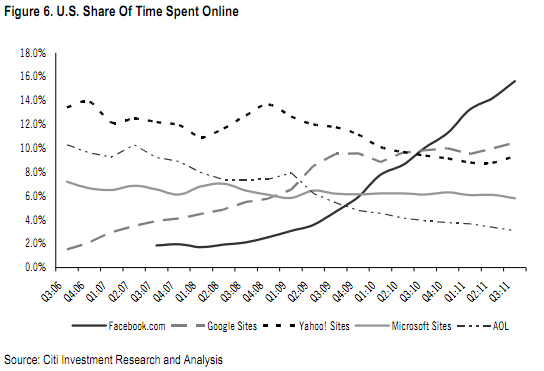 Over the last several years, social networking steadily has claimed more end user engagement. Google application engagement has grown as well, but not as clearly as Facebook.
Gary Kim was cited as a global "Power Mobile Influencer" by Forbes, ranked second in the world for coverage of the mobile business, and as a "top 10" telecom analyst. He is a member of Mensa, the international organization for people with IQs in the top two percent.
Over the last several years, social networking steadily has claimed more end user engagement. Google application engagement has grown as well, but not as clearly as Facebook.
Gary Kim was cited as a global "Power Mobile Influencer" by Forbes, ranked second in the world for coverage of the mobile business, and as a "top 10" telecom analyst. He is a member of Mensa, the international organization for people with IQs in the top two percent.
Verizon Wireless Stashing Cash for Acquisitions
No matter what happens with the AT&T bid to buy T-Mobile USA, Verizon Wireless is storing up cash that might be needed to make acquisitions or other investments. Verizon Wireless is slated to make a $10 billion one-time payout to the two owners, but Vodafone wants a regular annual payment, too. Verizon Wireless says it can't do so.
Verizon CEO Lowell McAdam, told the Financial Times of London that an annual dividend was unrealistic because “we may end up buying spectrum, and we may end up buying another company.” Verizon gets ready for more acquisitions
Verizon would have one set of options if the AT&T deal fails, other sets of options should it succeed. If the AT&T deal is rebuffed, Verizon Wireless likely would conclude that it cannot make a similar big deal of its own. If the AT&T deal succeeds, Verizon would be free to consider an acquisition of Sprint or other spectrum assets.
Gary Kim was cited as a global "Power Mobile Influencer" by Forbes, ranked second in the world for coverage of the mobile business, and as a "top 10" telecom analyst. He is a member of Mensa, the international organization for people with IQs in the top two percent.
Sunday, September 25, 2011
PayPal Now Processing $315 Million In Payments Per Day
PayPal is processing around $315.3 million in payments per day. On average, the payments platform is seeing upwards of over five million transactions a day. PayPal also has raised its estimates of the amount of mobile payments transactions, doubling the estimate to $3 billion in mobile total payments volume in 2011.
PayPal says that the rate at which people are using the payments technology to buy items via their mobile phones is growing rapidly and this is actually the third time the company has had to update its numbers. At years end in 2010, PayPal predicted $1.5 billion in mobile payments and in February, the company revised this to $2 billion. PayPal Now Processing $315 Million In Payments Per Day
PayPal says that the rate at which people are using the payments technology to buy items via their mobile phones is growing rapidly and this is actually the third time the company has had to update its numbers. At years end in 2010, PayPal predicted $1.5 billion in mobile payments and in February, the company revised this to $2 billion. PayPal Now Processing $315 Million In Payments Per Day
Gary Kim was cited as a global "Power Mobile Influencer" by Forbes, ranked second in the world for coverage of the mobile business, and as a "top 10" telecom analyst. He is a member of Mensa, the international organization for people with IQs in the top two percent.
Is Google is a Monopoly? If So, Are Consumers Harmed?
Oddly enough, whether Google is, or is not, more or less a monopoly, might not matter. How does it not matter, in terms of classical antitrust thinking?
One can argue, since Google provides its services for free, that whether Google competitors are at a disadvantage or not is not the real issue. How one can prove that consumers are harmed is the issue, and one might question how consumers are harmed by Google's dominance in the search market.
For purposes of assessing whether Google in some way violates U.S. antitrust law at least, the issue is less "monopoly-like characteristics. The issue is whether Google has acquired that monopoly by nefarious or anticompetitive means, or is using that dominant position in a way that harms the market for those services.
The problem with applying that to Google is that even if you assume it has a monopoly and is being anticompetitive, it’s not at all clear how that is bad for consumers.
Gary Kim was cited as a global "Power Mobile Influencer" by Forbes, ranked second in the world for coverage of the mobile business, and as a "top 10" telecom analyst. He is a member of Mensa, the international organization for people with IQs in the top two percent.
Kindle to Get eBook Lending, Periodicals
It looks like Amazon is going to be adding newspaper and magazine subscriptions for iPads and iPhones. The Kindle for Android app and other apps will get the same update too later down the line. Kindle to Get eBook Lending, Periodicals
Will the new Amazon tablet also get e-book lending?
Gary Kim was cited as a global "Power Mobile Influencer" by Forbes, ranked second in the world for coverage of the mobile business, and as a "top 10" telecom analyst. He is a member of Mensa, the international organization for people with IQs in the top two percent.
Print Industry Disruption Drivers Not There for TV, Telcos
Some might argue that among the primary reasons for the disruption of print industry business models were high fixed cost, high debt loads and inability to satisfy new end user demands for content formats. Some might think those same issues will affect the video subscription business. Some might say such issues will have more implications for communications service providers than cable TV and other video distributors. Traditional TV disruption
The argument that the same "high fixed cost, high debt load, new application" pressures will afflict the subscription TV business, as the Internet has reshaped the print industry, is an argument some of us might consider too glib. Execs don't agree.
Time Warner Cable executives are right to point out that people really do want to watch professionally-produced video. TWC executives also are almost certainly right that abandonment of video subscriptions specifically for the purpose of consuming professional content online is not happening, much. Little evidence of major cord cutting
But high debt and high fixed cost, as well as an inability to keep up with new application creation, does sound more like the telecom industry, some might argue. That is not to say the need for broadband and Internet access ever "goes away." But some might argue that the better historical fit is "print industry and telecom," rather than "print industry and TV."
The argument that the same "high fixed cost, high debt load, new application" pressures will afflict the subscription TV business, as the Internet has reshaped the print industry, is an argument some of us might consider too glib. Execs don't agree.
Time Warner Cable executives are right to point out that people really do want to watch professionally-produced video. TWC executives also are almost certainly right that abandonment of video subscriptions specifically for the purpose of consuming professional content online is not happening, much. Little evidence of major cord cutting
But high debt and high fixed cost, as well as an inability to keep up with new application creation, does sound more like the telecom industry, some might argue. That is not to say the need for broadband and Internet access ever "goes away." But some might argue that the better historical fit is "print industry and telecom," rather than "print industry and TV."
Gary Kim was cited as a global "Power Mobile Influencer" by Forbes, ranked second in the world for coverage of the mobile business, and as a "top 10" telecom analyst. He is a member of Mensa, the international organization for people with IQs in the top two percent.
Execs Don't Agree on Whether A La Carte Means Lower Consumer Prices
“Don’t sell products into a platform where you end up with less money than when you were selling it to the previous buyers," says Time Warner CEO Jeff Bewkes. That bit of advice suggests why consumers might not save much money, if any, as professionally-produced video and movie content distribution shifts from current channels to new channels. Cordcutting Hasn’t Arrived
Over-the-top programming could help moderate rising programming costs in the future, Cablevision Systems chief operating officer Tom Rutledge has said. Lower content costs?
Gary Kim was cited as a global "Power Mobile Influencer" by Forbes, ranked second in the world for coverage of the mobile business, and as a "top 10" telecom analyst. He is a member of Mensa, the international organization for people with IQs in the top two percent.
69% of Businesses Say Blogging Increased Leads

The study also found that 75 percent of businesses believed search engine optimization was a primary factor. Social media came in third with 47 percent, just a hair shy of triple that of paid search.
Gary Kim was cited as a global "Power Mobile Influencer" by Forbes, ranked second in the world for coverage of the mobile business, and as a "top 10" telecom analyst. He is a member of Mensa, the international organization for people with IQs in the top two percent.
15X Growth for Social Commerce by 2015
 Social shopping is a bit like "mobile money," including a number of distinct market segments, value chains and ecosystems. Some would say daily deals are "social shopping," while others might include the other ways social mechanisms shape and then drive retail purchasing.
In the former case, the social element is the end user demand process, where a certain number of people might have to agree to buy something before the deal is triggered. In other cases the social element further extends to social distribution of the offers, as when people let others know an offer is available on Facebook or another network.
Some might also include within the social shopping or social commerce realm restaurant and other consumer ratings features and services, such as Google Places or Yelp. Others are looking at ways mobile payment services will incorporate social elements and socially-created content into merchandising efforts.
Gary Kim was cited as a global "Power Mobile Influencer" by Forbes, ranked second in the world for coverage of the mobile business, and as a "top 10" telecom analyst. He is a member of Mensa, the international organization for people with IQs in the top two percent.
Friday, September 23, 2011
Dish Network Could Partner With, or Buy Sprint or Clearwire
Dish Network Corp. , the second- largest U.S. satellite-TV provider, may consider partnering with or buying a wireless carrier such as Sprint Nextel Corp. or Clearwire Corp., Chief Executive Officer Joseph Clayton said.
“We’ll look at partnerships, acquisitions, all of the above,” Clayton said. Asked whether that could include buying or partnering with Clearwire or Sprint, he said: “Could be.”
Dish needs a wireless network to utilize the spectrum it has acquired in its deals for DBSD North America Inc. and Terrestar Networks Inc. announced this year. Dish filed for U.S. government permission to offer mobile high-speed Internet service to its customers last month. Government approval would allow the company to build a network.
“We’ll look at partnerships, acquisitions, all of the above,” Clayton said. Asked whether that could include buying or partnering with Clearwire or Sprint, he said: “Could be.”
Dish needs a wireless network to utilize the spectrum it has acquired in its deals for DBSD North America Inc. and Terrestar Networks Inc. announced this year. Dish filed for U.S. government permission to offer mobile high-speed Internet service to its customers last month. Government approval would allow the company to build a network.
Gary Kim was cited as a global "Power Mobile Influencer" by Forbes, ranked second in the world for coverage of the mobile business, and as a "top 10" telecom analyst. He is a member of Mensa, the international organization for people with IQs in the top two percent.
Dish’s Blockbuster Movie Pass is no Netflix Killer
 Though there had been some speculation that Dish Network might position its Blockbuster assets in a way that challenges Netflix, Dish Network has taken more of a "TV Everywhere" approach, unveiling Blockbuster Movie Pass as a complement to its linear video service.
That might happen some day, but for the moment, Movie Pass is strictly tied to the satellite operator’s subscription video service.
Movie Pass will provide its subscribers access to more than 100,000 DVD titles and 4,000 streaming titles at a cost of $10 a month. The DVD by mail service is included.
 Dish subscribers with IP-connected set-top boxes will be able to stream movies and TV shows from the Blockbuster MoviePass service along with their on-demand offerings.
That said, Dish Network could be in position to introduce a wider program at some point, as its content library is extensive, and compares most closely with that of Netflix DVD by mail offerings.
Movie Pass will provide its subscribers access to more than 100,000 DVD titles and 4,000 streaming titles at a cost of $10 a month. The DVD by mail service is included.
 Dish subscribers with IP-connected set-top boxes will be able to stream movies and TV shows from the Blockbuster MoviePass service along with their on-demand offerings.
That said, Dish Network could be in position to introduce a wider program at some point, as its content library is extensive, and compares most closely with that of Netflix DVD by mail offerings.
Gary Kim was cited as a global "Power Mobile Influencer" by Forbes, ranked second in the world for coverage of the mobile business, and as a "top 10" telecom analyst. He is a member of Mensa, the international organization for people with IQs in the top two percent.
Subscribe to:
Posts (Atom)
-
We have all repeatedly seen comparisons of equity value of hyperscale app providers compared to the value of connectivity providers, which s...
-
It really is surprising how often a Pareto distribution--the “80/20 rule--appears in business life, or in life, generally. Basically, the...
-
Financial analysts typically express concern when any firm’s customer base is too concentrated. Consider that, In 2024, CoreWeave’s top two ...

