Facebook does massive surveillance, he argues. If there is a "Like" button on a page, Facebook knows who visited that page and it can get the IP address of the computer visiting the page, even if the person is not a Facebook user. Privacy issues
Saturday, December 3, 2011
Facebook Collects Data from any Visits to Pages with "Like" Buttons
Computing guru Richard Stallman, creator of the GNU Project and founder of the Free Software Foundation, points out a feature of Facebook that most of us do not know about.

 Gary Kim was cited as a global "Power Mobile Influencer" by Forbes, ranked second in the world for coverage of the mobile business, and as a "top 10" telecom analyst. He is a member of Mensa, the international organization for people with IQs in the top two percent.
Friday, December 2, 2011
Telefónica to Introduce Europe-Wide Mobile Wallet Service
Telefónica's new Digital unit and Giesecke & Devrient have reached an agreement to establish a single European-wide platform for Near Field Communication services, with Giesecke & Devrient providing the trusted service manager platform, including over-the-air transfer and personalization of NFC applications.
Telefónica's wallet application, to be available in Europe over the next few months will also be made available to third-party service providers, including financial institutions, transit operators, and loyalty partners.
Telefónica's wallet application, to be available in Europe over the next few months will also be made available to third-party service providers, including financial institutions, transit operators, and loyalty partners.
Gary Kim was cited as a global "Power Mobile Influencer" by Forbes, ranked second in the world for coverage of the mobile business, and as a "top 10" telecom analyst. He is a member of Mensa, the international organization for people with IQs in the top two percent.
Microsoft Will Buy Netflix, LinkedIn In 2012, IDC Predicts
It's the time of year for predictions, and technology research firm IDC has a few predictions of its own, including the forecast that Microsoft will buy Netflix to give it a foothold in online video entertainment and LinkedIn to get into social networking.
Those moves would be part of a flurry of mergers and acquisitions in 2012 by companies seeking to increase their presence in cloud computing, social networking and online content. The
IDC predictions about Microsoft and Netflix actually also were made by IDC 12 months ago.
Chief analyst Frank Gens said it makes even more sense now, given Netflix’s diminished market value and expected losses next year from growing content licensing bills. Microsoft Predicted To Buy Netflix, LinkedIn in 2012
“In 2012, part of Microsoft’s challenge is to counter what Apple and Amazon have done and what Google is building up, a really strong media and content marketplace,” Gens said.
By offering movies, music and other content, Apple , Amazon and Google are aiding their mobile device ecosystems, including tablets and smartphones. “Without a media and content cloud, the competitiveness of Microsoft’s mobile platforms could be greatly diminished,” Gens says.
In many ways, that observation also illustrates the changing nature of the consumer electronics business as well. To a greater extent, the value of a device hinges on the content resources available to users of the devices.
Those moves would be part of a flurry of mergers and acquisitions in 2012 by companies seeking to increase their presence in cloud computing, social networking and online content. The
IDC predictions about Microsoft and Netflix actually also were made by IDC 12 months ago.
Chief analyst Frank Gens said it makes even more sense now, given Netflix’s diminished market value and expected losses next year from growing content licensing bills. Microsoft Predicted To Buy Netflix, LinkedIn in 2012
“In 2012, part of Microsoft’s challenge is to counter what Apple and Amazon have done and what Google is building up, a really strong media and content marketplace,” Gens said.
By offering movies, music and other content, Apple , Amazon and Google are aiding their mobile device ecosystems, including tablets and smartphones. “Without a media and content cloud, the competitiveness of Microsoft’s mobile platforms could be greatly diminished,” Gens says.
In many ways, that observation also illustrates the changing nature of the consumer electronics business as well. To a greater extent, the value of a device hinges on the content resources available to users of the devices.
Gary Kim was cited as a global "Power Mobile Influencer" by Forbes, ranked second in the world for coverage of the mobile business, and as a "top 10" telecom analyst. He is a member of Mensa, the international organization for people with IQs in the top two percent.
Market More Competitive if AT&T Gets T-Mobile USA?
Most people looking at the proposed AT&T purchase of T-Mobile USA might conclude that the deal would reduce competition in the U.S. mobile market. Others might argue it would be more efficient, if not more competitive.
Some people might argue that the apparent failure of the bid is "a potential missed opportunity for consumers to benefit from more carrier competition." Precisely why that might be the case is not explained. Even without AT&T-Mo, we still have no competition
One argument about the "limited state of competition" in the U.S. mobile market is that the existence of incompatible air interface standards (CDMA and GSM) means consumers cannot move their devices freely among the leading carriers, thus limited competition. That argument is fine, as far as it goes. In that vein, one might also note that the carriers do not all use the same spectrum bands, either.
But that problem is going away, since all the U.S. mobile providers have settled on Long Term Evolution. Whether we will see a dramatically different competitive environment, just because all users have LTE handsets, remains to be seen, when LTE is firmly established.
One countervailing argument to the "handset freedom" argument is complicated, but might explain why "competition" will not be dramatically different once all carriers have moved to a single air interface standard. Consumers could buy unlocked handsets and then use several carriers, even now, with the market using different air interfaces. But few consumers choose to pay full price for handsets, especially as we now are moving to a smart phone market where the full retail price of a new device can be $500.
Most consumers simply choose to limit their freedom by signing service contracts that reduce the cost of new handsets to no more than $200. After two years, they typically want to replace those older models with the latest new models in any case, so they once again have to decide whether paying full retail or exchanging a contract for a subsidized phone makes more sense.
To the extent that competition is limited, it is voluntary. Consumers would rather get the cheaper devices, even if the price is a service contract.
That is not to say there are no competitive issues, or potential competitive issues, in any part of the U.S. communications business. But device portability and air interfaces do not seem to be the biggest issues.
Gary Kim was cited as a global "Power Mobile Influencer" by Forbes, ranked second in the world for coverage of the mobile business, and as a "top 10" telecom analyst. He is a member of Mensa, the international organization for people with IQs in the top two percent.
Do Data Hogs Cause Peak-Hour Congestion?
It is an unquestioned fact that a small percentage of broadband users, on virtually any network, use vastly more data than typical users do. The top one percent of data consumers account for 20 percent of the overall consumption, for example.
In the absence of mechanisms--or demonstrated end user demand--to price by value, rather than on a flat rate, most service providers rely on simple monthly data caps to attempt to regulate usage overall.
But that doesn’t necessarily affect peak-hour usage, some will argue. One issue is that users vastly prefer “buckets of usage” with predictable recurring costs, to metered pricing. So peak-hour pricing would introduce some element of pricing uncertainty, which consumers presumably would not prefer.
Presumably a better tactic would be creation of “additional fee” services that provide quality of service at peak hours, for users willing to pay. Some will object to such policies as creating a “two-tier” Internet. Others will simply say it offers consumers choice.
But are heavy users the problem?
The question might seem silly. If the big problem for an access provider is peak hour congestion, then heavy users would seemingly have to be part of the analysis. But the question some would ask is “who are the heavy users, at peak hours?” That might be a different question than “who are the heavy users, over a billing period?”
In the absence of mechanisms--or demonstrated end user demand--to price by value, rather than on a flat rate, most service providers rely on simple monthly data caps to attempt to regulate usage overall.
But that doesn’t necessarily affect peak-hour usage, some will argue. One issue is that users vastly prefer “buckets of usage” with predictable recurring costs, to metered pricing. So peak-hour pricing would introduce some element of pricing uncertainty, which consumers presumably would not prefer.
Presumably a better tactic would be creation of “additional fee” services that provide quality of service at peak hours, for users willing to pay. Some will object to such policies as creating a “two-tier” Internet. Others will simply say it offers consumers choice.
But are heavy users the problem?
The question might seem silly. If the big problem for an access provider is peak hour congestion, then heavy users would seemingly have to be part of the analysis. But the question some would ask is “who are the heavy users, at peak hours?” That might be a different question than “who are the heavy users, over a billing period?”
Some argue that bandwidth caps do not necessarily alleviate congestion problems. Do data hogs cause congestion? If not, then it makes more sense to use other pricing and value mechanisms to shape demand. Do Data Hogs Cause Peak-Hour Congestion?
A new analysis by analyst Benoît Felten suggests the answer is highly nuanced. Felten argues that about 78 percent of peak-hour congestion is caused by the heaviest users.
A new analysis by analyst Benoît Felten suggests the answer is highly nuanced. Felten argues that about 78 percent of peak-hour congestion is caused by the heaviest users.
Gary Kim was cited as a global "Power Mobile Influencer" by Forbes, ranked second in the world for coverage of the mobile business, and as a "top 10" telecom analyst. He is a member of Mensa, the international organization for people with IQs in the top two percent.
Comcast, Time Warner Cable, Bright House Sell Spectrum to Verizon
SpectrumCo, LLC, a joint venture between Comcast Corporation, Time Warner Cable, and Bright House Networks, is selling Verizon Wireless its 122 Advanced Wireless Services spectrum licenses covering 259 million POPs for $3.6 billion. What might be noteworthy is the strategic change of direction. The cable companies purchased the AWS spectrum at least in part as a potential foundation for wireless service.
The sale, and the agreement by the owners to resell Verizon Wireless services instead, suggests the cable operators once again have decided that they could not create independent wireless operations.
Moreover, given the business relationship cable companies have had with Sprint since at least 1994, the move also suggests that the cable operators are breaking with the idea of Sprint as a strategic partner. Since cable companies have been among the potential buyers of Sprint Nextel, the latest moves would seem to indicate no interest in that area.
Cable TV operators have been spending money to get into the wireless business for decades, with little success. In 1994 Sprint, Tele-Communications, Comcast and Cox Cable formed a joint venture to build a nationwide network to provide wireless service.
However in 1998, Sprint assumed control of the business and bought the cable companies' interest in the company.
In 2005 Comcast, Cox, Time Warner and Advance/Newhouse formed a joint venture with Sprint Nextel to provide a quad-play cable TV, high-speed data, landline and wireless service to their customers. But the quad-play idea never panned out and Pivot never grew beyond the initial 33 markets Sprint launched in November 2007.
Sprint said that Pivot was being hindered by provisioning issues. Time Warner later said that demand for Pivot services was "tepid." Pivot users eventually were given the option of switching to Sprint's regular service.
In 2008, Sprint and Clearwire announced that they would combine their WiMAX businesses and create a new company that would include a $3.2 billion investment from Intel, Google, Comcast, Time Warner Cable, Bright House Networks and Trilogy Equity Partners. Cable wireless history
Recently, Cox Communications decided to shutter its own wireless business as well.
Comcast owns 63.6 percent of SpectrumCo and will receive approximately $2.3 billion from the sale. Time Warner Cable owns 31.2 percent of SpectrumCo and will receive approximately $1.1 billion. Bright House Networks owns 5.3 percent of SpectrumCo and will receive approximately $189 million. Comcast, Time Warner Cable sell spectrum to Verizon
The sale, and the agreement by the owners to resell Verizon Wireless services instead, suggests the cable operators once again have decided that they could not create independent wireless operations.
Moreover, given the business relationship cable companies have had with Sprint since at least 1994, the move also suggests that the cable operators are breaking with the idea of Sprint as a strategic partner. Since cable companies have been among the potential buyers of Sprint Nextel, the latest moves would seem to indicate no interest in that area.
Cable TV operators have been spending money to get into the wireless business for decades, with little success. In 1994 Sprint, Tele-Communications, Comcast and Cox Cable formed a joint venture to build a nationwide network to provide wireless service.
However in 1998, Sprint assumed control of the business and bought the cable companies' interest in the company.
In 2005 Comcast, Cox, Time Warner and Advance/Newhouse formed a joint venture with Sprint Nextel to provide a quad-play cable TV, high-speed data, landline and wireless service to their customers. But the quad-play idea never panned out and Pivot never grew beyond the initial 33 markets Sprint launched in November 2007.
Sprint said that Pivot was being hindered by provisioning issues. Time Warner later said that demand for Pivot services was "tepid." Pivot users eventually were given the option of switching to Sprint's regular service.
In 2008, Sprint and Clearwire announced that they would combine their WiMAX businesses and create a new company that would include a $3.2 billion investment from Intel, Google, Comcast, Time Warner Cable, Bright House Networks and Trilogy Equity Partners. Cable wireless history
Recently, Cox Communications decided to shutter its own wireless business as well.
Comcast owns 63.6 percent of SpectrumCo and will receive approximately $2.3 billion from the sale. Time Warner Cable owns 31.2 percent of SpectrumCo and will receive approximately $1.1 billion. Bright House Networks owns 5.3 percent of SpectrumCo and will receive approximately $189 million. Comcast, Time Warner Cable sell spectrum to Verizon
Gary Kim was cited as a global "Power Mobile Influencer" by Forbes, ranked second in the world for coverage of the mobile business, and as a "top 10" telecom analyst. He is a member of Mensa, the international organization for people with IQs in the top two percent.
Rogers Exec Calls for 100% Availability of Ethernet Services
Cable companies have a major opportunity to win enterprise business away from telcos, but need to interconnect their networks to provide national coverage and deliver higher-quality customer service, Terry Canning, senior vice president of Canada-based Rogers Business Solutions, says.
"Telcos were built on five-nines, but they stopped there," Canning said. "We have the opportunity to win huge shares of marketplace if we pursue 100. But we're not there yet." MSOs Can Outdo Telcos in Ethernet
The need for 100 percent availability is particularly important as more enterprises move critical applications into the cloud and rely on network connections into the cloud for those applications, he said.
"Telcos were built on five-nines, but they stopped there," Canning said. "We have the opportunity to win huge shares of marketplace if we pursue 100. But we're not there yet." MSOs Can Outdo Telcos in Ethernet
The need for 100 percent availability is particularly important as more enterprises move critical applications into the cloud and rely on network connections into the cloud for those applications, he said.
Whether in actual fact any communications service can reach 100-percent availability, and still be profitable, is the issue.
The issue of national interconnects between major local cable companies is a related, but separate, issue. Where cable is disadvantaged, compared to telcos, is in going outside the typical regional footprint of a cable operator to serve national and multinational enterprises, he said.
Rogers is developing network-to-network interfaces to interconnect with other cable operators, but more work is needed to develop a standard product set across the cable industry. That impediment also illustrates the issues faced by the cable industry. Unlike the telecom industry, which builds every network element and system for interconnection, cable operators traditionally have not needed to do so.
Rogers is developing network-to-network interfaces to interconnect with other cable operators, but more work is needed to develop a standard product set across the cable industry. That impediment also illustrates the issues faced by the cable industry. Unlike the telecom industry, which builds every network element and system for interconnection, cable operators traditionally have not needed to do so.
Cable also must overcome its reputation as a "best effort" service provider by delivering higher-quality customer service to its most important customers, Canning said.
Gary Kim was cited as a global "Power Mobile Influencer" by Forbes, ranked second in the world for coverage of the mobile business, and as a "top 10" telecom analyst. He is a member of Mensa, the international organization for people with IQs in the top two percent.
YouTube Now More Like TV
YouTube now features a few new changes that make the experience more like TV, especially the "channels" format. Now if Google can someday acquire more "TV" content to fill those channels, we can better a better sense for the actual shifts in user behavior many have been predicting ultimately will happen.
Gary Kim was cited as a global "Power Mobile Influencer" by Forbes, ranked second in the world for coverage of the mobile business, and as a "top 10" telecom analyst. He is a member of Mensa, the international organization for people with IQs in the top two percent.
Cable Success in Mid-Market Requires Changes
David Strauss, a cable industry consultant, explains what cable operators in the U.S. market must add to their playbooks as they target mid-sized businesses more aggressively. Cable Expands Its Business Game
Up to this point cable has been most successful in the small business segment (a dozen to 16 phone lines).
Gary Kim was cited as a global "Power Mobile Influencer" by Forbes, ranked second in the world for coverage of the mobile business, and as a "top 10" telecom analyst. He is a member of Mensa, the international organization for people with IQs in the top two percent.
Thursday, December 1, 2011
Google Delivery Service Protects Search
You might think a shipping service for online products is directly related to protecting the value of a search business, but that is precisely what Google believes. The problem, in a nutshell, is that Amazon Prime, and perhaps Amazon in general, often becomes the "go to" search engine when people are shopping online.
So Google is in talks with major retailers and shippers to create a service that lets consumers shop for goods on the Web and receive orders within a day for a low fee, all as a way of bolstering the use of Google's search engine for e-commerce activities.
Amazon's growth has surged in recent years with the help of a service called Prime that allows people to receive many items they order from the site in a day or two for a $79 annual fee, analysts say. Google, Retailers in Fast-Delivery Talks
Amazon's growth has surged in recent years with the help of a service called Prime that allows people to receive many items they order from the site in a day or two for a $79 annual fee, analysts say. Google, Retailers in Fast-Delivery Talks
For Google, the issue is that when users bypass Google's search engine and go straight to Amazon, Google's advertising model is threatened.
Gary Kim was cited as a global "Power Mobile Influencer" by Forbes, ranked second in the world for coverage of the mobile business, and as a "top 10" telecom analyst. He is a member of Mensa, the international organization for people with IQs in the top two percent.
Revenues from Multiscreen Content Platforms to Top $21 Billion in 2015?
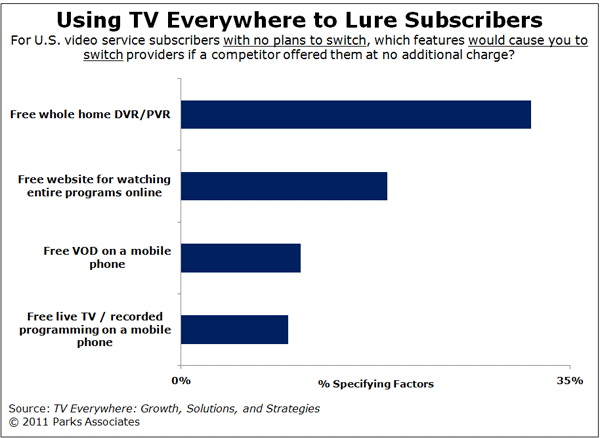 New NPD In-Stat research forecasts that revenues from multi-screen content platforms will top $21 billion in 2015. Asia Pacific will have the most active multi-screen households by 2015, and 273 million households will be using some kind of multi-screen service by 2015.
Precisely what that revenue forecast actually means is an issue, though. As is the case for triple-play services, the precise revenue contribution from each of the constituent parts is an accounting issue.
All revenue forecasts for "TV everywhere" or "multi-screen" video entertainment services faces the same issue. When the ability to stream some content to a tablet or smart phone, within a home, is bundled with a cable TV subscription, how does one attribute the revenue?
If an additional fee is assessed, the issue is clearer, but that might not be the dominant way such services are sold to consumers.
Multiscreen Content Platforms to Top $21 Billion in 2015
Gary Kim was cited as a global "Power Mobile Influencer" by Forbes, ranked second in the world for coverage of the mobile business, and as a "top 10" telecom analyst. He is a member of Mensa, the international organization for people with IQs in the top two percent.
HTC, Sprint Acknowledge Using Carrier IQ Software But Deny Snooping
Sprint and HTC apparently use a diagnostic application called "Carrier IQ" that can record keystrokes and even encrypted search terms on some smart phones.
Sprint and HTC say the software is used for ordinary diagnostic reports needed to help improve the performance of mobile devices and mobile networks. HTC, Sprint Acknowledge Using Carrier IQ Software
Sprint and HTC say the software is used for ordinary diagnostic reports needed to help improve the performance of mobile devices and mobile networks. HTC, Sprint Acknowledge Using Carrier IQ Software
Gary Kim was cited as a global "Power Mobile Influencer" by Forbes, ranked second in the world for coverage of the mobile business, and as a "top 10" telecom analyst. He is a member of Mensa, the international organization for people with IQs in the top two percent.
Carrier IQ Logs Smart Phone Keystrokes
In November 2011, security researcher Trevor Eckhart announced that he found software made by Carrier IQ that may be logging your every move on your mobile phone.
Trevor referred to it as a "rootkit", a piece of software that hides itself while utilizing privileged access like watching your every move. Carrier IQ didn't take too kindly to this accusation, and responded aggressively with a cease-and-desist letter, and went on to deny this accusation. However, to further back his accusation, Eckhart released a video that he says shows the software working.
.
Trevor referred to it as a "rootkit", a piece of software that hides itself while utilizing privileged access like watching your every move. Carrier IQ didn't take too kindly to this accusation, and responded aggressively with a cease-and-desist letter, and went on to deny this accusation. However, to further back his accusation, Eckhart released a video that he says shows the software working.
.
Gary Kim was cited as a global "Power Mobile Influencer" by Forbes, ranked second in the world for coverage of the mobile business, and as a "top 10" telecom analyst. He is a member of Mensa, the international organization for people with IQs in the top two percent.
Mobile Commerce Will Grow 73% in 2012
 U.S. mobile commerce sales will reach $6.7 billion this year, a tiny fraction of overall retail sales, but a 91.4 percent increase over 2010. In 2012, sales will rise another 73.1 percent, to $11.6 billion, according to eMarketer. Growing mobile commerce activity
M-commerce sales include sales of physical goods as well as travel and event tickets purchased via mobile, but exclude digital downloads and usage of mobile phones as a point-of-sale payment mechanism, the way eMarketer analyzes the market.
Also, eMarketer forecasts 37.5 million US consumers ages 14 and up will make at least one purchase on their mobile phone in 2012, up from 26.8 million in 2011. Overall, 72.8 million mobile users will research or browse items on their phone next year, but not necessarily make a purchase.

Mobile Coupons: Growing But Consumers Are Still Afraid
Gary Kim was cited as a global "Power Mobile Influencer" by Forbes, ranked second in the world for coverage of the mobile business, and as a "top 10" telecom analyst. He is a member of Mensa, the international organization for people with IQs in the top two percent.
History of U.S. Telco Consolidation
 Gary Kim was cited as a global "Power Mobile Influencer" by Forbes, ranked second in the world for coverage of the mobile business, and as a "top 10" telecom analyst. He is a member of Mensa, the international organization for people with IQs in the top two percent.
Subscribe to:
Comments (Atom)
-
We have all repeatedly seen comparisons of equity value of hyperscale app providers compared to the value of connectivity providers, which s...
-
It really is surprising how often a Pareto distribution--the “80/20 rule--appears in business life, or in life, generally. Basically, the...
-
One recurring issue with forecasts of multi-access edge computing is that it is easier to make predictions about cost than revenue and infra...


