Friday, January 20, 2012

Mobile a Work in Progress for "Prestige" Brands

Prestige fashion brands have been inconsistent in their adoption of mobile commerce and other mobile features, a study sponsored by L2 Research has found. That mobile remains a work in progress should not be surprising.

Mobile commerce and marketing encompasses a wide range of processes, channels and business objectives and functions. At this early stage, it might be unusual indeed if retailer programs and end user behavior were to produce an upheaval in terms of customer behavior or business results.

About 66 percent of prestige brands maintain a mobile-optimized site, and about 33 percent of these mobile development efforts do not yet support commerce.

Fewer than 20 percent of brands have created unique app content for the iPad and other tablets, a fact some will say is a missed opportunity as these devices register high usage among affluent consumers.

About 16 percent of brands have yet to develop a mobile-optimized site or mobile site, the study finds.

The study also suggests that mobile searches disproportionately are conducted by users with a higher than average propensity to buy luxury products, the study suggests.

This observation underscores the urgency to adapt search engine optimization, email marketing, and other digital efforts for mobile platforms, the study suggests.


As a product class, tablet devices have proven a boon to m-commerce. Tablet shoppers demonstrate a conversion rate of four to five percent compared with three percent on a PC.

Even when compared directly to smart phones, 25 percent of “dual owners” surveyed by Ipsos demonstrate a preference to purchase on sites while using a tablet.

Although 37 percent of all prestige brands have a presence on both the iPhone and iPad, only 16 percent have created a unique experience for iPad users rather than simply replicating the same app across both devices. Given the dramatic difference in screen sizes, that will not continue to be the case, one might argue.

“Location” also is the defining and unique smart phone capability. But we are early in the process of adapting marketing and commerce to user location in real time.

Only five percent of Americans use geo-local apps (check in services, for example) at least once a month, but these active users represent a high-value demographic. They skew younger, register higher income, and are twice as likely to share product information.

Also, 14 percent of global monthly Google searches for prestige brands originate from mobile devices, which is significant given that non-computer devices account for less than seven percent of traffic in the U .S. and less than five percent of traffic in France, Germany, Italy, Spain, and U.K. markets.

Mobile efforts often also are marketing or commerce “silos,” isolated from other marketing channels. Only 28 percent of the brands in the Index are developing mobile apps promote them on their main sites. But 82 percent of the brands link to their Facebook pages and 66 percent to their Twitter accounts.

Nor are older communication channels unimportant, compared to the newer tools. During the second half of 2011, mobile email open rates increased 34 percent, with consumers opening 23 percent of all emails on their mobile devices.

About 78 percent of the surveyed prestige brands engage in email marketing, only 24 percent have links to mobile-optimized versions of their email content, and 55 percent opt to provide
links to plain HTML versions.



New Mobile Payment Firms Will Not Displace Banks Easily

Some genuinely believe that banks are in danger of serious displacement by mobile payment and mobile banking competitors. It will be harder than many believe. Banking executives will respond; many already are doing so. 


Beyond that, it is difficult to dislodge "trusted providers" in just about any business you can think of. Observers have been predicting the imminent demise of traditional TV distributors or creators for a decade or more. It has failed to materialize, if the measurement is revenue, rather than viewing hours.


Many veterans of the U.S. competitive local exchange carrier business will agree that upending the leading suppliers in the telecom business has proven to be devilishly hard. Some would argue it has proven difficult for all contenders except the cable companies, at least in the consumer market. 


There arguably has been more success in the business customer segments. 


In the emerging mobile payments and mobile wallet businesses, even players as large as Google and Isis (AT&T, Verizon Wireless and T-Mobile USA) are working with banks, rather than trying to displace them. 


PayPal and Square are more directly threats to banks in the ecosystem, but only to a certain extent. 

Banks will be harder to dislodge than many believe.

Don't be Surprised if Google 1 -Gbps Network Gets Low Buy Rates


There is some uncertainty about the construction time table for Google's 1-Gbps fiber access network being built in Kansas City, Kan. and Kansas City, Mo.


That is a relatively trivial issue, though. The bigger issue is whether any significant number of users actually will buy the service.


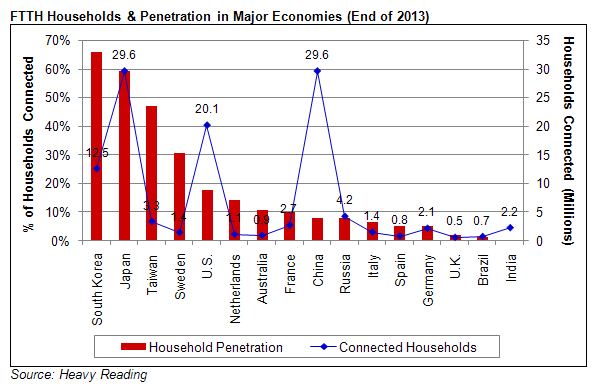
With a small handful of exceptions, fiber to home uptake globally seems relatively restrained, suggesting that, for most consumers, what they can buy on the older networks provides a value-price relationship that is good enough. 


Under Google's deal with the Kansas City Board of Public Utilities, the municipal power and water provider that owns the utility poles, the company has the option of attaching fiber either in the space reserved for telecommunications for the standard pole-attachment fee or in the electrical supply space for free (although the latter is costlier because it requires more highly skilled technicians). Kansas City Fiber on Track 


Google and officials in Kansas City, Kan., said Google remains on schedule to go live for the first customers for Google's 1-Gbps network in the first half of 2012.


The Kansas City Star has reported that negotiations over pole attachment rates have slowed the build. Those of you familiar with fixed network construction projects will not be surprised by that report.


Disagreement about rates and conditions for pole attachments are an old, and possibly recurring, issue when new providers want to build new communication networks.
The bigger issue will come when Google actually unveils its prices and products. Some will note that other fiber to home services, in the United States and elsewhere, have not universally been met with high consumer demand.

In Germany, for example, FTTH take rates are just 0.4 percent, though one million homes are able to buy the service. Low take rates

Will Enterprise "Consumerization" Be More than a Device Issue?

Enterprise workers have been bringing their "consumer" tools and apps into the workplace for some time. Enterprises have started to respond by approving use of such devices, such as Apple products in the phone, PC and now tablet areas. 


Longer term, the issue is how much other movement will be seen in the applications area. Skype is among the best current examples of a consumer tool that is widely used within enterprises. So is LinkedIn. Also, Facebook and other social networks now are being adapted for enterprise purposes. 


For the moment, devices seem to be at the forefront, though.


via

Google Fourth Quarter Results Disappoint

[GOOGAD]Google reported revenues of $10.58 billion for the quarter ended December 31, 2011, an increase of 25 percent compared to the fourth quarter of 2010, and a record for Google.

Though a revenue record, investors were expecting more, primarily on the earnings front, putting pressure on Google's equity price. Google Results

Some think investors are worried about the growing regulatory scrutiny Google is facing, or the implications of its ownership of Motorola Mobility.

But most executives would probably love to have such problems. Consider Google's share of display advertising, which probably will pass Yahoo early in 2012.


Long criticized as being a revenue one trick pony, Google's display ad business now amounts to about 10 percent of total revenues, which continue to be lead by search advertising. 


Remarkably Consistent Smart Phone Video Consumption in France, UK, US Markets

It will come as no surprise to just about anyone that people who own smart phones watch video on those devices. What is interesting, in this bit of survey research, is the consistency of the behavior in different markets. As it turns out, the percentage of respondents to a Yankee Group survey who say they watch video at least once a week on their smart phones is precisely 42 percent each, in France, the United Kingdom and the United States. 


As you also would guess, feature phone users watch far less video. 

Thursday, January 19, 2012

AT&T Price Hike Illustrates Trend

Beginning March 1,2012, AT&T's base rate for "measured phone service" in California will rise $3 a month to $15.37 from $12.37, — a 25 percent increase. The charge for additional local calls will be three cents per minute. Separately, AT&T's flat-rate charge for unlimited local calls will increase $1.05, to $21 a month. Some think the rates are not justified. Granted, it's always hard to determine whether retail rates are "fair" or not. But the rates do illustrate one often-forgotten and fundamental change in AT&T's cost structure.

As more and more customers abandon landline service for mobile service or rival providers, a fundamental issue is that a smaller customer base means fixed overhead costs of the network must necessarily be shared by a smaller number of customers. line loss


That means higher costs for the remaining customers, and the process will not stop as customers continue to shift their communications spending to other providers or other types of service.


Capital intensive networks are susceptible to changes in demand. In Denver, where we live in an arid climate and are highly susceptible to drought, residents continually are exhorted to use less water. We have done so. The result is higher rates. Why? Because the water utility's fixed expenses have to be covered, even in the face of lower usage (what we were asked to do), which lowers Denver Water's revenue. 


Predictions about Mobile Web Experiences Will Be Wrong


Union Square Ventures Partner Andy Weissman argues that, up to this point, most observers have assumed that mobile versions of PC experiences would be be similar to the bigger screen experiences, with relatively similar take rates, use cases and business opportunities.

He now suggests that we might have been wrong, and have been applying old rules in a new context, where the predictive value of the older assumptions isn’t as accurate. One might therefore guess that lots of unexpected change will occur as the smart phone experience begins to mature into a very distinct medium.

Reading, social networking, payments, learning, location services, medicine and media are some of the areas where expectations of end user behavior, value and revenue creation could be different than expected.

Think back to Netscape (if you are old enough) when it first was introduced in 1994, or even 1995 and 1996.  What were the then-current experiences Netscape enabled? Keep in mind this was before Amazon, eBay and Google, before e-commerce, before web mail, before Netflix, iTunes.

Who would have predicted then, the way the web has developed? Much the same is likely to happen with mobile web and smart phone-enabled experiences.

Unpredictable mobile impact

Wednesday, January 18, 2012

The Device is the Disruption


“Disruption” is the whole reason most companies receive venture capital backing. Disruption largely defines what has been happening in the telecom business for several decades. And yet there is extreme sensitivity about the notion. For good reason, one might argue.

Just one example: Microsoft owns Skype, which soon will be available on every major smart phone operating system used globally. Oddly, Microsoft is the last remaining major OS where Skype has not been supported.

So the irony is that voice revenues, which continue to represent 70 percent to 75 percent of all mobile service revenues, now will start to be challenged by mobile VoIP that is simply built in to the smart phones that represent the industry’s future.

Disruption, in other words, now has become a feature of the very devices the mobile networks themselves depend on for future growth.
Mobile VoIP forecast

M2M Revenue $35 Billion in 2016?

The machine-to-machine (M2M) market, basically the ability of sensors to communicate using wrieless means to servers, generally is viewed as one of the key three to four areas where the mobile services industry can look for growth in coming years, especially once sales of mobile broadband services become saturated.

By the end of 2011, most major mobile operators in North America, Europe, and the Asia-Pacific region had established M2M business units, in part because of a belief that connections will rise from about 110 million in 2011 to approximately 365 million connections by 2016.

The caveat is that some observers consider tablet, e-book and mobile PC connections to be M2M, while others do not.

Still, the 27 percent compounded annual growth rate between now and 2016 and translates to about $35 billion in connectivity services revenue.

The two largest cellular M2M market segments over the forecast period, by revenue, will be automotive telematics and smart energy.  

Automotive telematics, including factory-installed systems such as GM’s OnStar service, aftermarket services such as usage-based insurance, and fleet management systems, will together represent more than $15.5 billion in 2016, according to ABI Research.

Meanwhile, smart energy, specifically cellular connectivity to smart meters and data concentrators, will represent more than $7.5 billion in 2016.  M2M

Android, Apple iOS Continue to Dominate

If you want to know why Research in Motion is in trouble, just look at RIM's market share. 


smartphone-os-share


Android, iOS dominate smart phone OS market

Wireless Spectrum Shifts

Verizon Wireless now has gained a step on AT&T in the spectrum resources area, adding additional capacity from SpectrumCo, Comcast, Cox Communications, adding about 54 megahertz, for a total of about 172 MHz, while AT&T has about 114 MHz.


To put that in perspective, 20 MHz is a big deal, allowing use of about 10 MHz for both upstream and downstream communications.


But total spectrum doesn't really tell the story. The key is how much new spectrum is available to support a fourth generation Long Term Evolution network. And that's where the disparity between Verizon and AT&T is most stark.


The cable deals leave Verizon Wireless with 56 percent more 4G spectrum than AT&T in the top 10 markets and 46 percent more in the top 100, according to John Hodulik, a UBS AG analyst.


Mobile Ad Impressions Growing Exponentially

In 2011, the InMobi mobile ad network saw 251 percent growth in mobile impressions globally. That is perhaps not unusual in rapidly-growing new businesses that have a small base to build on.

Given the rapid uptake of smart phones, and heavier use of smart phones for mobile web and mobile apps, InMobi also says growth of mobile impressions on smart phones was about 488 percent in 2011.


In North America, mobile impressions grew 366 percent while smart phone impressions grew 625 percent, inMobi says. 


Tablets also were a new factor, with tablet impressions increasing 771 percent year-over-year, to 11.2 billion. Review of 2011 mobile ad growth

Tuesday, January 17, 2012

AT&T Will Have to Do Something About Spectrum

AT&T will have to acquire more spectrum to support its fourth-generation network plans, most believe. The only question is what it can do to acquire that spectrum without triggering another regulatory battle.

Dish Network seems to many the safest and most-logical bet. Dish has no mobile or telecom subscribers and therefore would not represent another horizontal size issue for AT&T.

Dish owns satellite spectrum acquired from DBSD North America and TerreStar Networks that Dish has proposed to reuse for a Long Term Evolution network. AT&T Bid for Dish?

What Future for Fixed Line Providers in a Wireless World?


It is reasonable to note that a majority of global telecom service provider revenue already is being generated by mobile services. By some estimates, mobile already represents 56 percent of global retail service revenues. For AT&T, wireless represents about half of total revenue.

At Verizon, wireless represents 63 percent of total revenue. So what does that imply for the future of the business?

“If you are in the desktop business or the fixed line business, lie down and die,” quips Kara Swisher, All Things D co-producer. Swisher made those comments in reference to her view that “mobile now is everything.”

Swisher’s quip would be shared by many others, who in a purely studied way would point out that, on a global basis, mobile already contributes more than half of all global service provider revenues, and that most of the growth will be coming from mobile services over the next decade.

But there might be more to it than that. Ross Patterson, a commissioner of the New Zealand Commerce Commission, argues that “without government funding, fiber to the home networks would not have been built in Australia, New Zealand and Singapore.”

Those networks feature structural separation of wholesale network operations and retail service delivery, as well as open access to the wholesale infrastructure by third parties.

The direct implication is that the business model for ubiquitous fiber to the home is unattractive enough that public capital had to be pledged to create the infrastructure.

Granted, investment models and regulatory schemes vary around the world, but those choices in Southeast Asia and Australia point out the difficulty of the business model for large fiber to premises networks.

In the U.S. market, Verizon Communications, long the largest telecom firm to champion fiber to the home networks, has halted new builds, has sold rural exchanges and has inked deals with cable operators that suggest it no longer has complete confidence that the financial payback is there.

Other service providers, with more limited geographic areas to cover, or with some form of local government sponsorship or ownership, might not have different business models that could be workable.  

But Swisher’s half-in-jest quip, and the decisions of regulators and industry participants in three nations, suggest that the business model for widespread and large fiber to home networks could be more uncertain now that mobility has clearly become the growth engine for global telecom, and as wireless broadband alternatives become more workable.

Regulators in much of Europe also now seem to be grappling with the riskiness of such investments. What to do is the issue.

In Germany, there are mandatory open access rules, but only in areas where there is no cable competition, and with no mandatory pricing rules, says Matthias Kurtz, president of the Federal Agency for Electricity, Gas, Telecommunications, Post and Railways.

That is not to say anything is inevitable. But neither is it true that the financial prospects for fixed network service providers are as predictable or certain as they used to be.

There seem also to be growing voices saying “I’m not saying broadband is a human right, but...” 


Many also argue that broadband is infrastructure “like roads or electricity,” says Swisher. That implies a view of what should be done that could have potential unsettling results.


Whatever else you might say, the regulated monopoly period featured low consumer prices for basic local access, high rates for long distance calling, low rates of innovation, and very high business prices. Utilities often work that way. Some may yearn for some version of the "good old days," which, it might be argued, were not so good.


Quick Fixes and Fixations

“One pill makes you larger, and one pill makes you small,” sang Jefferson Airplane lead singer Grace Slick . Some might say that was just a...