Barnes & Noble has unveiled its new Nook tablet, a device with 8 GBytes of memory, a seven-inch screenn and priced at $199. That is an obvious positioning directly head to head with the Kindle Fire.
In addition, the company’s Nook Color e-reader has been repriced at $169. The new Nook tablet can be bought online or at Barnes & Noble retail locations.
Tuesday, February 21, 2012
New Nook Tablet
Gary Kim was cited as a global "Power Mobile Influencer" by Forbes, ranked second in the world for coverage of the mobile business, and as a "top 10" telecom analyst. He is a member of Mensa, the international organization for people with IQs in the top two percent.
Monday, February 20, 2012
So Far, LTE is About PC Access, More than Phones
According to the Global Mobile Suppliers Association (GSA), there have been 49 Long Term Evolution network launches so far, and most have launched with an emphasis on PC connectivity, not use of smart phones. There also has been a big emphasis on what might be called fixed line substitution (if there was any widespread fixed line broadband to displace).
In large part, that reflects the relative paucity of LTE handsets available to sell.
Some 285 service providers have committed to commercial LTE network deployments or are engaged in trials, technology testing or studies, the GSA reports.
The GSA report also confirms 226 firm commercial LTE network deployments.
Some 49 LTE networks, which is more than double the number 6 months ago, have launched commercial services in 29 countries: Armenia, Australia, Austria, Bahrain, Belarus, Brazil, Canada, Denmark, Estonia, Finland, Germany, Hong Kong, Hungary, Japan, Kuwait, Latvia, Lithuania, Norway, Philippines, Poland, Puerto Rico, Saudi Arabia, Singapore, South Korea, Sweden, UAE, Uruguay, USA, and Uzbekistan.
Gary Kim was cited as a global "Power Mobile Influencer" by Forbes, ranked second in the world for coverage of the mobile business, and as a "top 10" telecom analyst. He is a member of Mensa, the international organization for people with IQs in the top two percent.
66% of Users 24 to 34 Own Smart Phones
While overall smart phone penetration stood at 48 percent in January, those in the 24 to 34 age group showed the greatest proportion of smart phone ownership, at 66 percent.
In the same age group, 80 percent of those that had gotten a new device in the last three months chose a smart phone.
Among those who chose a device in the last three months, more than half of those under 65 had chosen a smart phone, by way of comparison.
Income also plays a significant role. When age and income are both taken into account, older subscribers with higher incomes are more likely to have a smart phone.
For example, those 55 to 64 making over $100,000 a year are almost as likely to have a smart phone as those in the 35 to 44 age bracket making $35,000 to $75,000 per year.
Gary Kim was cited as a global "Power Mobile Influencer" by Forbes, ranked second in the world for coverage of the mobile business, and as a "top 10" telecom analyst. He is a member of Mensa, the international organization for people with IQs in the top two percent.
120 MHz of 700 MHz Spectrum to Be Auctioned, Eventually
U.S. wireless service providers (and potentially others) soon will have the chance to bid on new wireless spectrum in the 700 MHz frequency range, and expected to be used to support new Long Term Evolution mobile networks.
The allocation is important for a couple of reasons.
First, it might be the last big block of new wireless spectrum to be allocated for some time. “This is going to be the largest block of spectrum made available to the public for mobile broadband purposes in the next few decades,” said Harold Furchtgott-Roth, a former member of the Federal Communications Commission. “Don’t see what else that is out there after this auction.”
Second, firms that do not win spectrum in the auction will have incentives to buy spectrum from other potential suppliers, especially Clearwire. Also, holders of some satellite spectrum that could be “re-purposed” for such purposes, notwithstanding the recent failure of LightSquared to win approval of its plan to re-use mobile satellite spectrum for a terrestrial Long Term Evolution network.
The expected 120 MHz of spectrum has been authorized for release by the U.S. Congress, but the Federal Communications Commission still has to craft the bidding rules.
Nor is it immediately clear how soon auction rules could be approved, or how long it will take to clear broadcast television users out of the spectrum. Though broadcasters received use of that spectrum for free, they will be compensated to vacate the spectrum.
Gary Kim was cited as a global "Power Mobile Influencer" by Forbes, ranked second in the world for coverage of the mobile business, and as a "top 10" telecom analyst. He is a member of Mensa, the international organization for people with IQs in the top two percent.
Why LightSquared Failed
When the frequencies were originally awarded for mobile satellite use, what became the LightSquared spectrum was a "low-power" application, in terms of the transmitted downlink signals.
Mobile communications service is, by way of contrast, a "high-power application." And since all radio communications (digital or analog) is fundamentally a matter of signal-to-noise ratio, there are some physical locations (close to proposed cell sites) where the signal strength of the cell towers simply overpowers the received GPS signal.
This is physics, not politics. As originally designed, the satellite-based GPS network and the satellite-based mobile communications network could have co-existed, without interference, because both were low-power systems.
LightSquared has tried to paint the objections as a matter of politics and vested business interests. Those interests do exist. So one explanation for LightSquared's almost-certain failure (assuming one believes there still is a real possibility of fixing the interference issue) already can be sketched out.
"Entrenched and vested interests," including the GPS industry and some mobile telecom providers, were able to defeat LightSquared by political and financial assets brought to bear on the spectrum re-authorization process.
Others would note that the aviation industry and U.S. military also objected, though. No FCC commissioner is going to risk "an airliner falling out of the sky," or other risks to passenger safety.
LightSquared has tried to paint the objections as a matter of politics and vested business interests. Those interests do exist. So one explanation for LightSquared's almost-certain failure (assuming one believes there still is a real possibility of fixing the interference issue) already can be sketched out.
"Entrenched and vested interests," including the GPS industry and some mobile telecom providers, were able to defeat LightSquared by political and financial assets brought to bear on the spectrum re-authorization process.
Others would note that the aviation industry and U.S. military also objected, though. No FCC commissioner is going to risk "an airliner falling out of the sky," or other risks to passenger safety.
LightSquared needed an FCC waiver because it was trying to use spectrum allocated for low-power space-to-ground transmissions for high-power ground-only transmissions. Interference issues with adjacent low-power satellite apps are well understood, which is why two adjacent satellite bands originally were authorized. Why LightSquared failed
Gary Kim was cited as a global "Power Mobile Influencer" by Forbes, ranked second in the world for coverage of the mobile business, and as a "top 10" telecom analyst. He is a member of Mensa, the international organization for people with IQs in the top two percent.
Sunday, February 19, 2012
Big Change Coming for Mobile Payments in 2012, 2013
In fact, 2012 will see much more attention paid to a range of other ways of handling the communications, credentials storage and commerce applications. The reason is simple enough: NFC simply has not gotten enough marketplace traction, and ecosystem participants are eager to move ahead.
It was inevitable that hype around near field communications would begin to ebb. That happens with all important new technologies. And one might argue the hype around NFC reached a peak in 2011.
Instead, we will likely see growing interest in cloud-based wallet solutions that can be used by current point-of-sale system, rather than requiring the use of a mobile phone.
PayPal, First Data and Visa are among the “big names” promoting retail solutions that do not require mobile phone involvement, and further integrate with online and possibly other devices such as connected game playing units or even video set-top boxes at some point.
Beyond that, the focus has broadened beyond the payment function, in part because of the time and expense required to create scalable solutions, and in part because the value of mobile payments, in a narrow sense, has yet to prove itself in the U.S. market.
Also, in an attempt to find a winning value proposition that drives massive end user and retailer uptake, most ecosystem participants are looking at any number of broader value propositions with elements of marketing, advertising, location-based couponing and dynamic inventory management, not just “payments.”
Gary Kim was cited as a global "Power Mobile Influencer" by Forbes, ranked second in the world for coverage of the mobile business, and as a "top 10" telecom analyst. He is a member of Mensa, the international organization for people with IQs in the top two percent.
Could Fewer Wireless Providers Mean Lower Consumer Prices?
Economic models are all about the assumptions, and that applies to analyses of what should happen as additional spectrum is made available to U.S. wireless providers. Specifically, policymakers looking after the "public welfare" must make choices that could affect the amount of consumer benefit.
The problem, as with virtually everything in the global mobile business or the global fixed network business, is the business terrain between monopoly on one hand and multiplicity on the other. Most policymakers globally have concluded that monopoly is, in fact, a poor way to encourage innovation, efficiency and lower prices.
On the other hand, a simple spreadsheet exercise will be enough to convince anyone that the mobile or fixed network communications business, when conducted in a facilities based way, simply cannot support lots of contestants.
Whatever you might suppose total demand is, when multiple providers start to divide up that demand, markets can become ruinous, meaning no contestant gets enough market share and revenue to sustain itself.
The Phoenix Center for Advanced Legal & Economic Public Policy Studies long has argued that the sustainable number of network-based contestants in either the wireless or fixed network business will be limited to just a few firms, for this reason.
Phoenix Center Chief Economist George Ford now argues that consumers actually would be better off if any future wireless spectrum auctions allow all wireless providers to bid, rather than trying to ensure that spectrum assets are allocated more broadly.
This might seem counter-intuitive. If competition is better than a monopoly, shouldn't broader spectrum awards create more competition, and therefore lead to more innovation and lower retail prices?
That's the argument the Phoenix Center takes on in a new study. There are two key assumptions.
"First, we assume that price falls as the number of competitors increases (e.g., the Hirschman Herfindahl Index or “HHI” falls)," says Ford. "More formally, we assume Cournot Competition in Quantities."
In other words, the Phoenix Center uses the same framework as the the Federal Communications Commission and the Department of Justice, where it comes to assessing market concentration and the impact of competition on retail prices.
A second key assumption is important, though. The Phoenix Center does not assume the amount of capacity from spectrum is not linearly related to the amount of spectrum a firm has.
That is, if we double the amount of spectrum, then the capacity provided to a firm from that additional spectrum more than doubles. That might be a head turner, at first. After all, are we not dealing here with laws of physics?
My apologies to Dr. Ford if I misapply the assumption, but here's how I'd explain it.
Yes, laws of physics do apply. But wireless networks routinely "re-use" spectrum. A single physical allotment can be used repeatedly across a network, with a primary determinant being the coverage size of each cell. Lots of smaller cells can use a single amount of frequency more efficiently than a few big cells.
But cutting the cell radius by 50 percent quadruples the number of required cells. And since each cell represents more capital investment, you see the issue. Spectrum does not linearly relate to effective end user bandwidth. The amount of actual bandwidth a network can provide is related to the amount of spectrum re-use.
"Richer" providers can better afford to create the denser smaller cell networks, so can provide more bandwidth from a fixed amount of spectrum.
On the other hand, a simple spreadsheet exercise will be enough to convince anyone that the mobile or fixed network communications business, when conducted in a facilities based way, simply cannot support lots of contestants.
Whatever you might suppose total demand is, when multiple providers start to divide up that demand, markets can become ruinous, meaning no contestant gets enough market share and revenue to sustain itself.
The Phoenix Center for Advanced Legal & Economic Public Policy Studies long has argued that the sustainable number of network-based contestants in either the wireless or fixed network business will be limited to just a few firms, for this reason.
Phoenix Center Chief Economist George Ford now argues that consumers actually would be better off if any future wireless spectrum auctions allow all wireless providers to bid, rather than trying to ensure that spectrum assets are allocated more broadly.This might seem counter-intuitive. If competition is better than a monopoly, shouldn't broader spectrum awards create more competition, and therefore lead to more innovation and lower retail prices?
That's the argument the Phoenix Center takes on in a new study. There are two key assumptions.
"First, we assume that price falls as the number of competitors increases (e.g., the Hirschman Herfindahl Index or “HHI” falls)," says Ford. "More formally, we assume Cournot Competition in Quantities."
In other words, the Phoenix Center uses the same framework as the the Federal Communications Commission and the Department of Justice, where it comes to assessing market concentration and the impact of competition on retail prices.
A second key assumption is important, though. The Phoenix Center does not assume the amount of capacity from spectrum is not linearly related to the amount of spectrum a firm has.
That is, if we double the amount of spectrum, then the capacity provided to a firm from that additional spectrum more than doubles. That might be a head turner, at first. After all, are we not dealing here with laws of physics?
My apologies to Dr. Ford if I misapply the assumption, but here's how I'd explain it.
Yes, laws of physics do apply. But wireless networks routinely "re-use" spectrum. A single physical allotment can be used repeatedly across a network, with a primary determinant being the coverage size of each cell. Lots of smaller cells can use a single amount of frequency more efficiently than a few big cells.
But cutting the cell radius by 50 percent quadruples the number of required cells. And since each cell represents more capital investment, you see the issue. Spectrum does not linearly relate to effective end user bandwidth. The amount of actual bandwidth a network can provide is related to the amount of spectrum re-use.
"Richer" providers can better afford to create the denser smaller cell networks, so can provide more bandwidth from a fixed amount of spectrum.
Wireless Competition Under Spectrum Exhaust provides the detailed model, but the point is that a smaller number of new spectrum recipients creates more effective end user bandwidth than a larger number of new recipients. That seems counter to reason, and the analysis is important for suggesting the "common sense" understanding is wrong.
The important public policy implication is that rules to "spread the spectrum awards to more providers" has a negative impact on end user pricing. In fact, a more concentrated distribution should lead to increases in supply that more effectively lead to lower prices.
It is not what most might assume is the case. The policy implication is that it is not helpful to restrict the ability of any contestants, especially the dominant contestants, from acquiring more spectrum in new auctions.
One might note that bidding rules in some countries, such as Germany, do in fact limit the amount of spectrum the dominant providers can acquire. Though the Phoenix arguments are about upcoming policy for U.S. spectrum auctions, the same analysis should apply in all markets.
The important public policy implication is that rules to "spread the spectrum awards to more providers" has a negative impact on end user pricing. In fact, a more concentrated distribution should lead to increases in supply that more effectively lead to lower prices.
It is not what most might assume is the case. The policy implication is that it is not helpful to restrict the ability of any contestants, especially the dominant contestants, from acquiring more spectrum in new auctions.
One might note that bidding rules in some countries, such as Germany, do in fact limit the amount of spectrum the dominant providers can acquire. Though the Phoenix arguments are about upcoming policy for U.S. spectrum auctions, the same analysis should apply in all markets.
Gary Kim was cited as a global "Power Mobile Influencer" by Forbes, ranked second in the world for coverage of the mobile business, and as a "top 10" telecom analyst. He is a member of Mensa, the international organization for people with IQs in the top two percent.
Saturday, February 18, 2012
EU to Clear Some 800 MHz Spectrum for LTE in 2012?
Every country in Europe will be required to clear TV transmissions out of the higher frequencies of 800MHz band by the end of 2012, the European Parliament has ruled.
That might not mean it actually happens that soon, but at least that's the goal. The expectation is that spectrum auctions then could follow, with networks being built after the completed auctions. All that means much of Europe will not see LTE in the next few years.
The 800MHz band is being cleared as part of the switch to digital television, freeing up some spectrum at the top and bottom of the band. The EU proposal concerns the higher frequencies in the 800-MHz band. By some estimates even that new spectrum will not be enough to meet mobile data demand by 2015. EU to clear 800 MHz band
Gary Kim was cited as a global "Power Mobile Influencer" by Forbes, ranked second in the world for coverage of the mobile business, and as a "top 10" telecom analyst. He is a member of Mensa, the international organization for people with IQs in the top two percent.
Why LTE Kills Batteries
Devices running on Long Term Evolution and other 4G networks consume battery life, most users have discovered. Nokia Siemens Networks did some preliminary studies on LTE phone’s power drain versus their equivalent 3G models and found that LTE devices consume from five percent to 20 percent more than previous-generation phones, depending on the application used.
Some of you will instinctively guess that battery drain is worse than that.
In its review of the Samsung Galaxy Nexus, Engadget found that the Google Navigation running over the LTE network ate battery power faster than the Nexus’ car charger could restore it, for example. Why LTE drains batteries
Some us have started carrying extra batteries. Recently, some of us have been turning off both the 4G and 3G radios most of the time when out and about, using the devices only for voice and text.
And more of the time, the devices simply get turned off. That originally struck me as a complete waste of device capabilities. But we all learn to make trade offs. Increasingly, the only way to stretch battery life is simply not to use the data network at all, much of the time, so your batteries are available when you really need the power.
Gary Kim was cited as a global "Power Mobile Influencer" by Forbes, ranked second in the world for coverage of the mobile business, and as a "top 10" telecom analyst. He is a member of Mensa, the international organization for people with IQs in the top two percent.
1% of Mobile Users Consume 1/2 of Bandwidth
A new study sponsored byArieso finds that extremely-heavy users of mobile bandwidth are becoming even heavier users.
About one percent of subscribers now consumes 50 percent of all downloaded data. Arieso reveals latest trends in smartphone data use:
Gary Kim was cited as a global "Power Mobile Influencer" by Forbes, ranked second in the world for coverage of the mobile business, and as a "top 10" telecom analyst. He is a member of Mensa, the international organization for people with IQs in the top two percent.
1/2 of U.S. Adults Will Use Mobile Banking by 2016
By 2016, about half of U.S. adults will be using mobile banking, predicts. About 92 percent of the top-25 largest banks offer mobile banking, says Javelin.
A study by Javelin Strategy and Research suggests that larger banks, armed with greater resources, have jumped into the mobile banking applications area at a level that small banks and credit unions have not generally been able to match, says Mary Monahan, Javelin Strategy and Research EVP and Research Director, Mobile.
Also, the complexity of mobile banking, with the many devices to support, as well as text messaging, mobile apps and web channels, smart phones, tablets and PCs, make it harder for smaller institutions to respond, says Monahan.
And there are key challenges to be faced. For one thing, younger consumers “are migrating to the larger banks” that do offer the mobile banking features, says Monahan. “As a result, the small bank clientele is older.” If younger customers are the bulk of future customers, you seen the danger.
About 11 percent of users have switched from smaller institutions to larger institutions, the study found. To be sure, about 20 percent of switchers say they moved because of “fees.”
But mobile banking users also tend to be younger, disproportionately in the 18 to 34 age bracket, and also tend to be wealthier, says Monahan. “They are more likely to have incomes over $100,000 a year, for example. And about half of tablet owners already are using mobile banking, suggesting that tablets will become an important new platform.
Of the top 25 banks, 30 percent already have developed tablet apps, the survey suggests. And Monahan notes that tablet apps have to be custom built for tablets, not ported over from existing PC apps.
As you might expect, users check balances, search for ATM locations and shift money between accounts. The coming new app, though, is peer-to-peer money transfer, and about 26 percent of banks already support that function in some way.
In many cases, users take advantage of that feature to do things such as splitting restaurant bills, for example. About 27 percent of survey respondents say they are interested in mobile P2P payments.
About 22 percent of institutions already support remote check deposit as well. But half the survey respondents say they will be adding remote check deposit within a year.
After a pause in 2010, mobile banking adoption surged by 63 percent in 2011, rising to 57 million from 35 million U.S. adults, representing 22 million consumers in one year, according to a new study by Javelin Strategy and Research.
Over the next five years, mobile banking is projected to increase at a steady compound annual growth rate (CAGR) of 10.3 percent as financial institutions roll out new offerings and the pent-up backlog of demand is eased, says Monahan.
Smart phones are the immediate platform to be accommodated. Over the next five years, it is estimated that 68 million consumers will become new smart phone users, rising to 72 percent of the mobile phone user base. Smart phone adoption from 2011 to 2016 is projected to rise at a CAGR of 11.9 percent .
Smart phones currently drive mobile banking: Half of smart phone owners use mobile
banking versus 14 percent of non-smart phone owners, Javelin notes.
Tablets are the next frontier. The number of tablet users in the U.S. is expected to more than double over the coming year from its current base of 16 million (for an increase of 113 percent).
The number of adults using tablets is estimated to increase at a CAGR of 40.3 percent over the next five years.
By 2016, it is projected that 40 percent of mobile consumers, or 87 million people, will have adopted a tablet.
And it is new applications both smart phones and tablets enable that could emerge as important new mobile banking capabilities, Javelin argues.
Video messaging provided by Microsoft Skype, video chat services such as Apple FaceTime and Google Talk allow for easy face-to-face messaging between devices that could provide much of the personal feeling of face-to-face communication.
Fears related to security and uncertainty about value are the main
roadblocks to initial consumer adoption of mobile banking. Also, perception of the value of mobile banking is a factor of age: Younger consumers are more likely to understand its worth, Javelin says.
Mobile P2P, mobile offers, mobile remote deposit, and all features that use the inherent nature of the phone will build the value proposition. And faster mobile networks will help. Lack of speed was the most common reason for dissatisfaction among customers who adopted the technology.
Gary Kim was cited as a global "Power Mobile Influencer" by Forbes, ranked second in the world for coverage of the mobile business, and as a "top 10" telecom analyst. He is a member of Mensa, the international organization for people with IQs in the top two percent.
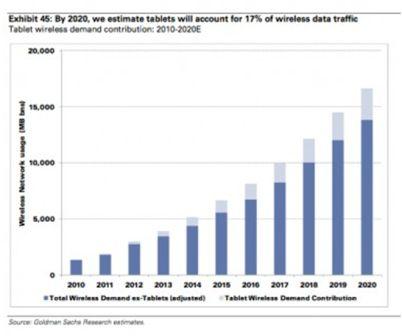
What is Tablet Impact on Mobile Networks?
Tablets are the new factor, as most mobile network bandwidth demand has been driven by PC dongles and increasingly by smart phones.
But tablets add a new unknown element. The simple answer is that, over time, "more" bandwidth will be consumed by tablet devices.
The issue is how much new demand will be created, and just as importantly, where and when that demand occurs.
And there arguably are significant differences in the way people use bandwidth, when out and about and when at home or in the office.
On one hand, possibly nine percent of mobile usage occurs when people are out and about.
About nine percent of usage occurs when users are moving, the balance occurring either at stationary locations such as home or work.
Mobile voice minutes of use in the home environment represented about 42 percent of total mobile voice traffic by the end of 2008. Mobile voice usage at home would gradually increase to reach 49 percent by 2013, Informa estimated.
About nine percent of usage occurs when users are moving, the balance occurring either at stationary locations such as home or work.
As early as 2007, about 40 percent of total mobile traffic was generated in the home environment Informa Telecoms & Media has said. By 2013 in-home usage is expected to reach 58 percent, with about eight percent of total mobile traffic offloaded to fixed broadband, Informa predicted at that time.
In 2008, the home environment represented more than 43 percent of total mobile data traffic and Informa revised its forecast, estimating that in-home mobile usage would climb to 60 percent by 2013.
Mobile voice minutes of use in the home environment represented about 42 percent of total mobile voice traffic by the end of 2008. Mobile voice usage at home would gradually increase to reach 49 percent by 2013, Informa estimated.
Mobile use at work was estimated to represent 30 percent of usage, with nine percent of calls initiated while users were moving. About 21 percent of calls would be generated from other public environments. All of that makes planning difficult.
The good news is that users often simply do not have time to engage with applications that consume lots of when on the move. On the other hand, at-home usage probably will look more like PC behavior.
The new question is what impact tablets will have. Since most tablets now in the user base rely on Wi-Fi connections, the impact on mobile networks might be very slight. But it would be reasonable enough to assume that, over time, tablet consumption might start to resemble smart phone patterns.
The good news there, for mobile network capacity planners, is that Wi-Fi usage will be offloaded traffic, and will have minimal mobile network impact.
At-home tablet mobile network usage, though more substantial than "on the go" usage, at least will be more predictable.
Gary Kim was cited as a global "Power Mobile Influencer" by Forbes, ranked second in the world for coverage of the mobile business, and as a "top 10" telecom analyst. He is a member of Mensa, the international organization for people with IQs in the top two percent.
iZettle, "Square of Europe," Adds New Features
Most of the time, we seem to focus on mobile payments as a value for end users. But iZettle seems to have approached it as a payments system with built-in value for the retailers who have to support the systems.
Some call iZettle the "Square of Europe," and that's a reasonable enough way to describe it.
The company has released a brand new app with new features that help sellers manage inventory.
The latest version, iZettle 1.7, comes with product folders. Some retailers have libraries with tens or even hundreds of products.
Now you can drag and drop products on one another to gather them all in a single product folder. Users also can also move your products around simply by pressing and holding.
The latest version also adds a feature called "Product variants" that allows retailers to better support sale of clothing, food items or other products that come in different sizes, colors or price ranges, for example.
Gary Kim was cited as a global "Power Mobile Influencer" by Forbes, ranked second in the world for coverage of the mobile business, and as a "top 10" telecom analyst. He is a member of Mensa, the international organization for people with IQs in the top two percent.
Friday, February 17, 2012
Mobile Now "Is Communications"
About 85 percent of U.S. consumers use mobile devices for communications. For many, mobile is the way they generally use voice, even when they have access to a landline service.
In 2011, 202 million adults own mobile phones.
Mobile usage has surpassed landline usage as well. Today, approximately 28 percent of American consumers do not have a landline phone whereas just 15 percent do not have a mobile phone. In addition, mobile usage has surpassed online usage (85 percent of people, compared to 78 percent of people who use landline services.
Gary Kim was cited as a global "Power Mobile Influencer" by Forbes, ranked second in the world for coverage of the mobile business, and as a "top 10" telecom analyst. He is a member of Mensa, the international organization for people with IQs in the top two percent.
Another New Social Network Revenue Model" Affiliate Fees
Traffic to the Pinterest website has grown by a factor of 10 over the past six months. In January 2012, the number of visitors on Pinterest.com was almost a third of that on Twitter.com. That’s a lot of users.
"Pinterest's monetization strategy isn't in the oven and it's not even off the baking table," says Jeremy Levine, a board member of Pinterest and a venture capitalist at Bessemer Venture Partners. "We have one hundred ideas but no execution as of yet."
But Josh Davis says that isn’t quite true. Highly unusually for a start-up social network, Pinterest does seem to have an existing revenue stream that is different from all the other monetization schemes other major social networks have developed.
Twitter has “promoted tweets.” Facebook has display ads. LinkedIn had the same “no revenue” problem years ago, but now makes money from subscriptions, advertising sales, and hiring solutions.
LinkedIn gets 25 percent of its revenue from premium subscriptions; 33 percent from text and display advertising and 42 percent from LinkedIn Jobs, a job-matching or automated headhunting service.
Pinterest apparently already has develooped an affiliate revenue stream. If you post a pin to Pinterest, and it links to an e-commerce site that happens to have an affiliate program, Pinterest modifies the link to add their own affiliate tracking code.
If a user clicks through the picture from Pinterest and makes a purchase, Pinterest gets paid. So add “affiliate links” to the list of possible revenue models for a “free to use” social network.
Pinterest apparently is using a service called SkimLinks. SkimLinks' software looks at links users post to websites, determines if there is an affiliate program to which they can be linked, and appends a code that ensures Pinterest gets credit for (and data from) the referral.
That is highly unusual for a young social network. But it tends to validate the notion that users are the “product” that underlies all social network revenue models, at the end of the day.
Some would argue that Pinterest already is driving truly massive traffic to retail sites, by some accounts more than YouTube, LinkedIn, and Google+ combined, and the affiliate links model should be meaningful.
Commissions on sales for affiliate links vary widely, but they average around five percent. After SkimLinks gets paid, Pinterest might be looking at 3.75 percent net revenue. That will not be enough, by itself, to keep Pinterest in business over the long term. But it is more revenue than virtually all the other big social networks had when they started.
Gary Kim was cited as a global "Power Mobile Influencer" by Forbes, ranked second in the world for coverage of the mobile business, and as a "top 10" telecom analyst. He is a member of Mensa, the international organization for people with IQs in the top two percent.
Subscribe to:
Comments (Atom)
"Organized Religion" Arguably is the Cure, Not the Disease
Whether the “ Disunited States of America ” can be cured remains a question with no immediate answer. But it is a serious question with eno...
-
We have all repeatedly seen comparisons of equity value of hyperscale app providers compared to the value of connectivity providers, which s...
-
It really is surprising how often a Pareto distribution--the “80/20 rule--appears in business life, or in life, generally. Basically, the...
-
One recurring issue with forecasts of multi-access edge computing is that it is easier to make predictions about cost than revenue and infra...