There are growing signs that the U.S. mobile service provider market is unstable, in terms of market structure, and on the cusp of changes that could include a significant wave of provider restructuring, despite the failure of the AT&T bid to buy T-Mobile USA.
"What is clear for now, in our view, is that the current strategy, indeed the entire current business, isn't working," said Craig Moffett, an analyst at Sanford C. Bernstein. Moffett seems to be referring to the whole business operated by regional U.S. wireless carriers.
To be sure, Moffett has been saying that the U.S. mobile business is saturated since at least 2009.
Oddly enough, to some of us the new stresses resemble the earlier transition from dial-up Internet access to broadband access. In this case, the transition is from feature phone to smart phone business models.
In that earlier transition, many suppliers that had made a business of supplying dial-up access found they no longer could compete in the broadband business. Now, in mobile, it appears that the cost of supporting handset subsidies is pinching operating revenue, while the cost of building fourth generation networks likewise will hit earnings.
Of the "big four" U.S. mobile carriers, only T-Mobile USA seems to have experienced a subscriber loss.
In its second quarter of 2012, AT&T added 1.5 million net new customers. Verizon Wireless added 1.2 million net new subscribers. Sprint added postpaid net additions of 442,000 postpaid net additions. But T-Mobile USA, one the "big four" U.S. mobile service providers, lost 510,000 subscribers in the first quarter.
The immediate stress is heavy for the regional mobile providers, often using prepaid models.
Regional or prepaid service providers clearly have had a tougher 2012 than had been the case in the mid-2000s, for example. Leap hasn't been profitable since 2005, for example. MetroPCS profits dropped 63 percent during the first quarter of 2012.
A study undertaken by Tellabs suggests that mobile service provider profitability could become extremely challenging for some mobile operators within three years, with costs surpass revenues for many operators.
In North America that could happen by the fourth quarter of 2013 or as early as Q1 2013. Developed Asia Pacific service providers could see problems by the third quarter of 2014. In some cases this could happen as early as Q3 2013, Tellabs said.
Service providers in Western Europe could run into trouble by the first quarter of 2015. In some cases this could happen as early as the first quarter of 2014.
Tuesday, August 7, 2012
U.S. Mobile Business Now is Unstable

 Gary Kim was cited as a global "Power Mobile Influencer" by Forbes, ranked second in the world for coverage of the mobile business, and as a "top 10" telecom analyst. He is a member of Mensa, the international organization for people with IQs in the top two percent.
Photo of Mars Rover "Curiosity" Heat Shield Dropping Away
Here's a shot of Mars Rover Curiosity dropping its heat shield on the Martian descent. Also, lots of dusty brown rocks, eh?


Gary Kim was cited as a global "Power Mobile Influencer" by Forbes, ranked second in the world for coverage of the mobile business, and as a "top 10" telecom analyst. He is a member of Mensa, the international organization for people with IQs in the top two percent.
M2M Mobile Connections: 2.5 Billion by 2020
Mobile network machine to machine (M2M} connections will grow from 277 million in 2012 to 2.5 billion by 2020, growing at a 30 percent compound annual growth rate between now and 2020, according to Strategy Analytics.
Health, meter reading, energy management and transportation applications are expected to lead the growth.
Health, meter reading, energy management and transportation applications are expected to lead the growth.
Gary Kim was cited as a global "Power Mobile Influencer" by Forbes, ranked second in the world for coverage of the mobile business, and as a "top 10" telecom analyst. He is a member of Mensa, the international organization for people with IQs in the top two percent.
Mobile Broadband Subscriptions for Tablets: $15 Billion Incremental Revenue in 2017
Consumers will add 150 million new data subscriptions for their tablet devices in the next five years, creating a new data access market representing $15 billion in revenue by the end of 2017, when tablet subscriptions will reach 172 million worldwide, Strategy Analytics says.
"Less than 13 percent of the global tablet installed base will have active mobile broadband service in 2012, yet in the US, both AT&T and Verizon Wireless saw tablets play a key role in net subscriber additions in the second quarter this year," says Susan Welsh de Grimaldo, Director, Mobile Broadband Opportunities (MBO) at Strategy Analytics.
Long Term Evolution will become the access technology of choice for mobile network connections, accounting for nearly 68 percent of mobile broadband tablet subscriptions by the end of 2017, Strategy Analytics says.
"Less than 13 percent of the global tablet installed base will have active mobile broadband service in 2012, yet in the US, both AT&T and Verizon Wireless saw tablets play a key role in net subscriber additions in the second quarter this year," says Susan Welsh de Grimaldo, Director, Mobile Broadband Opportunities (MBO) at Strategy Analytics.
Long Term Evolution will become the access technology of choice for mobile network connections, accounting for nearly 68 percent of mobile broadband tablet subscriptions by the end of 2017, Strategy Analytics says.
Gary Kim was cited as a global "Power Mobile Influencer" by Forbes, ranked second in the world for coverage of the mobile business, and as a "top 10" telecom analyst. He is a member of Mensa, the international organization for people with IQs in the top two percent.
Tablet Users Don't "Work" on Tablets
 There will be nearly 70 million tablet users in the United States by the end of 2012, an increase of more than 100 percent over 2011, eMarketer estimates. Aside from representing the fastest-adopted digital device ever, tablet usage also shows the way digital device activities have changed since the advent of the "PC" era.
Of the top 10 or 11 categories of things people report doing on a tablet, only using email is arguably something that could sometimes be called a "work activity," most of the time.
And that also is something not specific to a tablet, as more people can use email on their smart phones, as well.
Granted, we all have been at meetings where an attendee looked something up using a browser and search engine. But those things also are done by other attendees on smart phones or PCs. The point is that PCs, smart phones and tablets all are multiple-function devices. But the lead functions of each device are distinct.
For many observers, that suggests tablets are not a "replacement" for a PC so much as an indicator of the ways digital appliances now have become content consumption vehicles. True, tablets are smarter than TVs, radios, DVRs or some older MP3 players. But they are content consumption or media players as much as anything.
For all tablet owners under age 50, playing games was the most common activity. For the youngest tablet owners, ages 18 to 29, this was followed by shopping, reading books and email.
Email had a much greater importance among 30- to 49-year-olds, who were about twice as likely to use their tablets for email purposes than were their younger counterparts.
For 50- to 64-year-olds, email was the most common tablet activity overall.
Gary Kim was cited as a global "Power Mobile Influencer" by Forbes, ranked second in the world for coverage of the mobile business, and as a "top 10" telecom analyst. He is a member of Mensa, the international organization for people with IQs in the top two percent.
Monday, August 6, 2012
Apple Co-Founder Wozniak Thinks Cloud is a Huge Problem
"I really worry about everything going to the cloud," he said. "I think it's going to be horrendous. I think there are going to be a lot of horrible problems in the next five years," says Steve Wozniak, Apple co-founder.
The reason is not that the cloud won't work. Instead, he worries about content ownership. "With the cloud, you don't own anything," he says. "You already signed it away" through the legalistic terms of service with a cloud provider that computer users must agree to."
The reason is not that the cloud won't work. Instead, he worries about content ownership. "With the cloud, you don't own anything," he says. "You already signed it away" through the legalistic terms of service with a cloud provider that computer users must agree to."
Gary Kim was cited as a global "Power Mobile Influencer" by Forbes, ranked second in the world for coverage of the mobile business, and as a "top 10" telecom analyst. He is a member of Mensa, the international organization for people with IQs in the top two percent.
iOS and Android Tablets Capturing Different Consumer Segments
Clear customer segments emerged from a comScore analysis of tablet purchasing, and the findings might strike you as entirely believable.
Apple iPad owners skewed male (52.9 percent), slightly younger (44.5 percent under the age of 35) and wealthier (46.3 percent residing in households with income of $100k or greater) compared to an average tablet user during the three-month average period ending June 2012. That over-indexing for younger and richer users has been a notable characteristic of iPad adopters since the product first launched.
In comparison, Kindle Fire owners saw their audience skew female with 56.6 percent of its audience base represented by females.
Both Android and Kindle Fire users saw household income below that of iPad owners, aligning more closely with household income reported by smart phone owners.
Apple iPad owners skewed male (52.9 percent), slightly younger (44.5 percent under the age of 35) and wealthier (46.3 percent residing in households with income of $100k or greater) compared to an average tablet user during the three-month average period ending June 2012. That over-indexing for younger and richer users has been a notable characteristic of iPad adopters since the product first launched.
In comparison, Kindle Fire owners saw their audience skew female with 56.6 percent of its audience base represented by females.
Both Android and Kindle Fire users saw household income below that of iPad owners, aligning more closely with household income reported by smart phone owners.
| Demographic Profile: Tablet* and Smartphone Audience 3 month avg. ending June 2012 Total U.S. Tablet Owners and Smartphone Subscribers, Age 13+ Source: comScore TabLens and comScore MobiLens | |||||
| Total Smartphone | Total Tablet | iPad | Android** Tablet | Kindle Fire | |
| Gender | |||||
| Male | 51.9% | 50.0% | 52.9% | 50.9% | 43.4% |
| Female | 48.1% | 50.0% | 47.1% | 49.1% | 56.6% |
| Age | |||||
| 13-17 | 6.0% | 5.5% | 4.7% | 6.2% | 5.5% |
| 18-24 | 17.5% | 13.0% | 14.0% | 12.9% | 12.2% |
| 25-34 | 24.6% | 24.2% | 25.8% | 22.5% | 24.7% |
| 35-44 | 21.0% | 20.6% | 21.4% | 20.1% | 20.5% |
| 45-54 | 16.7% | 18.1% | 16.8% | 19.7% | 16.9% |
| 55-64 | 9.0% | 11.0% | 9.7% | 10.8% | 12.5% |
| 65+ | 5.3% | 7.6% | 7.5% | 7.8% | 7.6% |
| Household Income | |||||
| <$25k | 12.0% | 7.8% | 5.5% | 11.7% | 7.0% |
| $25k to <$50k | 19.6% | 18.1% | 14.4% | 20.4% | 20.9% |
| $50k to <$75k | 19.3% | 19.1% | 17.2% | 20.0% | 21.3% |
| $75k to <$100k | 15.6% | 16.7% | 16.6% | 15.3% | 17.5% |
| $100k+ | 33.5% | 38.4% | 46.3% | 32.5% | 33.3% |
Gary Kim was cited as a global "Power Mobile Influencer" by Forbes, ranked second in the world for coverage of the mobile business, and as a "top 10" telecom analyst. He is a member of Mensa, the international organization for people with IQs in the top two percent.
Does Mobile Commerce Make More Sense Than Mobile Advertising?
If you are a tier-one mobile service provider exploring large potential future opportunities, it matters greatly how big each potential new business might be. Though most such firms will place lots of bets, and wait to see what develops, tier one service providers cannot waste time on "small" opportunities.
Typically, services such as mobile advertising, mobile payments or mobile commerce, machine to machine communications or enterprise-oriented services are on the list of such possibilities. So how big might "advertising" be, compared to "commerce?"
It's a hard question to answer, in part because "mobile advertising" and "mobile commerce" clearly overlap, while mobile commerce overlaps with mobile payments and banking.
Google Wallet or Isis, for example, both envision their mobile wallets becoming a hub or intermediary for all sorts of deals, offers, coupons and loyalty and reward programs, even though mobile wallets are seen as intimately related to mobile payments.
In fact, it might be the case that the interest in "mobile advertising" now should better be described as an interest in mobile commerce, anchored initially by mobile wallet efforts.
At least in part, mobile commerce also makes sense because research from Nielsen in 2011 already was showing that 29 percent of smart phone owners use their phone for shopping-related activities.
But at least so far, few of the top activities conducted by mobile shoppers are extremely conducive to direct mobile service provider participation. Some 38 percent of respondents conduct in-store price comparisons (38 percent of mobile shoppers), about 38 percent browse products through their mobile Web or apps while 32 percent report reading online product reviews.
The opportunity for mobile service providers to create value and a role in those activities and ecosystems is largely unclear. Mobile wallets, on the other hand, could represent a much more logical role for a mobile service provider.
Mobile advertising, for example, might represent $2.6 billion in 2012 revenue, and little of that flows to mobile service providers. Mobile commerce includes sales of mobile content, purchasing of services and products, mobile offers and deals, for example. That activity, even exclusive of sales of ring tone, mobile video or games, shows, already had reached


Apps, which account for the majority of mobile phone time in the U.S., may be the key to shifting consumers from browsing products on their phone to making purchases, some would argue.
There also is a relationship to mobile payments as well. Although only nine percent of mobile shoppers have used their phone to pay for a purchase at a retail point of service terminal, 71 percent of app downloaders would be interested in an app that allows them to use their phone as a credit card.
Even those preliminary figures suggest the potential, from a mobile service provider perspective, of pursing mobile commerce, wallet and payment initiatives, compared to mobile "advertising," in a narrow sense.
Loyalty, offers and other revenue streams related directly to mobile wallets are feasible and logical, but might more logically be seen as mobile commerce rather than mobile advertising revenue streams.

Typically, services such as mobile advertising, mobile payments or mobile commerce, machine to machine communications or enterprise-oriented services are on the list of such possibilities. So how big might "advertising" be, compared to "commerce?"
It's a hard question to answer, in part because "mobile advertising" and "mobile commerce" clearly overlap, while mobile commerce overlaps with mobile payments and banking.
Google Wallet or Isis, for example, both envision their mobile wallets becoming a hub or intermediary for all sorts of deals, offers, coupons and loyalty and reward programs, even though mobile wallets are seen as intimately related to mobile payments.
In fact, it might be the case that the interest in "mobile advertising" now should better be described as an interest in mobile commerce, anchored initially by mobile wallet efforts.
At least in part, mobile commerce also makes sense because research from Nielsen in 2011 already was showing that 29 percent of smart phone owners use their phone for shopping-related activities.
But at least so far, few of the top activities conducted by mobile shoppers are extremely conducive to direct mobile service provider participation. Some 38 percent of respondents conduct in-store price comparisons (38 percent of mobile shoppers), about 38 percent browse products through their mobile Web or apps while 32 percent report reading online product reviews.
The opportunity for mobile service providers to create value and a role in those activities and ecosystems is largely unclear. Mobile wallets, on the other hand, could represent a much more logical role for a mobile service provider.

Mobile advertising, for example, might represent $2.6 billion in 2012 revenue, and little of that flows to mobile service providers. Mobile commerce includes sales of mobile content, purchasing of services and products, mobile offers and deals, for example. That activity, even exclusive of sales of ring tone, mobile video or games, shows, already had reached
Apps, which account for the majority of mobile phone time in the U.S., may be the key to shifting consumers from browsing products on their phone to making purchases, some would argue.
There also is a relationship to mobile payments as well. Although only nine percent of mobile shoppers have used their phone to pay for a purchase at a retail point of service terminal, 71 percent of app downloaders would be interested in an app that allows them to use their phone as a credit card.
Even those preliminary figures suggest the potential, from a mobile service provider perspective, of pursing mobile commerce, wallet and payment initiatives, compared to mobile "advertising," in a narrow sense.
Loyalty, offers and other revenue streams related directly to mobile wallets are feasible and logical, but might more logically be seen as mobile commerce rather than mobile advertising revenue streams.
Gary Kim was cited as a global "Power Mobile Influencer" by Forbes, ranked second in the world for coverage of the mobile business, and as a "top 10" telecom analyst. He is a member of Mensa, the international organization for people with IQs in the top two percent.
Where Providers Can Make Money In Cloud Services, Now
If you agree with the notion of product life cycles, then you might also agree that new technologies have adoption cycles, and "hype cycles," as well.
The Gartner notion of how technologies develop incorporates the notion that a period of high expectations normally is followed by period where those initial hopes are dashed, eventually followed by a period where innovations are well understood and adopted.
You might argue that most of the money will be made once that occurs. If so, you might expect that email has been mainstream and throwing off substantial revenues for a while, and is maturing.
Cloud-based advertising (think Google) and cloud-based sales force automation (think Salesforce.com) and other software as a service apps are in the full deployment stage.
Infrastructure as a service is getting close to full deployment and acceptance. Public cloud storage has a ways to go before it will reach full deployment, though.

The Gartner notion of how technologies develop incorporates the notion that a period of high expectations normally is followed by period where those initial hopes are dashed, eventually followed by a period where innovations are well understood and adopted.
You might argue that most of the money will be made once that occurs. If so, you might expect that email has been mainstream and throwing off substantial revenues for a while, and is maturing.
Cloud-based advertising (think Google) and cloud-based sales force automation (think Salesforce.com) and other software as a service apps are in the full deployment stage.
Infrastructure as a service is getting close to full deployment and acceptance. Public cloud storage has a ways to go before it will reach full deployment, though.
Gary Kim was cited as a global "Power Mobile Influencer" by Forbes, ranked second in the world for coverage of the mobile business, and as a "top 10" telecom analyst. He is a member of Mensa, the international organization for people with IQs in the top two percent.
Mars Rover Curiosity Beats Odds
Almost 70 percent of previous missions to Mars had ended in failure, which explains the significance of Mars Rover "Curiosity" making a safe landing on the red planet.
A heat shield had to slow the spacecraft from 13,000 mph to about 800 mph. Then a giant supersonic parachute unfurled to slow the rover further to about 200 mph.
Then onboard radar has to detect the surface, and rocket engines aboard a kind of jet pack have to fire, slowing Curiosity to a crawl. Finally, a bridle had to lower the rover from the jet pack to the surface.

The landing sequence, dubbed “seven minutes of terror,” required the largest supersonic parachute ever deployed in space, and 76 pyrotechnic explosions. If any one of those explosions had not occurred, Curiosity would have crashed.
A heat shield had to slow the spacecraft from 13,000 mph to about 800 mph. Then a giant supersonic parachute unfurled to slow the rover further to about 200 mph.
Then onboard radar has to detect the surface, and rocket engines aboard a kind of jet pack have to fire, slowing Curiosity to a crawl. Finally, a bridle had to lower the rover from the jet pack to the surface.
The landing sequence, dubbed “seven minutes of terror,” required the largest supersonic parachute ever deployed in space, and 76 pyrotechnic explosions. If any one of those explosions had not occurred, Curiosity would have crashed.
Gary Kim was cited as a global "Power Mobile Influencer" by Forbes, ranked second in the world for coverage of the mobile business, and as a "top 10" telecom analyst. He is a member of Mensa, the international organization for people with IQs in the top two percent.
Sunday, August 5, 2012
Mobile Commerce Looks to be Bigger than Mobile Advertising
Though some might disagree, it appears that mobile commerce is poised to offer bigger financial returns for suppliers than mobile advertising, despite the headstart mobile advertising has had. To be sure, mobile advertising already represents $2.6 billion in U.S. market revenue in 2012.
Mobile payments transaction value on a global level will total $171.5 billion in 2012, Gartner estimates. If you assume payments revenue is two percent of the transaction value, that represents perhaps $3.43 billion in payment transaction revenue.
By some estimates, U.S. mobile payments transactions represent about $81 billion in 2012. If so, at two percent of gross transaction value, the mobile payment processing portion of the business is about $1.6 billion.
Of course, "mobile payments" represent multiple discrete lines of business, including remote purchases ("online" purchases), mobile purchases of content goods, retail point of sale payments and money transfers.
Gartner also projects annual rates of growth ranging from 40 percent to 70 percent in various countries, with U.S. rates closer to 70 percent annually.


Mobile payments transaction value on a global level will total $171.5 billion in 2012, Gartner estimates. If you assume payments revenue is two percent of the transaction value, that represents perhaps $3.43 billion in payment transaction revenue.
By some estimates, U.S. mobile payments transactions represent about $81 billion in 2012. If so, at two percent of gross transaction value, the mobile payment processing portion of the business is about $1.6 billion.
Of course, "mobile payments" represent multiple discrete lines of business, including remote purchases ("online" purchases), mobile purchases of content goods, retail point of sale payments and money transfers.
Gartner also projects annual rates of growth ranging from 40 percent to 70 percent in various countries, with U.S. rates closer to 70 percent annually.
Gary Kim was cited as a global "Power Mobile Influencer" by Forbes, ranked second in the world for coverage of the mobile business, and as a "top 10" telecom analyst. He is a member of Mensa, the international organization for people with IQs in the top two percent.
Saturday, August 4, 2012
U.K. House of Lords Proposes "Radical" Change in Broadband Policy
With the caveat that government reports are not policy, and that many such efforts have no ability to affect changes in policy, a report by the Select Committee on Communications of the U.K. House of Lords does suggest some potential new ways to structure the upgrade of the U.K. fixed network. Whether it is feasible or not remains to be seen.
Indeed, critics might say it is financially unworkable. It might arguably be politically unworkable. But it is different. Basically, the study suggests focusing fiber upgrades on the middle mile of the network, deploying new wholesale fiber to “open access hubs” within reach of every community, says the study by the U.K. House of Lords.
The idea is to encourage multiple providers to connect to the “hubs” to provide local access. That is not architecturally so different from what planners originally have proposed. There has been general agreement on extending fiber to cabinets, where it is not feasible to run fiber all the way to each premises.
What is different is the degree of wholesale network access points, and the way the access network is owned and paid for. Among the provisions with the greatest cost implications is the notion that perhaps end users should build and own more of the access plant.
Engineers immediately will grasp the cost implications. Service providers will immediately grasp the competitive implications.
The open access fiber optic hub “refers to a physical object—in all likelihood a box—situated in the vicinity of a community,” the report says. “Its job is to act as a way station between that community and the broadband infrastructure that spreads out across the rest of the country,” the report says.
Engineers immediately will wonder whether the hubs are equivalent to “central office” locations, or are positioned deeper in the distribution network. The report does not make that distinction unmistakably clear, though one assumes the hubs generally will be deeper in the access network than a central office.
Running into the hub from the wider network would be an ample number of “dark” fiberoptic cables, available on an “open access” basis. Retailers would then build local access networks of their own, between customer locations and the hubs.
Engineers will see some pitfalls. As a rule of thumb, it is precisely the local access portion of the network that drives half of the total cost of a fixed line network. That generally includes all plant between a central office and the actual customer.
The House of Lords report might include fiber pulled much closer to the customer, in which case the access portion of the plant that any competitor might have to supply could represent less investment than generally has been required.
One analogy might be the “fiber to node” designs used by cable operators, which position the termination of the fiber network at a point where 500 to 1,000 homes are served. Perhaps an open access hub is comparable to a fiber node, in a cable TV sense.
What is unclear is whether the report envisions the hubs to be the equivalent of passive optical network locations, which feed perhaps 30 to 100 homes or locations. There are serious cost implications to using either of those wholesale termination points.
Most potential competitors will find the costs of building their own local access all the way from any customer back to the central office. Many more would find the prospect of building only to a hub serving 30 to 100 locations much more palatable.
There are some physical issues, either way. Availability of underground duct facilities or space on aerial poles will put limits on the number of competitors that actually could build new facilities to reach a hub, much less a central office location.
The study also suggests a potentially different way of looking at connection costs, though. “Currently, most people’s conception of broadband infrastructure derives from their conception of the telephone network or other utilities whose termination point is at the curtilage of the household, after which ownership of the network is taken over by the owner of the premises.”
In other words, the provider’s network stops at the side of the house. The study says a different approach would entail the customer owning more of the drop and access network.
“An alternative way of thinking about the network might be that broadband rollout has more in common with the railways: the traveller has to get him/herself to the station and once there the train takes the train,” the report says.
The open access fibre-optic hub model would make it possible for individual property owners to build out the access network themselves, or at least have it built for them.
Marketers immediately will object that most users will be quite unwilling to undertake such investments themselves.
One alternative way of thinking of ownership structure is if the network is “a home with a tail,” where the household owns the last bit of fiber.”
Instead of having competition among suppliers to serve those homes, a reverse model would have a household auctioning the ability to connect with the backhaul and to the network.
That likely would be a harder sale than many suspect, as it could entail customers spending $500 or more to reach a neighborhood cabinet.
While providing an eventual upgrade path to fiber to home, the study also recommends placement of optical splitters at a central office location, presumably thereby allowing competitors to lease an entire access network, rather than building their own.
In any event, the study argues that “a reorientation is required in government policy away from the absolute edges of the network and towards that part of it which brings optical network closer into communities.” For some, that might mean funding the “middle mile,” but that arguably is less accurate than saying the report recommends funding open access facilities deeper into the access network, with unbundling at a level where any retail competitor has to supply a link from any location back to an optical hub serving 30 to 100 locations.
Whether the report will have an impact is perhaps highly questionable. Aside from some potential BT objections, and possibly some BT support, there are highly uncertain cost implications for retail competitors, as well as revenue implications if wholesale network access locations make it easier for competitors to enter markets on a facilities-based basis.
Indeed, critics might say it is financially unworkable. It might arguably be politically unworkable. But it is different. Basically, the study suggests focusing fiber upgrades on the middle mile of the network, deploying new wholesale fiber to “open access hubs” within reach of every community, says the study by the U.K. House of Lords.
The idea is to encourage multiple providers to connect to the “hubs” to provide local access. That is not architecturally so different from what planners originally have proposed. There has been general agreement on extending fiber to cabinets, where it is not feasible to run fiber all the way to each premises.
What is different is the degree of wholesale network access points, and the way the access network is owned and paid for. Among the provisions with the greatest cost implications is the notion that perhaps end users should build and own more of the access plant.
Engineers immediately will grasp the cost implications. Service providers will immediately grasp the competitive implications.
The open access fiber optic hub “refers to a physical object—in all likelihood a box—situated in the vicinity of a community,” the report says. “Its job is to act as a way station between that community and the broadband infrastructure that spreads out across the rest of the country,” the report says.
Engineers immediately will wonder whether the hubs are equivalent to “central office” locations, or are positioned deeper in the distribution network. The report does not make that distinction unmistakably clear, though one assumes the hubs generally will be deeper in the access network than a central office.
Running into the hub from the wider network would be an ample number of “dark” fiberoptic cables, available on an “open access” basis. Retailers would then build local access networks of their own, between customer locations and the hubs.
Engineers will see some pitfalls. As a rule of thumb, it is precisely the local access portion of the network that drives half of the total cost of a fixed line network. That generally includes all plant between a central office and the actual customer.
The House of Lords report might include fiber pulled much closer to the customer, in which case the access portion of the plant that any competitor might have to supply could represent less investment than generally has been required.
One analogy might be the “fiber to node” designs used by cable operators, which position the termination of the fiber network at a point where 500 to 1,000 homes are served. Perhaps an open access hub is comparable to a fiber node, in a cable TV sense.
What is unclear is whether the report envisions the hubs to be the equivalent of passive optical network locations, which feed perhaps 30 to 100 homes or locations. There are serious cost implications to using either of those wholesale termination points.
Most potential competitors will find the costs of building their own local access all the way from any customer back to the central office. Many more would find the prospect of building only to a hub serving 30 to 100 locations much more palatable.
There are some physical issues, either way. Availability of underground duct facilities or space on aerial poles will put limits on the number of competitors that actually could build new facilities to reach a hub, much less a central office location.
The study also suggests a potentially different way of looking at connection costs, though. “Currently, most people’s conception of broadband infrastructure derives from their conception of the telephone network or other utilities whose termination point is at the curtilage of the household, after which ownership of the network is taken over by the owner of the premises.”
In other words, the provider’s network stops at the side of the house. The study says a different approach would entail the customer owning more of the drop and access network.
“An alternative way of thinking about the network might be that broadband rollout has more in common with the railways: the traveller has to get him/herself to the station and once there the train takes the train,” the report says.
The open access fibre-optic hub model would make it possible for individual property owners to build out the access network themselves, or at least have it built for them.
Marketers immediately will object that most users will be quite unwilling to undertake such investments themselves.
One alternative way of thinking of ownership structure is if the network is “a home with a tail,” where the household owns the last bit of fiber.”
Instead of having competition among suppliers to serve those homes, a reverse model would have a household auctioning the ability to connect with the backhaul and to the network.
That likely would be a harder sale than many suspect, as it could entail customers spending $500 or more to reach a neighborhood cabinet.
While providing an eventual upgrade path to fiber to home, the study also recommends placement of optical splitters at a central office location, presumably thereby allowing competitors to lease an entire access network, rather than building their own.
In any event, the study argues that “a reorientation is required in government policy away from the absolute edges of the network and towards that part of it which brings optical network closer into communities.” For some, that might mean funding the “middle mile,” but that arguably is less accurate than saying the report recommends funding open access facilities deeper into the access network, with unbundling at a level where any retail competitor has to supply a link from any location back to an optical hub serving 30 to 100 locations.
Whether the report will have an impact is perhaps highly questionable. Aside from some potential BT objections, and possibly some BT support, there are highly uncertain cost implications for retail competitors, as well as revenue implications if wholesale network access locations make it easier for competitors to enter markets on a facilities-based basis.
Gary Kim was cited as a global "Power Mobile Influencer" by Forbes, ranked second in the world for coverage of the mobile business, and as a "top 10" telecom analyst. He is a member of Mensa, the international organization for people with IQs in the top two percent.
How Big an Opportunity is "Mobile Banking?"
Is "mobile banking" a key revenue opportunity, or not? The answer is that "it depends" on what you mean by "mobile banking" and where those operations are conducted.
According to recently conducted survey by ACI Worldwide, 76 percent of Indian mobile respondents used their mobiles for mobile banking in last six months.
Comparatively, only 38 percent of respondents from the United States, and 31 percent from the United Kingdom said they had used mobile banking in last six months.
China, came in after India with 70 percent of users using mobile banking followed by South Africa (61 percent). The global average for Mobile Banking adoption rate stands at 35 percent of mobile users.
But there are key differences. Where both online banking using PCs, and branch bank infrastructure are highly developed, people tend to use mobile banking to check balances or move money between accounts.
In regions where the banking infrastructure is undeveloped, and availability of PCs and Internet access is limited, people more often use mobile banking as a way to move money from one person to another, or from person to organization (to pay a utility or school bill, for example).
As you would guess, the revenue opportunity for a "mobile banking" services supplier is greater, and more direct, in scenarios where peer to peer payments are involved. As people pay fees to Western Union to move money, so mobile banking in a P2P context represents per-transaction fees that are easy to measure.
That is not the case for "softer" mobile banking transactions conducted in regions where the banking infrastructure is highly developed. In Western Europe or North America, for example, mobile banking more often is used in place of an online session to check balances, rather than as a way to move money from person to person, or person to organization.
That means "mobile banking" is a clearer revenue generating activity and business in developing region, than in developed regions.
In India, 64 percent of ACI Worldwide survey respondents used their mobile phones to make payment at least once in last six months, while in China 66 percent said they had done so.
Only 30 percent of U.S. respondents and 23 percent of U.K. respondents reported they had made payments on mobile in last six months. Keep in mind that all the data includes content and virtual goods purchases (remote payments), as well as peer to peer money transfers or other mobile payments such as in-store purchases.
So it is likely that mobile banking activity in developed regions is "checking my balance," while mobile payments activity is "remote payments" (buying a game or app).
Some 25 per cent of U.K. mobile internet users now use mobile banking services, according to Antenna Technologies.
Likewise, the mobile commerce market is expected to account for 24.4 percent of overall e-commerce revenues by the end of 2017.
This represents the result of some spectacular growth in 2011, when the mobile online commerce market doubled in size to $65.6 billion, according to to ABI Research. If you assume that transaction fees amounted to 1.75 percent of the value of the transactions, then mobile payments provider revenue amounted to something like $1.1 billion in 2011.
The potential revenue is bigger if you assume an average of 2.75 percent transaction fees. In that case, the transaction fee revenue was about $1.8 billion in 2011.
But there are many other segments of the mobile commerce business, including hardware and software to support commerce, advertising, loyalty, marketing. In that sense, the mobile commerce opportunity is bigger, and affects more suppliers, than the mobile payments business.


According to the ACI Worldwide survey, the countries with highest levels of mobile payment adoption also display highest importance on mobile payments and money movement. Roughly two-thirds of Indian consumers consider making payments and moving money using their mobile phone in the next three years to be “very important” to them —in contrast only one in 10 French and Canadian consumers think mobile payment is “Very Important”.
In Brazil, for example, although 39 percent of consumers consider mobile payment and money movement to be “very important,” 75 percent would use their mobile phone to replace cards. That points up a key difference between “developed” and “developing” regions.
The ability to use a mobile phone as a payment channel is of clear value in settings where the banking structure is undeveloped. That function offers less value in markets where both online banking by PC and the branch banking infrastructure are highly developed.

The point is that "mobile banking" represents different opportunities in developed and developing regions. In the former markets, it is broader mobile commerce, including point of sale payments, where the revenue gains lie. In developing regions, it is peer to peer money transfers, for the most part.
According to recently conducted survey by ACI Worldwide, 76 percent of Indian mobile respondents used their mobiles for mobile banking in last six months.
Comparatively, only 38 percent of respondents from the United States, and 31 percent from the United Kingdom said they had used mobile banking in last six months.
China, came in after India with 70 percent of users using mobile banking followed by South Africa (61 percent). The global average for Mobile Banking adoption rate stands at 35 percent of mobile users.
But there are key differences. Where both online banking using PCs, and branch bank infrastructure are highly developed, people tend to use mobile banking to check balances or move money between accounts.
In regions where the banking infrastructure is undeveloped, and availability of PCs and Internet access is limited, people more often use mobile banking as a way to move money from one person to another, or from person to organization (to pay a utility or school bill, for example).
As you would guess, the revenue opportunity for a "mobile banking" services supplier is greater, and more direct, in scenarios where peer to peer payments are involved. As people pay fees to Western Union to move money, so mobile banking in a P2P context represents per-transaction fees that are easy to measure.
That is not the case for "softer" mobile banking transactions conducted in regions where the banking infrastructure is highly developed. In Western Europe or North America, for example, mobile banking more often is used in place of an online session to check balances, rather than as a way to move money from person to person, or person to organization.
That means "mobile banking" is a clearer revenue generating activity and business in developing region, than in developed regions.
In India, 64 percent of ACI Worldwide survey respondents used their mobile phones to make payment at least once in last six months, while in China 66 percent said they had done so.
Only 30 percent of U.S. respondents and 23 percent of U.K. respondents reported they had made payments on mobile in last six months. Keep in mind that all the data includes content and virtual goods purchases (remote payments), as well as peer to peer money transfers or other mobile payments such as in-store purchases.
So it is likely that mobile banking activity in developed regions is "checking my balance," while mobile payments activity is "remote payments" (buying a game or app).
Some 25 per cent of U.K. mobile internet users now use mobile banking services, according to Antenna Technologies.
Likewise, the mobile commerce market is expected to account for 24.4 percent of overall e-commerce revenues by the end of 2017.
This represents the result of some spectacular growth in 2011, when the mobile online commerce market doubled in size to $65.6 billion, according to to ABI Research. If you assume that transaction fees amounted to 1.75 percent of the value of the transactions, then mobile payments provider revenue amounted to something like $1.1 billion in 2011.
The potential revenue is bigger if you assume an average of 2.75 percent transaction fees. In that case, the transaction fee revenue was about $1.8 billion in 2011.
But there are many other segments of the mobile commerce business, including hardware and software to support commerce, advertising, loyalty, marketing. In that sense, the mobile commerce opportunity is bigger, and affects more suppliers, than the mobile payments business.
According to the ACI Worldwide survey, the countries with highest levels of mobile payment adoption also display highest importance on mobile payments and money movement. Roughly two-thirds of Indian consumers consider making payments and moving money using their mobile phone in the next three years to be “very important” to them —in contrast only one in 10 French and Canadian consumers think mobile payment is “Very Important”.
In Brazil, for example, although 39 percent of consumers consider mobile payment and money movement to be “very important,” 75 percent would use their mobile phone to replace cards. That points up a key difference between “developed” and “developing” regions.
The ability to use a mobile phone as a payment channel is of clear value in settings where the banking structure is undeveloped. That function offers less value in markets where both online banking by PC and the branch banking infrastructure are highly developed.
The point is that "mobile banking" represents different opportunities in developed and developing regions. In the former markets, it is broader mobile commerce, including point of sale payments, where the revenue gains lie. In developing regions, it is peer to peer money transfers, for the most part.
Gary Kim was cited as a global "Power Mobile Influencer" by Forbes, ranked second in the world for coverage of the mobile business, and as a "top 10" telecom analyst. He is a member of Mensa, the international organization for people with IQs in the top two percent.
Friday, August 3, 2012
Smart Phone Adoption Correlates with Household Income, Except in China
Generally speaking, smart phone adoption is directly related to household income. But there are exceptions, such as the Chinese market, which "over indexes" for smart phone penetration.
One suspects that subsequent generations of lower-cost smart phones and new retail plans are going to allow smart phone penetration rates to over index more like the Chinese market already does.
In fact, you might argue that, despite lower per-capita monthly income, users in some "developing" markets already over index for smart phone penetration.

Source data: International Labor Organization, MobiThinking

Source data: Telefonica January to June 2012 Results
One suspects that subsequent generations of lower-cost smart phones and new retail plans are going to allow smart phone penetration rates to over index more like the Chinese market already does.
In fact, you might argue that, despite lower per-capita monthly income, users in some "developing" markets already over index for smart phone penetration.
Source data: International Labor Organization, MobiThinking
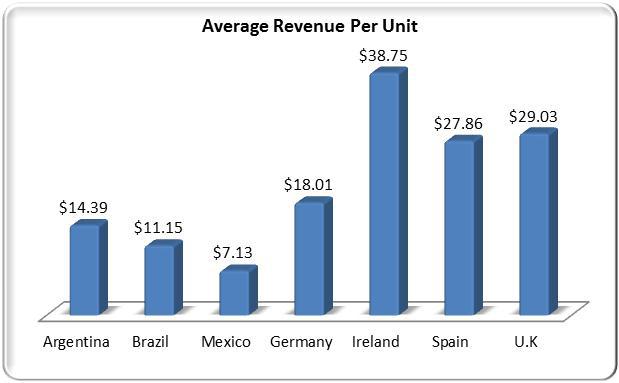
Source data: Telefonica January to June 2012 Results
Gary Kim was cited as a global "Power Mobile Influencer" by Forbes, ranked second in the world for coverage of the mobile business, and as a "top 10" telecom analyst. He is a member of Mensa, the international organization for people with IQs in the top two percent.
AT&T to Shut Down 2G network by 2017
In a Securities and Exchange Commission "10Q" filing, AT&T said that it will it will shutting down its second generation network so that it can concentrate on upgrading infrastructure to better technologies for the future.
The network shutdown will occur by January 1, 2017, and the spectrum used by 2G services will be reallocated for 3G and 4G use. Currently, about 12 percent of its customers under contract are still using handsets that do not support 3G.
The network shutdown will occur by January 1, 2017, and the spectrum used by 2G services will be reallocated for 3G and 4G use. Currently, about 12 percent of its customers under contract are still using handsets that do not support 3G.
Gary Kim was cited as a global "Power Mobile Influencer" by Forbes, ranked second in the world for coverage of the mobile business, and as a "top 10" telecom analyst. He is a member of Mensa, the international organization for people with IQs in the top two percent.
Subscribe to:
Posts (Atom)
-
We have all repeatedly seen comparisons of equity value of hyperscale app providers compared to the value of connectivity providers, which s...
-
It really is surprising how often a Pareto distribution--the “80/20 rule--appears in business life, or in life, generally. Basically, the...
-
Financial analysts typically express concern when any firm’s customer base is too concentrated. Consider that, In 2024, CoreWeave’s top two ...