Thursday, November 8, 2012

Post PC is Based on Mobile, Untethered, Cloud

You safely can assume we are entering a new era of computing when people do not even agree on a "name" for that era. We have passed through eras dominated by particular types of devices, such as mainframes, minicomputers and personal computers.

We now live in a world lead by use of smart phones, tablets and other devices such as MP3 players and game consoles. People seem to agree the coming or emerging era will feature cloud computing rather than locally-based, shrink-wrapped applications, untethered and nomadic or mobile devices.

People seem to agree that the "purpose" of computing appliances has changed. We use some devices mostly for "work," such as a desktop PC at the office. But most of the other devices, though sometimes also used for work, have a broader range of  use cases.
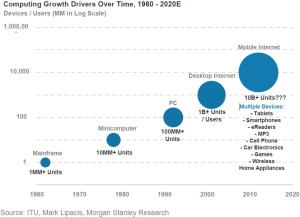
 Devices / Users (MM in Log Scale)

Smart phones routinely are used for work and play. Tablets are used in the same way, but lean towards consumption of content, not its creation. MP3 and game consoles obviously are used mostly for entertainment and play. 

Computers started out in glass rooms, moved to desktops, and now to pockets and purses. They are embedded in vehicles, industrial and commercial systems of all types. 

But it remains difficult to separate out cloud computing from mobile, untethered and other forms of ubiquitous computing as the "defining" characteristic of the new era. 


"Post-PC" Affects Device Usage, Design, Sales, Activities, Purpose and Places

PC shipments in Western Europe totaled 13.6 million units in the third quarter of 2012, a 15.4 percent decline compared with the same period in 2011, according to Gartner.

"We've witnessed a decline across all PC segments this quarter in Western Europe," said Meike Escherich, principal analyst at Gartner. In the third quarter of 2012, mobile PC shipments declined 15.2 percent while desktop PC shipments decreased 15.7 percent. The professional and consumer PC markets declined 15.8 percent and 15 percent, respectively.

In the third quarter of 2012, the U.K. consumer PC market declined eight percent, while the professional PC market declined six percent. The mobile PC market declined three percent. The biggest problem was the desktop PC market, which fell 13 percent.


In the third quarter of 2012, the French consumer market decreased nearly eight percent due to low back-to-school sales. The French professional market declined 7.4 percent in the third quarter 2012. 


PC shipments in Germany dropped 19 percent compared with the same period in 2011. 

Germany mobile PC shipments declined 14 percent in the third quarter of 2012, while desktop volumes decreased 13 percent year over year. Consumer dropped 20 percent and professional PC demand declined 18 percent. 

So what does it all mean? Computing is shifting from stationary to ubiquitous. Instead of "sitting at a desk," starting and finishing a task, users increasingly start on one device and then finish on other devices, at other times, Forrester Research says. 
Ubiquitous computing also incorporates more "context," supplied by accelerometers, gyroscopes and geolocators. 
"Post PC" computing also often is more casual. Compared to use of a PC at work, post PC consumption is interstitial: people use computing appliances for short periods of time, in between something else they are doing. 
Use of computing appliances also is more often used on the couch and in bed, rather than at a desk or table. And physical interaction is physical (touch and swipe) rather than abstracted through the use of a keyboard and mouse. 
The biggest evolution is from computing as "work" to computing as entertainment or play. 


Wednesday, November 7, 2012

Vodafone Spain Learns Important Lesson About Mobile Device Subsidies

Mobile service providers have good reasons for disliking subsidized smart phones, since the practice puts a real drag on operating results. 

For AT&T, the financial impact of iPhone subsidies is clear. AT&T profit margins had grown for five straight years beginning in 2005, but reversed in 2010, apparently related directly to iPhone 4 demand and subsidies, BTIG argues.

BTIG estimates that the iPhone subsidies reduced AT&T margins by at least 10 percent in 2011, for example. To be sure, there also are churn reduction effects, as customers sign two-year contracts to earn the subsidies. But the subsidy costs outweigh the value of the churn benefits. 

Vodafone Spain and Telefonica tested the theory that consumers would respond favorably to unsubsidized device prices by ending all device subsidies early in 2012. Both carriers might now agree that device subsidies are required.
Vodafone's Spanish division is bringing back subsidized smart phones, apparently on a "permanent" basis, after losing more than half a million customers in the second quarter of 2012 while competitors Orange and Yoigo gained market share. 

A temporary restoration of subsidies was announced by Vodafone in August 2012. 

Vodafone Spain  and rival Telefonica used Spain as a testing ground for getting rid of the costly subsidies for new customers and ended the policy in April and March respectively.

But both companies lost out to rivals Orange and Yoigo, with Vodafone losing 639,000 customers in the second-quarter, while Telefonica lost 830,000 customers between April and August of 2012. 

Meanwhile Orange gained 80,240 customers and Yoigo 58,069 in the second quarter and other operators gained 238,578 customers between them.

Can LTE Replace Fixed Wireless?

AT&T says it will invest $14 billion over three years in new broadband facilities, including $8 billion for mobile and $6 billion for fixed network initiatives. The program would bring "fiber to the node" services to 75 percent of AT&T customer locations. 

Perhaps significantly, AT&T says the investments will provide Long Term Evolution high speed access to 99 percent of AT&T's customer locations. 

In other words, one might argue that nearly a quarter of AT&T customers might find that faster broadband access is made possible by LTE mobile networks. 

Some now argue that LTE can replace T1 service. Others argue that cable modem service can cannibalize both T1 and DS3 or other high-capacity access services. That might be more true for business customers than consumers, given the higher price-per-bit of LTE access, compared to either telco DSL, fiber to the node, fiber to the home or cable modem high speed access. 


In some ways, that is a simple continuation of global trends we have seen since the mid-1990s, when mobile began to represent a greater share of industry revenue. 

In 2016, IDATE predicts that the number of LTE subscribers will exceed 900 million, compared to nearly 230 million for fixed ultrafast-broadband using fiber to the home, fiber to the building or high speed digital subscriber line (VDSL).


One Way of Looking at "Small Cells"

Even a casual conversation about the definition of a "small cell" will quickly lead to a series of necessary qualifications and a "fuzzy" answer. Pressed for a concise answer, many observers might point out that a "small cell" approach meaningfully could include every radio installation
smaller than a traditional cellular macrocell.


And that's quite a lot of terrain. It includes "carrier" cell sites of 2-kilometer radius, "pico" cells of  perhaps 200 meters, but also customer-owned "femto" cells that cover indoor areas of perhaps 50 meters, and use the customer's own "backhaul" or "access," not a carrier-supplied link. 

Those are some reasons why the "heterogeneous network" terminology now has become commonplace.  Future mobile networks will use a variety of cell types, with different capital investment parameters and coverage areas.

Future networks also might make much more direct use of both carrier-supplied and customer-supplied backhaul. A carrier public Wi-Fi hotspot might use a carrier-supplied access connection, while, on an informal basis, most smart phone customers use their own fixed network connections, with their devices connected to in-home or in-building Wi-Fi, in place of any of the mobile cell site types. 

Without making too much of the development, "heterogeneous" implies a mix of carrier and consumer-supplied radio and backhaul network resources; a range of management options and quality of service mechanisms. 

One might also say that heterogenous networks and customer offloading to Wi-Fi also represent an unparalleled and new form of asset sharing. Whether by formal contract or simply informal mechanisms, customers are using a mix of carrier and "owned" access to support their "untethered" access requirements. 

While some entrepreneurs continue to work at creating whole networks using end user supplied access and radio assets, the heterogeneous network does the same thing, essentially. In a broad sense, users and their devices are supported by a mix of carrier-owned and customer-owned networks, both "mobile" and "fixed," using mobile air interfaces and simple Wi-Fi. 

The point is that "small cells" are more than a technology. They are part of a shift to more use of "shared" networks in a real sense. 

Smart Phones Now Lead Public Wi-Fi Hotspot Activity

Smart phones now are the devices most often used at Wi-Fi hotspots, a study of Wi-Fi usage now finds. Respondents said 40 percent of Wi-Fi hotspot connections were used by smart phones, while 39 percent were notebook PCs. Tablets represent 17 percent of connections. 

As you would guess, Wi-Fi is said to be playing an increasingly important role as a feature of a mobile or fixed network high speed Internet access service. That, in fact, is why cable operators and telcos have moved to offer public hotspot networks in their service territories, for example. 

Smartphones overtake laptops as the most popular way to connect to Wi-Fi Hotspots

Smartphones overtake laptops

Telefonica to Compete with Amazon for Cloud Computing Infrastructure

"Instant Servers" is a cloud-based infrastructure as a service offering that Telefonica hopes will allow it to offer a big branded alternative to other services such as Amazon's Elastic Compute Cloud that offer virtual server services.

That a big global telco thinks cloud computing is a business opportunity is not new. But the move might also illustrate one other aspect of competing with Amazon. A big company, with a "trusted" brand might be helpful, and sometimes essential, for any would-be competitor to firms such as Amazon. 

Some familiar with customer opinion surveys might counter that people do not "like" their telco suppliers so well. That is true. But the issue is "trust," not "likability." The point is that potential customers might trust a telco to engineer and operate a reliable, available service, even if those suppliers are not particularly well liked. 

Instant Servers promises 99.996 percent availability with a service guarantee that pays customers when those service level agreements are violated. 

Telefonica  also says its clouds can quadruple in capacity instantly, and without rebooting.

Tuesday, November 6, 2012

Will Mobile UC Mostly be a "Consumer Tools" Development

Mobile unified communications is in the early stages of mainstream adoption, so it is tough to predict how it will develop. But there is at least some thinking that consumer tools, not enterprise solutions will be a big factor.

In fact, some question the findings, arguing that survey findings might be overstating the use of "enterprise" unified communications systems and tools.

The native capabilities on virtually any smartphone can provide click-to-call, click-to-join a meeting, access to multiple communications modes (text, email, voice, or video), and a number of other features that either by themselves or through the use of a network-based service like Skype could be called "UC." 

The longer term issue is whether consumer tools might wind up representing a huge part of business mobile UC adoption. 


1000-Fold Improvement in Mobile Bandwidth Requires Multiple Changes

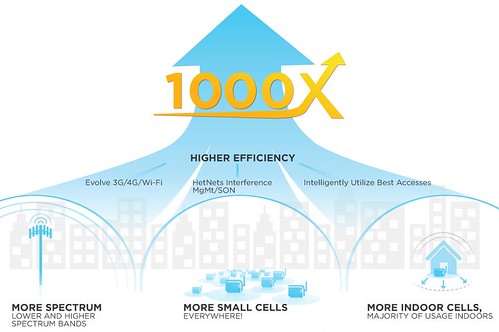
Though some might question the assumptions, many in the mobile industry would argue that a 1,000-fold increase in mobile bandwidth is going to be needed, over time, and some think that will be necessary as early as 2020.

That assumption tends to rely on typical mobile consumers downloading a gigabyte every day. You can make your own assumptions about whether that is a reasonable assumption. 

No single technique is likely to provide an improvement of three orders of magnitude in mobile bandwidth, though. So most think several different approaches will be needed, in tandem. 

One promising example is the “Neighborhood Small cells” model — a network of extremely low-cost, plug-and-play, open, indoor small cells, Qualcomm argues.

What makes the approach unusual is that the subscriber hosting the cell supplies the backhaul, which also bleeds out into the neighborhood to reinforce mobile coverage for other neighbors.

Studies show potential capacity increases of up to 500 times with a mere nine percent penetration of households and up to 1,000 times with 20 percent penetration, when combined with 10 times more spectrum.

Qualcomm is among firms that see three basic ways to get to a 1,000-fold increase
 in effective bandwidth. Virtually all the ways to get to 1,000 involve more spectrum, more small cells and use of offload strategies or better coding techniques.

Mobile broadband trends and data usage


Is 1-Gbps a "Hail Mary Pass"for Burlington Telecom?

Financially troubled Burlington Telecom, a municipally-owned communications provider, has decided to sell 1-Gbps Internet access services. 

The symmetrical 1-Gbps service will sell for $150 to $200 a month. The issue at this point is whether the new superfast access is capable of turning around revenue enough to stave off a financial collapse. 

A 2010 study concluded that “BT is not viable in relationship to its current debt load of $51 million and its ability to generate earnings to repay this debt."

"BT cannot meet its principal and interest obligations at this time,” the study concluded, noting that the company’s current business plan can’t meet future financial challenges either.

An agreement with pirmary lender Citibank in March 2012 stipulates that the first 60 percent of BT profits are to be paid to Citibank, which means taxpayers now are second in line to protect their investment. 

At current rates, it will take 96 years for BT to pay off the Citibank loan. 

Soon We'll Start Seeing 2013 Global Telecom Revenue Forecasts...

Though we should expect to continue to see higher growth rates in parts of the Asia-Pacific, Latin American and African regions, expectations might be more challenging elsewhere. 

Purchasing managers indexes (PMI)  gauge the activity of thousands of companies, and are considered a leading indicator of coming economic activity.

The latest eurozone PMI reading from survey compiler Markit indicates that the eurozone economy is shrinking at a quarterly rate of around 0.5 percent, according to the purchasing manager surveys. That should also translate into reduce or constricted communications and information technology spending by business customers, probably indicates lower spending by consumers, and therefore will lead to lower capital investment by service providers. 

U.S. enterprises also are cutting spending. And on top of all that are declining text messaging, voice and other legacy revenues. 

So if global industry revenue grows, it will likely be because of China, India, activity in other developing regions and results from operators in a few developed countries. You should expect trouble in European markets, for the most part. 

Fight or Flight is the Fundamental Service Provider Choice

Many global service providers now face a classic “fight or flight” choice. Faced with an immediate threat to life, humans experience physiological changes that prepare them to respond to an immediate stress by fighting or fleeing.

Some might argue that service providers now face similar choices. The “fight” response can be seen in service provider efforts to create their own over the top apps and otherwise invest in upgrading existing legacy services.

The “flight” response has more tactical expressions, but basically amounts to a “harvest and invest elsewhere” effort. The determination is that, fundamentally, no matter what a contestant does, the revenue stream cannot meaningfully be “saved.”

The fundamental assumption for the “fight” strategy is that a product category can be revitalized and sustained by investment. The fundamental assumption for the “flight” strategy is that the product category either cannot be revived, or that the financial returns will not match the returns from investing elsewhere.

That is the challenges posed by over the top messaging and voice apps, for example. As customers increasingly use services such as Skype, BlackBerry Messenger and WhatsApp, service providers must decide whether fight or flight is the proper response.

“Joyn” is an example of “fighting,” as it attempts to create a carrier-owned substitute for over the top mssaging services. But much service provider attention now seems to be in the “flight” direction.

New pricing plans instituted by Verizon Wireless as one example of flight. Share Everything essentially creates a flat-fee “use the network fee” that includes unlimited domestic calling and texting. That’s a defensive measure to keep some voice and messaging revenue while revenue growth occurs elsewhere.

But most flight strategies entail finding new sources of revenue. That is why Telefónica set up its "Digital" division in September 2011, to develop new products and services that create new customer value.

The flight response also is one reason tier-one service providers around the world are taking a look at growth opportunities such as advertising, banking and machine-to-machine initiatives. Some might include cloud computing businesses among the top possible new areas as well.

Capital investment also is another example the “fight or flight” choice. How much capital should be invested in fixed networks, if investment in mobile networks is a viable alternative? So far, most service providers with a real choice have favored mobile networks.

One Thing Everybody Can Agree On: UN Shouldn't Control the Internet

The International Telecommunication Union (ITU) plans to hold a treaty conference, the World Conference on International Telecommunications, in December 2012, which will revise a 1988 treaty. 

At stake are the ways communication network owners compensate each other for terminating international voice calls through the payment of settlements. But that is but one of many huge implications. Observers say the danger is direct controls on freedom of Internet expression.


The ITU is seeking to gain more control over Internet content. One reason is that countries such as Russia have called for restrictions over the internet where it is used to" interfere in the internal affairs of a state."

Opponents rightly say this represents a dramatic threat to the openness of the internet, where countries could regulate content not just within their own borders but globally.

But there are many practical business implications as well. The ITU proposes to change the way the Internet is governed, in ways that will harm the Internet by raising the cost and complexity of exchanging traffic, Analysys Mason researchers argue. 


In part, the ITU wants to create a new Internet traffic “settlements regime” modeled on voice precedents that will be difficult to administer and raise overhead costs.

But there could be other significant effects. First, operators might be induced to maintain their customers‘ websites abroad. One of the significant benefits of establishing an internet exchange point is to make it attractive for domestic websites to be hosted at home, in order to increase their performance and lower costs, Analysys Mason notes.

However, given that foreign websites will generate a source of incoming settlements revenue, the incentive to keep them abroad would increase.

At the same time, foreign operators, in order to compensate for the higher settlements costs, would likely raise the price of hosting websites serving countries with high settlement rates.

While this could be seen to increase the incentives to locate content in the target country in order to avoid settlements, that is often not efficient, particularly for small or undeveloped markets from which access to a regional server may be sufficient, Analysys Mason argues.

In addition, it is likely that infrastructure investment decisions would be affected, as providers would be reluctant to invest in providing infrastructure to a particular country to which it is expensive to deliver traffic. In other words, there will be financial reasons not to build more undersea links to certain countries, for example.

Also, huge volumes of Internet traffic could be artificially generated in order to arbitrage a rate-regulated model, to generate inbound payments, alter traffic balances, or otherwise unfairly leverage any accounting rate regime that may be applied to the Internet.

Entities that believe they would be net recipients of settlements, based on current projections of traffic flows, might find themselves net payers as a result of the manipulation of traffic flows by other players. In other words, the incentives for arbitrage will increase.

Consider the flows of traffic. The notion of settlements is that a carrier that terminates traffic incurs costs to deliver that traffic. So a sending carrier pays the terminating carrier. In many cases, the traffic flows should largely balance each other, so the net payments are relatively small in magnitude.

But there are scenarios where traffic is unbalanced, and that causes problems. In the voice settlement regime, carriers that accept more traffic than they send wind up paying money. Carriers that send more traffic than they receive make money.

Some of you will remember, or even be able to point to, instances where revenue arbitrage was possible precisely because of such asymmetrical traffic flows. Server farms and “free conference calling services” in the United States provide examples.

In the proposed ITU framework, it is server farm traffic that could be troubling for some carriers.

Multimedia content, for example, might represent as much as 98 percent of Internet traffic. Right now, where those servers are located does not have implications for inter-carrier settlements.

For cost reasons, many of those servers are located in Africa. In 1999, 70 percent of international Internet bandwidth originating in Africa went to the United States. In  2011, less than five percent goes to the United States.  

These days, content is stored at African server farms, for distribution largely to Africa, Analysys Mason notes. In some ways, that is helpful to African consumers, for quality and cost reasons. In other ways, high cross-border charges are unhelpful.

While it is true that IXPs are emerging to facilitate local exchange of traffic in Africa, the cost of cross-border connectivity between many African countries is still quite high, and this is hindering the emergence of regional IXPs to help exchange traffic and distribute content.

The bandwidth from Latin America presents the same broad picture. Between 1999 and 2011, the percentage of bandwidth going to the United States fell from just under 90 percent to 85 percent, replaced by more intra-regional traffic.

The main similarities between Africa and Latin America are that over 80 percent of their Internet bandwidth is connected to another region (Europe and the US respectively). At the same time, little bandwidth goes between countries within the region. Intra-Latin American traffic is 15 percent of total, while intra-African traffic is two percent.

In ways directly related to human freedom, the free flow of information and the cost of getting information anywhere on the planet, U.N. governance of the Internet would be harmful.

By 2016, 66% of Workers Will Use Smart Phones

“In 2016, two-thirds of the mobile workforce will own a smart phone, and 40 percent of the workforce will be mobile,” sayts Crolina Milanesi, Gartner VP.

Gartner estimates that in 2012 purchases of tablets by businesses will reach 13 million units and will more than triple by 2016, to reach 53 million units. 

Some 821 million smart devices (smart phones and tablets) will be purchased worldwide in 2012 and pass the billion mark in 2013, Gartner says. Smart devices will account for 70 percent of total devices sold in 2012.

“For most businesses smart phones and tablets will not entirely replace PCs, but the ubiquity of smart phones and the increasing popularity of tablets are changing the way businesses look at their device strategies and the way consumers embrace devices,” said Milanesi. 

Gartner estimates that 56 percent of smart phones purchased by businesses in North America and Europe will be Android devices in 2016, up from 34 percent in 2012 and virtually no penetration in 2010. 

Android Adoption Ramping Up 6X Faster Than iPhone, Mary Meeker Says

Meeker Android AdoptionAndroid phone adoption is growing six times faster than the Apple iPhone, says Kleiner Perkins Caufield & Byers Partner Mary Meeker

Android also surpassed Windows as the number-one operating system for Internet-enabled devices in the first quarter of 2012, Meeker says. 

Apple iPad adoption also is growing five times faster than the  iPhone did. In fact iPad adoption rates have accelerated. In May 2012, Meeker said the iPad ownership was growing three times faster than did the Apple iPhone. 

In fact, it appears that Android has been adopted faster than Google itself had expected. In this Asymco estimate, the blue line is Google's forecast, while the yellow line is actual adoption. 


Google cares about devices, operating systems, faster Internet access and browsers because alll of those are tools that get the Intenet in front of more people, who can see more ads. In fact, Google arguably is the first very-large software company in history to make a business model out of providing technology while earning its revenue indirectly, from advertising. 

In the past, Google has tweaked its mobile browser and tried to show website owners see the connection between their sites’ performance and sales. In fact, Google search ranking depends, in part, on loading speed. 

But the "need for speed" even has lead Google to invest some money in higher-speed access experiments designed to prod others to invest more, and invest faster. 

Faster mobile Web loads could increase mobile commerce sales in the United States by 10 percent, or about $600 million a year, said Forrester Research analyst Sucharita Mulpuru.

Almost half of mobile users are unlikely to return to a website at all if they had trouble accessing it from their phone, a 2011 study by Equation Research found.

On the Use and Misuse of Principles, Theorems and Concepts

When financial commentators compile lists of "potential black swans," they misunderstand the concept. As explained by Taleb Nasim ...