EE, the U.K. mobile service provider now offering Long Term Evolution services, has boosted 4G data allowances about 60 percent, while keeping prices the same.
The 2GB plan now becomes a 3GB allowance, with the 3GB plan increasing to 5GB, and the 5GB allowance now extending to 8GB. All existing 4GEE customers will be automatically upgraded to the new data allowances, with no increase in their monthly fee, the company says.
Wednesday, November 28, 2012
U,K. Mobile Operator EE Boosts Data Allowances 60%

 Gary Kim was cited as a global "Power Mobile Influencer" by Forbes, ranked second in the world for coverage of the mobile business, and as a "top 10" telecom analyst. He is a member of Mensa, the international organization for people with IQs in the top two percent.
iPhone 5 Tops U.S. Smart Phone Sales, Android Leads Elsewhere
 The latest smart phone sales data from Kantar Worldpanel ComTech shows that strong uptake of the iPhone 5 over the past 12 weeks ending in October 2012 has boosted iOS back to the number one spot in the U.S. market.
 Apple now has a 48.1 percent share of U.S. smartphone sales compared with Android which has 46.7 percent.
Android leads in other markets, though. In Europe, Android has the lead, accounting for 73.9 percent of sales in Germany and 81.7 percent in Spain.
The majority of US iPhone 5 sales, 62 percent, have come from existing Apple owners upgrading to the new device.
Gary Kim was cited as a global "Power Mobile Influencer" by Forbes, ranked second in the world for coverage of the mobile business, and as a "top 10" telecom analyst. He is a member of Mensa, the international organization for people with IQs in the top two percent.
Apple Maintains Lead in Tablets but Market Share Down 14% in 3Q 2012
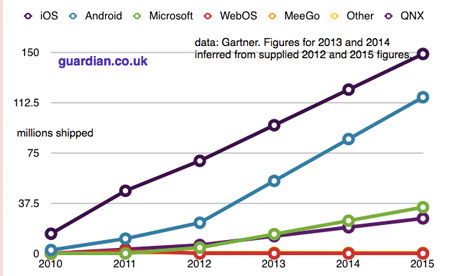 Apple had 55 percent share of the tablet market in the third quarter of 2012, says ABI Research. But competition from tablets powered by Google’s Android OS continue to eat away at Apple’s share.
 “With the introduction of a smaller, lower-cost iPad mini, Apple has acknowledged Android’s beachhead of 7-inch-class tablets,” says ABI Research senior practice director Jeff Orr.
If this continues, we will have the answer to the question of whether can create an MP-3 style market, where it completely dominates market share, or whether a pattern somewhat more akin to the smart phone or notebook markets will ultimately develop. So far, it appears Apple will not be able to sustain an MP-3 style lock on the market.
So the market perhaps already has changed. Where early on one might have argued there was an "iPad market" and then a "tablet market," it seems that a unified "tablet" market is developing. For some, the additional question is whether we might see replay, in the tablet space, of the older Microsoft-Apple story, with Android taking the place of Microsoft.
Gary Kim was cited as a global "Power Mobile Influencer" by Forbes, ranked second in the world for coverage of the mobile business, and as a "top 10" telecom analyst. He is a member of Mensa, the international organization for people with IQs in the top two percent.
More Carrier Over the Top Services Launching
 A few more European mobile service providers are jumping into the over the top voice and messaging app business. In Spain, Movistar, Orange and Vodafone, Spain's three leading mobile service providers, have launched "Rich Communication Services" using the "joyn" brand.
That makes Spain the first country in the world to offer a fully interoperable carrier-owned over the top voice and messaging app, meaning that any customers of any of the mobile service providers can communicate with each other.
In Germany, Deutsche Telekom and Vodafone both support joyn.
The idea is that joyn will allow mobile service provides to create a very large community of users, with access to "rich" voice and messaging ("rich" generally implies support for video) features. So both "scale" and "feature richness" are viewed as part of the strategy.
There are about three or four different ways mobile service providers globally can react. About half the options are hostile or unfriendly to the consumer. Carriers can block use of over the top apps, or charge extra fees for people who use the generally free apps. Neither of those approaches are especially desirable in competitive markets where another provider will avoid blocking or charging.
There are two approaches that are less surly ways of approaching the problem. Joyn is one way of competing with a carrier-owned alternative intended from the start to be a "third party" brand.
In other cases, carriers have created their own branded OTT apps. The level of competition in a given market tends to suggest whether mobile service providers should offer their own OTT apps, or avoid doing so.
In markets where voice and messaging revenue already is sharply declining, competing might be the only choice. In other markets, where there is less pressure, service providers generally will resist jumping into branded OTT voice and messaging apps, to avoid cannibalizing carrier voice and messaging.
In other cases, as with Verizon Wireless, carriers simply offer unlimited domestic calling and texting as a basic network access fee, to undercut the value proposition of the "free" OTT apps. That arguably works best where there is a very-large internal calling market.
But third party developers aren't stopping. A newer trend is use of the "WebRTC" platform to create rnd audio communications from inside the context of a browser. Vidtel, for example, now support the built-in ability to connect WebRTC-enabled browsers to enterprise video conferencing infrastructure.
Vidtel says it iis the first to bridge WebRTC browsers with 3rd party video conferencing infrastructure such as Cisco, Polycom, or Vidtel’s own MeetMe service without the need for plugins.
Gary Kim was cited as a global "Power Mobile Influencer" by Forbes, ranked second in the world for coverage of the mobile business, and as a "top 10" telecom analyst. He is a member of Mensa, the international organization for people with IQs in the top two percent.
Tuesday, November 27, 2012
European Broadband Access: DSL and Satellite Rule
Despite the seeming reality presented by media and analyst reports, change comes relatively slowly in the access business.
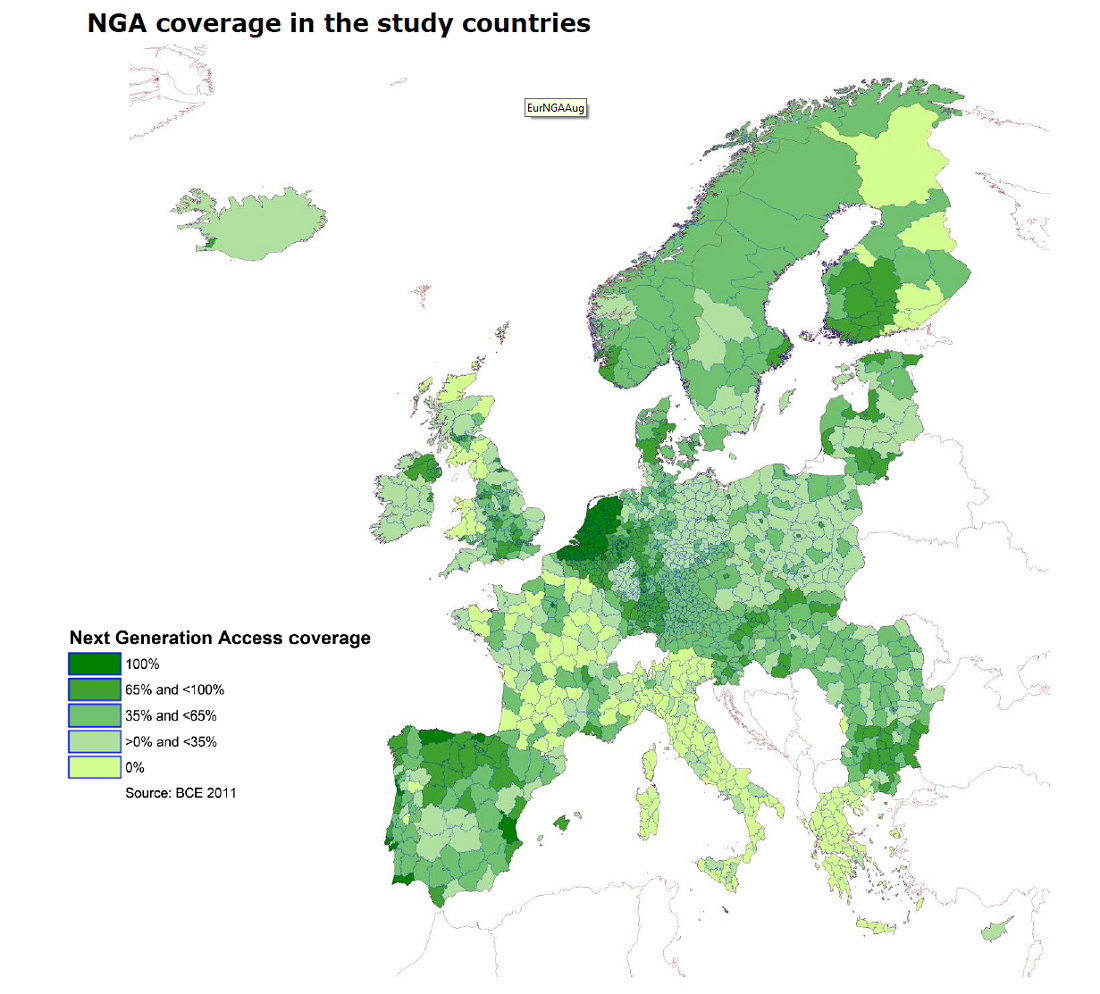
"Despite all the publicity, FTTP doesn’t offer the main route to digital heaven, at least not for the time being. So far FTTP covers only 12 percent of homes," says Tim Johnson, Point Topic chief analyst.
By way of contrast, cable operators can reach about 37 percent of homes with the Docsis 3.0 network, generally capable of providing faster speeds than digital subscriber line.
In rural areas, only DSL and satellite networks are ubiquitous.

Click image for larger version of infographic
"Despite all the publicity, FTTP doesn’t offer the main route to digital heaven, at least not for the time being. So far FTTP covers only 12 percent of homes," says Tim Johnson, Point Topic chief analyst.
By way of contrast, cable operators can reach about 37 percent of homes with the Docsis 3.0 network, generally capable of providing faster speeds than digital subscriber line.
In rural areas, only DSL and satellite networks are ubiquitous.
Click image for larger version of infographic
| Rural coverage by technology for each country in 2011 | |||||||||
|---|---|---|---|---|---|---|---|---|---|
| Countries | DSL | VDSL | FTTP | WiMAX | Standard cable | Docsis 3 cable | HSPA | LTE | Satellite |
| France | 96.3% | 0% | 0.3% | 0% | 39.9% | 28.2% | 87% | 0% | 100% |
| Germany | 51.4% | 0% | 0% | 11.5% | 2% | 2% | 30.7% | 41% | 100% |
| Spain | 90.1% | 12.6% | 0.4% | 7% | 0.4% | 0.4% | 88% | 0% | 100% |
| Sweden | 84.4% | 7.2% | 9.4% | 0.1% | 1.7% | 1% | 98.8% | 13.9% | 0% |
| United Kingdom | 100% | 17.4% | 0% | 0% | 2% | 2% | 88.5% | 0% | 100% |
Gary Kim was cited as a global "Power Mobile Influencer" by Forbes, ranked second in the world for coverage of the mobile business, and as a "top 10" telecom analyst. He is a member of Mensa, the international organization for people with IQs in the top two percent.
Monday, November 26, 2012
Globally, Satellite TV Subs will Surpass Cable TV Subs in 2016
 On a global basis, there will be more satellite subscription TV customers than cable TV customers by about 2016, Infonetics Research now predicts.
Gary Kim was cited as a global "Power Mobile Influencer" by Forbes, ranked second in the world for coverage of the mobile business, and as a "top 10" telecom analyst. He is a member of Mensa, the international organization for people with IQs in the top two percent.
On a global basis, there will be more satellite subscription TV customers than cable TV customers by about 2016, Infonetics Research now predicts.
Gary Kim was cited as a global "Power Mobile Influencer" by Forbes, ranked second in the world for coverage of the mobile business, and as a "top 10" telecom analyst. He is a member of Mensa, the international organization for people with IQs in the top two percent.
Half of all Mobiles Will Use 3G, 4G networks by 2017
About half of all mobile devices in use in 2017 will use either 3G or 4G networks according to Wireless Intelligence. About 40 percent of connections will use 3G. About half will use 2G. Fourth generation networks will support about 10 percent of connections.

Gary Kim was cited as a global "Power Mobile Influencer" by Forbes, ranked second in the world for coverage of the mobile business, and as a "top 10" telecom analyst. He is a member of Mensa, the international organization for people with IQs in the top two percent.
U.K. Mobile Operator Three Launches M2M Platform
 |
| m2m revenue forecast worldwide in billion EUR |
Ericsson is providing the platform, said to enable MVNOs launching M2M services to do so in just two weeks time.
Three partners get their own branded portal, the ability to activate and deactivate their own connections, apply data caps and track data usage.
Most researchers believe M2M will be a big market for mobile service providers.
Gary Kim was cited as a global "Power Mobile Influencer" by Forbes, ranked second in the world for coverage of the mobile business, and as a "top 10" telecom analyst. He is a member of Mensa, the international organization for people with IQs in the top two percent.
Mobile Service Provider Capex Will Shift to Small Cells by 2014
Joe Madden of Mobile Experts thinks the global mobile service provider industry is about to enter a period where capital investment shifts to smaller cells. To be sure, 2012 seemed to see a waning of capital investment, with 12 percent lower RF transceiver shipments than 2011.
Madden says that fits a pattern of investment in transmission facilities that has been typical of second generation and third generation networks.
He calls the pattern a "two hump camel.” The first hump reflects the initial build. About four years later, those initial systems are upgraded with additional radio capacity and additional towers, and the second "hump" begins.
Of course, many service providers globally are on the cusp of major investments for Long Term Evolution. But global economic uncertainty appears to be causing a delay in capital investment, either in the form of additional 3G base stations or new LTE base stations, Madden argues.

The next big upsurge in investment will occur about 2014 or 2015, when consumers start to complain about performance. At that point, mobile service providers will turn to small cells for their 3G and LTE networks. Madden predicts more than nine million carrier-grade capacity small cells will therefore be deployed during 2017.

Madden says that fits a pattern of investment in transmission facilities that has been typical of second generation and third generation networks.
He calls the pattern a "two hump camel.” The first hump reflects the initial build. About four years later, those initial systems are upgraded with additional radio capacity and additional towers, and the second "hump" begins.
Of course, many service providers globally are on the cusp of major investments for Long Term Evolution. But global economic uncertainty appears to be causing a delay in capital investment, either in the form of additional 3G base stations or new LTE base stations, Madden argues.
The next big upsurge in investment will occur about 2014 or 2015, when consumers start to complain about performance. At that point, mobile service providers will turn to small cells for their 3G and LTE networks. Madden predicts more than nine million carrier-grade capacity small cells will therefore be deployed during 2017.
Gary Kim was cited as a global "Power Mobile Influencer" by Forbes, ranked second in the world for coverage of the mobile business, and as a "top 10" telecom analyst. He is a member of Mensa, the international organization for people with IQs in the top two percent.
How Much Mobile Traffic Can be Offloaded to Wi-Fi?
How much smart phone traffic can be offloaded to Wi-Fi is uncertain, at this point, though it already is clear that perhaps a majority of at-home smart phone usage routinely is shifted to Wi-Fi access.
The bigger question is how much "out and about" usage might be shifted to Wi-Fi, particularly in urban areas. That might affect the deployment of small cells that also support Wi-Fi.
Softbank in Japan has tested the offload potential of dense Wi-Fi deployments and apparently has concluded that less than 25 percent of mobile data traffic can be offloaded to public Wi-Fi in the long term.
Those estimates correspond with figures Boingo suggests. Boingo believes about 22 percent of mobile traffic will be offloaded to Wi-Fi by about 2016.
Others might disagree. Cisco analysts say as much as 30 percent of mobile traffic could occur on Wi-Fi networks. And analysts at Juniper Research think more than 60 percent of mobile device traffic could be offloaded to Wi-Fi means by about 2015.
Others say studies show as much as 70 percent of smart phone traffic uses a Wi-Fi connection.


The bigger question is how much "out and about" usage might be shifted to Wi-Fi, particularly in urban areas. That might affect the deployment of small cells that also support Wi-Fi.
Softbank in Japan has tested the offload potential of dense Wi-Fi deployments and apparently has concluded that less than 25 percent of mobile data traffic can be offloaded to public Wi-Fi in the long term.
Those estimates correspond with figures Boingo suggests. Boingo believes about 22 percent of mobile traffic will be offloaded to Wi-Fi by about 2016.
Others might disagree. Cisco analysts say as much as 30 percent of mobile traffic could occur on Wi-Fi networks. And analysts at Juniper Research think more than 60 percent of mobile device traffic could be offloaded to Wi-Fi means by about 2015.
Others say studies show as much as 70 percent of smart phone traffic uses a Wi-Fi connection.
Gary Kim was cited as a global "Power Mobile Influencer" by Forbes, ranked second in the world for coverage of the mobile business, and as a "top 10" telecom analyst. He is a member of Mensa, the international organization for people with IQs in the top two percent.
Service Providers Don't Always Pick Technology Winners
For those who can remember widespread cable operator interest in "interactive TV," dating back to the 1980s, there is a lesson. Service providers are not always "right" about what consumers want, or how to supply the demand.
The early thinking was that people wanted, and would use, interactive features built around the video experience, using the TV, remote control and cable box as enablers.
As it turns out, people do "interact" or "augment" video programming, but in a way not foreseen: they use their PCs, tablets and smart phones to multitask. In other words, they "do other things" while watching TV.
But they do not really want to interact directly with video content. The lesson is that suppliers do not always understand what it is that people might want to do. So the instinctive response is to ask people what they want, what they might pay for experiences and how they want those experiences delivered.
But consumers nearly always have a tough time figuring out how they might use a product they never have seen. In such cases, asking doesn't help. Steve Jobs, former CEO of Apple, perhaps was the foremost practitioner of a skeptical approach to asking people what they want.

The early thinking was that people wanted, and would use, interactive features built around the video experience, using the TV, remote control and cable box as enablers.
As it turns out, people do "interact" or "augment" video programming, but in a way not foreseen: they use their PCs, tablets and smart phones to multitask. In other words, they "do other things" while watching TV.
But they do not really want to interact directly with video content. The lesson is that suppliers do not always understand what it is that people might want to do. So the instinctive response is to ask people what they want, what they might pay for experiences and how they want those experiences delivered.
But consumers nearly always have a tough time figuring out how they might use a product they never have seen. In such cases, asking doesn't help. Steve Jobs, former CEO of Apple, perhaps was the foremost practitioner of a skeptical approach to asking people what they want.
Gary Kim was cited as a global "Power Mobile Influencer" by Forbes, ranked second in the world for coverage of the mobile business, and as a "top 10" telecom analyst. He is a member of Mensa, the international organization for people with IQs in the top two percent.
Android, Apple iPhone: Key Mobile Shopping Differences
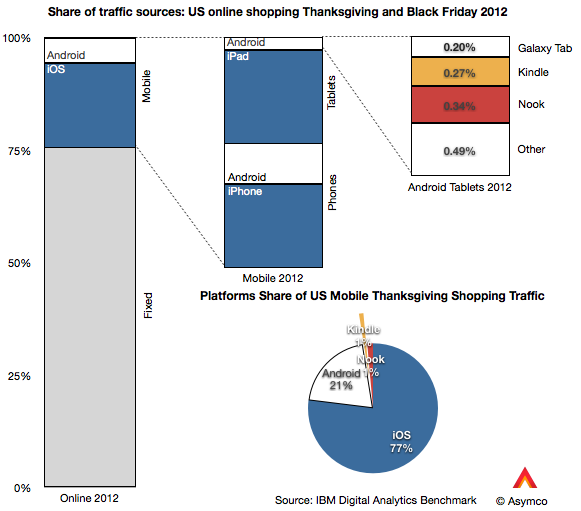
IBM’s Digital Analytics Benchmark reported U.S. Black Friday sales and the news is reasonably good. Overall online sales grew by 17.4 percent while mobile sales grew to make up 24 percent of traffic. That probably does not come as a surprise.
The study suggests 75 percent of the activity was from PCs. Of the mobile activity, a highly disproportionate share was conducted by owners of Apple iPhones. That is more notable.
Apple iPhone owners were nearly four times more likely to conduct transactions using their devices, compared to Android owners.
What nobody can tell, at this point, is whether those differences are due to some key difference in user interface, activity preferences or are more related to differences in end user personal wealth, or something else.

The study suggests 75 percent of the activity was from PCs. Of the mobile activity, a highly disproportionate share was conducted by owners of Apple iPhones. That is more notable.
Apple iPhone owners were nearly four times more likely to conduct transactions using their devices, compared to Android owners.
What nobody can tell, at this point, is whether those differences are due to some key difference in user interface, activity preferences or are more related to differences in end user personal wealth, or something else.
 Gary Kim was cited as a global "Power Mobile Influencer" by Forbes, ranked second in the world for coverage of the mobile business, and as a "top 10" telecom analyst. He is a member of Mensa, the international organization for people with IQs in the top two percent.
Google Rumor: 13-inch Chrome OS Touch Notebook?
 The launch of a rumored touch-enabled Chrome OS touch notebook might suggest Google is tiptoeing even further towards offering its own branded devices, as Microsoft has done with its branded "Surface" tablet.
 As always, the move would increase the odds of channel conflict for both Google and Microsoft.
Gary Kim was cited as a global "Power Mobile Influencer" by Forbes, ranked second in the world for coverage of the mobile business, and as a "top 10" telecom analyst. He is a member of Mensa, the international organization for people with IQs in the top two percent.
European Smart Phone Penetration Hits 54%
 Smart phone penetration in EU5 (France, Germany, Italy, Spain and UK) is now at 53.7 percent, with nearly 130 million people using smart phones in the three month average ending September 2012, according to comScore.
Out of this smart phone audience, 15.5 percent also own a tablet, compared to 9.3 percent last year.
Gary Kim was cited as a global "Power Mobile Influencer" by Forbes, ranked second in the world for coverage of the mobile business, and as a "top 10" telecom analyst. He is a member of Mensa, the international organization for people with IQs in the top two percent.
Deutsche Telekom Faces Same Challenge as Many U.S. Service Providers
Most telecom executives, especially those facing growing competition from cable operators, have had to ask hard questions about their options for upgrading access networks. The simple fact is that a full replacement of the network to fiber to the home technology is expensive.
Japan's Bank Nomura estimated the cost of a digital subscriber line upgrade, in areas where Deutsche Telekom needs more speed to counter cable operator high speed access offering, at around 4 billion euros ($5.1 billion), while a full upgrade to fiber to the home, across Germany, could cost around EUR80 billion, or perhaps $102 billion.
So Deutsche Telekom plans to selectively upgrade, using a faster form of digital subscriber line technology, in those areas where competition is most fierce. The vectoring approach provides a dramatic boost in speeds.
Some would argue that Deutsche Telekom should simply rebuild its network using fiber to the home, essentially creating a "future proof" network.
The problem, some would say, is that the financial return from doing so is questionable, at some level. Mobile substitution is one issue. The bigger problem is that the basic business case, overall, is much tougher.
A shift of end user spending to mobile services means less potential revenue from a mix of services, ranging from voice to high speed access to video. Also, incumbent market share is far lower than it once was. In many cases, established operators have 30 percent to 40 percent market share, where they once had virtually 100-percent share.
That means a complete upgrade is bound to "strand" a significant portion of those assets, which will not have revenue attached to the lines.


Japan's Bank Nomura estimated the cost of a digital subscriber line upgrade, in areas where Deutsche Telekom needs more speed to counter cable operator high speed access offering, at around 4 billion euros ($5.1 billion), while a full upgrade to fiber to the home, across Germany, could cost around EUR80 billion, or perhaps $102 billion.
So Deutsche Telekom plans to selectively upgrade, using a faster form of digital subscriber line technology, in those areas where competition is most fierce. The vectoring approach provides a dramatic boost in speeds.
Some would argue that Deutsche Telekom should simply rebuild its network using fiber to the home, essentially creating a "future proof" network.
The problem, some would say, is that the financial return from doing so is questionable, at some level. Mobile substitution is one issue. The bigger problem is that the basic business case, overall, is much tougher.
A shift of end user spending to mobile services means less potential revenue from a mix of services, ranging from voice to high speed access to video. Also, incumbent market share is far lower than it once was. In many cases, established operators have 30 percent to 40 percent market share, where they once had virtually 100-percent share.
That means a complete upgrade is bound to "strand" a significant portion of those assets, which will not have revenue attached to the lines.
 Gary Kim was cited as a global "Power Mobile Influencer" by Forbes, ranked second in the world for coverage of the mobile business, and as a "top 10" telecom analyst. He is a member of Mensa, the international organization for people with IQs in the top two percent.
Subscribe to:
Posts (Atom)
Dolly Parton
source: People Dolly Parton, a light gone out at 80. Dolly Rebecca Parton, the singer, songwriter, actress, entrepreneur and philanthro...

-
We have all repeatedly seen comparisons of equity value of hyperscale app providers compared to the value of connectivity providers, which s...
-
It really is surprising how often a Pareto distribution--the “80/20 rule--appears in business life, or in life, generally. Basically, the...
-
Financial analysts typically express concern when any firm’s customer base is too concentrated. Consider that, In 2024, CoreWeave’s top two ...

