Nobody argues that end user bandwidth demand will keep growing. The issues are "how much" and "how fast" the demand will grow.
For many, the issue therefore is how to achieve a three order of magnitude increase in delivered end use bandwidth, over a relatively short time frame. the problem is most acute for wireless service providers, of course.
Expand image to read by clicking lower right corner of document.
userbandwidth.
Friday, April 12, 2013
1000 Times More Bandwidth Needed?

 Gary Kim was cited as a global "Power Mobile Influencer" by Forbes, ranked second in the world for coverage of the mobile business, and as a "top 10" telecom analyst. He is a member of Mensa, the international organization for people with IQs in the top two percent.
“Transparency,” Not “Choice” or “Savings” is Value of “Non-Subsidized” Phones
O2 in the Unitted Kingdom has launched “O2 Refresh,” a new service plan that decouples a two-year service contract from the consumer purchase of a phone.
O2 Refresh therefore offers two separate plans, one for the phone and one for the airtime.
The issue really is “transparency,” not savings, as some have suggested would be the consumer value of moving to “unlocked phone” policies.
“By signing up to and paying separately for their phone and airtime, customers are given complete transparency, while paying the same overall as they would on a standard 24 month pay monthly tariff,” O2 says.
That’s the key. Some observers have argued that consumers should be able to buy fully unlocked phones and use them on any mobile network, or buy service without a contract.
With some technology constraints where both GSM and CDMA are used, ipeople generally can do that.
What O2’s new plan shows is that the “remedy” of separating device purchases from service plans doesn’t actually provide all that much consumer benefit. If consumers can afford full retail price for phones, they already are free to buy them. If they want service without contracts, they already can buy such service (prepaid, generally).
Under the O2 Refresh plan, users actually will not save money, and still will have a contract. The incremental advantage for O2 is that it can advertise lower monthly fees for service. The advantage for a consumer is the ability to upgrade a phone at any time.
“Increasingly our customers are telling us that they don’t want to be tied to the same phone for two years,” said Feilim Mackle, Telefónica UK sales and service director.
Customers will have a choice of three O2 Refresh Airtime Plans, which have been tailored to meet varying call, text and data requirements. For £12 a month, customers get 600 minutes, unlimited texts and 750MB of data; for £17, customers will have unlimited minutes, unlimited texts and 1GB of data and for £22 they receive unlimited minutes, unlimited texts and 2GB of data.
At launch, O2 Refresh will be available on a range of phones including the HTC One, Sony Xperia Z, Blackberry Z10, Samsung Galaxy S3 and Apple iPhone 5. Following the launch, O2 Refresh will be extended to include a wider range of phones, with a specific focus on high-end smartphones including the Samsung Galaxy S4.
In essence, that approach is what T-Mobile USA is doing with its “no-contract” approach to mobile service pricing. Consumers can buy a full-price retail phone or under an installment contract, with service then offered without a contract.
As you might guess, the actual out of pocket monthly payments for T-Mobile USA service might not change very much.
If one assumes most consumers still are going to opt for device installment plans rather than buying their devices outright, the savings are relatively slight, on a recurring basis, for purchases involving high-end devices.
T-Mobile USA has a $60-a-month 2.5 gigabyte data plan is more than $300 cheaper over two years than an AT&T plan that offers 3 gigabytes and 450 minutes of talk time with the same device. For a user who opts for the installment plan, that works out to about $12.50 a month lower bills than for the rival AT&T plan.
There is an argument that T-Mobile USA plans will save more, compared to service from Verizon Wireless. A user buying that same T-Mobile USA plan, and using the installment plan, would save perhaps $20.83 a month, over two years, compared to a single-user Verizon Wireless plan with 2 gigabytes of data (though the Verizon Wireless plan also would offer unlimited talking and text messaging).
Transparency is a good thing, of course. But the notion that phone unbundling and an end to contracts necessarily provides huge end user value is not so clear.
Gary Kim was cited as a global "Power Mobile Influencer" by Forbes, ranked second in the world for coverage of the mobile business, and as a "top 10" telecom analyst. He is a member of Mensa, the international organization for people with IQs in the top two percent.
Thursday, April 11, 2013
Largest 10 Telecom Service Providers: 90% Own Mobile Assets

Of the 10 largest telecom service providers in the world, only one does not have a facilities-based, owned-spectrum mobility business. On the other hand, one of the 10 is a “cable TV company.”
Both of those trends--mobility and cable TV--tell the story of how the global telecom business has changed over the past several decades.
Gary Kim was cited as a global "Power Mobile Influencer" by Forbes, ranked second in the world for coverage of the mobile business, and as a "top 10" telecom analyst. He is a member of Mensa, the international organization for people with IQs in the top two percent.
Can Distributors Force Video Channel Unbundling?
 Distributors might think channel unbundling is a good thing. But it doesn't matter. Programming networks think unbundling is a bad idea, and they control the programming people mostly want to watch. Distributors might think sports programming costs are exorbitant. Program networks do not.
 Some video distributors are willing to consider letting consumers buy channels one at a time. Few networks would do so voluntarily.
It isn't so clear how much leverage video distributors actually have, with one interesting exception, namely the efforts by Aereo and Aereokiller to disrupt the broadcast TV distribution system. What makes that a structurally different situation is that cable, satellite and telco providers, plus ISPs such as Google Fiber and others, must have direct contractual relationships with the programming networks.
Aereo and Aereokiller are trying to pioneer a way to deliver video without the need for a direct business relationship with the broadcaster. That's different, way different, in terms of the structure of the relationship.
In a sense, Aereo and Aerokiller operate much as any third party application on the Internet, with no direct business relationship with an access provider.
To be sure, there always is the theoretical possibility of government intervention to force unbundling, but that seems unlikely.
But Aereo and Aerokiller conceivably could provide a breakthrough of sorts. Assume for the moment that the concept survives legal challenge (whether or not either firm emerges in the end to take advantage of the opportunity).
Assume Aereo, Aerokiller or others can then amass a content offering including local TV channels, plus some other popular "cable channels," but without sports networks which drive much of the cost of traditional video subscription packages.
That could create a huge opportunity for lower-cost video services, and that in turn would increase pressure on programming networks to make some accommodations with distributors. Perhaps challenged by potential new lower-cost services, major programming networks would become more flexible about the ways they allow distributors to sell content, possibly including some forms of a la carte access.
Gary Kim was cited as a global "Power Mobile Influencer" by Forbes, ranked second in the world for coverage of the mobile business, and as a "top 10" telecom analyst. He is a member of Mensa, the international organization for people with IQs in the top two percent.
By 2023, 1/2 of all U.S. TV Viewing Will Use the Internet
By about 2023, half of all U.S. TV viewing will be of online video, Technology Futures predicts. In large part, that will be because virtually every household using the Internet will be watching Internet TV or Internet video.
By about 2020, half of all U.S. “television homes” will be “Internet TV homes” as well.
If you want to ask what households and users will be doing with all that bandwidth, the answer is “watching TV.” In fact, by about 2020, it is quite conceivable that 60 percent of all video being watched by an Internet-connected user will be viewed online. 
Gary Kim was cited as a global "Power Mobile Influencer" by Forbes, ranked second in the world for coverage of the mobile business, and as a "top 10" telecom analyst. He is a member of Mensa, the international organization for people with IQs in the top two percent.
Wednesday, April 10, 2013
At Least 1/2 of Typical U.S. Consumers Will be Using 100 Mbps by About 2020, Really
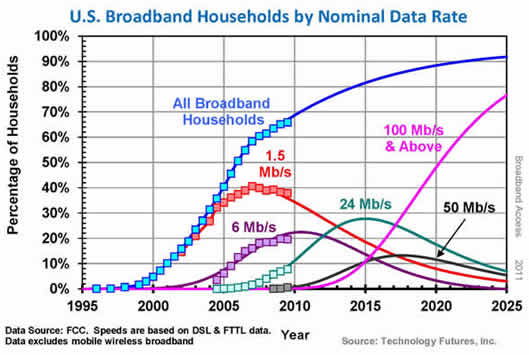 Wireless, either mobile or fixed, seems an inevitable solution for providing broadband access in rural areas, everywhere in the world.
Over time, the solution choices are likely to shift, if one assume gigabit access really is the future.
In the meantime, to about 2020 or 2025, the issue really will be getting to a fairly widespread 100 Mbps.
About 10 percent will be buying 50 Mbps connections.
Nearly 24 percent will still be buying 24 Mbps service.
That might seem a crazy amount of bandwidth for “many typical users,” but standard technology forecasting techniques have, for more than a decade, actually suggested that would happen.
In 2001, for example, Technology Futures predicted that by year-end 2004, over 25 percent of U.S. households will have adopted broadband services, up from about five percent at the end of 2000. The actual U.S. broadband penetration rate was 30 percent, according to the Pew Internet and American Life Project.
“By 2010, we expect that the percentage will exceed 60 percent,” Technology Futures predicted in 2001. The actual penetration wound up being 66 percent.
 “Our forecasts indicate that 1.5 Mbps will meet the typical user's expectations until about 2005, that 6 Mbps will do so until about 2010, then 24 Mbps until 2015, and finally 100 Mbps thereafter,” Technology Futures said in 2001.
There is at this point little reason to doubt that the forecast will continue to be substantially correct. Keep in mind that the 100 Mbps forecast by 2020 represents the “typical user’s” access speed, not the top “headline speed.”
 Gary Kim was cited as a global "Power Mobile Influencer" by Forbes, ranked second in the world for coverage of the mobile business, and as a "top 10" telecom analyst. He is a member of Mensa, the international organization for people with IQs in the top two percent.
PC Shipments Post the Steepest Decline Ever
PC shipments dropped the most in history (or at least since 1994, when IDC began tracking PC shipments) in the first quarter of 2013, according to IDC. That will surprise virtually nobody, given the clear shift of consumer demand to tablets.
Worldwide PC shipments totaled 76.3 million units in the first quarter of 2013, down 14 percent compared to the same quarter in 2012 and worse than the forecast decline of 7.7 percent, according to IDC.
Worldwide PC shipments totaled 76.3 million units in the first quarter of 2013, down 14 percent compared to the same quarter in 2012 and worse than the forecast decline of 7.7 percent, according to IDC.
The results also marked the fourth consecutive quarter of year-over-year shipment declines.
"Fading Mini Notebook shipments have taken a big chunk out of the low-end market while tablets and smartphones continue to divert consumer spending," IDC says.
"At this point, unfortunately, it seems clear that the Windows 8 launch not only failed to provide a positive boost to the PC market, but appears to have slowed the market," said Bob O'Donnell, IDC Program Vice President, Clients and Displays.
Gary Kim was cited as a global "Power Mobile Influencer" by Forbes, ranked second in the world for coverage of the mobile business, and as a "top 10" telecom analyst. He is a member of Mensa, the international organization for people with IQs in the top two percent.
What is "Most Important" in ISP Marketing?
Most ISPs--whether mobile, fixed or satellite--historically have highlighted speed and price. Whether those attributes are the best ways to compete, or the most relevant attributes of service, is some minor extent debatable. But that is how it often is assumed consumers are evaluating competing offers.
That might not be correct. In fact, one study of U.K. consumers suggests quality and reliability of a broadband connection (36 percent) is the most important factor when selecting a broadband service. That might surprise many observers.
Speed turns out to be the most-important factor for 21 percent of respondents. Price was paramount for just 15 percent of respondents.
A different set of drivers might drive churn, though. “Download speed” is the most important factor for those considering switching.
Some 33 percent of respondents rate “speed”as primary reason for wanting to switch providers. Fully 64 percent consider it a factor.
But price (47 percent) and service quality (43 percent) also were ranked as key drivers of a desire to change. About 18 percent each said price or service quality were the most-important reasons they were thinking about switching service providers.
So although customer-perceived “service quality” was the single most-important reason for choosing a provider, speed is the single most important element for driving a change of ISPs.
Subjective quality assessments therefore are among the top three reasons for choosing an ISP, or for changing an ISP. Other potential criteria seem seldom used. Few consumers probably buy based on “price per megabyte” or “price per megabit per second.”
It is a truism that products should not be sold on “price alone.” And yet that often happens in markets. Granted, a product must work. But there are many examples of firms leading with price.
Leading with quality is more difficult, as it is hard to quantify in a simple way, and rarely can be evaluated until a single consumer has tried several, or in some times all, the available providers.
Speed has the salient advantage of being quantifiable and easy to understand. Like price, it is quantifiable and easy to understand.
Still, as a practical matter, it is tough to know whether price, speed, reliability, usage caps or other factors are "most important" for an ISP's retail packaging, especially when high speed access is part of a bundle.
Nor is it so clear whether the same attributes are most important for an initial purchase or as drivers of dissatisfaction, leading to churn. In fact, almost by definition, an ISP might agree that price is most important for the "price conscious consumer." Those potential customers might be people who only use the Internet occasionally, and mostly for email, not just budget-minded consumers.
Other consumers--especially those who have used many ISPs in the past, or those experiencing lots of outages--might be especially attracted to a "quality of service" pitch, though it generally is difficult to quantify "quality."
In yet another segment are consumers who have become unhappy with some "speed related" element of their experience.
It is possible a new segment is the "heavy video user," who might need not so much speed, quality or even price but a large usage bucket.
The bottom line is that it isn't so drop dead obvious what the right positioning should be, for any ISP.
Gary Kim was cited as a global "Power Mobile Influencer" by Forbes, ranked second in the world for coverage of the mobile business, and as a "top 10" telecom analyst. He is a member of Mensa, the international organization for people with IQs in the top two percent.
By 2017, 66% of Verizon Wireless Traffic Will be Video
Video already accounts for 50 percent of Verizon Wireless'network traffic today and by 2017 video will represent about 66 percent of all Verizon Wirelessll traffic, saysVerizon Communications CEO Lowell McAdam.
Most ISP networks probably are in the same situation.


Most ISP networks probably are in the same situation.
Gary Kim was cited as a global "Power Mobile Influencer" by Forbes, ranked second in the world for coverage of the mobile business, and as a "top 10" telecom analyst. He is a member of Mensa, the international organization for people with IQs in the top two percent.
Service Providers Must Expect to Lose 50% of Legacy Revenue in 10 Years
One fundamental rule of thumb I use when looking at revenue sources in the global communications business is that service providers must plan for a loss of about half of current revenue every decade or so, as markets continue to evolve.
This graph illustrates the point. In 2001, about 65 percent of total consumer end user spending for all things related to communications and video services went to "voice." In 2011, voice represented only about 28 percent of total consumer end user spending. That is easily a reduction by half.
To be sure, this graph only shows relative spending, not absolute amounts. But you get the point.
Over that same period, mobile spending grew from about 25 percent to about 48 percent. Again, you see the pattern: growth of about 100 percent (losses of 50 percent require gains of 100 percent, to return to an original level, as equity traders will tell you).
Video entertainment spending likewise doubled.
In the U.S. market, one can note roughly the same pattern for long distance and mobile services revenue. Basically, mobile replaced long distance revenue over roughly a decade.
It is worth noting that voice revenue trends have been through two fundamental cycles, with a third on the way.
At one time, international long distance was the highest-margin product, followed by domestic long distance.
That changed fundamentally between 1997 and 2007.
Over that 10-year period, long distance, which represented nearly half of all revenue, was displaced by mobile voice services.
In the next displacement, broadband is going to displace voice.

This graph illustrates the point. In 2001, about 65 percent of total consumer end user spending for all things related to communications and video services went to "voice." In 2011, voice represented only about 28 percent of total consumer end user spending. That is easily a reduction by half.
To be sure, this graph only shows relative spending, not absolute amounts. But you get the point.
Over that same period, mobile spending grew from about 25 percent to about 48 percent. Again, you see the pattern: growth of about 100 percent (losses of 50 percent require gains of 100 percent, to return to an original level, as equity traders will tell you).
Video entertainment spending likewise doubled.
In the U.S. market, one can note roughly the same pattern for long distance and mobile services revenue. Basically, mobile replaced long distance revenue over roughly a decade.
It is worth noting that voice revenue trends have been through two fundamental cycles, with a third on the way.
At one time, international long distance was the highest-margin product, followed by domestic long distance.
That changed fundamentally between 1997 and 2007.
Over that 10-year period, long distance, which represented nearly half of all revenue, was displaced by mobile voice services.
In the next displacement, broadband is going to displace voice.
Gary Kim was cited as a global "Power Mobile Influencer" by Forbes, ranked second in the world for coverage of the mobile business, and as a "top 10" telecom analyst. He is a member of Mensa, the international organization for people with IQs in the top two percent.
Will Regulators Allow ISPs to Build Where There is Demand?
Should AT&T get municipal authority to build its proposed 1-Gbps access network in Austin, Texas, new issues will be raised. Some providers, such as Sonic.net, have been extending 1-Gbps service first to the places Sonic.net believes there will be the highest demand.
Sonic.net is "prioritizing our fiber build-out efforts on communities where we see very high uptake of our Fusion Broadband Phone service." Google has done the same in Kansas City, Mo. and Kansas City, Kan.
And now AT&T says it wants the same terms and conditions as Google Fiber got, before starting its own 1-Gbps upgrade in Austin.
That raises an issue. Traditionally, municipal franchise authorities have required universal coverage of all homes in a franchise area as a condition of getting a franchise. That can raise overall deployment costs high enough that many would-be providers are discouraged from trying to do so.
So the broader issue is whether regulators will relent, allowing suppliers to build where there is demand, rather than stipulating that facilities be built where there is little demand, or requiring suppliers to build low-demand areas roughly as fast as they build high-demand areas.
Other proponents of gigablit service, including Gig.U and Ignite, as well as the Federal Communications Commission, recognize that gigabit service has to occur first in selected parts of communities.
The issue is whether it is not realistic to recognize that similar priorities might be necessary if the fastest extension of gigabit service is desirable. The point is that gigabit networks are expensive. And it might be that the best way to encourage such upgrades is to foster "spot deployments" as widely as possible, without immediately worrying about "universal service."
That isn't the way regulated communications has been governed in the past. But new policies that do not require universal access might speed up investment. There are public policy issues, to be sure. But gigabit networks are a gamble.
Perhaps we should encourage providers to make the gamble by loosening requirements for universal service, in preference for "build everywhere you can make money, as fast as possible." Oddly enough, if prices do not fall until there is competition and scale, which will lead to applications innovation and then more scale, one has to "prime the pump."
Sonic.net is "prioritizing our fiber build-out efforts on communities where we see very high uptake of our Fusion Broadband Phone service." Google has done the same in Kansas City, Mo. and Kansas City, Kan.
And now AT&T says it wants the same terms and conditions as Google Fiber got, before starting its own 1-Gbps upgrade in Austin.
That raises an issue. Traditionally, municipal franchise authorities have required universal coverage of all homes in a franchise area as a condition of getting a franchise. That can raise overall deployment costs high enough that many would-be providers are discouraged from trying to do so.
So the broader issue is whether regulators will relent, allowing suppliers to build where there is demand, rather than stipulating that facilities be built where there is little demand, or requiring suppliers to build low-demand areas roughly as fast as they build high-demand areas.
Other proponents of gigablit service, including Gig.U and Ignite, as well as the Federal Communications Commission, recognize that gigabit service has to occur first in selected parts of communities.
The issue is whether it is not realistic to recognize that similar priorities might be necessary if the fastest extension of gigabit service is desirable. The point is that gigabit networks are expensive. And it might be that the best way to encourage such upgrades is to foster "spot deployments" as widely as possible, without immediately worrying about "universal service."
That isn't the way regulated communications has been governed in the past. But new policies that do not require universal access might speed up investment. There are public policy issues, to be sure. But gigabit networks are a gamble.
Perhaps we should encourage providers to make the gamble by loosening requirements for universal service, in preference for "build everywhere you can make money, as fast as possible." Oddly enough, if prices do not fall until there is competition and scale, which will lead to applications innovation and then more scale, one has to "prime the pump."
Gary Kim was cited as a global "Power Mobile Influencer" by Forbes, ranked second in the world for coverage of the mobile business, and as a "top 10" telecom analyst. He is a member of Mensa, the international organization for people with IQs in the top two percent.
What Google is Up to In Travel
It isn't unusual when a firm buys an asset that will help build an important new business. It is rare for a firm to buy a key asset and then sell it again, in less than 12 months. And that's what Google did with Frommer's Travel, part of a broader effort to build a mobile commerce revenue stream to augment its advertising revenue streams.
In saying it wants to turn intention into action, Google is providing more of its own content to Web surfers by adding information on hotels and restaurants around the world, a bid to attract users and advertisers from sites such as Yelp.
Travel is an important category for Google as it allows Google sites to become a destination. That's why Google bought Zagat and travel information provider ITA Software.
Google looks to become a one-stop-shop for not only product search but anything to do with the process of gathering information about travel and destinations. But
Google has other travel related interests, ranging from mobile payments to "local deals." In some ways, airline schedules are another form of "search." But Google would seem to have ambitions across a broader swath of the shopping process.


In saying it wants to turn intention into action, Google is providing more of its own content to Web surfers by adding information on hotels and restaurants around the world, a bid to attract users and advertisers from sites such as Yelp.
Travel is an important category for Google as it allows Google sites to become a destination. That's why Google bought Zagat and travel information provider ITA Software.
Google looks to become a one-stop-shop for not only product search but anything to do with the process of gathering information about travel and destinations. But
Google has other travel related interests, ranging from mobile payments to "local deals." In some ways, airline schedules are another form of "search." But Google would seem to have ambitions across a broader swath of the shopping process.
Gary Kim was cited as a global "Power Mobile Influencer" by Forbes, ranked second in the world for coverage of the mobile business, and as a "top 10" telecom analyst. He is a member of Mensa, the international organization for people with IQs in the top two percent.
The Reason Why Broadcasters Want to Kill Aereo
In 2012, local TV stations earned about 6.5 percent of total revenue from fees paid by cable TV, satellite TV and telco TV video service providers to carry the local TV signals on their video subscription services.
By 2017, that could grow to 9.5 percent of total revenue, according to BIA/Kelsey. Some might note that affiliate fees also are paid to the broadcasting network with which each local broadcaster has affiliated.
Such retransmission fees are the reason broadcasters are trying to kill Aereo and Aereokiller.

By 2017, that could grow to 9.5 percent of total revenue, according to BIA/Kelsey. Some might note that affiliate fees also are paid to the broadcasting network with which each local broadcaster has affiliated.
Such retransmission fees are the reason broadcasters are trying to kill Aereo and Aereokiller.
Gary Kim was cited as a global "Power Mobile Influencer" by Forbes, ranked second in the world for coverage of the mobile business, and as a "top 10" telecom analyst. He is a member of Mensa, the international organization for people with IQs in the top two percent.
10% of U.K. Mobile Users Routinely Use a Shopping App
More than half of European online adults owning two or more connected devices, Forrester Research now says. As you would guess, that has indirect and direct implications for mobile commerce and e-commerce and other parts of the Internet ecosystem.
The United Kingdom has the highest percentage of consumers going online regularly, the most online shopping and the most mobile Internet usage. Some 10 percent of U.K. consumers with a mobile phone have used a shopping app in the past month.
Germany has the largest online audience in Europe. Almost three in four German online adults have ordered products or services online in the past three months, spending an average of €225. But Germans do not use newer e-commerce modes such as social or mobile commerce.
Compared with Spain and the United Kingdom, French online consumers are less likely to own multiple connected devices; they are also, overall, the least likely across the five countries to own a laptop, tablet, smartphone, or netbook.
About 58 percent of Italian adults and 69 percent of Spanish adults go online monthly.. However, those who are online are very active social media users. In both countries, 66 percent of the online population has a Facebook account, and they are more likely to be active content creators.
Gary Kim was cited as a global "Power Mobile Influencer" by Forbes, ranked second in the world for coverage of the mobile business, and as a "top 10" telecom analyst. He is a member of Mensa, the international organization for people with IQs in the top two percent.
"Nobody Rides for Free: Issue in Mobile Payments and Telecom
MasterCard recently has instituted a new fee structure for “staged” digital wallet providers such as Google Wallet, PayPal and Square, In practical terms, it means the cost of doing business, for those digital wallets, is higher than it used to be, when using MasterCard bank-issued cards are invoked by wallet users.
The point is that although the mobile commerce ecosystem now is a battleground on many fronts, upstart disruption agents now have to confront incumbent resistance.
The process is reminiscent of what happened when U.S. local telecommunications stopped being a monopoly after 1996. There was an explosion of new competition. Regulatory rules favored the attackers, up to a point.
But incumbents counterattacked, with prices charged for use of their networks being one element of the resistance.
Chris A. McWilton, MasterCard’s U.S. Markets president, said PayPal “rides for free" on the back of other business models." Does that sound familiar?
Back in 2006, then AT&T CEO, Ed Whitacre complained that “some people” want AT&T to act as a “dumb pipe that just keeps getting bigger and bigger.”
“If you build it, you have to make a return on that,” Whitacre said. “Nobody gets a free ride , that’s all.”
It's the same language, and with similar justifications. Of course, there are differences. Business partners cannot use the MasterCard network or the public switched telephone network without paying the network owners. Both of those networks are "closed."
The actual problem AT&T was complaining about was use of the Internet access service. There's a key difference, or at least an important nuance. Use of the global voice network is a fee for service, as is use of MasterCard's clearing and settlements network.
Though users pay a fee to get access to the Internet from an ISP, they do not pay for use of the Internet.
Still, you get the point. Incumbents faced with disruptive challenges to their business model will eventually use all the powers of incumbency, when they can, to fight back. Veterans of the U.S. competitive local exchange carrier business will recall just how effective incumbents can be.
Despite the familiar refrain that "the present year" is the year of mobile wallet or mobile commerce or mobile payments disruption, we are a long ways from knowing how the full story will play out.
The point is that although the mobile commerce ecosystem now is a battleground on many fronts, upstart disruption agents now have to confront incumbent resistance.
The process is reminiscent of what happened when U.S. local telecommunications stopped being a monopoly after 1996. There was an explosion of new competition. Regulatory rules favored the attackers, up to a point.
But incumbents counterattacked, with prices charged for use of their networks being one element of the resistance.
Chris A. McWilton, MasterCard’s U.S. Markets president, said PayPal “rides for free" on the back of other business models." Does that sound familiar?
Back in 2006, then AT&T CEO, Ed Whitacre complained that “some people” want AT&T to act as a “dumb pipe that just keeps getting bigger and bigger.”
“If you build it, you have to make a return on that,” Whitacre said. “Nobody gets a free ride , that’s all.”
It's the same language, and with similar justifications. Of course, there are differences. Business partners cannot use the MasterCard network or the public switched telephone network without paying the network owners. Both of those networks are "closed."
The actual problem AT&T was complaining about was use of the Internet access service. There's a key difference, or at least an important nuance. Use of the global voice network is a fee for service, as is use of MasterCard's clearing and settlements network.
Though users pay a fee to get access to the Internet from an ISP, they do not pay for use of the Internet.
Still, you get the point. Incumbents faced with disruptive challenges to their business model will eventually use all the powers of incumbency, when they can, to fight back. Veterans of the U.S. competitive local exchange carrier business will recall just how effective incumbents can be.
Despite the familiar refrain that "the present year" is the year of mobile wallet or mobile commerce or mobile payments disruption, we are a long ways from knowing how the full story will play out.
Gary Kim was cited as a global "Power Mobile Influencer" by Forbes, ranked second in the world for coverage of the mobile business, and as a "top 10" telecom analyst. He is a member of Mensa, the international organization for people with IQs in the top two percent.
Subscribe to:
Posts (Atom)
-
We have all repeatedly seen comparisons of equity value of hyperscale app providers compared to the value of connectivity providers, which s...
-
It really is surprising how often a Pareto distribution--the “80/20 rule--appears in business life, or in life, generally. Basically, the...
-
Financial analysts typically express concern when any firm’s customer base is too concentrated. Consider that, In 2024, CoreWeave’s top two ...

