Monday, May 6, 2013

YouTube Set to Launch Paid Channels

YouTube is about to launch as many as 50 paid TV channels, the Financial Times reports. Viewers will be able to subscribe to each channel for as little as $1.99 a month.

The immediate financial impact probably will be relatively slight. The longer term implications could be rather large. And no matter what YouTube says, it might indeed be the "next generation of cable TV," though YouTube executives say it is not. 


YouTube is “not a replacement for something that we know. It’s a new thing that we have to think about, to program, to curate and build new platforms," said Eric Schmidt, Google chairman. Granted, YouTube tends to be shared and social, to a greater extent than traditional linear TV. 

But since linear TV is trying hard to become shared and social, it isn't so clear that the actual difference between a smaller TV network appearing on a cable, satellite or telco TV service, and a YouTube paid channel, is truly significant. 

Indeed, as the large video entertainment distributors try to rein in costs and supply lower-cost, more basic programming menus, many of the smaller networks could find they must consider YouTube, Netflix or some other distribution method to get their content to end users. 

In that sense, YouTube conceivably could emerge as a way for smaller networks to build an audience when carriage on the tier-one video services is not possible. The difference between a niche "cable channel" and a niche YouTube channel mostly is the willingness of the network to make YouTube a major distribution channel. 

Also, the "for fee" element creates a revenue model for any niche channel that resembles the affiliate fee payments networks normally are paid by cable, satellite and telco TV providers. 

What YouTube might become is not so clear. What is clear is that, as often is the case, is that a business model will emerge, as much as be built. 

Back in 2011, when YouTube agreed to invest about $100 million in original programming for new "channels," the thinking was that advertising ultimately would provide the revenue. One might argue that the new emphasis on paid channels suggests the ad revenue, though important, is not sufficient to support the sort of original programming that drives viewership. 


Are We are Past "Peak" Text Messaging?

Minutes and Messages as a Measure of Wireless UsageThough some might argue otherwise, most observers might agree that over the top messaging gradually is supplanting use of text messaging. 

According to data from CTIA: The Wireless Association, one might hypothesize that text messaging  volumes hit a peak in 2011, and now are gradually dropping.

In 2012, mobile users in the United States sent and received 2.19 trillion text messages. 

That was down about five percent from 2011 levels, according to the CTIA, and was the first negative showing ever. 

The drop in SMS probably means U.S. mobile users are sending roughly the same number of text messages, but using over the top apps such as WhatsApp and Skype even more. 

Since the number of subscribers has grown since 2008 by about 56 million, the flat level of voice usage suggests people are calling less on their mobiles, using the carrier voice service. 

One cannot tell from the CTIA data whether the total volume of "voice" is up, flat or down, after including over the top app usage or video sessions that replace voice calls. But other studies suggest that behavior has been drifting in the direction of more texting and less talking  since at least 2008. 


Tablet Sales Will Surpass PCs in 2013, Continue Taking More Share, NPD Predicts

There are lots of ways to look at predictions of future PC, tablet and smart phone sales, but among the more important implications will happen in emerging markets, where network access historically has been a problem matched only by inability to afford a computing appliance.

“Low-cost tablets are reaching further into emerging regions where notebook PC penetration rates have remained low, resulting in cannibalization by tablet PCs.”” said Richard Shim, senior analyst with NPD DisplaySearch. 

Irrespective of what that means for suppliers of device, tablets will overcome the "cost of a PC" problem. 

Global Mobile PC Shipments, 2012-2017

Saturday, May 4, 2013

Statistical Differences are Not Always Evidence of Market Failure

One has to be careful about interpreting Internet or broadband usage trends. Statistical “differences” are not always evidence of “market failure,” for example. Sometimes differences are the result of consumer choice.

Consider the choices people make about how they prefer to use the Internet. About 17 percent of mobile phone owners do most of their online browsing on their phone, rather than a computer or other device, the Pew Center Internet & American Life Project reports.

Young adults and non-whites are especially likely to use their mobile phones for the majority of their online activity, the researchers say. And that could affect demand for some products, such as fixed network broadband.

Nearly half of all 18 to 29 year olds (45 percent) who use the Internet on their mobile phones do most of their online browsing on their mobile device, the study found.

Half (51 percent) of African-American mobile Internet users do most of their online browsing on their phone, double the proportion for whites (24 percent). Two in five Latino cell internet users (42 percent) also fall into the “cell-mostly” category.

That isn’t to say user income is irrelevant. All other things being equal, higher-income households buy more fixed broadband than lower-income households.

Users with annual household income of less than $50,000 per year and those who have not graduated college are more likely than those with higher levels of income and education to use their phones for most of their online browsing, Pew researchers say.

The Pew data suggests mobile broadband has been particularly important to populations that in the past have “under-indexed” for use of fixed network broadband. The same argument can be made for Internet access in most emerging nations, where it is expected that mobile devices and networks will be the way most people get access to the Internet.

Aside from buyer preferences being at play, fixed network broadband purchases increasingly are not suitable measures of “broadband adoption.”

Cloud Computing, Mobility Will Change Distribution


Changes in computing architecture usually have implications for the communications business, and cloud computing should not prove to be different. In fact, says Carolyn April, CompTIA director of technology analysis, the impact on the business is illustrated by the fact that “mobility and cloud are almost the same.”


At a high level, mobile devices virtually require cloud services. Where “sideloading” is a reasonable operation on a PC, it is painful on a tablet or smart phone. The “best” way to deliver software to a tablet or smart phone is by the mobile network or some other untethered method.

That should reinforce the notion that communications service providers are right to see cloud computing as a natural opportunity.

But that also should raise a warning flag for distributors in the information technology business. The downside, says April, is that there is significant danger of disintermediation. In other words, when any app is just a download from an app store, and all data is stored and updated in the cloud, there is less need for third parties to load, configure and update those applications.

And even where cloud computing and mobile device use do not completely remove the need for information technology specialists, those trends will change revenue prospects, profit margins and sales effort and skills.

“After-sales work has been the difficult stuff,” says April. “Cloud and mobile simplify all that.”

Sooner or later, most channel partners will find they must spend more time and money on sales, even as the average value of a sale declines, says April. That trend also implies that more prospects will have to be cultivated, and more volume of sales made.

That might remind you of the basic task for sellers of long distance voice minutes. As prices have declined, service providers have had to boost sales volume to maintain the same level of revenues.

Channel partners might also find they need sales people with different skills (people used to selling recurring services) than the people who today are the mainstay of transactional sales (selling equipment and systems).

The same dynamics will hold for communications service providers entering the retail part of the cloud computing business. It will, over time, tend to be a volume business. On the other hand, communications service provider sales and marketing teams are quite used to that model.

Cloud computing and mobility, in other words, represents more than a technology change; it is a “delivery shift.” At least in principle, cloud computing and mobility could play to a communications service provider’s historic strengths.

"It Takes a Village" to Bring Internet Access to Everyone


Though it is not so popular in some quarters, many key communications supply problems, including availability of voice and data services of high quality to everyone, tend to be solved in ways that are not expected.

Younger observers might not know it, but global policy makers struggled for decades to figure out how to get plain old telephone service to billions of people who had never made a phone call. The same sorts of concerns have been raised more recently about access to the Internet.

In an astounding achievement, the global mobile industry managed to achieve, in about a decade, something nobody could figure out how to do, for much of the 20th century. In emerging markets, the inflection point was reached sometime early in the 2000s.

 source: unctad


As it turns out, wireless services are solving both voice and Internet access problems. In other words, the “divide” between people with phone service, like the “divide” between people with Internet access, is in the process of being solved by mobile services and device suppliers.

But it also is important to note that none of the progress would have been possible without regulators supporting liberalized licensing, support for market entry and spectrum allocation, while investors had to supply the capital.

That is a noteworthy achievement.

Phone Subsidies Have Upside, as Well as Downside, for Carriers and Device Suppliers


With T-Mobile USA and Verizon Wireless both promoting some form of installment plan purchases for devices, there is a move towards “transparency” in pricing, to a greater or lesser extent: greater in the case of T-Mobile USA, less in the case of Verizon Wireless.

In fact, the last time I looked, I did not find that monthly recurring service fees had been reduced by Verizon Wireless for customers who opt for the installment plans. Since the typical practice has been to recover the cost of device subsidies in the monthly recurring fees, one would expect a “transparent” model to feature lower recurring costs for customers who are not paying for a device subsidy.

That essentially boosts Verizon Wireless potential profit margins on service plans. One senses we are not yet done with the changes in device retailing. But as much as there are elements of device subsidies that service providers do not like (lower operating profit, for example), there also are advantages.

So much of the change will come as service providers and handset suppliers think about ways to retain the value of subsidy plans while minimizing the downside.


                                                                                                        source: Yankee Group and CNet

Auto Apps Might Blend M2M, Ad Revenue Models


Generally speaking, you can assume that Internet application providers are going to resist sharing their revenue with ISPs, even if ISPs want to create “two-sided” revenue models where some significant percentage of revenue is earned from business partners, not direct payments by end users.

But there are some scenarios where advertising, machine-to-machine apps and payments by app providers to ISPs will make sense. If you think about the way Amazon Kindle content is delivered by a mobile operator, with that usage paid for by Amazon, you get the idea.

How many more such logical examples of sponsored consumption might exist, is the issue. Automobile applications seem likely to emerge, sometime relatively soon, as a venue for such sponsored consumption.

What isn’t yet clear is which models will become most popular. Conceptually, one can imagine a Kindle content model where communications are “free to the end user” in the context of a transaction of some type. In other cases a service provider will bill the end user and the ISP will be paid by the service provider.

In other cases a specific merchant might subsidize communications cost in exchange for the right to deliver a message (the difference between “buying an ad” and “sharing revenue with an ISP” sometimes will be a fuzzy matter).

There are of course many consumer privacy and consent issues, but an automobile is among the best location-aware devices other than the mobile phone, if it is outfitted with Internet communications and GPS.

And some amount of transaction activity can be predicted, in some cases, as when a user programs driving directions from Washington, D.C. to New York, using I-95.

In the past, entrepreneurs have experimented, largely unsuccessfully, with subsidized communications that involve taking surveys or listening to ads in exchange for communications usage. Usage in exchange for referrals or sharing a connection are some of the other ways subsidies are possible.

As a rule, the cost of running such programs, compared with the perceived value to a sponsor or end user, are important. As always, the value of a particular completed action, at some volume, is weighed by the sponsor against the cost of campaigns to induce such actions.

Real Time Entertainment Nears 55% of Total Mobile Data Consumption


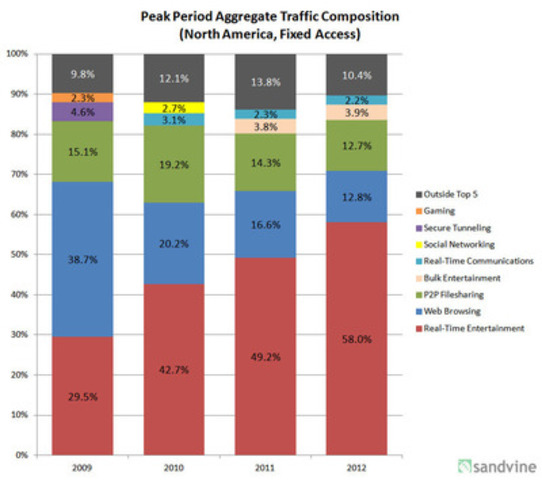
Between September 2011 and March 2012, real-time entertainment came to account for more than 50 percent of mobile traffic in the United States. 

And such traffic already represents more than 58 percent of total downstream traffic on fixed networks in North America, according to Sandvine.

And since large file downloads or peer-to-peer traffic sources are relatively rare apps for users on mobile networks, real-time entertainment video will be the dominant driver of bandwidth demand on mobile networks in the future as well.

But audio streaming also is becoming significant. Pandora, for example, accounted for about five percent of downstream mobile traffic in 2012.  

Real-time entertainment will cross the 60 percent threshold in late 2014 or early 2015 before leveling out at about 70 percent of total mobile traffic, Sandvine predicts.

So it would be reasonable to suggest that sometime in 2013, real-time entertainment traffic could grow to about 55 percent of total mobile data traffic.

With the exception of North America’s fixed access networks, where Netflix is dominant, YouTube is the largest single source of real-time entertainment traffic.

Mobile UseStill, the majority of mobile data in North America is streaming audio and video. YouTube accounts for 23.4 percent of daily traffic, while Pandora Radio represents 6.4 percent.

In North America, Netflix now represents 2.1 percent of mobile data.


Friday, May 3, 2013

Internet Access in Africa is Going to Grow Very Fast


In 2000, one might still have looked at tele-density figures for Africa and south Asia and still have concluded that not much was happening, in terms of adoption. 

But that changed, sometime around 2004, when a growth inflection point was reached, both in terms of income and use of mobile phones. 

 That change in growth means traditional barriers to Internet use, on the demand side, will fall rapidly over the next couple of decades. 

Though rural areas will progress at a slower rate than urban areas, change will be rapid, especially against the background of how much change happened over the last 100 years. 

Currently not even half of Africa’s countries are what the World Bank calls “middle income” (defined as at least $1,000 per person a year), by 2025 the bank expects most African countries to have reached that stage. 

That’s important. Statistics showing wide disparities in use of the Internet around the world are snapshots in time. 

What is equally important is the pace of change. One might have argued, based on statistics from 1990 or 2000, that many in developing regions, nothing much was happening. 

But an inflection point occurred, in India for example, around 2004. Much the same happened in Africa. 

Over the past ten years real income per person in Africa has increased by more than 30 percent. In the prior two decades real income per person shrank by nearly 10 percent. 

 Africa is the world’s fastest-growing continent now. 

Over the next decade its gross domestic product is expected to rise by an average of six percent a year. Foreign investment is helping. 

Africa has three mobile phones for every four people, the same as India. By 2017 nearly 30 percent of households are expected to have a television set, an almost 500-percent increase over ten years. 

In sub-Saharan Africa, secondary-school enrollment grew by 48 percent between 2000 and 2008. 

Over the past decade, malaria deaths in some of the worst-affected countries have declined by 30 percent and HIV infections by up to 74 percent. 

The point is that the Internet access gap is going to close, and relatively quickly, even in the regions and areas where the gaps are largest. The large mobile service providers likely will be providing most of the supply. But it is not unreasonable to predict that many independent ISPs also will emerge

Thursday, May 2, 2013

Time Warner Cable Now Finds Voice is a Legacy Product

Business customer services and high-speed Internet access drove growth at Time Warner Cable in the first quarter of 2013. But video and now voice have started shrinking. 

As telcos have faced for years, users are dropping VoIP lines as they have been dropping other fixed network voice connections, and shifting to use of mobiles instead. That doesn't mean every cable operator faces the problem to the same degree. 

But some cable operators no longer are taking voice share from telcos, because the big trend now is abandonment of fixed voice. 

What remains to be seen is how far service providers are willing to go in creating triple or quad play bundles that provide incentives for users to buy voice services even if they do not plan to use them. 

Residential high-speed data revenue growth was the result of an increase in average revenue per subscriber, primarily due to an increase in equipment rental charges and a greater percentage of subscribers purchasing higher-priced tiers of service, as well as growth in high-speed data subscribers. 

As has been the trend for some time, residential video revenue decreased, driven by declines in video subscribers and premium network and video-on-demand revenue, partially offset by price increases and a greater percentage of subscribers purchasing higher-priced tiers of service.

Time Warner Cable residential voice revenue decreased due to a decrease in average revenue per subscriber, the company says. 

Add Events to Google Calendar from Gmail

Gmail apparently is rolling out an update to Gmail that allows message recipients to create events directly from inside their Gmail messges. 

The update to Gmail is available to the first users May 2, 2013.  Dates and times within emails will appear as lightly underlined. When they are clicked a user's calendar (presumably the calendar associated with the same Gmail address, users will be able to preview their schedules and change the title, date or time of the event. 

Clicking “Add to Calendar” will do exactly that , the Official Gmail Blog says. The calendar event will include a link back to the original email. 

Those of you who have multiple Gmail accounts probably will find you cannot create an entry on the other account or accounts using the feature, though. I'd tell you, but I haven't gotten the update just yet. 

The other issue I am wondering about is the "different time zone" issue. I can't tell immediately whether it is possible to schedule an event, by time, using a discrete time zone other than the zone your PC is set to use. 

Still, I assume lots of us are used to manually setting different time zones. And of course, those of us using more than one Gmail account might prefer to be able to create events on both calendars, or all calendars. I'll have to wait to find out. 

Don't Wait for Federal Government to "Do Something" About Broadband, Gig.U Says

Blair Levin, executive director of the University Community Next Generation Innovation Project (Gig.U) believes the key to U.S, efforts to dramatically boost broadband speeds is not to rely on federal leadership but instead emphasize local leadership.

Working in partnership with companies willing to invest ahead of the current market is the way to make huge leaps, Levin argues. The point is that 
investment is needed. 

In many cases, the suggestion is that partnerships might try and leverage existing optical fiber networks already in place on the backbone level, in some form of public-private partnership, something that European broadband advocates also support. 

 That always is helpful, but broadband still hinges on access cost and clear-headed assessment of risk and reward


Do Spectrum Set-Asides Work?

Reserving spectrum for new competitors is a relatively common tactic regulators take when trying to encourage competition when new blocks of communications spectrum are to be licensed.

The U.S. Department of Justice has suggested Sprint and T-Mobile USA be allowed to acquire spectrum on a preferred basis, when auctions are held for upcoming blocks of spectrum at frequencies below 1 GHz, essentially.

Austria in 2013 will be holding an auction of 28 blocks of spectrum in the 800MHz, 900MHz and 1.8GHz bands, for launching Long Term Evolution networks.

Two of the 800-MHz blocks will be set aside for a new mobile firm not already in the market. The minimum reserve price for this spectrum will be €45.6 million.

Some think such spectrum set asides are not economically effective, essentially denying use of spectrum to the providers who can put resources to work most efficiently.

Nor is it clear that spectrum set asides actually wind up changing market structures long term. One might argue Illiad’s Free Mobile is shaking up France’s mobile market, but the full story is not to be told, yet.

One might argue the auction of personal communications service spectrum did enable firms such as Sprint to enter the U.S. market, and Sprint remains the number three provider, in terms of market share.

But it also is possible to argue that Sprint’s final story also is yet to be written. On the other hand, Sprint’s market entry was not enabled by a set aside, either. Typically, set asides do not allow a new contestant to amass enough total spectrum to really challenge market leaders.

The financial backers of a “set aside” firm do stand to profit.  But whether markets actually are changed, long term, when set-asides are used, is far from clear.

Belgian Content Companies Want 3.4% of ISP Revenue

Every new ecosystem of sufficient size, especially when that new ecosystem upsets legacy revenue models, faces challenge from legacy stakeholders. Telco executives complain about app providers "using our pipes for free." Physical retailers joust with Internet retailers. Google Drive competes with Microsoft Office. Newspapers want revenue sharing from Google. 

Now copyright owners in Belgium want Internet service providers to pay them 3.4 percent of access revenue. The thinking is that the Internet enables some amount of piracy, so copyright owners need to be compensated for such piracy by the ISPs that enable some users to steal content


The lawsuit has been brought by the Belgian Society of Authors, Composers, and Publishers, known as Sabam. 


It isn't the first, nor will it be the last effort to shift revenue flows within the Internet ecosystem. 


“Disruption” is a huge concept in the Internet and communications ecosystems precisely because, from time to time, a contestant tries to disrupt the structure of the business, and sometimes succeeds.

Nor, contrary to conventional wisdom, is it always young upstarts and start-ups that make the attempts. Apple was no small firm when it recreated the mobile phone business. Softbank was not an unknown little company when it reshaped the Japanese mobile service provider business.

Nor does disruption happen “overnight.” Huawei has disrupted the global telecom equipment business, but over a decade.

Fon has been trying, with some success of late, to create a new way for people and now even service providers to provide “access” to the Internet. Republic Wireless and FreedomPop are other entities attempting to disrupt the mobile or Internet access businesses.

For incumbents who are the target of the attempted disruptive attacks, the major issues include shrinking gross revenue, declining profit margins, fixed costs and the need to create new business models and revenue streams.

Mobile executives said they want “a more equitable share of the spoils” from mobile ecosystem value, says Emeka Obiodu, Ovum telco strategy analyst, Ovum. That isn’t a new refrain, nor unusual in a business where value and revenue are being created in new ways.

As usual, the separation of access and apps lies at the heart of the concern. The “problem” is that networks are seen as providing foundation for application businesses that service providers do not own or control. To put the matter in other terms, over the top app providers and businesses are viewed by telco executives as “riding the pipes for free.”

“This challenge needs to be overcome,” AT&T CEO Randall Stephenson noted.  Other executives tended to agree.

To be sure, precisely how modern networks can be built and upgraded is an issue.  There is universal agreement that most of the legacy revenue that historically has funded such networks is at risk of disappearing, in large part from competitive apps that displace communication services, or because consumers simply have changing preferences.

But some might note that a large part of the problem is simply that telco cost structures are out of line with current or future revenues. Other competitors offer similar services using networks and business models with different cost structures.

Clear AI Productivity? Remember History: It Will Take Time

History is quite useful for many things. For example, when some argue that AI adoption still lags , that observation, even when accurate, ig...