Tuesday, June 4, 2013

Smart Phones Will be Majority of Phones Sold in 2013, Globally

2013 will mark the first year that smart phone shipments surpass those of feature phones, with smart phones expected to account for 52.2 percent of all mobile phone shipments worldwide, IDC now predicts. 

Emerging markets will account for 65 percent of all smart phones shipped during 2013, up from 43 percent in 2010. 

Smart phone shipments are expected to grow 33 percent year over year in 2013 reaching 958.8 million units, up from 722.5 million units last year. 

As you might suspect, a growing volume of sales in emerging markets will mean lower average device selling prices. 

In fact, smart phone average selling prices (ASPs) have declined to $372 in 2013, down from $407 in 2012 and $443 in 2011. 

Smart phone ASPs are expected to drop as low as $309 by 2017 with emerging market demand the main catalyst for the change. Average smart phone selling prices are expected to decline by about nine percent in 2013, IDC predicts.

Mature Markets includes: USA, Canada, Western Europe, Japan, Australia, and New Zealand.

Europe is Falling Behind, GSM Association Argues

Drawing valid comparisons between countries, in terms of communications development, quality and pricing are difficult for any number of reasons. Some measures of “development” or usage are relevant on a household basis. But differing average housing densities materially affect per-capita metrics.

Average national revenue and cost of living indices likewise affect price levels. Average loop lengths and population densities affect the costs of deploying networks, both mobile or fixed.

Large continent-sized countries will tend to lag small, highly-dense countries and city-states on most measures of network performance or advanced network deployment, simply because of scale issues.

Regulatory and national investment priorities likewise will have a material effect on the quality and speed of advanced networks and services. Also, nations differ in ability to use infrastructure for maximum economic effect.

Even allowing for such important differences, relative rankings can change, and significantly, over time. Not so long ago, many critics pointed out that U.S. consumers lagged far behind Japan, South Korea and most Western European countries on any number of metrics, ranging from use of mobile services to use of mobile messaging to magnitude of Internet speeds.

Critics still point out that U.S. prices for any number of services are higher than elsewhere, or that average access speeds are lackluster. All that said, we should not be too alarmed that new studies suggest Europe is “falling behind” the United States in the use of mobile networks, especially the next generation of networks.

Over time, the differences will evaporate, just as differences have evened out in the past. And some differences principally are caused by prevailing levels of wages and prices in any particular country. In most countries, for example, when Internet access prices are three percent or less of typical household income, broadband adoption soars.

What matters is the retail price of broadband as a percentage of household income, not the absolute price.  

As recently as five years ago, the European mobile market was performing as well as, or even better than, the United States, any observer can conclude, looking at mobile service adoption or consumption of mobile services such as voice, texting or mobile Internet.

However, since then, the situation has dramatically reversed, a study sponsored by the GSM Association suggests.

The United States has opened up a “large lead in deployment of next-generation technologies,” the study suggests. By the end of 2013, nearly 20 percent of U.S. connections will be on Long Term Evolution  networks, compared to fewer than two per cent in the European Union, the study suggests.

U.S. mobile access speeds are now 75 percent faster than the EU average, and the gap is
expected to grow.

Also, the United States is deploying LTE at a much faster pace than the EU, the study argues. By the end of 2013, 19 percent of U.S. connections will be on LTE networks compared to less than two percent in the EU.

Some of us would say the problem will be rectified soon enough, and that the “gaps” will narrow to the point of meaninglessness, as similar gaps between Western European and U.S. markets were erased in the past.

Also, many studies are commissioned for some business or political purpose. The GSMA study is no different. It occurs in the context of a heated struggle to convince EU regulators to allow much more market consolidation, to allow faster innovation in next-generation networks.

That isn't to dispute the findings; simply to note the context.


Have Cloud Apps Started Disrupting the Computing Upgrade Cycle?

Gartner1Q13_IT_SpendingTechnology analyst Brian Proffitt suggests cloud apps now are disrupting the computing hardware upgrade cycle, which might explain the weakness of Windows 8 adoption. Simply put, and as has been the case for the last several Windows upgrade cycles, users are finding their apps work well enough that there is no need to upgrade hardware to run new software. 

That wouldn't be unusual, and represents a consumer trend that mirrors what should happen i the business networking space, others would suggest. 

Baird Equity Research Technology has argued that "cloud services will drive a shrinking IT spending pie," since companies will replace server and networking infrastructure with 
cloud services.

gartner ww it spend 2013-2014
That means spending will shift from owned hardware and software to services. 

"We estimate that for every dollar spent on [Amazon Web Services], there is at least $3 to $4 not spent on traditional IT, and this ratio will likely expand further," Baird analysts predict.


In part, that might explain any number of things, from shrinking PC sales to slower operating system upgrades. 

Cloud-based apps, in other words, have begun to affect the hardware upgrade cycle because cloud-based apps do not require hardware upgrades as much as locally-resident apps often do, are upgraded automatically in the cloud and rely as much as the Internet connection as processor speed and memory. 

Over the next three to five years, technology spending in both consumer and business markets will transition from PCs to mobile phones, from servers to storage, from licensed software to cloud, from fixed voice and data connections to mobile. 


EU Network Neutrality Rules Would be Less Restrictive than U.S. Rules

It appears that any European Union version of network neutrality would have some distinctive features, compared to the rules fixed network providers (cable and telco) must follow in the United States, if the framework now proposed by European Commission Digital Agenda Vice President Neelie Kroes is adopted.

Among the most-noticeable differences is that although fixed network ISPs can provide only “best effort” access, EU network neutrality rules would allow quality of service tiers. At the moment, mobile service providers can offer such features, while fixed network ISPs cannot.

“I you've just bought a videoconferencing system, you'll probably also want an internet service that guarantees the right quality, end-to-end,” said Kroes. “If someone wants to pay extra for that, no EU rules should stand in their way; it's not my job to ban people from buying those services, nor to prevent people providing them.”

In other ways, the EU rules would be similar, requiring plan transparency, for example. “Before you sign up to an internet contract, you want to know key details,” said Kroes.

But EU rules probably will regulate terms and conditions of service in a way U.S. rules do not. With an eye to allowing consumers more ability to switch ISPs, the EU will be looking at excessive charges, modem rentals or control of email addresses that tend to create barriers to switching behavior. In the U.S. market those might not be in the domain of network neutrality but more consumer protection.

As do U.S. rules, EU rules would prohibit the blocking or other degradation of lawful services such as voice over Internet Protocol (VoIP) or over the top messaging services.

Traffic management to avoid congestion will be allowed, as network management is permitted on U.S. networks, under network neutrality rules.

But there are key nuances. Under EU rules, it appears Kroes supports rules that would allow ISPs to separate time-critical traffic from the less urgent traffic. Under U.S. “best effort only” rules, that is not allowed.

The EU rules might also allow creation of access services customized for different types of lead applications, ranging from light email or Web surfing plans to video entertainment intensive plans. “Operators need to respect these different needs, and to do that they must also be allowed to innovate to meet those needs,” said Kroes.

On balance, the EU rules would be less restrictive of ISPs, allowing more use of quality of service and assured levels of service features, while also making clear that all lawful applications must be free of interference, compared to U.S. rules.

Monday, June 3, 2013

Justice Department tries to force Google to Hand Over User Data

U.S. citizens no longer trust their government, polls suggest. A recent national survey by the Pew Research Center for the People & the Press found that 53 percent of respondents think the federal government threatens their own personal rights and freedoms. 

Just 28 percent of respondents surveyed by the Pew Research Center rate the federal government in Washington favorably. That is down five points from a year ago and the lowest level of trust 
percentage ever in a Pew Research Center survey.

A new lawsuit illustrates why the lack of trust exists. The U.S. Justice Department lawsuit, filed April 22, 2013, attempts to force Google to comply with Federal Bureau of Investigation demands for confidential user data. 

The FBI uses so-called National Security Letters, a secret electronic data-gathering technique that does not need a judge's approval and recently was declared unconstitutional in an unrelated court case.

NSLs  supposed are used only in national security investigations, not routine criminal probes, and there's no upper limit on the amount of data a single NSL can demand. Also, any recipient of an NSL, which do not require warrants, also make criminal the act of revealing that an NSL was issued. 


50 Mbps Services Dropping to About $1 to $1.60 Per Mbps Per Month?

Cable ONE says it has eliminated fixed usage caps for its high speed Internet access plans, and instead suggests that its plans assume a 300 GB maximum on monthly usage on its 50 Mbps plans. The 50 Mbps plan sells for $50 a month (before the taxes and fees) when bundled with voice service. 

Cable ONE also is launching new 60 Mbps and 70 Mbps plans, though pricing was not immediately made public. 

One might conclude that the dropping of the usage cap and the expansion of speeds is, at least indirectly, a response to Google Fiber. In 2010, for example, 50 Mbps service in the U.S. market cost about $145 a month, or nearly $3 per Mbps of access speed. 

The latest Cable ONE offer pegs bandwidth at $1 for each Mbps of access speed, when access service is bundled with a voice plan. 

Verizon FiOS likewise now is available, on a promotional basis, for about $1.20 per Mbps of speed for about a year, on contract, with second-year prices of about $1.60 per Mbps of speed. 


Line's "Chat" Revenue Model: Stickers and Messaging to Followers

"Monetization" is a very big deal for most Internet app firms, and a reasonably big deal for any would-be Internet access provider, simply because any entity requires a sustainable revenue model of some sort to stay in business and create new features. 

Line, the Taiwan-based messaging provider, now appears to be generating revenue by selling businesses access to Line users. 

A company buying a Line corporate account can send buy plans allowing sending of 15 messages or 30 messages a month to its followers. For those who select a limit of 15 messages, the cost would range from NTD 150,000 ($5014) – for up to a maximum of 100,000 fans – to NTD 450,000 ($15,047) – for more than 600,000 fans. 

The developing adage that if a user is not paying for a service, then the user is the product, applies to Line and many other application providers. 

But Line might make more money selling sponsor "stickers." For example, a firm might pay NTD 1 million ($33,438) for the right to develop eight stickers available for download for one month and which users can use up to six months.


Line's "Chat" Revenue Model: Stickers and Messaging to Followers

"Monetization" is a very big deal for most Internet app firms, and a reasonably big deal for any would-be Internet access provider, simply because any entity requires a sustainable revenue model of some sort to stay in business and create new features. 

Line, the Taiwan-based messaging provider, now appears to be generating revenue by selling businesses access to Line users. 

A company buying a Line corporate account can send buy plans allowing sending of 15 messages or 30 messages a month to its followers. For those who select a limit of 15 messages, the cost would range from NTD 150,000 ($5014) – for up to a maximum of 100,000 fans – to NTD 450,000 ($15,047) – for more than 600,000 fans. 

The developing adage that if a user is not paying for a service, then the user is the product, applies to Line and many other application providers. 

But Line might make more money selling sponsor "stickers." For example, a firm might pay NTD 1 million ($33,438) for the right to develop eight stickers available for download for one month and which users can use up to six months.


How Tim Cook Sees Apple's Values

It is a given that Apple is different, post Steve Jobs. Equity prices aren't everything, but Apple's stock price suggests investors are uncertain about the company's prospects, with Tim Cook as CEO. The comparison is unfair, in many ways. 

Some of us would argue that although it largely is true "nobody is indispensable," it is not always true. Steve Jobs was an extremely unusual CEO. So would there be a regression to the mean, in terms of CEO "potential impact?" Almost certainly. 

The issue is how well Apple can manage its future without Steve Jobs. In that regard, Cook argues that Apple will in the future have to rely on many contributions, with teams--and teamwork--more important than in the past. 

That likely would be the only logical answer no matter who was running Apple. 

Mobile PCs are Driving Mobile Data Consumption

During 2013, overall mobile data traffic is expected to continue the trend of doubling each year, Ericsson predicts, driven in most regions except North America by mobile-connected PCs.

On average, a mobile PC generates approximately five times more traffic than a smart phone.

By the end of 2012, an average mobile PC generated approximately 2.5 GB per month, versus 450 MB per month produced by the average smartphone.

By the end of 2018, an average a mobile PC will generate around 11 GB per month and a smart phone around 2 GB.

Video traffic on mobile networks and is expected to grow by around 60 percent annually up until the end of 2018, by which point it is forecast to account for around half of total global traffic, according to the latest Ericsson estimates.


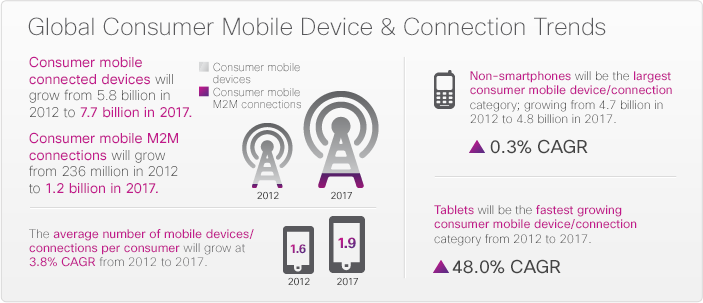
About 50 percent of all mobile phones sold in the first quarter of 2013 were smartphones, resulting in a doubling of mobile data traffic between 2012 and 2013,  also says.


EU Digital Commissioner wants 2014 Single Telecoms Market

Neelie Kroes, Europe’s digital commissioner, wants to unify the EU telecom market by the spring of 2014, including provisions that would end all roaming charges across national borders within the EU. But there are two distinct potential revenue implications.


Ending roaming charges will put pressure on mobile service provider top line revenue. But a single telecom market also should help clear the way for continent-wide consolidation of service providers, moves that should strengthen revenue and also allow operating cost economies.


The issue is whether a faster end to roaming charges is balanced with greater freedom to consolidate assets.


The European Commission has already restricted how much operators in Europe can charge for roaming, and the EC also has made clear its intention to seek further changes. In that sense, the end of roaming charges will be a negative for mobile service provider top line revenue.

Current and proposed retail price caps (excluding VAT)
 1st July 20121st July 20131st July 2014
Data (per MB)70 cents45 cents20 cents
Voice calls made (per minute)29 cents24 cents19 cents
Voice calls received (per minute)8 cents7 cents5 cents
SMS (per SMS)9 cents8 cents6 cents


As an example, the existing price caps, in place since July 2012, allow a maximum of
70 cents per Megabyte when using the Internet whilst travelling abroad.


In July 2009, use of a megabyte worth of data would have cost more than € 4. So the cost of roaming use of the Internet was cut about 600 percent or more, in some cases.


Charges will continue to fall down to 19 cents per minute for calls and 20 cents per MB for internet access by 2014.


Given the financial pain lower wholesale roaming rates have been causing for European service providers, and the certainty that revenue will continue to fall further, an end to all roaming charges might not seem a welcome change.


Vodafone, for example, says international roaming in Europe accounts for around three percent of group revenue. And you can assume profit margins are very high, as there is almost no cost to generate the roaming revenue.


Vodafone furthermore generates around 11 percent of group earnings before interest, taxes, depreciation and amortization from European roaming, according to Bernstein Research.


But there is another potential change if the EU really can move to a single telecom market framework, namely that cross-border operations, and presumably cross-border mergers and acquisitions, will allow carriers to gain the scale they believe they need to make investments and slice operating costs.


On the other hand, European service providers have broadly called for relaxation of antitrust rules, to allow for much more consolidation in the market.


With more than 1,200 fixed network operators and almost 100 mobile networks, most operating with less than optimal economies of scale, operators argue it is not possible to create viable long-term businesses unless cross-border acquisitions and mergers are permitted and even encouraged.


Part of the impetus for reform is a perceived need to create a more-encouraging climate for investment in next generation networks. That is more controversial than might first seem to be the case.


One of the problems with the wholesale framework used in Europe is that network owners do not have high incentives to upgrade their networks. At least, that is the underlying carrier argument.


Where service providers leasing wholesale capacity often have profit margins in the 20-percent range, few network operators who provide that access have profit margins much exceeding 10 percent, if they make money at all.


As was the case in the United States, European service providers have complained that mandatory wholesale provisions with high discounts for wholesale customers make high-risk investments in next generation networks unappetizing.
So the call for an expedited move to a single telecom market conceivably would allow service providers more freedom to acquire assets and create fewer, but larger, suppliers.


Somewhat ironically, restricting mobile service provider revenues (lowering and then ending roaming charges) to gain a consumer advantage also creates a greater need for service providers to consolidate, which might create more market power, which some would argue necessarily means consumers lose advantage.


But consolidation now seems inevitable, as the underlying economics of the fixed network business worsen, while the mobile business also faces more challenging economics. 

"Bulking up" to remove overhead costs and gain customer and revenue scale is a proven way for contestants to increase operating results and obtain growth in mature or declining markets.

Under those conditions, regulators have to pay as much attention to spurring investment as to ensuring robust competition.

Saturday, June 1, 2013

Dish Really Doesn't Want to Buy Sprint, Grubman Argues

Jack Grubman, the once-influential telecom equity analyst who now is banned from the business, remains an astute observer of the U.S. telecom business. Count Grubman among those who believes Dish Network really does not want to own Sprint or Clearwire. "[Ergen] wants to agitate … to get a network access deal from Sprint," the founder of consultancy firm Magee Group said. 

In effect, the Dish Network bids for Clearwire and Sprint really are bargaining chips intended to convince Sprint and Softbank to work with Dish Network as it creates a new national Long Term Evolution network.

Grubman does not seem to believe the Dish Network gamble will ultimately result in the upstart taking significant share from the market leaders, or even continuing to exist as a going concern. 

"For someone who made his name covering the 1990s explosion in the telecommunications sector, the "strategic logic" behind Dish Network's bid for Sprint Nextel brings back bad memories," Grubman said.  

"A newly formed, highly leveraged company promising to take market share from more established competitors with stronger, less leveraged balance sheets is a movie I have seen before. Trust me, it ends badly," Grubman said. 

Veterans of all the various disruptions within the U.S. telecommunications business might tend to agree that there is very little precedent, at least so far, for a true upstart to take market leadership, on a sustained basis, from the leaders. 

Equity value will not be created. But at least so far, no challenger has managed to upset the ranks of leading service providers. That is not to say it "cannot be done." It just hasn't happened   yet. 

Thursday, May 30, 2013

Global IP Traffic Will Grow 23% Annually to 2017

Global IP traffic has increased more than fourfold in the past five years, and will increase three fold over the next five years, according to the Cisco Visual Networking Index.  Growth would surprise absolutely nobody. But the relatively restrained rate of annual growth might.

Overall, IP traffic will grow at a compound annual growth rate (CAGR) of 23 percent from 2012 to 2017. Given rates of growth that had been higher in the past, that relative slowdown in growth rates is noteworthy.

Among other notable changes, metro traffic will surpass long-haul traffic in 2014, and will account for 58 percent of total IP traffic by 2017
Metro traffic will grow nearly twice as fast as long-haul traffic from 2012 to 2017 in large part because of the increasingly significant role of content delivery networks, which bypass long-haul links and deliver traffic to metro and regional backbones.
Content Delivery Networks (CDNs) also will carry 51 percent of all Internet traffic in 2017 globally, up from 34 percent in 2012. 
Also, nearly half of all IP traffic will originate with non-PC devices by 2017
In 2012, only 26 percent of consumer IP traffic originated with non-PC devices, but by 2017 the non-PC share of consumer IP traffic will grow to 49 percent. 
PC-originated traffic will grow at a CAGR of 14 percent, while TVs, tablets, mobile phones, and machine-to-machine (M2M) modules will have traffic growth rates of 24 percent, 104 percent, 79 percent, and 82 percent, respectively.
Traffic from wireless and mobile devices will exceed traffic from wired devices by 2016. By 2017, wired devices will account for 45 percent of IP traffic, while Wi-Fi and mobile devices will account for 55 percent of IP traffic. 

In 2012, wired devices accounted for the majority of IP traffic at 59 percent. 

Tablets Replace PCs in Dakar Cybercafe

go 730x276 Google replaces computers with tablets in a Senegal cybercaféThe Equinox cybercafe, located in Dakar’s Medina neighborhood, has replaced PCs with 15 tablets. Available at the same price as a regular cybercafe computer session at about $0.60 an hour, the move illustrates the potential role tablets will play in getting computing devices into the hands of users in many developing regions, according to the Google Europe Blog.

Aside from lower capital and probably operating costs for the cybercafe, use of tablets also consumes less electricity. Smart phones will play much the same role.

Now if we can just get the cost of infrastructure down, in a disruptive way. 


Will Mobile and Fixed Internet Access Business See Substitution?

In 2012, perhaps one percent of U.S. households stopped paying for home Internet subscriptions and relied on wireless access instead, according to Leichtman Research Group. 

That small amount of wireless substitution in the Internet access market will not bother providers of mobile broadband service. 


Video cord cutting, though more prevalent, still amounts to only about a few percent of households.

Zero TV households number about five million, or about three percent of U.S. households.

Arguably, most "mobile broadband substitution" takes the form of users dropping their fixed wireless subscriptions and relying on free Wi-Fi and their mobile broadband plans. 


Some lighter users, who mostly use social networking apps and sites, might find the approach works. People who don't mind moving to places where there is public Wi-Fi might add some amount of watching video. But multi-user households and frequent video watchers will find mobile broadband substitution a difficult proposition.

How do Computing Products Sold Close to Marginal Cost Recover Capital Investment?

Marginal cost pricing has been a common theme for many computing industry products. The concept is that retail pricing is set in relation t...