Friday, July 19, 2013

European Service Providers Continue to Face More Market Troubles than North American Providers

New financial results from service providers in North America and Europe continue to show the disparate fortunes of tier-one service providers in those regions.

Verizon Communications reported second-quarter 2013 results that stand in high contrast to results many Europe-based service providers are likely to post in 2013, across both Verizon’s fixed network and mobile lines of business.

Service revenues in the quarter totaled $17.1 billion, up 8.3 percent year over year. Retail service revenues grew 7.8 percent year over year, to $16.4 billion.

Verizon Wireless generated $20 billion in second-quarter revenues, up 7.5 percent year over year. Postpaid average revenue per account rose 6.4 percent to $152.50. Wireless operating margin came in at 32.4 percent, up from 30.8 percent for the same quarter of 2012.
In the wireline business, revenues increased 4.7 percent to $3.6 billion in the second quarter, with most of the growth coming from Verizon’s FiOS service. Verizon added 161,000 net new customers to its FiOS Internet service and 140,000 to its FiOS video service. FiOS Internet service is up 12.2 percent compared with the second quarter of 2012, and FiOS video service is up 12.6 percent.

Vodafonel Group service revenue including joint ventures declined 3.5 percent; or 1.3 percent excluding joint ventures. Though revenue grew strongly in Turkey at 15.5 percent and India at 13.8 percent, revenues in Germany declined 5.1 percent and 4.5 percent in the United Kingdom.

Revenue in Italy dropped 17.6 percent, while in Spain revenue dropped 10.6 percent.

Telefonica, Europe's biggest telecom operator (ranked by revenue), in May 2013 reported a 11.7 percent revenue drop to 6.7 billion euros ($8.8 billion) for its European operations in the first quarter, with total revenue down 9 percent at 14.1 billion.

Deutsche Telekom said revenue in Europe shrank 6.9 percent to 3.33 billion euros, while overall revenue fell 4.5 percent to 13.8 billion.

But there are perhaps signs that Verizon is being forced to spend a bit more to propel those earnings. Verizon operating expenses were up 1.4 percent year over year.

Sales, general and administrative expenses were up 2.2 percent in the quarter to more than $8 billion.

Verizon also is slightly increasing its capital spending guidance from $16.2 billion in 2013 to a new range of $16.4 billion to $16.6 billion, with the capital slated for deploying new wireless data and services spectrum in the second half of 2013.

Retail postpaid average revenue per account increased 6.4 percent over the second quarter 2012, to $152.50 per month.

The number of retail postpaid customers grew by 941,000 in the quarter, bringing Verizon’s total number of retail connections to 100.1 million, up 6.3% compared with the second quarter of 2012.

Mobile  operating income margin was 32.4 percent, compared with 30.8 percent in second quarter of 2012. EBITDA margin on service revenues was 49.8 percent.

Fixed network consumer revenues were $3.6 billion, an increase of 4.7 percent compared with second-quarter 2012. Consumer ARPU for wireline services increased to $109.67 in second-quarter 2013, up 9.4 percent compared with second-quarter 2012.

FiOS revenues grew 14.7 percent, to $2.7 billion in second-quarter 2013, compared with $2.4 billion in second-quarter 2012. ARPU for FiOS customers continued to be more than $150 in second-quarter 2013.

Sales of strategic services to global enterprise customers increased 4.8 percent compared with second-quarter 2012 and represented 57 percent of total enterprise revenues, compared with 52 percent in second-quarter 2012. Strategic services include cloud and data center services, security and IT solutions, advanced communications, strategic networking and telematics services.

Gigabit Speed Prompts Kansas City Library to Lend Productivity Apps

One of the claimed advantages for enabling faster Internet access is that doing so encourages developers to create new applications that take advantage of those higher bandwidths. One might point to the precedent of the World Wide Web, real-time applications of all sorts and video-heavy apps as examples of what happens when faster Internet access is available.


It appears one example is a new plan by the Kansas City Public Library to provide access to high-end productivity software such as Microsoft Office, Adobe Photoshop and Adobe Premier, to library patrons.


With the help of the Mozilla Ignite Challenge, intended to foster applications that take advantage of gigabit-per-second Internet speeds, the Kansas City Public Library is developing a high-speed Software Lending Library that will allow users to “check out” applications hosted by the library.


According to the proposal, the library can do so because of gigabit speeds provided by Google Fiber, which will enable library patrons to access brand-name business software from gigabit-wired locations even using low-performing or older computers and devices.

So far, that is one concrete example of a new app enabled by gigabit speeds. By extension, the same should be true of any other cloud-based service.

$157 Billion Telecom API Revenue Opportunity?

Telephony application program interfaces can generate as much as $157 billion in global revenues by 2018, growing at a CAGR of 38 percent between 2013 and 2018, according to Mind Commerce

The Asia Pacific, North America and Western Europe region will remain to be the largest market segments by the end of 2018, while the Latin America and Central America and Middle East and Africa regions will see the healthiest growth rates over the next five years.

The subscriber data management category will witness the fastest growth rate and will eventually account for $29 billion in global revenue by the end of 2018. 

The average volume of API transactions for a tier one wireless carrier will eventually reach 167 billion transactions a month on average.

Telecom APIs allow carriers to generate revenue by exposing network features to third-party service or application providers. 


Examples include network quality of service for video services, subscriber data management for advertising and profiling. 

Today nearly 24 percent of all Web and 15 percent of all mobile applications utilize APIs, the report suggests. This figure is expected to increase to over 80 percent by the end of 2018. 


Small Alberta Town to Get Gigabit Speeds

Residents of a 8,500-resident Canadian town north of Calgary will get gigabit service for the same price they now pay for 100 Mbps, as part of a network upgrade by the town's non-profit ISP. 

The non-profit Olds Institute for Community and Regional Development in Olds, Alberta, Canada will pay $57 a month for a gigabit connection if they also subscribe to television or phone services, or pay $90 a month a la carte, at least as part of a promotion the ISP is running. 

O-Net already provides 100 Mbps service in town, and O-Net also got a $6 million loan from the town of Olds to support construction of the network. 

Tablet Mobile Connections Grow 48%

Mobile service providers are having success convincing subscribers to buy access for their tablets, according to NPD Connected Intelligence. Mobile connections for tablets grew 48 percent in the first quarter of 2013 compared to the first quarter of 2012, and are used on 12 percent of U.S. tablets.


Tablet connections tend to use 850 MB of mobile data per month, compared to 1 GB on smart phones, according to NPD.


Tablet Wi-Fi data use averages around 10 GB of data per month, or more than 2.5 times the amount of Wi-Fi data being used on smart phones.


“The difference in consumption on the Wi-Fi side comes from much higher video consumption on tablets (4GB per tablet per month), which accounts for 40 percent of all tablet data traffic, compared to less than 10 percent of data consumption on smart phones.” said Eddie Hold, NPD Connected Intelligence VP.


The connected tablet market is currently dominated by and AT&T and Verizon Wireless, in large part because most consumers purchase the tablet connection from their smart phone service provider.


It is highly likely that AT&T and Verizon Wireless are benefiting from their shared data plans, which make it relatively easy to add another device to a data plan. About a third of Verizon Wireless customers now are on “Share Everything” plans that make adding a tablet relatively affordable, at about $10 per tablet per month.


Still, given the fact that most tablets get used inside the home, where Wi-Fi typically is available, demand for mobile broadband likely will remain fairly muted. “Most consumers haven’t found that key application convincing them to add a cellular connection,” says Eddie Hold, vice president, Connected Intelligence.


Source: The NPD Group/Connected Intelligence Mobile Data Consumption Report

To be sure, use of tablets when on the go and at work will increase as more people get them, and more discover they can dispense with use of a PC.


According to a Google survey from March 2011, people were generally using their tablets at home. 82 percent said they primarily used their tablet device at home, followed by 11 percent on the move, and seven percent at work.


A survey by Forrester Research in 2013 suggested that work-issued tablets get used 48 percent of the time at a desk during a typical work week, while 68 percent of the time in a work week,  tablets get used at home.


Bill Proposes Auctioning 1755 MHz to 1780 MHz Spectrum for Mobile Use

Legislation that would require the spectrum between 1755 MHz and 1780 MHz be reallocated and auctioned for commercial mobile broadband use has been introduced in the U.S. House of Representatives. The bill first was introduced in 2012.

The additional spectrum is intended to be paired with the 2155 MHz to 2180 MHz spectrum band and then auctioned.

The “Efficient Use of Government Spectrum Act of 2013” was introduced by Representatives Doris Matsui (D-CA), Brett Guthrie (R-KY), Duncan Hunter (R-CA) and Adam Smith (D-WA).

The National Telecommunications and Information Administration has concluded that 95 megahertz of spectrum, the 1755 MHz to 1850 MHz band can be repositioned for wireless broadband use.  

NTIA has proposed a combination of relocated federal users and spectrum shared between federal agencies and commercial users.  

Are "Data Only" Phones Inevitable?

For 43 percent of respondents to a U.K. survey, data allowances now have become more important than the number of minutes in a mobile service plan.

Those results are one more indication of a potential future trend, namely, service provider offering of data-only phones that do not include voice service, much as mobile broadband dongles allow only Internet access.

Randall Stephenson, AT&T CEO, has said he believes such plans are inevitable, and that such plans could be in the market by 2014 or so.

If that happens, some might speculate it would make more sense than it has in the past for third parties to become branded service providers, the better to integrate apps and device features with the access function itself.

Channel conflict is an issue, but across the Internet ecosystem we have seen that suppliers wind up competing with their customers in at least some ways.

Booksellers and content providers become device suppliers. Operating system suppliers become device suppliers. Device suppliers have become content service suppliers.

To be sure, it is a troublesome issue for any device or operating system supplier to ponder becoming a branded mobile access provider, creating unwanted channel conflict.

On the other hand, bundling data access with devices would provide some advantages for a device supplier, possibly including the ability to package the experience in different ways. It might also be possible to subsidize the cost of access in new ways, as by using advertising support.

Google in fact, already has become an ISP in several U.S. cities, and is experimenting with novel ways of providing Internet access. Google also has bid on 4G Long Term Evolution spectrum, owned part of Clearwire and has offered municipal broadband services as well.
Google’s “moon shot” testing of balloon based Internet access might be the best example of an attempt at widespread disruption of the traditional costs of providing Internet access at the low end, the bookend to Google Fiber, the effort to disrupt the market for high-end Internet access.

In fact, rumor has it that Google submitted a big to buy T-Mobile USA. With its advertising business model, Google might be ideally placed to test the value of an ad-defrayed, ad-supported or “subscriber” relationship with mobile users.

Data Allowance Now Top Priority for U.K. Mobile Users

For 43 percent of respondents to a U.K. survey, data allowances now have become more important than the number of minutes in a mobile service plan. For those respondents, the top priority for users, when choosing a service plan, is the amount of the data allowance (presumably assuming pricing is roughly comparable).


Still, for 41 percent of respondents, the size of the voice bucket still is the top criteria.


The importance of the data allowance arguably is a function of the importance of web-based apps and  Internet communications apps such as email. Some 73 percent of survey respondents reported that web access was essential.


Likewise, 71 percent indicated email access also was essential. As other surveys have shown, people are using voice less as they shift to Internet-supported messaging, text communication modes or simply spend more time engaging with web or native apps.


Some 26 percent of respondents consume less than 30 minutes of voice a month. Some
23 percent, however, spend more than five hours each month browsing the web on their
phones.


About nine percent of respondents say they make or receive five hours worth of calls a month.


Some 32 percent of respondents have allowances of less than 300 minutes per month
and just 11 percent buy service that includes unlimited minutes.


Some 25 percent of respondents estimate they use less than a fifth of their minutes each
month, while eight percent use more than 80 percent of their voice allowances.


About 29 percent of users report they consume their minutes allowance primarily for quick chats with friends and family of under five minutes each, while 12 percent say they only use the call function of their phone in emergencies.
.
Fully 75 percent of respondents report using text messaging and 41 percent say they use mobile email. About 13 percent use Apple’s FaceTime video messaging to communicate with family and friends.


Some 16 percent use Skype.


The research was carried out online via online with the uSwitch consumer opinion panel of 1,649 respondents in July 2013.


When respondents were asked “which of the following phone functions do you think you could live without?”, 5.2 percent said “calling function,” 7.8 percent said “texting function,” 26.8 percent said “web browsing” and  29.1 percent said “email.”


Some 33.5 percent said “apps” were indispensable. Some 20.7 percent said “camera,” 19.8 percent indicated the “clock/alarm” and 54.1 percent reported “music/radio.”

About 24.5 percent reported they needed all those functions.  

Thursday, July 18, 2013

Will Early Device Plans be Good for Service Providers?

T-Mobile's Jump plan, the Verizon Wireless "Edge" program and the AT&T "Next" plans for more frequent device upgrades might not be the best plans for most smart phone users, as attractive as they will be for people who really want to upgrade often, and really do not care so much about the cost of doing so.

One might ask whether the plans will be good for the service providers who offer the plans. 

At least in the case of AT&T and Verizon Wireless plans, where the traditional recurring cost is assumed by many observers to include both the cost of service and the recouping of handset subsidies, it so far does not seem to be the case that users who want to take advantage of the early device upgrade feature are compensated for separating their device plans from their service plans by lower service prices. 

In other words, buying a device on the installment plan, with the possibility of early upgrade, does not come with a reduced service plan cost.  That might strike you as unfair. 

It might also be argued that the early upgrade decision is a relatively costly proposition for users who take advantage of the feature, at least on Verizon and AT&T networks. 

It actually might not be "unfair" to consumers who want to take advantage of the early upgrade.

AT&T and Verizon Wireless might argue they still are subsidizing devices when a user pays half the retail price and then upgrades without paying the final half of the full device cost. 

If that is so, then maintaining the recurring service plans equivalent to "device plus service" plans makes sense, since service providers essentially recoup at least part of the potentially foregone device payments.

In other words, if the assumed device subsidy is $200, representing half the retail cost of $400, then when a consumer has paid off $200, returns the device and buys another, the carrier is left with $200 in phone subsidies to cover. 

The unchanged monthlhy recurring fees help the carrier recoup those lost device payments. 

So keeping the former "device plus service" price essentially compensates AT&T or Verizon Wireless for the lost subsidy recovery when a user upgrades after paying for half the full retail cost. 


Verizon Edge Device Upgrade Plan Coming Aug. 25, 2013

Verizon Edge, the new device upgrade plan, will be available Aug. 25, 2013. 

Verizon Edge essentially is an installment payment plan for devices, spreading a device purchase over 24 months. 

If a consumer wants to upgrade a device after six months, that is possible if 50 percent of the retail cost of the device has been paid. 

Verizon says there are no long-term service contracts, finance charges or upgrade fees with Verizon Edge. 

Every six months, as long as 50 percent of the cost of the phone has been paid, you can upgrade to the newest basic or smartphone available.

The Verizon plan is a reaction to T-Mobile USA's "Jump" program, which allows customers to trade in their existing phone as much as twice a year, with payment of a $10 a month fee. 

That innovation was intended to differentiate T-Mobile USA from the policies of the other three national carriers, which have restricted “new phone upgrades” to about once every 20 months or so.


But AT&T already has countered with its own similar "Next" program, and Verizon has responded as well.
“Sustainable competitive advantage” is a difficult challenge in competitive markets, and especially when the advantages are new retail packaging concepts. T-Mobile USA has gotten confirmation of that difficulty.


Firms can obtain a competitive advantage by “implementing value-creating strategies, not simultaneously being implemented by any current competitor,” strategists might say. But it often is too easy to claim such advantage.


Competitive advantage really only is possible when strategies provide value that is rare, valuable, and non-substitutable.


“Sustainable competitive advantage” is obtained when those advantages that are not easily copied by other contestants and can be maintained over a long period of time.


If a firm’s competitors can counter quickly, there is no sustainable advantage. In fact, one might argue whether there is much advantage.


In the mobile service provider business, one might ask whether there is any such thing as sustainable competitive advantage. From time to time, a firm can gain some ground. AT&T having a monopoly on the Apple iPhone provides a recent example.


Verizon Wireless building out its Long Term Evolution 4G network might provide another example of a tactical advantage.


But it is hard to point to sustainable sources of advantage in the mobile business, in the sense of “rare” and “non-substitutable.”


AT&T “Next,” to be available July 26, 2013, allows AT&T customers to buy their devices on installment plans that pay off the device cost in 20 months, as does the T-Mobile USA plan.


AT&T customers also can upgrade after a year by turning in their old phone and beginning payments on a new phone.


Using AT&T Next, a customer buying an Apple iPhone 5 with a retail price of $650 would make monthly payments of $32.50 a month. Under a traditional AT&T two-year contract plan, the same device would cost about $200 upfront.


The shift of all three carriers to new device payment plans will arguably be more transparent and will allow customers the freedom to upgrade devices on a more timely basis.


But the moves by Verizon Wireless and AT&T to match the new T-Mobile USA device programs also shows how hard it will be for T-Mobile USA to mount and sustain any marketing initiatives that truly distinguish T-Mobile USA from either AT&T and Verizon Wireless, when those carriers think the new initiatives, offers or retail packaging actually will resonate with customers.


Fiber to Home Reaches 15% of Broadband Lines in OECD Countries

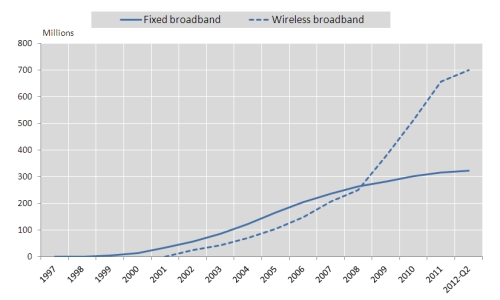
Fiber to home deployments have reached nearly 15 percent of fixed broadband connections at the end of December 2012, representing some 48.7 million connections, according to the Organization for Economic Cooperation and Development.


Fiber deployments  grew by 12.7 percent  in 2012, four times as much as fixed broadband at 3.27 percent, the study suggests.
Luxembourg (324 percent), Austria (194 percent), Turkey (170 percent) and Switzerland (150 percent) had the strongest annual growth in fiber connections, while seven countries had growth rates above 100 percent year over year and 11 countries had growth rates higher than 50 percent, according to the Organization for Economic Cooperation and Development.


Japan and Korea still are the countries with the highest broadband penetration, with over 60 percent of fixed broadband lines using fiber to home technology. In Estonia, Sweden and the Slovak Republic, fiber to the home now represents 30 percent of broadband access lines.
Switzerland (43 percent), Netherlands (40 percent) and Denmark (39 percent) top the OECD’s fixed broadband penetration rankings, in terms of adoption per 100 inhabitants.


The OECD’s average fixed broadband penetration is 26.3 lines per 100 inhabitants (327.2 million subscriptions).
Wireless broadband increased by 14 percent year over year and reached a penetration of 62.75 lines per 100 inhabitants, up from 58.6 lines per 100 people in June 2012.


The total number of wireless broadband subscriptions in the OECD area is just above 780 million.


Separately, the OECD says fixed networks have, in effect, become the backhaul for mobile and wireless devices with some studies claiming that 80 percent of data used on mobile devices is received using Wi‑Fi connections to fixed networks.


For that reason, communications policy makers and regulators need to ensure there is enough backhaul for for wireless networks, especially if there is insufficient fixed access network competition.

Wireless Backhaul a Major Policy Concern Across OECD

Policy makers and regulators need to ensure enough supply to maintain sufficient backhaul for wireless networks, especially if there is insufficient fixed access network competition, a new report by the Organization for Economic Cooperation and Development says.


The challenge for regulators is that, regardless of the technology used, many parts of the OECD look likely to face monopolies or duopolies for fixed networks. Wireless can provide competition, but spectrum availability will always impose limits that are not a constraint for fiber networks.


Fixed networks have, in effect, become the backhaul for mobile and wireless devices with some studies claiming that 80 percent of data used on mobile devices is received using Wi‑Fi connections to fixed networks.


Wireless and fixed broadband subscriptions in OECD countries

Policy makers and regulators have a vital role to play in ensuring sufficient competition, the study argues.  This includes making sure there is adequate available spectrum, abundant IP addresses or other numbering resources for new market entry, and fair competition between operators and over the top providers.


Ensuring markets remain open to OTT and facilities‑based providers is essential to innovation in broadband infrastructures, and critical to addressing major industry and broader economic and social challenges.

A growing number of industry leaders claim high prices for international mobile roaming are detrimental to their relationship with their customers, and a significant barrier to trade and travel in OECD economies. The OECD Recommendation of the Council on International Mobile Roaming Services (February 2012) recommends removing such barriers to lower-cost roaming.


Among other findings, the study points out that telephony costs have continued to fall, at least up to the 2012 period for which the OECD report reports results.


In 2011, mobile subscriptions represented 65.4 percent of paths, up from 64 percent in 2009, while use of  traditional fixed telephony subscriptions continued to decline.


The average subscription rate of mobile Internet access in OECD countries as a whole rose to 56.6 percent in June 2012, up from just 23.1 percent in 2009.


Prices for fixed telephony and, more markedly, for mobile voice services decreased from 2010 to 2012, showing significant declines across all consumption patterns, with the exception of fixed business services.


A laptop‑based wireless broadband usage bucket (offers within the 500 MB per month range) cost US$13.04 on average across the OECD in purchasing power parity terms, although it reached US$30 in some countries.


Average expenditure was US$37.15 for a 10 GB bucket. A 250 MB tablet package cost US$11.02 per month on average. A 5 GB basket for tablets cost US$24.74 on average, but varied from US$7.98 (Finland) to US$61.84 (New Zealand).


Telecommunication revenues experienced a notable decline in 2009 but stabilised in 2010 and rebounded in 2011, the report notes.

But data services are growing at double‑digit rates in most OECD countries, and transport of data is now the major source of growth for network operators.


Few expect growth in traditional services such as telephony or text messaging, the report also says.

With 2000 as a baseline, typical consumer spending on communications is up about five percent to 2011.

Wednesday, July 17, 2013

U.S. Smart Phone Customers Slow Device Upgrades

U.S. mobile customers are upgrading their devices at slower rates than they had been doing a few years ago, a trend many will attribute to the more-incremental advances in smart phone devices.


According to analysts at UBS, replacement rates actually turned negative in 2012, when device upgrades dropped about nine percent, year over year.


UBS predicts upgrades will fall again in 2013.

The trend will worry device makers, but might have unclear impact on service providers, who gain when users upgrade from basic phones to smart phones, adding a data plan.

It is far less clear how service providers fare if their customers upgrade less often.

Service providers might spend less money buying devices. Assuming those users already have and use data services, device upgrades might have relatively little impact on data revenues.


How do Computing Products Sold Close to Marginal Cost Recover Capital Investment?

Marginal cost pricing has been a common theme for many computing industry products. The concept is that retail pricing is set in relation t...