Monday, May 25, 2015

Charter Makes Bid for Time Warner Cable

In a move virtually all observers expected, Charter Communications is making a bid to buy all of Time Warner Cable for about $55.1 billion in cash and stock.

Among other things, the deal would cement the leading position of cable TV operators in the fixed network high speed Internet access market. After the deal, the two largest providers would be cable TV companies. The first telco, AT&T would rank only third, in terms of subscribers.

Cable TV companiesj would hold three of the top four subscriber rankings for fixed network Internet access.


Bright House Networks, a smaller cable company that Charter is trying to buy, and which traditionally has acted in concert with Time Warner Cable, will also be merged into the combined entity.


If the deals are approved, and most believe they will be approved, would make Charter the clear number-two U.S. cable TV provider, in terms of subscriber share, and would further concentrate the industry.


Charter would have about 17.8 million video subscribers, trailing Comcast with up to 22.3 million. The new number three provider would be Cablevision Systems Corp., at 2.6 million video subscribers.


Many observers would say video market share, while important, is not as important as high speed access market share.


Looked at it those terms, Comcast would have 22.4 million high speed access accounts, the largest share in the fixed network industry. Among cable TV firms, Charter would be the clear number two with up to 20 million Internet access subscribers.


Cablevision Systems Corp. likewise would be the third-largest U.S. cable TV operator in terms of Internet access subscribers.


In the fixed network segment overall, the Internet access rankings would include Comcast at number one, Charter number two, AT&T at about 16 million ranking third.

Verizon would rank fourth, with about 9.2 million Internet access subs. CenturyLink would rank fifth, Cablevision Systems sixth and Frontier Communications seventh.

Mobile Internet Access Prices are Dropping

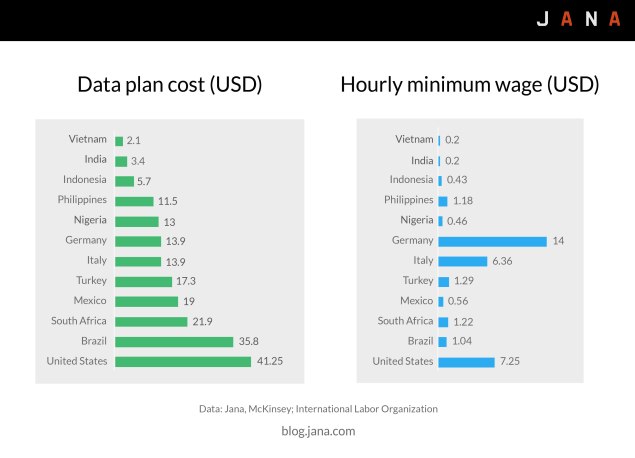
Affordability is a key problem for use of the Internet in many developing markets, including India. The good news is that service prices and the cost of devices are dropping.

In India, 20 percent of smartphone users top up their data plans daily. In the Philippines, 60 percent of smartphone users top up daily.

In Nigeria, 56 percent of users top up daily.

Because they’re buying the smallest packages of data they can afford, they miss out on the cost savings of purchasing larger ones.

To be sure, prices are dropping. Portio Research estimates that the cost per megabyte of mobile data around the world decreased by 93 percent from 2008 to 2012.

In Latin America, GSMA observed that the monthly price of low-end smartphone data plans (250 Mb usage cap) fell from USD 17.68 in 2010 to USD 8.33 in 2013, a decline of 52 percent in just three years.

Plans with a higher usage cap (1GB) also saw significant declines, dropping 37 percent annually from 2010 to 2013, from USD 23.07 to USD 14.44
data trap figure 2_

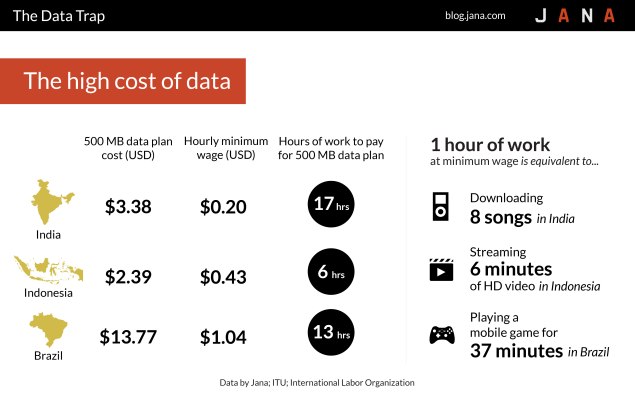
 When you look at the cost of a 500 MB mobile data plan in relation to income, it’s pretty clear to see why 50 percent of smartphone users in India deactivate their data plans. 


1 hour of work high cost of data

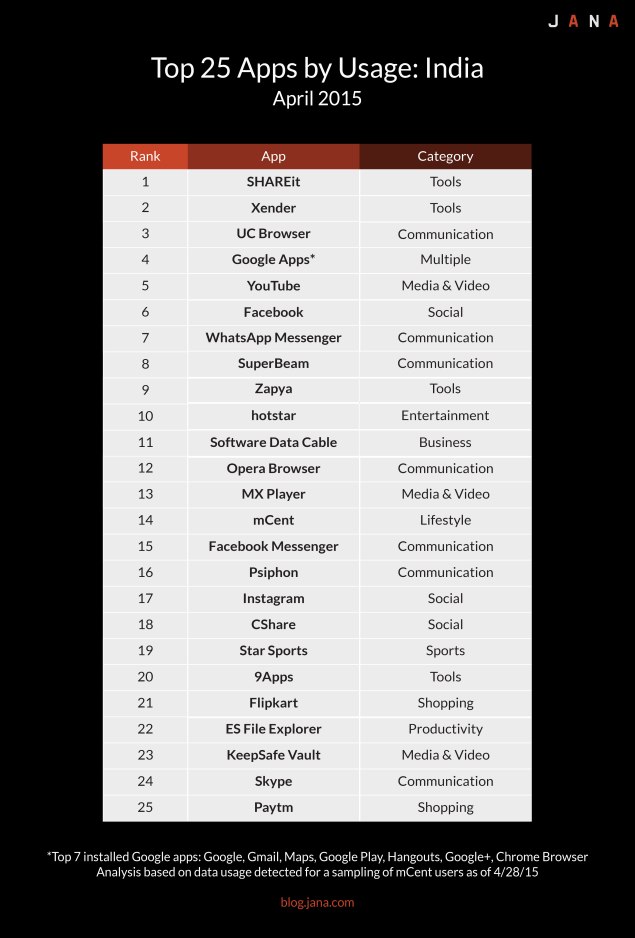
Top 25 Android Mobile Apps in India

Communications and sharing information are the leading apps for India mobile users on Android devices, Jana reports. You'd expect that to be the case. 

About the only thing not done on a mobile is heavy content creation. 

april top 25 apps by usage in india blog

Sunday, May 24, 2015

If You Can Aggregate Enough Spectrum, 10 Gbps Per Device is Possible

Channel bonding is how digital subscriber line and DOCSIS 3.1 bandwidths have grown. The same principle will allow 5G and future generations of mobile networks to provide gigabits to every connected device. 


Has Prepaid Growth Stalled?

Has the decades-long growth of the U.S. prepaid mobile phone business hit its limit?

The assumption, over more than a decade, has been that prepaid would continue growing, as a percentage of total mobile accounts, for several reasons.

In most markets, incremental users tend to be lighter users, more cost conscious users and therefore tend to spend less on a product.

Recently, postpaid services have become more competitive with prepaid services, making the type of payment plan a possibly lesser adoption factor.

The ability to buy postpaid service without a contract, for example, also narrows the gap between prepaid and postpaid. Traditionally, one advantage of prepaid was that using it did not require users to sign a contract. But service without a contract now is possible in the postpaid realm as well.

And promotions linked to the U.S. mobile marketing war mean the price of using postpaid has dropped.

At least two of the top-four service providers also are less stringent about credit policies, traditionally one reason many consumers use prepaid.

Inability to offer the Apple iPhone undoubtedly slowed demand for prepaid services as well.  

Some leading prepaid brands are encountering dramatically slower growth, while repaid revenue and subscriptions seem still to be growing, but at a slower rate.

Growth continues, but at a very-slight rate, so a reasonable assumption, based on history, is that the trend will continue.

Over the past decade, prepaid plans generally has been growing. In 2014, T-Mobile US said it was the largest prepaid provider in the U.S. market. And many forecasts suggest U.S. prepaid revenue will keep growing.  

Sprint's most recent quarter showed a loss of a net 201,000 postpaid phone accounts during the quarter and a net 546,000 prepaid phone, and 349,000 net prepaid tablet accounts. The trend is clear: Sprint is losing postpaid and gaining prepaid accounts.

T-Mobile US, in its most-recent quarter (first quarter of 2015), added 991,000 postpaid phone customers and 134,000 postpaid mobile broadband customers.

T-Mobile also added 73,000 branded prepaid customers quarter, as well as 620,000 wholesale customers in the period, including 479,000 mobile virtual network operator  customers and 141,000 M2M connections.

So one might conclude that, at Sprint, prepaid net additions continue to accumulate. At T-Mobile US, prepaid net adds vastly lagged postpaid additions.

So maybe T-Mobile US is converting prepaid users to postpaid, even if Sprint continues to grow prepaid share.

The prepaid market seems to be at a point where future growth could go either way: up or down.

Saturday, May 23, 2015

How Architecture Solves LeoSat Stranded Asset Problem

Stranded assets are a big problem for fixed network operators when markets are highly competitive.

The big issue is that, in an instance where there are two providers, equally competent, half of each network’s access assets are stranded.

In a market with three equally competent contestants, as much as 66 percent of deployed network assets could easily be stranded.

That is a similar problem, historically, for low earth orbit satellite networks, which “spend most of the time flying over uninhabited areas,” notes LeoSat CEO Vern Fotheringham.

But LeoSat thinks it has an answer for stranded assets. By using direct satellite to satellite links and a mesh architecture, LeoSat can carry live, paid-for traffic over the entire fleet, all the time. That means the stranded asset problem essentially is solved.

Even a satellite flying over an ocean can be relaying traffic, essentially functioning as a simple signal repeat station.

The state of the art today is about 6 Gbps between adjacent satellites, but speeds up to 24 Gbps might be possible if free space optics can be adapted. Intra-plane speeds would be higher than inter-plane connections, Fotheringham says.

There would be other advantages. The signals “can’t be tapped into, from the ground, so the constellation would have better security than a terrestrial network,” Fotheringham says.

In principle, LeoSat signals also would travel at the speed of light, with not glass-imposed impedance. Since the LeoSat signals would move through a vacuum, they would travel at the full speed of light.

And though the total amount of backhaul would be modest, compared to the undersea cable network, that could change, over some decades, he says.

On the Tokyo to New York route, undersea latency is 280 milliseconds. LeoSat believes it will feature latency of just 90 milliseconds. For some apps, such as high frequency trading, that might matter.

The big change in business case, however, is a huge reduction of stranded asset issues.

Google Maps: Does Knowing "Why" Matter?


If you’ve ever been stuck in an airport with a delayed flight, you understand why information about “why” there is a delay is valuable, even if that information does not actually get you moving any sooner.

Google Maps already suggests alternative routes, but now it will tell users “why” it recommends a particular route.

It’s a subtlety, but probably will have value for the same reason knowing “why” a plane is delayed is helpful.

Starting today, Google Maps will provide more detailed alternative routes and notifications about traffic conditions.

if congestion lies ahead, Google Maps will provide an estimate of  how long you’ll be stuck in a traffic jam.

Aside from telling you where and what, the alerts and suggestions also give you the why. Google Maps explains why a certain traffic condition is taking place and, in case of an alternate route, why that path might be better.

The new feature might be a rather small tweak. But some of us would guess the value will be rather higher than the tweak might seem.


India Net Neutrality Rules Hang in the Balance

There seems to be a growing sense on the part of India regulatory officials that current application “zero rating” plans of two types violate the “spirit” of network neutrality principles, though some might suggest a final ruling is unlikely in the near term.

And the issues has become a major political issue, apparently. In fact, some might legitimately argue that India has become the current center of struggle over net neutrality policy.

Ironically, one unintended consequence of strong net neutrality rules that prohibit zero rating is that Internet adoption could be slowed and innovation thwarted.

The Progressive Policy Institute argues that bans on quality of service mechanisms, including zero rating, undermine innovation for real-time applications like telemedicine and high definition voice.

Many would argue that offering subsidized access to key apps is a proven and effective way to acquaint non-users with the value of Internet access and apps. That has proven to be the case in the Philippines and elsewhere where Internet.org has tested the concept.

Potential low-income users also suffer when subsidies such as zero rating are outlawed, the Progressive Policy Institute argues.

Still, the India Department of Telecommunications is said to have a "strong view" that 'Airtel Zero' and 'Internet.org' plans--which operate differently--do not follow net neutrality principles.

It is a horrendously complicated matter, one might well argue, and might not be resolved soon. The emerging “strong view” also is said to be “preliminary.”

“Any final decision regarding the two services will be taken only once the expert committee of the ministry submits its recommendations on the entire gamut of issues related to net neutrality,” one source says.

Further key input on network neutrality rules also are necessary and likely to take some time, as there is a change of Telecom Regulatory Authority of India leadership underway.

TRAI Chairman Rahul Khullar is leaving office and a new chair will likely need some time to develop a “detailed understanding” of an issue that is highly contentious and complicated.

So a delay of TRAI recommendations is expected.

The government is said to be investigating how other countries, including the United States and European region are dealing with the issue.

"It is a complex issue and all efforts are being undertaken to ensure that any best practices, if they are in place somewhere, are also considered by us," ETTelecom.com reports an official’s comments on the subject.

Airtel Zero might be considered the more controversial of the programs, though it is a well established concept in retailing.

Under the Airtel Zero program, application providers can subsidize data charges when Airtel customers use their apps.

The principle is similar to the notion of “toll free calling,” where a business pays for long distance calls made by its prospects, customers and partners. The “800” number is a good example.

Internet.org is different. Under that program, any app provider, without paying any money to anybody--not the mobile service provider and not Internet.org--is offered free of charge to users, who do not have to buy a data plan.

The intent is to allow consumers who do not use the Internet to sample key apps and learn the value of the Internet. Any app provider can apply to be part of Internet.org.

But some object to Internet.org principles that apps need to be optimized for low-bandwidth connections.

Many who have experienced similar low-bandwidth situations can understand the performance challenges and the value of optimizing apps for better performance under challenging conditions.

Indeed, “better performance” is a recurring concern. It is why Google Fiber was launched, for example.

So one might hope the examination of network neutrality both thoughtful and detailed. The issue is horrendously complex, has many subtleties and might have direct bearing on how fast demand for Internet access is stimulated, in India and elsewhere.

Friday, May 22, 2015

Moore's Law Comes to the Satellite Business in a Big Way

In consumer or business technology markets, Moore’s Law matters. Over the past decade, consumer applications also have been leading and driving business technology, a vast change from typical adoption patterns before the Internet.

Now consumer electronics dynamics, especially consumer market manufacturing volumes, are creating new economics for satellite services, according to
Vern Fotheringham, LeoSat CEO.

Because of relentless advances in chip-layer processing, memory and integration, the costs of satellite bandwidth and communication are falling significantly, allowing new economics, Fotheringham says.

“As you look at the migration to low earth orbit, small satellites and consumer grade microprocessors can be applied to the space segment,” says Fotheringham.

One example: where “hardened” platforms always were essential for satellites expected to orbit for 15 years without failing or any ability to roll a truck to fix something that has broken, now massive redundancy is an alternative approach to reducing risk.

Having huge fleets, and a mesh architecture, really helps, from the standpoint of redundancy, Fotheringham says. “The cost of hardening has changed. Now we can use redundancy, instead.”

And it would be hard to underestimate the impact of ability to use components and systems produced at consumer market volumes.

Also, because the new constellations use much smaller, and much lighter satellites, the cost to build satellites, and the cost to launch them, will drop dramatically as well.

To a reasonable extent, bigger satellite constellations also mean buying more units, instead of single units. That makes possible volume pricing and creates new trade-offs for business planners.

LeoSat, for example,  plans to launch a constellation of small, high-throughput Ka-band spacecraft that will deliver Internet services globally.

The network initially would comprise 80 satellites aimed at fixed and maritime markets by 2019, and grow to around 120 satellites assuming the business grows as expected.

LeoSat was founded by former Schlumberger executives Cliff Anders and Phil Marlar, who knew well enough the challenges and requirements for energy company communications.

For perhaps the first time, Moore’s Law is going to affect satellite communications business models in a significant way.

93% of India Internet Users are Mobile

Fully 93 percent of Indian consumers who use the Internet in October 2014 did so using their mobile phones, according to Deloitte Touche Tohmatsu India.

India had 254 million mobile Internet users as of October 2014, the latest data available. Of these, 235 million accessed the Internet through a mobile handset.

It is not clear how much that could change as new access platforms become available, or as existing rival platforms are extended or upgraded.

One could well argue that most of the market has yet to be gotten, if the assumption is that, eventually, most people will use the Internet. At present, perhaps 15 percent of Indians use the Internet.

Some expect 500 million new users could be added in India by 2017.

Fact It: Dumb Pipe Often is the Fastest Growing Revenue Source

As much as service providers might dislike the idea, consumer Internet access mostly is a “dumb pipe” service.

And since Internet access already is, or soon will be, the revenue growth driver for most service providers, there is no way any service provider can fully avoid being a major “dumb pipe” access provider.

So discussions about the need to avoid “becoming a dumb pipe” are largely pointless. To the extent any service provider supplies Internet access service, it is, by definition, a dumb pipe supplier.

That does not mean the “only” service provided is “dumb pipe” access, but it is a large part of the total revenue stream, and with the exception of entertainment video, is in many markets the only service whose revenue is growing.

By definition, the “access” is to the Internet-based third-party apps people want to use, not access to a managed service created by the access provider.

So even if consumer desire to use third party Internet apps now is--or soon will be--the most-important driver of service provider revenue (all service providers now are Internet service providers), Internet access directly reduces demand for the key managed services provided by incumbents.

“Adoption in wireless data on most occasions globally has resulted in cannibalization of voice and SMS,” says Rajiv Sharma, HSBC Securities and Capital Markets analyst.

That is a direct result of success selling mobile Internet access, one might say.

Airtel, for example,  has seen its revenue from data surge from four percent of mobile services revenue in March 2012 to 17.6 percent in March 2015.

Thursday, May 21, 2015

Windstream to Upgrade Access to Gigabit Speeds

Add Windstream to the growing list of U.S. Internet service providers planning or already offering gigabit Internet access to their customers.

"Windstream is going to launch GPON, or 1 Gbps service, to homes that are already fiber-fed enabled," said Windstream CEO Tony Thomas.

Thomas said in the near term, it will launch one market with 1 Gbps this year with the potential to reach five markets.

"We are drawing a line in the sand that says we're going to launch a 1 Gbps market in 2015 and if the team overachieves, we'll launch in five," Thomas said. "I think after that we're going to launch in every one of our markets a 1 Gbps product because in almost every one of our markets where Windstream competes today we deployed fiber."

Comcast Gigabit Pro 2 Gbps Symmetrical Service Launching in Multiple Cites This Summer

Comcast is rolling out its “Gigabit Pro” symmetrical 2-Gbps Internet access service to nearly one million Colorado homes starting in the summer of 2015.

Gigabit Pro also is being added in Oregon and Southwest Washington, Houston and other marktes as well.


Comcast earlier had annouced Gigabit Pro rollouts in Atlanta, cities in California, Chattanooga, Chicago, cities in Florida and Nashville and will roll out to more cities throughout the year, with the objective of making 2-Gbps service available to perhaps 85 percent of all Comcast-served locations.


In addition, Comcast is launching Extreme 250, a new 250 Mbps Internet speed tier for Colorado customers with immediate availability.


The new Gigabit Pro service will be enabled by an overlay “fiber to home” network, while the 1-Gbps service will be supported on Comcast’s hybrid fiber coax network.


Comcast is currently testing DOCSIS 3.1, its solution for 1 Gbps, and plans a national introduction in early 2016.

When fully deployed, DOCSIS 3.1 will mean almost every customer in Comcast’s national footprint will be able to receive gigabit speeds over the existing HFC network.

Wave Broadband Plans $130 Million Expansion

Kirkland, Wash.-based Wave Broadband has raised $130 million to expand its gigabit Internet access services in the Puget Sound region of Washington, possibly to an additional 10,000 locations in downtown Seattle, but also possibly including other areas as well.

If one assumes $2,000 cost per new location, that would entail spending about $20 million. If Wave adds another 1,500 route miles of fiber, at a cost of $20,000 per mile, that implies an investment of $30 million.

Those two elements would account for about $50 million. That suggests Wave will expand in yet other areas.

In the past, Wave has grown by acquisition, so it would be reasonable to assume some of the new capital will be used to acquire assets.

Wave’s current business is 85 percent residential and 15 percent commercial. But that ratio could change, given the targeted move to downtown Seattle. The company says it is seeing commercial business growing 25 percent annually.

The company said it has annual revenue of more than $350 million.

What Qualifies as "All Fiber" for an Access Network?

Commercial disputes between competitors and partners are not unusual. But one dispute over marketing claims in the access business is unusually stretched. U.S. cable TV operator Cablevision has sued to prevent Verizon from claiming its FiOS service is “all fiber.”


The reason for the lawsuit is that Verizon uses coaxial cable for in-house signal distribution.


Cablevision has for many decades been viewed as a cable TV firm that goes its own way. When virtually all the rest of the industry was pushing for use of the 1310 nanometer optical window for optical fiber systems, Cablevision pushed for 1550 nm.


Earlier, when the rst of the industry saw satellite as a direct competitor, Cablevision was interested in satellite distribution. When it recently got into the “mobile” business, it did so using a “Wi-Fi only” approach all other service providers have eschewed.


So being different is not new for Cablevision.


Some observers might say the Cablevision lawsuit is disingenuous in a technology sense, however much sense it might make as a tactic in a marketing war. No other company has literally argued that FiOS cannot properly be called an “all optical” access system.


As any knowledgeable engineer will attest, whatever the access medium (airwaves, optical fiber or copper), the actual local connection always will use either radio (Wi-Fi) or some copper medium.


The reason is simply that no consumer device actually can accept a native optical connection.


TVs, radios, PCs, game players, cell phones, tablets, home security systems or any other connected device are unable to connect directly to an optical interface.


So it actually is disingenuous to conflate the access network with the in-home network. Not only are they separate logical, functional and legal entities, but it is literally impossible to connect any optical  facility directly to any end user device.


So “no network” could ever, in such a sense, ever be called “all optical.”


In a strict sense, “access networks” of all types are about the portion of any network that connects any single location or subscriber to the core network, typically between any location or customer and a central office, headend or cell tower.


The network beyond the cell tower, headend or central office is the “transport” network.


So the character of an access network properly concerns only that portion of the network between the customer location and the node (central office, mobile tower or headend) that aggregates traffic before it is send to the transport network.


In-home networks are traditionally and properly considered the “in-building” or local distribution network, never the access network. Ownership is one key distinction. The service supplier owns the assets all the way up the customer termination interface.


The customer owns the internal distribution network. It is the difference between the public access network and the private local area network.

Cablevision’s lawsuit, as they say, is “without merit.” Access networks are one thing; transport and in-building networks quite another.

Is Private Equity "Good" for the Housing Market?

Even many who support allowing market forces to work might question whether private equity involvement in the U.S. housing market “has bee...