Wednesday, April 5, 2017

Two Big Changes in Global Capacity Business

Much has changed in the global capacity business over the last few decades. Among the biggest changes is that so much global traffic is generated by a relatively small number of very big applications providers, not telcos moving traffic from central offices.

The other big change is that so much of global traffic now moves over private networks owned and operated by those relatively few huge app providers.

“Now networks are being built by hyperscalers,” says Tim Stronge, TeleGeography VP. That is a historic change.

On Latin American routes, about 70 percent of total traffic now moves over private networks. In other words, only about 30 percent of undersea, long haul traffic actually is sold to customers who use “public” networks,  according to Erick Contag, Globenet CEO.

On trans-Pacific routes, OTT app providers also are driving demand, accounting for about 33 percent of lit demand on the “public” networks, says Jonathan Kriegel, CEO Docomo Pacific.

“Content providers are removing a large portion of the customer base,” says Brianna Boudreau, TeleGeography senior analyst. That “makes the rest of the market extremely competitive.”

In other words, despite huge increases in capacity requirements every year, most of that growth is “private capacity,” used directly by the likes of Google and Facebook, and not part of the “public networks” market (that capacity is not purchased from a public networks supplier).
source: Google

Will Video Break Business Models?

Global traffic once was driven by voice. Then it was driven by internet data. Increasingly, traffic is dominated by video entertainment. That has serious business model issues for access providers.

That video now drives global traffic is uncontestable. There will be nine-times more mobile video traffic by 2021, according to Jean-Luc Valente, Cisco VP. Fully 75 percent of mobile data traffic will be video by 2021. That is important, in part, since as much as half of all traffic is generated by mobile devices, while by 2020 perhaps 70 percent of all traffic will be related to mobile devices.

So here’s the problem: video consumes huge and growing amounts of bandwidth (first small screen, then standard definition video, now high definition video and more intense formats coming. But much of that video drives no direct revenue. And most video that does drive direct revenue (streaming video services) is not owned by the access providers.

At the same time, the revenue which can be driven by internet access services has an average revenue problem: prices per gigabyte keep dropping. In fact, some would argue such prices (at retail) must drop, to sustain the OTT video model.

New unlimited usage plans featured by the top-four U.S. mobile operators, or zero-rated video plans, provide concrete examples of how that process continues to unfold.


Some would note that bandwidth prices are plunging so much that overall network revenue per bit could even go negative within 10 years.

“Two decades ago, it would have cost almost $10,000 a month to get a data connection as fast as today's baseline internet wireline connections,” said Tom Nolle, CIMI Corp. principal. “Yet, the internet has pushed down revenue per bit transported so sharply that operators widely believe connection services will have a negative return on investment before the end of the decade.”

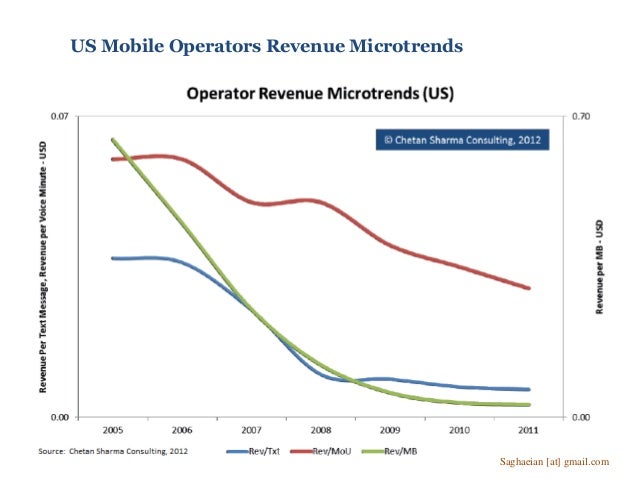
Indeed, revenue per gigabyte has been declining for some time, in the mobile and fixed realms.

The business model issue therefore has several key aspects. Revenue per gigabyte which can be earned by an access provider continues to drop. Up to some point, access providers can sell more units to offset declining prices, but only up to a point (unlimited usage or zero rating show the limits).

At the same time, the media type most desired by retail end users is video, which poses huge and growing capacity demands that require network upgrades, but without direct revenue increases to offset the investments.

Finally, consumers expect that subscription video or audio services will not require payment for consumed bandwidth. That pattern was set by broadcast radio, broadcast TV, then cable TV, satellite TV and telco TV. And though consumers understand they need to pay for internet access to watch Netflix or Amazon Prime, they likely would not pay for the incremental bandwidth correlated with their consumption, should that be proposed.

Video, in other words, has the potential to strain business models. Some think video could break the business model. The issue is simple. In the voice era, higher usage meant higher revenue.

In the era of internet video, greater usage does not necessarily drive much incremental revenue.

Wi-Fi Role Could Change in 5G Era

Price and quality matter, where it comes to user behavior related to use of internet access services and networks. In markets served by 3G networks, consumers chose to use Wi-Fi access because it saved them money, and provided a better experience. In most 4G markets, though “saving money” remains important, “quality” generally is not a driver, as 4G tends to be faster than Wi-Fi.

In the coming 5G era, it is conceivable that the new mobile network will eliminate “saving money” and “better quality” as reasons to offload access to Wi-Fi. That would represent a huge change in consumer behavior. To be sure, Wi-Fi will still be important. But its value to internet access constituencies could very well change.

If, in the 5G era, and even in the present 4G markets, unlimited usage plans eliminate both the advantages of “saving money” and “better experience” when switching to Wi-Fi.

On the other hand, some suppliers, particularly those with significant Wi-Fi assets, might find they can use Wi-Fi infrastructure to lower their mobile service operating and capital costs.

Likewise, mobile operators might benefit from bonding mobile access with Wi-Fi, in the “old way,” where offloading reduces traffic on the mobile network. But that advantage might be most valuable when customers are consuming video content, negligible to moderate for voice and messaging or internet access.

Revenue Per Bit is a Big Problem

Observers might disagree about how big a problem revenue per bit has gotten to be on most mobile networks. But everyone would agree it is a significant problem, as revenue per megabyte or revenue per gigabyte is quite low. 

After operating and capital investment, some might question how profitable mobile broadband services are, in some markets. A few might argue that mobile broadband, in some markets, already loses money. 


Deutsche Telekom Launches StreamOn Unlimited Media Usage Plan

Deutsche Telekom has launched StreamOn, a new unlimited usage plan for its German customers, who now will be able to watch video and listen to music without incurring mobile data usage charges.

Almost certainly inspired by the success of the U.S. unit’s experience with such plans, DT has signed up Amazon, Apple, Netflix, Sky, YouTube and Deutsche Telekom's own Entertain TV offering as partners.

As seems always to be the case when technology disrupts the boundaries between formerly-discrete industries (TV and radio broadcasting, cable TV, telecom, print, social networks, shopping), old regulatory concepts become unwieldy and nonsensical, as firms selling the same services labor under different regulations.

Cable TV firms, for example, are regulated differently from telcos; VoIP often is regulated differently from carrier voice; over-the-top streaming video is handled differently than broadcast media or print.

More significantly, over the long term, is that business models and consumer expectations of each product do not change, simply because the delivery method changes.

Consumers do not expect to pay for bandwidth--which is an essential requirement for broadcast TV, broadcast radio, or any network-delivered video or audio service--when consuming traditional media.

As traditional “television” and “movie” media becomes internet media, those consumer expectations are not going to change. So zero rating is a business requirement.

Also, networks face physical issues. Video is hugely more bandwidth-intensive, but revenue per bit is quite low. There simply is no way media business models work if, in the switch to internet delivery, consumers pay for bandwidth in addition to cost of content.

Revenue per bit matters, even if no consumer ever sees such metrics, nor do service providers normally track it.  

The revenue per bit problem is easy to describe. Assume an ISP sells a triple-play package for a $130 a month retail price, where each component--voice, Internet access and entertainment video--is priced equally (an implied price of $43 for each component).

Ignore other cost of service elements, such as marketing and content acquisition fees. In term of network usage, that would make sense if each constituent service “consumed” roughly equivalent amounts of capacity, or if retail charging was based relatively directly on consumed bandwidth, and not “perceived value.”

Use of network resources is unbalanced, though. Voice requires use of almost no bandwidth, while video consumers nearly two orders of magnitude more capacity, for each minute of use. Internet traffic is in between, with some apps consuming little capacity (email), some apps consuming a moderate amount of capacity (web browsing) while others are heavy capacity consumers (video).

So, by some estimates, where voice might earn 35 cents per megabyte, revenue per Internet app might generate a few cents per megabyte. Recall that actual revenue per megabyte is statistical: it hinges on how much a user consumes after paying a flat fee for the right to use bandwidth.

Tuesday, April 4, 2017

MulteFire: Second or Third Coming of Personal Communications Service?

Sometimes, past is prologue where it comes to ideas, platforms and services in the telecom industry. Back in the 1990s, for example, at a time when mobile service was not used by most people, and was expensive, it was thought there was a market opportunity for a new type of service that would be half way between cordless indoor telephone service and fully-mobile outdoor service.

That concept, known as “Personal Communications Service (PCS)” lead to the entry of Sprint and what became T-Mobile US into the U.S. mobile market, using 2-GHz spectrum. The original thought was that PCS would be a pedestrian speed network, supporting cell tower handoff at pedestrian speeds.

Later, Cablevision Systems Corp., which studied and then shelved the idea, eventually did launch a similar service, essentially mobile phone service using unlicensed Wi-Fi spectrum exclusively. Much as did PCS, it never took off.

In a sense, MulteFire is a second coming of the older PCS idea. PCS was conceived as a communications service used by people moving at pedestrian speeds, with session handoff. The CableVision implementation did not feature session handoff, but could be used anywhere Wi-Fi access was available (indoor at the subscriber’s home or at public Wi-Fi locations).

It is not clear how MulteFire might develop, or which use cases prove to be sustainable. Some larger cable operators, such as Comcast, have huge deployed networks of Wi-Fi homespots that could provide a foundation for MulteFire networks spanning rather extensive geographies, even if call handoff might be a limitation.

But that is why most believe hybrid networks that can default to mobile networks are important. Google Fi, for example, uses a mobile-first model where users are connected first to Wi-Fi, then to either the Sprint or T-Mobile US network, depending on which network has the better signal at a specific location.

Even if we all know 4G as a mobile network standard, supporting mobile phone service, other new protocols, such as MulteFire, create the potential, for the first time, of 4G networks operated much as Wi-Fi networks are, using unlicensed spectrum and operating in indoor settings or as small cells.  

MulteFire is suitable for any spectrum band that requires over-the-air contention for fair sharing, such as the global 5 GHz unlicensed spectrum band or shared spectrum in the upcoming 3.5 GHz CBRS (Citizens Broadband Radio Service) band in the U.S. market.

Business models for networks running 4G LTE protocols in a private LTE mode might be likened to similar use of venue Wi-Fi. An enterprise might consider creating its own enterprise 4G network. There will be business model differences based on which spectrum is used. In the CBRS band, for example, a venue owner deploying MulteFire would have proprietary rights of a sort, being able to block other temporary MulteFire networks from being created by a user hotspot, for example.

Wholesale models, such as neutral host networks open for use by third parties, represent another new business model.

In some ways, MulteFire takes the old debate about whether Wi-Fi can replace licensed mobile networks to a new level. In the future, it will be possible to create 4G networks that operate exclusively using unlicensed spectrum, or in forms that bond licensed mobile spectrum with unlicensed Wi-Fi spectrum or other spectrum.  

MulteFire also is, in many ways, the latest iteration of any idea decades old, that there is room in the market for services that are someplace between full mobile and cordless telephone service.

Sometimes an idea is before its time, and demand or network infrastructures will not support the new ideas. We will see whether PCS is such an idea.

Is 5G Overhyped?

Is 5G overhyped? Yes. Is the hype unwarranted? In the near term, perhaps. Long term? The global communications business might well prosper or fail based on new revenue streams created by 5G. So, long term, the hype is totally warranted. 

Industrial Internet Consortium Releases IIoT Connectivity Model

The Industrial Internet Consortium has released an extensive white paper on its model for industrial internet of things connectivity. As you might guess, the connectivity model is designed for technology developers, and corresponds, in general, to the Open Systems Interconnect seven-layer model.

As some of us might note, there are business analogies. With the embrace of OSI, applications now are written to be independent of access media and network platforms; as well as independent of devices and operating systems, to a large extent. In such an environment, though there still remain vertical integration opportunities, the basic framework is openness.

But that also means business models are less amenable to “lock in” based on specific protocols, networks or access media. So it is worth noting that, above the  the “framework” layer (structured data) is the unnamed “business model” layer, where businesses with revenue models decide to use IIoT.

It is natural that ecosystem participants in the communications segments focus on “how” to achieve ubiquitous communications for IoT. Ultimately, as always is the case, business value will determine whether IoT is embraced, and therefore whether markets for communication services are created.


Does NFV Enhance or Replace Evolved Packet Core?

In many ways, network slicing features of coming 5G-compliant core networks builds on  evolved packet core (EPC), the current framework for providing converged voice and data on a 4G Long-Term Evolution (LTE) network. The 2G and 3G networks use a different architecture, using
circuit-switched networks for voice and packet-switched networks for data.

Evolved packet core uses Internet Protocol, which is simpler and media independent. Standards for EPC were developed by the Third Generation Partnership Project (3GPP) in early 2009.

As always is the case, networking professionals can disagree about whether NFV either “improves or replaces” the EPC. Perhaps most would argue that NFV extends and builds upon EPC.

It might be somewhat subtle, but CIMI principal Tom Nollte says network slicing (a feature of 5G-compliant core networks) could have an impact in terms of “eliminating the expensive evolved packet core infrastructure that handles mobility in 4G networks.”

Most would probably argue that NFV virtualizes the EPC function. But that is where the nuances are important. If EPC is virtualized, is that a functional replacement of EPC by NFV networks using network slicing? It’s subtle. It might be most accurate to say that virtual replaces physical in the area of EPC functioning.

EPC also separates the control plane from the user plane, where control network is separate from the actual payload data, a move intended to reduce costs and network overhead, while improving ability to scale networks more easily (and at less cost) by reducing the amount of active elements.


The next evolution, many would argue, is network functions virtualization (NFV), a network architecture concept that uses “information technology” approaches to virtualize entire classes of network node functions, making them building blocks that can be connected or chained together to create communication services.

One way to look at such an NFV network is that the business case can drive the configuration of network capabilities for each specific application (at least to the extent the network can be customized for latency, security, geography, bandwidth or quality). Historically, the goal of every next-generation network was to create the ability for bandwidth on demand, something NFV builds on, but augments.

So it might be an irrelevant argument (“how many angels can stand on the head of a pin”), but virtualizing networks using network slicing and NFV might either been seen as “improving” existing network functions, or as “replacing” them.

Monday, April 3, 2017

Who Will Develop Shared Spectrum Facilities?

Since 5G networks will build on other developments, such as the latest generations of 4G, core network virtualization, new spectrum access methods (shared spectrum) and millimeter wave frequencies and small cells, business models are likely to be evolutionary, rather than a “flash cut,” compared to prior mobile network generations.

For example, development of new commercial method for spectrum sharing in the 3.5-GHz band are not a formal part of the 5G standards process. But shared spectrum access is expected to be a staple of 5G network access methods.

Likewise, the release of more millimeter wave spectrum partly is, and partly is not, part of the 5G standards process. Similarly, small cell deployments, additional distribution fiber deployments, new radio technology and even open source efforts will eventually contribute to enabling and improving the 5G business model.

Perhaps oddly, the 3.5-GHz Citizens Broadband Radio Service (CBRS) being introduced in the U.S. market might see some unusual demand patterns. CBRS uses a three-tier access priority system, with existing licenses having interference protection rights from commercial users, while a a second tier offers priority access, while a third tier operates much as does Wi-Fi (best effort access).

The Priority Access Licenses (PAL), expected to be made available at auction, and with interference rights over the “best effort if capacity is available” General Authorized Access (GAA) tier of service, might be considered the preferred choice of mobile service providers, who have tended in the past to require quality-of-service protections.

The GAA spectrum would allow licensees the right to use 10 MHz channels for two three-year periods (3550–3650 MHz). And that is the issue: the six-year license duration limits the attractiveness of PAL for mobile operators who, in the U.S. market, are used to perpetual license terms, argues Senza Fili principal Monica Paolini.

As a result, she argues, the strongest interest might lie in use of the license-exempt GAA tier, which will effectively represent a new capacity option that is similar to Wi-Fi. That might have other repercussions as well.   

If GAA spectrum can be used by any entity without a license, then CBRS can be built out by property owners in the same way they use Wi-Fi. That might effectively limit use of CBRS capacity by mobile operators

Also, CBRS access using GAA will allow venues to block use of other temporary Wi-Fi access points (consumers using their own devices, for example).

That also increases the likelihood that neutral host approaches could develop on a fairly widespread basis, eventually. The advantage there is that each service provider could use CBRS facilities without building in-building infrastructure. The disadvantage is that mobile service providers and others using a neutral host network would not be able to control the facilities to the same extent as if each provider supplied their own radio infrastructure.

So much remains to be discovered, in terms of the ultimate pattern of CBRS license preferences by commercial users (such as mobile or cable operators), venue owners (building owners and managers) or third-party developers of CBRS indoor access facilities.

If the present Wi-Fi pattern develops, then venue owners will develop CBRS access services that resemble today’s Wi-Fi. In principle, new neutral host facilities could develop, with a property owner or third party operating the radio infrastructure, and offering access to all who wish to partake. Unclear is the amount of demand for priority access approaches that resemble today’s mobile licenses.

Potential regulatory changes that would extend PAL licenses for longer durations also could have an impact. If that were to happen, then CBRS using PAL would more closely resemble traditional mobile licensing.

If one had to make a guess today, it might be that most smaller locations eventually will have CBRS operating just as Wi-Fi does today, with a property owner or tenant making the decision to create a small cell running a CBRS network using the GAA access method, just like they would operate a Wi-Fi network.

Neutral host is going to make more sense at large venues, though it remains unclear how scale will become a factor, favoring larger service providers rather than individual venue owners.

Charter Does Not Have to Overbuild, FCC Says

Charter Communications will not be required to overbuild (compete with an existing cable operator) as part of its acquisition of Time Warner Cable, the U.S. Federal Communications Commission has ruled.

That preserves the collegial structure of the U.S. cable TV industry, which historically has held to a practice of not competing with other cable operators, even if such competition is lawful. Basically, as industry execs have privately said, that “no competition” behavior has meant cable had the “best of all possible worlds, able to operate an an unregulated monopoly.”

That remains only partly true now that U.S. telcos and cable operators compete head to head, with the same key product lines, virtually everywhere. But the historic restraint (no competing with another cable company) remains largely intact.

The big changes will come as Comcast and Charter Communications enter the mobile and OTT streaming businesses, which require national scale. In such areas, Comcast and Charter will “compete” with other cable operators at least in the OTT video area. In that sense, the “competition” will be indirect, similar to the notion of a cable operator competing with Netflix.

Even so, the competition will more theoretical than practical, as smaller cable operators will not have the scale to compete in the OTT streaming services market. It is virtually certain neither Comcast nor Charter would directly challenge other cable operators in the core fixed networks business.

In the mobile business, it is possible local cable partners might, in many cases, also act as marketing and infrastructure partners with either Comcast or Charter or both. Despite that, Comcast and Charter will be trying to market services to customers served by other cable operators. No doubt both firms will do everything possible to minimize the perceived degree of competition and revenue threat.

As a condition of FCC approval of the acquisition, the FCC under the Obama administration had required that Charter build internet access facilities to about a million households that currently have service from other cable operators.

As you would expect, the smaller rural cable operators that would have faced new competition from Charter opposed the provision.

As a condition of approval for its acquisition of two cable companies, Charter in May 2016 agreed to extend high-speed internet access to two million potential customers within five years, with one million served by an existing cable competitor. That would have created new cable operator competition in those overbuilt areas for the first time.

Text Messaging Revenue Opportunities Shift to Marketing, Customer Service, Other Business Revenue Models

New findings from Juniper Research forecast that OTT messaging applications, such as WhatsApp and Snapchat, will see adoption grow from 2.3 billion unique users in 2016 to 4.2 billion by 2021 representing a growth of over 12 percent  CAGR (compound annual growth rate).

It anticipates that players will begin focusing their strategies around the development and provision of artificial intelligence (AI) chatbot tools. In other words, the revenue upside now is seen as marketing, not consumer direct revenue.

That is one example of a broader trend, namely the decline of voice and messaging revenues and the shift of such apps to “features” rather than revenue drivers. To be sure, some revenue still is made from voice and text messaging, and no mobile service provider would dare market a mobile service that did not support voice and messaging.

From time to time, a supplier might ponder offering services that use over the top voice and messaging, with no carrier voice and messaging capability. So far, that business model does not appear to be appealing.

To be sure, traffic or usage is different from “revenue earned from providing such usage,” but consumers globally simply are talking and texting less using carrier services, and substituting OTT voice and messaging, or using social media as a substitute in many cases.


That explains the new emphasis on use of text messaging as an advertising or business-to-business tool.

Juniper Research predicts that OTT players will reposition their messaging platforms as customer relationship management tools, for example.

By leveraging AI technology, these OTT apps--it is hoped--will create a service that drvies revenue because it offers  a new level of consumer engagement and customer service.

The other interesting implication is that these new customer service and marketing tools will be built on use of artificial intelligence tools.

End of An Era: Android Passes Microsoft Globally as Top OS

Some milestones are turning points. Some turning points illustrate that an era has passed. Even if the fact will surprise virtually nobody, it is worth noting that, in March 2017, for the first time ever, Android passed the Microsoft operating system as the world’s most popular operating system (OS) in terms of total internet usage across desktop, laptop, tablet and mobile devices combined, according to StatCounter.

Granted, you might argue the OS share was a tie. In March of 2017, Android topped the worldwide OS internet usage market share with 37.93 percent usage, compared to Windows, with 37.91 percent share. Five years ago, Android had market share of about 2.4 percent, notes
Aodhan Cullen, CEO, StatCounter.  


That noted, Microsoft Windows still dominates the worldwide operating system desktop market (PC and laptop) with a 84 percent internet usage share in March.

“Windows won the desktop war but the battlefield moved on,” said Cullen.

In substantial part, you can credit use of smartphones In Asia for Android’s global growth. In Asia, Android represents 52.2 percent of internet-using device operating systems,  compared to 29.2 percent share for Windows.

In other regions, Windows retains its lead. In North America Windows had 39.5 percent share in March, followed by iOS at 25.7 percent and Android at 21.2 percent.

In Europe, Windows had 51.7 percent, with Android at 23.6 percent.

When Was the Last Time 40% of all Humans Shared Something, Together?

I miss these sorts of huge global events where 40 percent of living humans share a chance to build something for others.