Friday, May 19, 2017

AT&T Activates LTE-M Network for IoT

AT&T has deployed its nationwide LTE-M network intended to support IoT, about a year ahead of schedule, which provides some idea of the faster tempo of network deployment to support both internet of things applications and 5G.


The LTE-M network is live across the United States on AT&T’s  4G LTE network.


AT&T also says it is deploying LTE-M across Mexico by the end of 2017 to create a North American LTE-M footprint covering 400 million people.


LTE-M rate plans start at $1.50 per month per device.  Further discounts will be available for yearly and multi-year plans, as well as volume commitments, AT&T says. That pricing illustrates one important facet of IoT connection revenue: it will be far less than connections for human devices such as phones.


LTE-M modules will be available for as low as $7.50 each, including a SIM card. That is half the cost of the LTE Cat-1 module AT&T launched in 2016. That fact also illustrates an ongoing process where mobile operator IoT retail costs plunge. That has been touted as an advantage for specialized IoT networks, but as promised and expected, mobile IoT retail costs are dropping to ranges at least equivalent to those of rival and specialized IoT networks.

At a high level, the specialized IoT networks arguably have a market window before mobile operator IoT networks are ubiquitous. After that happens, many expect advantage to shift to the mobile suppliers, for reasons of scale (marketing, capital resources and relationships).

Spectrumfutures postcard v5 final print

Mobile Internet Access Now Makes a Big Difference in "Access" Domain

If there are any certainties, it is that "everyone" agrees internet access, and faster access, are good things that "everybody" should have. That typically means "most people" approve of measures to improve access and speeds in rural areas and for poorer people.

One recent example: Tennessee Gov. Bill Haslam has signed the Tennessee Broadband Accessibility Act into law, releasing $45 million, to be disbursed over the next three years, in the form of grants and tax credits for Internet Service Providers (ISPs) making broadband service available to unserved homes and businesses.

internet_usage_2009_2016_ww
source: StatCounter
Connected Nation says the plan allows Tennessee’s private, non-profit electric cooperatives to provide retail broadband service and make grant funding available to the state’s local libraries to help residents improve their digital literacy skills.

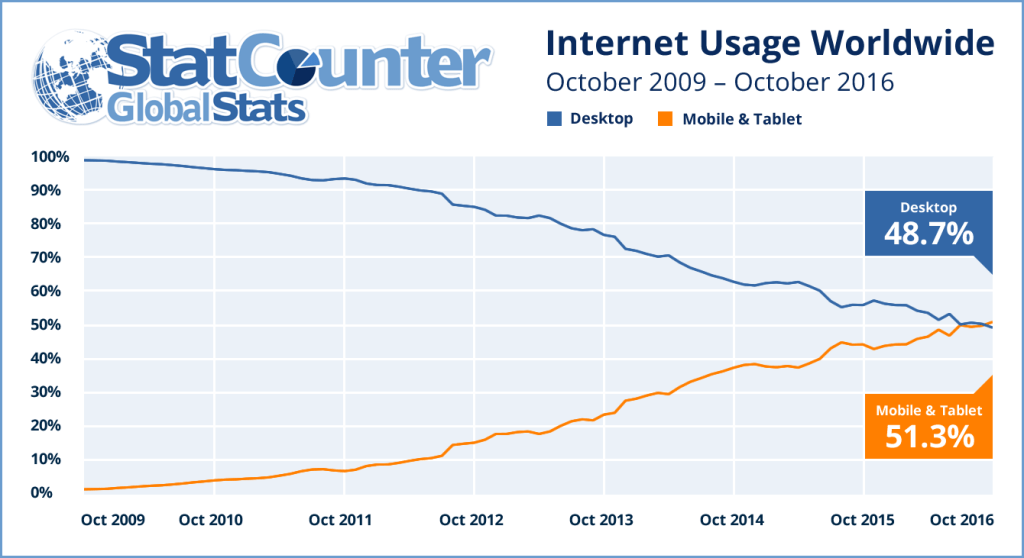
Observers can applaud the new efforts, while also noting that consumer preferences appear to be changing. It appears that virtually all the growth in broadband usage since about 2013 has come either from mobile or some other method of gaining access, based on a reported decline in home internet access purchasing since 2013.

There was a seven percent net gain in internet usage between 2013 and 2014, even as fixed network access dropped two percent. That suggests consumers are opting increasingly to use the internet significantly or primarily on their mobiles.

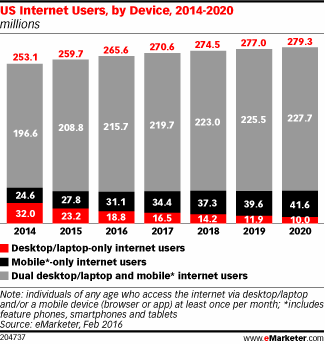
In the U.S. market, about 12 percent of all internet users relied solely on mobile only for internet access.

About six percent of Tennessee homes are unserved, studies have concluded. The bigger problem is the percentage of homes that do not have access at speeds at least 25 Mbps.


Perhaps 17 percent of Tennessee homes apparently did not have 25 Mbps access in 2014, while 66 percent did have such access.


Fixed network adoption in Tennessee seems to have peaked about 2013, even as internet access adoption climbed to 81 percent.  


That trend, reported in other earlier studies, suggests that mobile internet now is what is driving incremental subscription growth.

A related trend--faster speeds--could also affect our statistics. Some access lines using digital subscriber line could shift to fixed wireless as Verizon and AT&T turn to fixed wireless, including 5G variants, to boost access speeds.

How those lines are counted also could affect fixed access adoption figures. There is a logic to counting a fixed wireless connection as a "fixed" connection. There also is a logic to counting it as a "mobile" connection, if supplied by a mobile operator's network.

The point is that all things related to use of the internet, its apps and devices change with time. It almost does not make sense to distinguish between "broadband" access and ""internet access." It no longer makes sense to ignore the huge amount of internet access that happens in the mobile domain.

Nor, where it comes to measuring "broadband" or "internet access" progress, can be ignore the role played by mobile internet access.

AI No Longer a "Science Project"

source: Tata Consultancy Services
Some technologies are in development for such a long time it seems as though they always will be “science projects,” not commercial realities. That actually is not true for artificial intelligence, which is being used to reduce electrical use at data centers or expedite customer service interactions.


Amazon Web Services uses a compute capacity forecasting model driven by machine-learning (artificial intelligence), AWS CEO Andy Jassy said.


For example, AWS uses sales team efforts (who they visit, when)  to forecast demand. The company also has used AI to predict where it has to store excess components, he adds.


All that helps AWS control its capital spending.


AWS also uses AI to reduce fraud, bad debt, and the number of customers who didn’t get their goods and suppliers who didn’t get their money.


AI has been important for content and search activities. Bing uses AI to support search operations, for example. Other firms use AI to personalize content for discrete users.


Also, sales automation, an older trend, now is being boosted by application of AI to allow more predictive value, not so much “what happened?” but “what will happen next?”


Insurance payments are another area where AI is applied to streamline operations. Others use AI to automate chatbot interactions.


Uber uses AI to personalize rider interactions, such as offering suggested destinations based on your current location and past habits. Expedia uses AI for fraud detection and better travel recommendations.  Banks use AI for phone-based customer service interactions.


Tata Consultancy Services says enterprises it surveyed already are using AI in 63 core areas,  most frequently to detect and fend off computer security intrusions in the IT department.

Spectrum futures flyer 2017 7 final print


Thursday, May 18, 2017

Capex Estimates Hinge on Assumptions, Since it All is At the Margin

Assumptions always matter when conducting studies. But assumptions also are important when looking at levels of capital investment at aggregate levels. Firm priorities can vary. Industry segment patterns can be quite distinct. Also, "capex" includes all manner of investments not directly related to network investment. 

It is worth noting that “capex” includes lots of spending (trucks, customer premises equipment, international spending, smartphone leasing, buildings and computing gear) that might not contribute to our assessment of “network” investment.

Also, big mergers and acquisitions, plus spending on customer premises equipment, can skew reported capex. When total spending is deemed to have changed in low single digits, such nuances can make the difference between growth or decline, on a reported basis.

USTelecom’s seventh annual report on U.S. broadband investment numbers is not available yet, but “our initial analysis strongly suggests that investment in 2016 continued to trend downward following the Federal Communications Commission’s (FCC) adoption of the 2015 Open Internet Order,” says Patrick Brogan, UST VP.

Data compiled from internet service providers representing 90 percent to 95 percent of annual industry capital expenditures, suggests the dip in broadband investment UST reported on in 2015 was not a one-off occurrence.

In 2016, capital expenditures was $71 billion, down from $73 billion in 2015 and $74 billion in 2014, UST says, an amount $2.5 billion to $3 billion lower in 2016 than it was in 2014, the year before the FCC adopted Title II utility regulations.

The amount of U.S. capital investment  is highly contested. Clearly, cable TV operator capex was up; fixed network capex was down and mobile capex was up, though one has to adjust for the impact of handset subsidy accounting rules. Financing of smartphone handsets is “capex” under accounting rules, but does not help us understand changes in network capex.

That noted, some studies suggest higher capex under common carrier rules, while others argue the opposite case.  

For others, what would have happened is the key issue.


Claims by some that broadband provider capex increased in 2015 and 2016 ignore accounting adjustments for certain non-material items like leased cellphones and acquisitions, such as AT&T’s merger with DirecTV and a Mexican wireless operation, UST argues.

The crucial question is what would have capex been if Title II had not been imposed, controlling for other factors.

IoT Connectivity: "All of the Above"

By most estimates, device connectivity revenue might represent as little as five percent or perhaps 10 percent of the new revenue to be created by most internet of things applications and services. Among the reasons is that existing connectivity solutions could well play a part

Short-range access methods such as Bluetooth, Wi-Fi, and 802.15.4, for example, could be device connectivity options that leverage existing network access services. To the extent that happens, nearly zero incremental access revenue is created.

ABI Research forecasts IoT will represent 15 percent of Wi-Fi, 27 percent of Bluetooth, and over 60 percent of 802.15.4 device shipments by 2022.

LPWAN and legacy M2M cellular technologies are set to ship nearly 575 million chipsets by 2022, growing faster than any short-range connectivity solution across IoT verticals.

ABI Research finds that cellular and LPWAN technologies, often perceived as more reliable than short-range connectivity solutions, require less intermediary gateways, can support greater distances between end nodes, and scale from the very smallest to the largest number of end devices, while providing a battery life that exceeds 10 years.

It is reasonable to assume widespread use of existing short-range access methods to support consumer wearable apps. It might not be so much the case for enterprise and business apps, which might require higher perceived reliability or reach.

“These technologies are specifically designed for IoT and are arguably much better matches for outdoor, larger-scale IoT applications due to their abilities to target greater coverage areas, their ease of deployment, and their greater scalability,” says says Andrew Zignani, Senior Analyst at ABI Research.

Wholesale is Among AT&T's Smart Cities Revenue Opportunities

There seems to be growing recognition that internet of things will create incremental revenue opportunities for access providers, but not as much incremental revenue as will applications in a number of vertical settings, ranging from water and lighting grids to urban transportation and parking.

Connectivity alone accounts for between five percent and 10 percent of the smart cities value chain, says Mike Zeto, general manager of AT&T's smart cities business unit. Among the opportunities AT&T sees is the chance to license its platforms to other telcos, providing a wholesale applications capability that is subscriber information module based, and can then be bundled with the access services partners already operate.


Business Case is the Big Issue for 5G

Bob Everson, mobility domain leader for Cisco’s Global Service Provider segment, points out that a  clear business case as their most significant service provider concern about 5G. That is logical, considering that the big new use cases for 5G are more about internet of things and non-human users, than new use cases for humans. Fixed wireless would seem to be the big new opportunity, near term. 

Advanced 4G Underpins 5G, Says AT&T Director Brian Daly

Brian Daly, AT&T director of core and government/regulatory standards, emphasizes not only that 4G will underpin 5G for a long time, but also that 5G is about both fixed and mobile access. 

FCC Moves to End Common Carrier Regulation of Internet Access

As expected, the U.S. Federal Communications Commission has voted to open a proceeding on internet access regulation, seeking what it calls a return to “light touch” regulation, and specifically, reconsidering regulation of internet access services under common carrier rules, something that was instituted in 2015. The proposal would return internet access to the “information service” category it had held for decades.

Some have supported the shift to common carrier regulation for a few stated reasons, including protecting edge providers (app providers) from “paid prioritization” schemes instituted by major internet service providers. Others opposed the common carrier rules because it limited permissible business models based on quality of service.

The ironic twist is that the viability of “paid prioritization” is questionable. Few seem to believe it is possible to create a sustainable market for such services.

Dr. George Ford, The Phoenix Center chief economist, argues that “no paid prioritization rule, from an economist’s point of view, should not be prohibited on a blanket basis.”

But that is not the same as arguing there is a clear consumer demand, or sustainable business case. “I’m not sure there is a business case.”

It is not that such possible payments are unusual. They are not. Two-sided markets in media, content and retailing are rather common, where an entity connects buyers and sellers, generating revenue from one set of partners, or sometimes from both. Any retailer--physical or online--can generate revenue from consumer buyers and product sellers.

Content networks earn money from distributors (satellite, cable TV, telco TV, Netflix, Prime) and advertisers. Distributors earn fees from subscribers (end users) as well as advertisers.

“Some sort of payment from a content provider is not that unusual,” says Russ Hanser, Wilkinson, Barker Knauer partner. “Is there a business model? I don’t know.”

There are analogies. The best example is the content delivery network (CDN), where content or app providers pay a third party to expedite delivery of packets over backbone networks, controlling latency. By extension, some have proposed there might be a market, or markets, related to providing latency protection issues in the consumer access services business.

The issue is whether direct revenue models can be created, and if so, how big those markets could be. The argument is that some apps, especially voice, videoconferencing and highly-transactional apps (gaming, for example) benefit enough from latency control that entities (app providers or end users) are willing to pay to have that capability. As always, consumers are resistant to value-added services, so value is less a question than propensity to pay.

Zero rating is sort of the mirror opposite of that issue. Where there clearly is a large market is allowing users to consume as much bandwidth as required to stream video or listen to audio. Where paid prioritization concerns revenue paid to ISPs by app providers, zero rating actually allows app providers to be used without any concern for mobile data usage limits.

In such cases, any revenue benefit is indirect, taking the form of higher new account additions or reduced churn. Eventually, ISP owners of their own subscription content services obviously will benefit more directly in the form of revenue earned by selling content subscriptions.

So far, it is not clear whether there is a market for paid prioritization. And, if so, it is not clear that the market is big.

Voice Hasn't Been Core for Mobile Since 3G

Looking at all the standards activity around 5G, it is easy enough to see reflections of the reality that voice is a fundamental feature for a communications provider, but drives a declining portion of revenue. All of the future revenue upside, in other words, comes from internet access and the services that access enables.  


Simply put, all the 5G activity is around mobile and fixed data. It is not clear that voice ever again will be a primary problem to be solved.

Some might argue that voice might become a bigger concern for mobile generation seven. Others might argue 3G was the last mobile network platform centrally concerned with voice.

Many speculate that mobile generation six could focus more on integrating mobile and satellite links, as 5G integrates licensed and unlicensed spectrum. That might also be an indication that mobile issues, as such, largely have been developed to a point where commercial attention turns elsewhere.


For the moment, most service providers in developed markets are trying to harvest voice revenues. In developing markets, voice remains a key revenue driver, particularly because subscription growth remains relatively high.

In fact, we might be entering an era where mobile data becomes more akin to a feature than a revenue driver as well, following the pattern of voice services. To be sure, voice over LTE is expected to grow, in the 4G realm. Other forms of voice using an over-the-top method also will grow, though.


If you take the long view, some “news” items are not surprising. If you observe that mobile data revenues are peaking, then it is not too surprising when a decline occurs. Analyst Chetan Sharma notes that U.S. mobile data services revenue had seen quarter-over-quarter growth for 17 straight years until the first quarter of 2017.


In that quarter, revenue growth went negative.


Verizon saw its first-ever decline in service revenues, year over year.


For the first time, industry postpaid net-adds also were negative, while, for the first time, cars accounted for 50 percent of the total net-adds for the quarter, Sharma notes.


A product lifecycle top has been coming for some time. In developed markets, after “everyone who wants to use mobile” is doing so, and when “everyone who wants to use mobile data” is doing so, and when “everyone uses as much as they need”, the market simply is saturated.


And that means, as executives have understood, drives the search for big sources of new revenue to displace the lift once provided by mobile data services.


So 5G is not simply the latest in a series of mobile network generations, defined in part by air interface or data rate. In fact, that often is the way 5G is described.  No, 5G is something else, a deliberate attempt to build a network with intrinsic support for non-human users (internet of things).


Some might note that this is precisely what many have called pervasive computing, a world in which almost anything can have computing and communications embedded.


That might not be so obvious at first, as the first “at scale” deployments of 5G will focus on extending services for humans (“enhanced mobile broadband”). Ironically, though mobile data is reaching saturation, the first “at scale” revenue benefits and value might well be generated by mobile or fixed broadband.


Most industry executives seem to agree that, at first, most of the customer-observed value will come from higher data rates. None of that should obscure the more fundamental hope, though. And that is that 5G networks will enable a big new internet of things business delivering services to non-human users.


Among the biggest hoped-for changes is in business model. Industry executives believe that new revenues disproportionately will come from enterprises, not consumers, undoubtedly a reflection of the expectation that the incremental new revenue streams will be created by various internet of things services and applications.


5G Really Will be Quite Different

It is easy to argue that 5G is different from prior mobile network generations. It is the first network intentionally designed to serve non-human users; the first to support gigabit speeds to every connected device; yet also the first to simultaneously support low-bandwidth apps and devices consuming very little power; the first air interface built on network virtualization; the first to commercialize millimeter wave assets for consumer uses; the first to incorporate in a fundamental way the use of licensed and unlicensed spectrum.

But 5G also follows another pattern set in 4G, where the fundamental objective of the  mobile network is to support internet access, not voice. One has to search pretty hard to find any discussion of voice, in any discussion of 5G, simply because voice will be supported as just another IP or internet-based app. In other cases, voice will supplied by the 3G or 4G network.

Some might argue voice should be a bigger part of the 5G standard. Others will argue that voice can be handled by the 3G and 4G networks, and as voice becomes a feature, not a revenue driver, that low-investment approach arguably makes sense, as nobody expects voice to be a big or bigger revenue contributor in the 5G era.

Global harmonization of 5G spectrum, as with global harmonization of every mobile platform’s spectrum bands, or global air interfaces, is helpful to grow big markets and create network and consumer gear economies of scale.

On the other hand, there often are countervailing pressures, of the “market creates the standard” sort. That often happens when a large internal market, available resources and first mover advantages all align.

In other cases, the key enabler seems to be that significant spectrum is available for use, in regions adjacent to currently-used bands.

Right now, the best characterization is that 5G will use all kinds of spectrum, at many frequencies.

That is a pretty big change from past practice, where specific frequencies were allocated for specific network platforms. Much of the attention now centers on use of frequencies below 6 GHz, even if most of the additional spectrum will come in the ranges beyond 6 GHz.

GSA, for example,  believes 3300 MHz to  4200 MHz and 4400 MHz to 4990 MHz will be the primary spectrum between 1 GHz and 6 GHz for the introduction of 5G.

Parts of the band 3300 MHz to 4200 MHz and 4400 MHz to 4990 MHz are being tested:
  • Europe                   3400 – 3800 MHz (awarding trial licenses)
  • China                      3300 – 3600 MHz (trial), 4400 – 4500 MHz, 4800 – 4990 MHz
  • Japan                      3600 – 4200 MHz and 4400-4900 MHz
  • Korea                      3400 – 3700 MHz
  • US                           3100 – 3550 MHz (and 3700 – 4200 MHz)


In the regions above 6 GHz, a number of bands are being looked at:

  • USA:      27.5 GHz to 28.35 GHz and 37 GHz40 GHz deployments in 2018
  • Korea:   26.5 – 29.5 GHz trials in 2018 and commercial deployments in 2019
  • Japan:   27.5 – 28.28 GHz trials planned from 2017 and potentially commercial deployments in 2020
  • China:    24.25 – 27.5 GHz and 37 – 43.5 GHz studies
  • Sweden: 26.5 – 27.5 GHz awarding trial licenses for use in 2018 and onwards
  • EU:        24.25 – 27.5 GHz for commercial deployments from 2020

In addition, the bands 600 MHz, 700 MHz, 800 MHz, 900 MHz, 1.5 GHz, 2.1 GHz, 2.3 GHz and 2.6 GHz may be of  interest for traditional and new applications in the internet of things (IoT) areas.

U.S. Consumers Still Buy "Good Enough" Internet Access, Not "Best"

Optical fiber always is pitched as the “best” or “permanent” solution for fixed network internet access, and if the economics of a specific...