Wednesday, March 27, 2019

Would You Build a Municipal Broadband Network Costing $23,000 Per Passing?

If you ran an internet service provider company, and you were looking at new markets to enter, would you attack where there are two suppliers of gigabit internet access already operating, with full-city networks and prices ranging from $65 to #110 a month?

Would you see unmet demand where 84 percent of households already buy service, and service at 40 Mbps costs $45 a month; 140 Mbps costs $65 a month, 250 Mbps service costs $60 and where lower prices are available in bundles?

None of that stopped the Tallahassee city council from voting to study the feasibility of a
municipal broadband network, in a city where adoption rates already exceed 84 percent and where 19 competitors offer service.

The city early estimated it would cost $280 million to $300 million to establish a city-run broadband utility. That works out to a cost of more than $23,000 per household.

For the sake of argument, assume that network eventually got 33 percent market share. That would be capex of $69,000 per account. In other words, there is no payback, as the typical customer pays $30 a month for service.

It is hard to see how there is a payback on such an investment. Nor does there evidence of big market gaps.

Comcast sells stand-alone internet access operating at 100 Mbps for $50 a month and gigabit service for $110 a month.  CenturyLink sells 40 Mbps service for $45 a month, 140 Mbps service for $65 a month and gigabit service for $65 a month.

Economic rationality does not always win out against political rationality. Bad ideas get funded when the benefit does not outweigh the cost. But one of the council members now will rescind her "yes" vote on proceeding with the feasibility study, perhaps after realizing how big the risks were.

The city of Tallahassee provides an example of economic reality creating a brake on an almost-fanciful public policy initiative to create a municipal broadband network where there is almost no evidence of need.  

Next-Generation Networks Might Cost Less Than You Might Think

Lots of people remain concerned about the cost of building new 5G mobile networks. But capital investment plans, the way 5G is built on 4G and open, dynamic, virtualized and lower-cost platforms all combine to reduce cost.

That is important because it means our existing notions of what it costs to build an advanced next-generation platform are less than once supposed. Also, the new platforms tend to be more efficient, wringing more value out of any specific asset.

And that leads to lower service costs, lower app creation costs and potentially higher financial returns and lower cost per bit.

Consider use of existing 4G spectrum.

In all prior generations, frequency division was used to add new mobile platforms while the older platforms continued to operate. In the 5G era, time division is possible, allowing 4G spectrum to support 5G devices--using the same spectrum--as demand requires.

Discussions of spectrum sharing have so far centered on innovations such as Citizens Broadband Radio Service, where multiple license modes are available to users sharing a single block of spectrum.

That provides huge economic benefits, since new users can take advantage of new spectrum resources without the cost and complexity of migrating legacy users off those bands.

Discussions of dynamic spectrum use have centered on innovations such as TV White Spaces, where cognitive radios sense where unused spectrum is and tune to those frequencies when transmitting.

Now dynamic spectrum sharing will be used in the transition from 4G to 5G, allowing existing 4G spectrum to support 5G devices, in the existing 4G spectrum. That is one more example of the way 5G builds on 4G, as well as the growing importance of new ways of allocating spectrum that are far more efficient than past methods.


"Dynamic sharing just allows you to use the same spectrum for both LTE and (5G) NR," says Igal Elbaz, AT&T SVP.

The Ericsson Spectrum Sharing software, for example, dynamically shares spectrum between 4G and 5G within the same frequency band, based on the actual traffic demand. The solution is available on all Ericsson Radio System products shipped from 2015 onwards.

More Enterprises Adding LTE 4G for Fixed Connections

Advanced LTE and emerging 5G services are set to become bigger substitutes for fixed network access over the next three years, a survey conducted by IDC of 505 mid-size and larger enterprises with 500 to 10,000 employees suggests.

Mobile network access is increasing as enterprises connect more IoT devices, vehicles and temporary network endpoints.

On average, enterprises connect 2.7 different type of endpoints, including branch locations (77 percent), IoT devices (68 percent), fleet vehicles (51 percent) and pop-up networks (50 percent). Nearly a quarter of respondents (22 percent) are connecting all of these different endpoints.

About 62 percent of the respondents plan to increase LTE usage within their WAN in the next three years.

Gigabit LTE and 5G will increase usage, the survey suggests. Fully 90 percent of respondents say gigabit LTE and 5G would lead to increased usage.

Monday, March 25, 2019

Volumetric Video as NFL and Verizon Might Use It


There are volumetric video applications for sports-themed video games, virtual reality and possibly live sports. 

51% of Seattle Homes Can Buy Gigabit Internet Access

Residential gigabit broadband internet service is available to more than 170,000 Seattle households, according to the City of Seattle.

There are about 335,000 households in Seattle. So roughly 51 percent of homes in Seattle can buy gigabit internet access service.

Beyond that, the absolute lowest rate of buying of fixed network internet access is 93 percent of homes. Keep in mind, those are take rates, not “availability.”


Apple Video Streaming is Not First, Apple Never is First

Apple never is first to market with any new product. It was not first in personal computers, MP3 players or music downloads, mobile phones or smartphones or tablets. Apple has not been first with video streaming services, either.

And while success is not guaranteed, Apple has the scale to make a good run at the market, which continues to face new challenges. Aside from Apple, AT&T and Disney are among the firms entering the video streaming market.

Comcast still resists. The firm has stayed away from launching its own streaming service in the past, trying to protect its legacy linear services.

Comcast now is selling Xfinity Flex, but positioning it as an “ease of use” service, not a content service in a direct sense. Xfinity Flex essentially is a navigation service for customers of Netflix, Amazon Prime, HBO or YouTube, with voice commands. It does not offer access to Comcast linear content or services of competitors such as DirecTV Now.


It is probably foolhardy to believe that Apple will not gain significant share in streaming, eventually. What remains to be seen are relative market size and market share for pre-recorded (not real time) content, compared to live streaming. Live streaming might eventually be the bigger market.  

Wednesday, March 20, 2019

SD-WAN Proves 4X Cheaper, While Boosting Bandwidth 4X, Says Cato Networks

MPLS was four times the cost of SD-WAN while delivering about 25 percent of SD-WAN bandwidth, say executives at Centrient Pharmaceuticals.

Centrient replaced an MPLS network with SD-WAN supplied by Cato Networks, linking headquarters in the Netherlands with nine manufacturing or office locations in China, India, Spain, Mexico and inside the Netherlands, as well as smaller offices in Egypt, Cairo, Moscow and the United States

The firm’s applications include Office 365, internet access, VoIP, SAP and other cloud-based applications using Azure.

To be sure, one issue was that the firm’s MPLS connections often ran at 6 Mbps, where the SD-WAN apps often run at 20 Mbps to 50 Mbps, when multiple local internet access connections are multiplexed.

In other cases, firms with global networks also saw an improvement in latency performance, ease of adding or dropping locations and also a reduction in cost.

The SD-WAN cost advantage, in terms of bandwidth, is stark. On the other hand, creating a new SD-WAN will increase operating costs, and requires new networking gear. Over five years, SD-WAN will, in many cases, be cheaper than an MPLS solution.


U.S. Streaming Spending Flat Last 3 Years, But Change Coming?

Most would agree the subscription video business now is unstable, with major changes looming. On the other other hand, consumers tend to operate within constricted budgets, so the amount of household spending change tends to change slowly.

Parks Associates finds household spending on streaming video services has held steady for three years, averaging just under $8 per month since 2016. Some of you will find that surprising, given the growth in volume of subscriptions.

But Parks Associates has an answer: “adoption of multiple services or expensive services by some consumers is offset by a larger base of consumers who either subscribe to one or two relatively inexpensive services, including 30 percent of consumers who do not spend any money on OTT video services.”


“The stability in average household spend belies the activity going on under the surface," said Brett Sappington, Parks Associates senior director. "2019 may be poised to break that trend.”

“One of three things will happen—more households will become OTT streaming households, rival services will begin to pull subscribers away from Netflix, or that spending number will go up," he said.

AI Impact on Jobs in IT

As has happened with earlier economic shifts such as the industrial revolution, there will be major changes in job markets, with implications for social policy as artificial intelligence possibly brings on a new and major economic era.

“Middle-level jobs that require routine manual and cognitive skilled are the ones that are most at risk,” Gartner researchers say. The big issue is workforce change.

“In the long run, initial labor displacement effects of jobs with routinised manual or cognitive skills, as in previous industrial revolutions, will be compensated for by the growth in non-routine jobs at the high and low end of the economy.”

One example Gartner cites is program and portfolio management, an information technology function.

“By 2030, 80 percent of the work of today’s project management (PM) discipline will be eliminated as artificial intelligence (AI) takes on traditional PM functions such as data collection, tracking and reporting,” Gartner says.  

New jobs will be created, without a doubt. Still, there also will be widespread job losses. A two-year study from McKinsey Global Institute suggests that by 2030, intelligent agents and robots could eliminate as much as 30 percent of the world’s human labor.

McKinsey believes that, in terms of scale, the automation revolution could rival the move away from agricultural labor during the 1900s in the United States and Europe.

McKinsey reckons that, depending upon various adoption scenarios, automation will displace between 400 million and 800 million jobs by 2030, requiring as many as 375 million people to switch job categories entirely.

What is an "OTT?"

I was reminded recently of the importance of “meaning” when we use words. Some people see terms such as 5G, IoT, mobility, satellite, undersea communications and “hear” technology. I myself “hear” businesses.

“Over the top” is that sort of word as well. Most often, the term “OTT” refers to third parties delivering products directly to buyers and users using an internet connection without paying a distribution partner for access rights.

It is synonymous with “edge provider,” a term referring to “a website, web service, web application, online content hosting or online content delivery service that customers connect to over the internet.”

It is a bit of a misnomer. On IP networks, all products, services and data are delivered direct to end user or customer irrespective of access network ownership.

Carrier-owned apps are delivered the same way, but nobody refers to such services as OTT. And that speaks to our understanding of the terms.

OTT,  to refer back to terms such as 5G, is a word referring to roles in the internet ecosystem, not technology.

In recent days, as access providers (cable TV, telco and satellite) have started to offer their own streaming services, the phrase  “direct to consumer” has been used, as compared to managed video subscriptions that rely on platforms distinct from the public internet.

That still remains imprecise, as third parties and access network owners can go “direct to consumer.”

The point is that the term OTT, edge provider or direct-to-consumer will continue to cause some confusion, as the words refer to roles or functions in the ecosystem as well as methods of product delivery.

The former makes more sense than the latter. To confuse matters even more, sometimes firms occupy multiple roles in the ecosystem. So Facebook is simultaneously a platform, an app provider, an ISP, and now a wholesale supplier of optical capacity.

Apple is a device supplier, app platform and now “OTT” itself in the streaming video and audio realms. Comcast and AT&T are ISPs and mobile services suppliers as well as providers of business communications and owners and producers of video and movie content.

There will always be some room for misunderstanding when people talk about OTT, edge provider or direct-to-consumer. The words do not carry the same meaning for everyone.

Tuesday, March 19, 2019

Are Telcos Like Airlines?

These days it seems just about every firm in every communications or computing industry segment touts its own relevance for either 5G or internet of things. That usually is a sign of big expectations for a growth wave.

It also can be interpreted as an indicator of something much darker: a grasping at flotation devices when a ship is sinking and passengers are in the water. That likely overstates matters a bit.

“It’s time the telecom companies embrace this new reality and rethink the key orthodoxies that have shaped their industry since the first phone call was made about 140 years ago,” McKinsey analysts argue. “If not, the alternative is dire.”

Among the problems is the relative shrinkage of connectivity provider role in the broader internet, communications and content ecosystems.

But the search for new sources of revenue is an urgent concern for an industry whose growth engines change over time, and which faces maturation and decline of all of its core legacy products.

There is more. The connectivity industry’s various segments have unclear positioning in financial markets, which means it is not so easy to value the assets. Nearly everyone would agree that the old valuation model--slow growth, dividend payers--is changing.

But what new positioning the industry eventually assumes is unclear. What if most connectivity providers cease to pay dividends? Aside from the danger of a massive turnover of investor base, what new position will telecom occupy? What other industries will it resemble? And what are the implications for valuation?

Classically, financial analysts have looked at equities are being either growth or value stocks, with high valuation multiples for growth stocks and low multiples for value. Telecom traditionally has been viewed in the value category.

Bu that is changing. To a growing degree, connectivity providers do not pay a dividend. In most cases, that is because cash flows no longer are sufficient to support such practices.

And that calls into question the whole notion of how to think about any connectivity provider’s equity.

Traditionally, if a firm does not pay a dividend, it adds value because it supplies growth. But what if a firm jetisons its dividend but also does not supply growth? What sort of asset is that, and how much should a rational investor be willing to pay for it?

The big question is why own any equity that has neither growth nor a dividend stream. That, in turn, affects ability to borrow money; make acquisitions and even survive as a public company.

Investors understand what a utility is; what a dividend growth company is; they understand cyclical and defensive sectors; growth vehicles as well as income plays.  

Perhaps distressingly, they also understand that some whole industries--including capital-intensive industries such as shipbuilding, some forms of transportation, mining, energy exploration and airlines--often have extreme difficulty maintaining profitable operations.

That affects their valuation. So what does that mean for the broad telecom business? We might have to look at analogies; industries that resemble the business much of telecom might become.

For decades, I have considered the airline industry a sort of analogy for telecom. It is a competitive, yet highly capital-intensive business with key governmental oversight and context.

Both industries suffer from periodic price wars, potential overcapacity and price-lead competition. Major waves of bankruptcies have occurred.

Business strategies also increasingly involve trade offs. No single firm can operate everywhere, supporting every product. So alliances form. Airlines do code sharing and co-marketing, telcos do interconnection agreements and roaming.

Like telecom, airlines have value that is intangible, though generated using quite-physical means. The value is perishable: once an airplane takes off, no more seats can be monetized. Once a minute of time has passed, the value of communications also passes, as well as the ability to monetize.  

Some argue telcos should emulate airlines, offering a basic service so bad that customers are willing to pay more to alleviate the pain. Some might argue that is precisely what most telcos already do, unwittingly.  

But the key lessons from the airline analogy are clear enough. Valuation multiples are low, as investors have no confidence long-term, stable profits are possible. The industry arguably has lost money much of the time since deregulation, in part because new competitors often enter the market with low price attacks that destroy profit margins.

“We’ve seen this before in other capital-intensive industries,” McKinsey consultants have said. “The airline industry, for example, despite incredible growth in travel during the early part of this century, destroyed economic value until 2015 when, for the first time, the industry-level average return on invested capital (ROIC) was just in excess of its cost of capital.”

So, like it or not, the connectivity industry is going to be looking an awful lot more like the airline industry, with related business problems and valuation assignments, in coming years. What might change what some would consider a trap is a fundamental change of industry business models and revenue sources.

As unpopular as AT&T’s move into content ownership has been, it mirrors the similar successful shift at Comcast, away from distribution and into content-based businesses. That could ease the transition as it means firm valuation has to be a complicated sum of the parts.

Some shrinking or slow-growing parts are matched with stable or fast-growing lines of business. Connectivity always will be key; it simply will not be the sole driver of results.

Monday, March 18, 2019

What Future for Telco Dividends?

S&P Global senior writer Sarah James takes a look at telco dividends, and the future for such payments. 

The problem is that an industry once characterized by slow growth and rich dividend-paying now is a mix of firms that do not pay dividends, firms that pay, but arguably cannot afford to do so, and a few that might eventually find their way to sustain the traditional model. 

The big challenge is what happens if big dividend payers discover they cannot sustain even slow growth, with moderately-high earnings and cash flow sufficient to pay the dividends. It will not attractive to be a negative-growth, no-dividend company.

It might prove difficult--maybe impossible--to make the transformation to high-growth, no-dividend status. That narrows options greatly, for the remaining dividend payers. 

Disappearing dividends deepen divide between AT&T, Verizon and smaller telcos.

Facebook to Sell Excess Capacity to 3rd Parties

Without making too much of the move, Facebook, which like other major app providers now drive deployment of wide areas optical fiber networks globally, now says it will sell excess capacity

“You’ll start to see a Facebook subsidiary, Middle Mile Infrastructure, operating as a wholesale provider (or, where necessary, as a telecommunications carrier).to third parties,” said Kevin Salvadori, Facebook director of network investments.


source: Broadband Now  

"Anxiety" at MWC2019

“Anxiety” is the word researchers at ABI Research use to describe the mood at MWC2019. Perhaps it would be more accurate to say connectivity providers were anxious, not the application suppliers that now are a fundamental part of the ecosystem, including suppliers of enterprise vertical market solutions.

That, in turn, largely reflects the saturation of consumer markets for mobile services, and the expectation that new enterprise use cases will drive new revenue sources in the 5G era.

It is hard to argue with that assessment, as the connectivity services market has been under pressure to change for decades already.

“There is widespread understanding in the sector that future revenue growth will come from vertical markets” (enterprise and business services) as the consumer market has nearly saturated,” ABI Research says.

Yes, there now is much hype about 5G, and hope that it will lead to discovery of big new revenue sources. The anxiety comes from the fear that this will not happen. It is not an unfounded concern.

It is not metaphor to suggest that the connectivity industry has had to replace about half
its present revenue about every decade or so since the beginning of deregulation and privatization in the 1980s and 1990s.

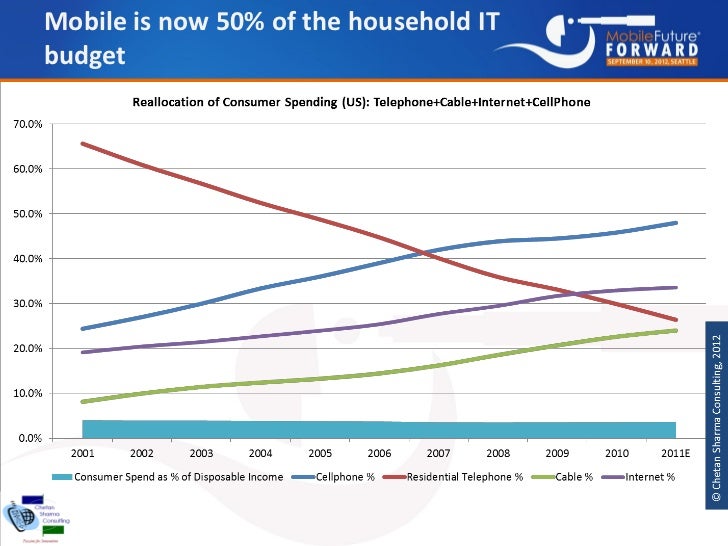
In 2001, about 65 percent of total consumer end user spending for all things related to communications and video services went to fixed network "voice."


In 2011, fixed network voice represented only about 28 percent of total consumer end user spending. That is easily a reduction by half.

Mobile is now 50% of the household ITbudget
source: Chetan Sharma

Mobility then replaced fixed network voice spending. 

Private LTE Use Case: Allowing Firefighters to See Through Smoke


Qwake’s C-THRU uses computer vision and augmented reality to allow firefighters to see in a smoke-filled building. It's an example of a private LTE use case. 

U.S. Consumers Still Buy "Good Enough" Internet Access, Not "Best"

Optical fiber always is pitched as the “best” or “permanent” solution for fixed network internet access, and if the economics of a specific...