Thursday, April 25, 2013

T-Mobile USA "No Contract" Plans are Deceptive, T-Mobile USA Agrees


T-Mobile USA’s “no contract” plans really aren’t, the Washington Attorney General's Office has found. As a result of an agreement between T-Mobile USA and the AG’s office, T-Mobile USA will modify its advertising nationwide.

T-Mobile USA recently launched new wireless service plans claiming to offer “no restrictions,” “no annual contract” and no requirement that the consumer “serve a two-year sentence.”  

The Attorney General argued, and T-Mobile USA agreed, that the claims are deceptive. Customers who purchase a phone using the 24-month payment plan must carry a wireless service agreement with T-Mobile USA for the entire 24 months or pay the full balance owed on phone if they cancel earlier.

So the plan really isn’t a “no contract” offer.

Logitech Revenue Dips 12%: Can You Say "Post PC?"


Logitech International fourth quarter results, for the period ending March 2013, fell 12 percent, year over year.

Sales for the latest quarter were $469 million, down 12 percent from $532 million for the same quarter of the prior year. "Turnaround" is the phrase the company now uses to describe its path forward. 

A "narrowed our strategic focus," job cuts and prioritized effort on products for tablets are examples of what Logitech is doing. 

It's just one more example of what is happening in the "post-PC" computing business. 


Time Warner Cable Offers its Customers "Free" Public WiFi

Google Fiber has gotten AT&T to say it will build a gigabit network in Austin. Time Warner Cable says it will give its Internet access customers "free" access to the Time Warner Cable public Wi-Fi network in Austin, Texas. 

"TWC WiFi" is a citywide WiFi Hotspot network free to Time Warner Cable customers with "standard Internet" plans or above, as well as "business class" subscribers. 

Prepaid access starting at $2.95 an hour will be available as well. 

So far, you'd have to deem Google Fiber a success, as far as spurring ISPs to upgrade Internet access. One would suspect the impact has only begun. 

OTT Messaging Represents 4% of Total Messaging Revenue

Over the top messaging apps are perhaps an apt metaphor for the ways the Internet has reshaped the communications business, most of us would likely agree. At various points in the recent past, there has been debate about whether the next generation telecom network would be the Internet.

That isn't true, precisely. There are private IP networks as there is a public Internet. There are Internet apps and carrier services. But to a degree that is discomforting, much of what people want to do these days can be done using the Internet, rather than any carrier-provided service.

Over the top messaging illustrates those changes as well as anything. But the OTT impact is not so much that it cannibalizes carrier messaging revenue. In fact, OTT probably represents something on the order of four percent of messaging revenues.

As often is the case, OTT does not so much replace existing revenue as destroy the business. Skype, for example, earns a modest amount of money in global telecom terms. But that is not what Skype represents. 

Instead of shifting revenue from one provider to another, Skype mostly kills the carrier voice business. Executives in the video entertainment business encapsulate that insight by talking by "trading analog dollars for digital dimes."

That pretty much gets it right. Internet alternatives only partly "take market share and revenue." Mostly, they destroy existing markets. T

bii_ottmsg_msgbrkdown

Will AT&T Try to Buy Vodafone?


A recent rumor that Verizon Communications and AT&T were making a huge joint bid for Vodafone was denied. Some think that only means Vodafone rejected the offer out of hand, but the deal of as much as $245 billion might yet see the light of day, in a new form.

Assume Verizon Communications is serious about now pursuing a long-rumored effort to buy  from Vodafone  the portion of Verizon Wireless it does not already own. Assume the deal proceeds and is finalized.

Would that put Vodafone back into play, with AT&T making a new bid?

Vodafone is the second-largest global mobile communications company, with approximately 403 million customers in its controlled and jointly controlled markets.

Vodafone currently has equity interests in over 30 countries across five continents and more than 50 partner networks worldwide.

AT&T would stand to expand in a major way as a global carrier, and find a way to overcome sluggish growth of its U.S. business.  

Such a bid would be ironic in some ways. In 2004, Vodafone made a bid for the entirety of AT&T Wireless when that company was for sale.

Had that bid been successful, Vodafone presumably would have sold its stake in Verizon Wireless, and then rebranded the former AT&T Wireless business as Vodafone.

Cingular Wireless, at the time a joint venture of SBC Communications and BellSouth ultimately outbid Vodafone and took control of AT&T Wireless, which now is known as AT&T Mobility.  

So in an odd turn of events, Vodafone, which tried to buy AT&T Wireless, would then be acquired by its former target.

Make no mistake, the rumored or potential deals would offer the two U.S. mobile service providers a pathway to growth. For Verizon Communications, owning all of its mobile business would immediately boost earnings. For AT&T, the Vodafone deal would catapult AT&T into the global market in a new way.

Strategically, the AT&T interest in Vodafone’s global assets is a clear sign that AT&T sees future growth in the U.S. market as problematic. Verizon first has to consolidate its U.S. business before it can consider looking overseas for future growth.

Internet Video Eventually Will Create Network Winners and Losers


The switch to Internet delivery of video is going to have profound impact on the strategic fortunes of current and future providers of Internet access and video content.

If you want to know why Charlie Ergen, Dish Network CEO, is so intent on getting into the mobile business, that is the reason. At some point, as bandwidth requirements rise, and more of the traffic load becomes video entertainment content, network topology matters.

Point-to-multipoint networks are very good at delivering linear TV, where essentially one copy of a stream can be beamed to scores of millions to hundreds of millions of people.

But such networks fall apart when the traffic is point-to-point, as traditional telephone networks are, or must support unicast video, as the Internet must. The faster Internet access becomes, and the more people use the Internet to watch lots of video, the more difficult it becomes for a satellite provider, or any other unicast medium, to match.

Likewise, as bandwidth demands grow, spectrum-based networks will be at a disadvantage, compared to wired networks. As much as people enjoy the freedom of watching video content anywhere, anytime, volume sooner or later will naturally be pushed onto fixed networks.

We already can see glimmers of that trend in smart phone consumption patterns, where in many instances a majority of volume is shifted to the fixed network. That will only be more important in the future, as unicast, personalized consumption begins to rival linear consumption.

“Eventually, as linear TV is viewed less, the spectrum it now uses on cable and fiber will be
reallocated to expanding data transmission,” says Reed Hastings, Netflix CEO. “Satellite TV subscribers will be fewer, and mostly be in places where high-speed Internet (cable or fiber) is not available.”

Clearly, Netflix and other streaming video services now are driving bandwidth consumption in the U.S. ISP business. Since at least 2011, real time entertainment content has represented at least 49 percent of peak hour traffic  in North America.

By 2012, video had grown to represent as much as 75 percent of peak hour traffic. For some ISPs, that is an opportunity to sell bigger access packages. For others, video entertainment represents a danger, threatening to overwhelm either access bandwidth or capacity caps, or both.

During peak periods of internet use in the US, Netflix constitutes 33 percent of all downstream traffic, according to Sandvine. That’s more than Google’s YouTube (14.8 percent), BitTorrent (5.9 percent), Apple’s iTunes (3.9 percent), Amazon Video (1.8 percent), and Facebook (1.5 percent).

That has clear implications for all ISPs. The issue is just how big an impact all that consumption is having.

Netflix says its users consumed “more than four billion” hours of content  in the first quarter of 2013, so assume that means 4.150 billion hours, globally.

The vast majority of Netflix streaming subs are in the United States, so assume about 88 percent of the streaming happens in the U.S., market.

That implies monthly U.S. consumption of about 1.2 billion hours. So how many subscribers are streaming? Netflix has projected 28.1 million streaming users. That further implies consumption of 73 billion minutes a month.

That implies 2,599 minutes of Netflix viewing per subscriber per month, or roughly 87 minutes per subscriber per day, or 43 hours per subscriber per month.

But there’s a new wrinkle: Netflix is launching new plans that allow for up to four simultaneous streams on an account instead of two for $11.99 a month, $4 more than the current $7.99 single user plan.

Netflix estimates one percent of customers will opt for the new “family plans.” But for ISPs already grappling with Netflix bandwidth demand, the new plan will potentially double Netflix bandwidth consumption from some percentage of Netflix households.

ISPs with the ability to provision lots more bandwidth and price services to reflect higher consumption will have an advantage. ISPs that cannot so easily do so will face a challenge competing.

The Telecom Business is Getting More Like the "Internet"


One growing discontinuity in the communications business is the natural tendency to view the business through functional silos that are losing their meaning. These days, in many markets, people using smart phones are on the fixed networks for access, more than mobile access.

That discontinuity is going to grow, but should be familiar to anybody who works in the Internet ecosystem. Namely, devices and apps are agnostic to the underlying access medium. So even when a company “knows” its own revenue model is directly driven by a specific network (mobile, fixed, fixed wireless, satellite), the networks get used by people and firms with which the access provider has no direct relationship.

In other words, there is a growing disconnect between the concepts of “my customers” and “my users.” Virtually any provider of Internet access has more “users” than “customers.” To be sure, some will see that as a prod to think about ways of creating relationships with users who aren’t customers.

But the trend also explains why ISPs worry about becoming “dumb pipes.” But there is a crucial distinction: every ISP always and everywhere operates as a dumb pipe. What people want is access to the Internet.

One can argue that particular ISPs sell “smart pipe” services. There is some logic to that. But most of those smart features wrap around the dumb pipe function is some way. Traffic can be shaped to improve user experience. Content can be cached. Charging systems can be reconfigured.

And ISPs routinely also act as content or app providers (carrier voice and entertainment video are services, not “Internet” accessed apps).

It is not that the Internet access function itself is in danger of disintermediation. It is not. But the business context is morphing. Some might well argue that dumb pipe Internet access is in fact the foundation service of the future, with “carrier services” wrapped around that access.

Some telcos are trying to do what cable operators have done, namely vertically integrating (in a loosely coupled way) by becoming app or commerce providers. The trend will grow, especially for ISPs that find they cannot significantly reduce operating or capital costs to compete with lower-cost providers.

“Until three or four years ago, consumers primarily accessed the Internet through PCs and laptops but at the beginning of 2013, the picture is very different,” says Amanda Sabia, principal research analyst at Gartner.

“Consumers use multiple screens to perform various activities that require both fixed and mobile internet connectivity,” Sabia says. Consumers are screen-agnostic; they will use whichever screen is convenient, as long as it is ‘connected.’”

Gartner reckons that global mobile devices (other than smart phones with a mobile data plan) per household will increase by more than eight percent annually through 2016.

1/3 of Planet Now Online

About a third of human beings now use the Internet. And most of the growth these days now comes from people in the developing regions. Mobile now represents about 10 percent of total usage, and will grow. 

New Rumor About Verizon Buying Rest of Verizon Wireless

Verizon Communications has hired advisers to prepare a possible $100 billion bid to take full control of Verizon Wireless from its partner Vodafone, according to Reuters. The latest rumor is but the latest rumor about Verizon buying the Vodafone stake

Among the recent rumors AT&T and Verizon bid for all of Vodafone. Given slower growth in most mobile markets globally and very low interest rates, the merger activity in the U.S. and other markets is logical. 

When firms cannot grow organically, they typically acquire growth. 


Wednesday, April 24, 2013

Does LTE Create New Revenue, or Only Displace 3G?

With every recent "next generation" of mobile networks, the hope and expectation has been that new revenue-generating services and applications would be created. That was true for 3G and now is said to be an expectation for 4G networks as well. 

It's a reasonable enough hope, even if it sometimes takes quite a long time for those new revenue-generating apps to be discovered and embraced. In fact, one might argue, it was until the advent of either mobile email and mobile Internet access that "new revenue generating services" became significant. 

That might logically be expected to happen for 4G Long Term Evolution networks as well. The issue is whether the "new revenue" is generated mostly by new retail policies, totally new apps, higher data consumption and therefore bigger data plans, or some combination of all of those possible trends.

Also, though it will be hard to quantify, users will simply shift from use of 3G to 4G, so LTE revenue cannibalizes 3G. 

Many executives say the "new revenue" will come in large part from an end to "all you can eat" data plans that are instituted with 4G. In that case, the "new revenue" does not come from "compelling new apps" but only from changes in charging policies. That is helpful for a mobile ISP, but perhaps not the same thing as arguing LTE will create brand new apps. 

So forecasts of "LTE revenue" have to be viewed with some circumspection. LTE might represent a third of revenue by 2017, Juniper Research forecasts, representing more than $340 billion worth of revenue. Other older estimates suggested faster revenue growth, but that isn't unusual early in the development of any new market. 

But the magnitude of the revenue stream is not the only, or most important, new fact. Aside from cannibalizing 3G revenue, aside from representing higher data consumption, and therefore higher access fee plans, will LTE actually enable the creation of brand new applications that generate revenue? That's the big question. 

Legacy Decline is Slow, at First, in Video Entertainment, Computing or Communications

In three different legacy businesses--video entertainment, communications and computing--we see examples of how robust markets eventually mature and then decay. 

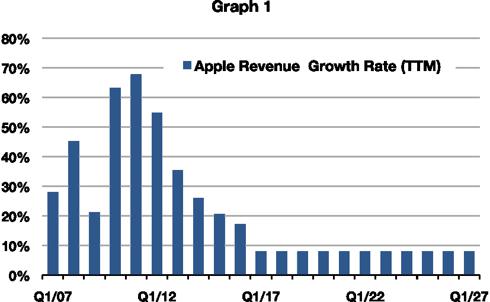
Apple. for example, might be on the cusp of transitioning from a fast-growing technology company to a slower-growing dividend-paying company, as many would argue already has happened to Microsoft. 

Canada has one of the highest pay TV penetrations in the world, estimated to reach nearly 90 per cent at year-end 2012, but like the US, IHS Screen Digest expects that pay TV penetration will be on a relentless yet shallow decline decline through 2017, as many newly formed households are less likely to take a traditional TV service. 

And AT&T seems to hitting something of a wall as well, as its recent earnings report show revenue is flat. If Long Term Evolution is doing anything other than compensating for declining revenues in other areas (parts of the consumer fixed network business or enterprise), it isn't immediately clear. 

But it also is important to note that even if firms such as AT&T, Apple and cable companies are at a point where the growth curve flattens, there is nothing to suggest inevitable rapid decline after a peak has been reached, or passed. 

In other words, transitions often build for long periods of time, with only apparently marginal and incremental changes in buyer behavior. But every big change eventually reaches an inflection point, where change is quite rapid. 

The big challenge is avoiding too much optimism about what can change in the near term, and too little optimism about the magnitude of ultimate change after the inflection point is reached. 

For suppliers, what happens, ideally, is a gradual decline, occurring over a relatively long time, allowing a firm time to reignite growth some other way. 

On the other hand, the technology business, especially the computing business, offers a rather bracing lesson for computing suppliers. 

Leaders in one era rarely survive as leaders of the next era. Some would argue the same process has been at work in the entertainment business, as it evolved from stage to radio to movies to television. 

The big question is how communications might change. Some would note that we are only now at the first big change in industry dynamics, as voice services cease to be the revenue driver. 

And though there is much logic to suggest the Internet access business largely will replace voice as the underpinning of the business, it is not axiomatic that today's suppliers of such access inevitably are so dominant in the future. We just cannot tell. 

Though Internet access will remain a capital intensive undertaking, precisely how much capital it will take, and who can do it, will be a somewhat open question in the future. 

And though one might argue that access providers these days are in a multi-product business (mobile voice, fixed voice, video entertainment, Internet access), there also are examples of "disappearance."

AT&T, for example, never was able to evolve beyond its "long distance" revenue dependence. Nor did MCI. As crazy as it sounds, we cannot say for certain, today, how Internet access will be supplied in the future, and by whom. 

Are Apple Earnings Evidence of a Coming New Era of Computing?

Students of computing history are familiar with the notion that each distinct era of computing has been lead by a different set of companies than lead the era that preceded the new era. that doesn't mean, in some mechanical fashion, that the leaders of a former era always disappear.

Some will note that IBM still exists, though as a far different sort of company. In fact, one might say other leaders in past eras, including HP and Dell, are trying to recreate themselves largely on the IBM model, which is to say as consulting specialists, not hardware suppliers. 

Its too early to say if the pattern will hold in the next era to come. But history suggests the pattern will hold. If so, household names such as Apple might cease to be seem as the trendsetters of the next era.

It is a shocking concept, to be sure. But some observers would say the recent Apple earnings call, with its predictions of slowing growth, declining profit margins and a greater emphasis on the "value" element of owning Apple equity, rather than growth, illustrate the process at work. 

As happened to Microsoft before it, Apple might be on the cusp of becoming a "value play," not a "growth play." The corollary, one might also argue, is that as Microsoft is seen in many quarters as "not leading" in computing any longer, so Apple in several years might also be seen as a past leader, not a current leader.

It's shocking, but history suggests it will happen. 

Netflix Success Challenge in a Nutshell

In a nutshell, the key challenge for Netflix is to "grow members and revenue faster than content spending," as the latest Netflix shareholder letter mentions. In other words, Netflix has effectively become a programming network, not just a content delivery service.

And as has been true for all programming networks, original and unique content is the growth driver. That doesn't mean every bit of content, or even most content, has to be unique to a particular network. But virtually all popular networks have one or more "signature series" that define the network and pull in viewers.

Netflix will have to invest to do so, and that means there is going to be a tension between doing so and then adding enough additional new subscribers to keep its profit margins intact. 

Apple Financial Results Answer No Key Questions

Apple's fiscal 2013 second quarter ended March 30, 2013 included quarterly revenue of $43.6 billion and quarterly net profit of $9.5 billion, compared to revenue of $39.2 billion and net profit of $11.6 billion for the same quarter of 2012.

Despite posting results most companies would be happy to report, such as "average weekly growth of 19 percent, Apple's quarterly results do not answer any of the strategic questions observers now have about the company. 


What is the "next big thing" to drive Apple sales and customer delight? 

Can Apple create yet another big new market? Perhaps most importantly, has Apple lost the creative edge and become a "normal company" with a "normal growth rate?

In fact, some think single-digit growth rates are where Apple is headed, in perhaps five years. 

Nor, it appears, will it be possible to resolve any of those questions until perhaps September 2013, or possibly even 2014, when Apple says it will launch the next round of new products. "Our teams are hard at work on some amazing new hardware, software, and services that we can’t wait to introduce this fall and throughout 2014," CEO Tim Cook said. 

And while the big strategic questions are not narrowly financial, financial performance is an issue. Gross margin was 37.5 percent compared to 47.4 percent in the year-ago quarter, for example. 

Apple estimates its gross profit margin will dip a bit further in the next quarter, and the company faces sharply declining rates of growth. Questions about Apple strategy also revolve around the likely impact on margins if lower-cost iPhones, despite the company's denials, are launched, as is the case for lower-cost iPads as well. 

International sales accounted for 66 percent of the quarter’s revenue, and growth was driven by the iPhone and iPad. Apple sold 37.4 million iPhones in the quarter, compared to 35.1 million in the year-ago quarter. 

Apple also sold 19.5 million iPads during the quarter, compared to 11.8 million in the year-ago quarter. 

By way of comparison, sales of sold just under four million Macs, compared to four million in the same quarter of 2012 show a slight decline. 


Tuesday, April 23, 2013

Apple and AT&T are Borrowing Money to Pay Dividends

In an unorthodox move that reflects relatively low interest rates and the high tax rate on bringing cash from overseas accounts back to the United States, Apple says it will begin to borrow money to fund share buybacks and a higher dividend

AT&T is doing so as well. In 2012, AT&T dividend payments were nearly $4 billion more than its free cash flow. And AT&T sees free cash flow being some $5 billion lower in 2013. Something has to give, some would say. 

In 2012, AT&T spent $12.8 billion to buy back shares, and another $10 billion to pay dividends. Company-wide, AT&T increased long-term debt by $5 billion in 2012. 

Given the super-low interest rates on corporate debt, there is an argument to be made for using debt to fund either share repurchases or dividends. Some might not agree it is a terribly good argument, though. 

Yes, Follow the Data. Even if it Does Not Fit Your Agenda

When people argue we need to “follow the science” that should be true in all cases, not only in cases where the data fits one’s political pr...