Monday, April 20, 2015

Commercial Project Loon Service in 2015 or 2016?

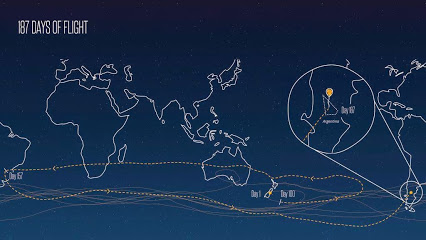
Some time in 2015 or 2016, if all goes according to plan, Google believes it will be able to create a continuous, 50-mile-wide ring of Internet service around the globe, initially focusing on potential customers across southern Africa, southern Australia, New Zealand and southern Latin America, and supplied by Project Loon, the constellation of planned unmanned balloons.  


The general plan seems to be to pioneer LTE service acorss relatively sparse areas before expanding to more-populous areas.

Google estimates the cost of coverage to be an order of magnitude less than building a network of cell towers to provide equivalent coverage.

Although Project Loon initially tested Wi-Fi as the communications protocol, it has since switched to Long Term Evolution, making mobile service providers logical partners.

Google says it can now deliver data at 5 Mbps to mobile phones, or 22 Mbps to fixed antennas.

Regulators Cannot See the Future, But Still Have to Try

Regulators cannot foresee the future: they have to do the best they can, without knowing how the economic context surrounding the industries they regulate will change.

So it is not surprising that it sometimes is said that regulators are “behind the market,” or “behind the technology,” no matter how hard they try to stay current.

A couple of recent developments illustrate the problem. In the U.S. market, where Comcast wants to acquire Time Warner Cable, Comcast has proposed concessions to keep its video market share at 30 percent, the traditional level of market share beyond which market concentration and antitrust issues are raised.

Some argue that is the wrong test. Combining the nation’s two largest cable and Internet providers would create a company with 57 percent share of the market for high speed access service, now defined by the FCC as 25 Mbps or higher.

That matters because the linear video business widely is viewed to be under threat, while high speed access has emerged as the key or strategic service for any access provider.

In other words, if the video business is declining, it makes little sense to worry too much about market share in that business. If, on the other hand, high speed access now is the crucial service, it makes lots of sense to watch market share developments for that product.

To be sure, “defining the market” always is a key premise and assumption. In this case, one might argue it is video, voice, Internet access or triple play services that constitute the relevant market. Some might argue the market is “fixed network” services only, while others might look at all providers--whether mobile or fixed.

Regulators have been surprised before by fundamental changes in markets. In the period leading up to passage of the Telecommunications Act of 1996, the thinking was that the relevant market was fixed network voice.

Within four years, the voice market peaked, and has declined steadily ever since. Instead, it was the Internet, and services, business models and apps based on the Internet, that has become strategic.

To a significant extent, U.S. antitrust regulators have to make choices about what drives future competition: video or high speed access?

European Union regulators face a related problem: namely perceived Google dominance of the search market, and possibly the mobile operating system market as well.

Some of us would say Google’s search market share is a  trailing indicator, not a leading indicator.

In other words, as was the case earlier when Microsoft was similarly investigated and fined, action assumed a linear continuation of alleged market dominance, instead of a market that already was peaking and headed for massive change.

In other words, a shift is likely already to be underway, rendering the danger of Google antitrust danger quite moot.

Whether the relationship was causal or simply correlated, the decade-ago investigation by the EU of Microsoft’s similar antitrust threat coincided with the emergence of a new era of computing, and computing industry leadership.

The problem faced by regulators and business leaders often is that strategies deemed vital at one moment in time can seem almost irrelevant a decade later.

Consider the launch of the Android mobile operating system by Google, seen in 2005 as an insurance policy against complete dominance in the mobile realm by Microsoft, with the danger that could pose for Google apps on mobile devices.

That was before the emergence of the Apple iPhone. A decade later, the strategic rationale arguably no longer has such potency. For starters, Microsoft Mobile is not a huge factor. Nor has Android proved to be the boon many might have expected. Android doesn’t directly generate revenue for Google, and “forked” versions of Android even are proving to be the foundation for new rival ecosystems (Amazon now, and possibly Microsoft and others in the future).

The Telecommunications Act of 1996 likewise was the first major revision of the Communications Act of 1934. Aiming to introduce competition in the telecommunications market, the Act focused on enabling voice competition.

More than a decade later, it is clear what really happened. Voice was about to reach its peak of adoption in 2000, to begin a steady decline. The Internet, meanwhile, emerged as the vital source of telecommunications-delivered applications and value.

The Act made sense at the time. But policymakers could not have foreseen the maturation of voice and its replacement by Internet apps as the source of innovation and growth.  

It is very hard to make the right strategic decisions today, and have them remain relevant after a decade. Both the Telecommunications Act of 1996 and launch of Android were aimed at problems that did not materialize, or arose from unexpected directions.
Google Project Loon Now Can Mass Produce Internet Balloons: Launch Coming?

Google "Project Loon," the anticipated effort to launch a constellation of unmanned balloons able to provide Internet access across the global south, now is able to mass produce the balloons in a matter of hours, where it once took three to four days to make a single balloon. 

That sounds like Porject Loon getting ready to launch a full constellation. 

With a few new low earth orbit satellite constellations also preparing to launch in coming years, competition in the Internet access business is heating up in a profound way, posing a challenge to mobile operators who once were thought to be the logical suppliers of Internet access across much of the global south. 

Still, Project Loon appears to be testing the use of mobile Long Term Evolution cell towers for backhaul. At the very least, Project Loon, in a commercial phase, could be a wholesale customer for many mobile service providers across the global south. 

Conversely, Project Loon could be a wholesale provider to mobile service providers, who would use the constellation to provide branded retail Internet access service. 

Sunday, April 19, 2015

Android, Telecom Act of 1996 Were Misplaced, as it Turns Out

The problem faced by regulators and business leaders often is that strategies deemed vital at one moment in time can seem almost irrelevant a decade later.

Consider the launch of the Android mobile operating system by Google, seen in 2005 as an insurance policy against complete dominance in the mobile realm by Microsoft, with the danger that could pose for Google apps on mobile devices.

That was before the emergence of the Apple iPhone. A decade later, the strategic rationale arguably no longer has such potency. For starters, Microsoft Mobile is not a huge factor. Nor has Android proved to be the boon many might have expected. Android doesn’t directly generate revenue for Google, and “forked” versions of Android even are proving to be the foundation for new rival ecosystems (Amazon now, and possibly Microsoft and others in the future).

The Telecommunications Act of 1996 likewise was the first major revision of the Communications Act of 1934. Aiming to introduce competition in the telecommunications market, the Act focused on enabling voice competition.

More than a decade later, it is clear what really happened. Voice was about to reach its peak of adoption in 2000, to begin a steady decline. The Internet, meanwhile, emerged as the vital source of telecommunications-delivered applications and value.

The Act made sense at the time. But policymakers could not have foreseen the maturation of voice and its replacement by Internet apps as the source of innovation and growth.  

It is very hard to make the right strategic decisions today, and have them remain relevant after a decade. Both the Telecommunications Act of 1996 and launch of Android were aimed at problems that did not materialize, or arose from unexpected directions.

Comcast Shows Moore's Law Applies in Internet Access Business

Comcast has been doubling the capacity of its access network every 18 months, precisely what one would expect from any product based on Moore’s Law.

The latest move is an upgrade of the entire Comcast residential footprint to 1 Gbps by the end of 2015, with 2 Gbps service available to about 86 percent of locations.

The thing about Moore’s Law, and any product built in part on Moore’s Law, is that the benefits flow broadly across the full range of use cases, and are not restricted to the headline improvements.

In other words, the fact that a given level of memory or processing doubles, but can be purchased at the same price, also means performance and price relationships are enhanced across the full range of processors and memory, below the headline figure.

That is the case for Comcast’s Internet access services, not scheduled to be upgraded to 1 Gbps across the full footprint, while 86 percent of locations are upgraded to a symmetrical 2 Gbps capability, by the end of 2015.

Though the “headline” is the boost in top marketed speeds to 2 Gbps, most consumers will  benefit because the speeds they actually buy are boosted, for no extra price.

That, more than the upgrade to 1 Gbps or 2 Gbps, symmetrical, is where the impact mostly will occur.

Comcast is launching “Extreme 250,” a new 250 Mbps Internet speed tier for California customers, but also boosting the “Performance” tier from 50 Mbps to 75 Mbps and its Blast tier from 105 Mbps to 150 Mbps, both at no additional cost to customers.  These changes will go into effect starting in May 2015.

Oddly enough, most consumers will not be able to detect the changes, the simple reason being that, beyond about 10 Mbps to 15 Mbps per user, the fundamental constraints on experience lie with the far-end servers, not the local access pipe.

Gigabit speeds will not--by itself--improve user experience, in other words.  After about 10 Mbps, no single user is likely to see much improvement, if at all, in page load times, for example.

The U.S. Federal Communications Commission and U.K. Ofcom agree: beyond 10 Mbps per user, experience is not measurably improved--if at all--by faster Internet access speeds.

Instead, latency is becoming the key experience limitation.

Still, the primary “benefits” of gigabit or 2 Gbps speeds will be “seen” (in terms of marketing message) at the lower speed tiers up to 150 Mbps, which users will get at no extra charge, and which are the tiers of service most people now buy.

That is as much a Moore’s Law impact as the headline speed.  

Saturday, April 18, 2015

Cut Fees to Spur Investment, India's Telecom Regulatory Authority Says

Lower the price of some desired product and consumer will buy more; raise the prices and consumers will buy less. That is the economic logic behind zero rating of apps and government taxation and fee policies as well.

So barring zero rating and sponsored apps will reduce demand and usage of the Internet. Likewise, limiting licensing fees for fixed network infrastructure will spur investment in facilities.

In fact, lower prices undoubtedly already have boosted high speed access adoption in India. Entry level tariffs for broadband services have dropped “drastically” (an order of magnitude, or 10 times) from Rs. 1500 per month (US$24) in 2004 to around Rs.500 a month (US$8) in 2014.

Most service providers charge a monthly rental between Rs.200 (US$3) to Rs.1600 (US$26) for a broadband connection (depending on speed), TRAI says.

In an effort to spur adoption by customers and investment by suppliers, the Telecom Regulatory Authority of India has asked the government to exempt fixed line broadband service from license fees for at least five years. That would have the effect of stimulating consumption by enabling lower prices.

But there are other obstacles as well. In a discussion of delivering broadband quickly, TRAI noted that “right of way” charges are the “single biggest impediment to the adoption of wire line technology for access networks.”

Also, “civic authorities have imposed stringent punishment on the erection of towers.”

In other cases, the time required to process applications is an issue. “Procurement of satellite capacity on foreign satellites through Department of Space (DoS) often results in long delay and increase in prices due to some process flaws,” said TRAI.

Similar bureaucratic issues surround the Bharat Braodband Network Limited (BBNL), the entity  set up by the Government of India to create a National Optical Fibre Network (NOFN).

TRAI also recommends allowing cable TV operators to provide high speed access. There are some 97 million Indian homes connected to cable TV networks, and a great proportion of those homes are in rural areas most in need of high speed access.

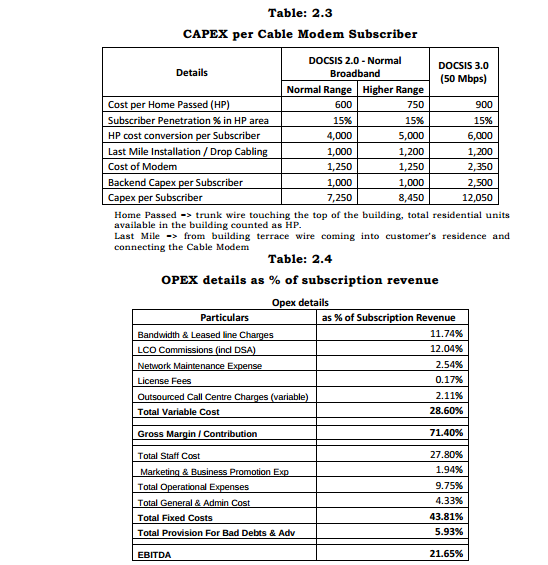
Perhaps 24 million of those homes are served by networks capable of supporting data services, TRAI estimates. It is possible the incremental cost of upgrading for 50 Mbps could be as low as Rs. 12,500 (US$200).

At least at the margin, the costs of deploying fixed network infrastructure are aided if licenses, permits and other processes are streamlined.

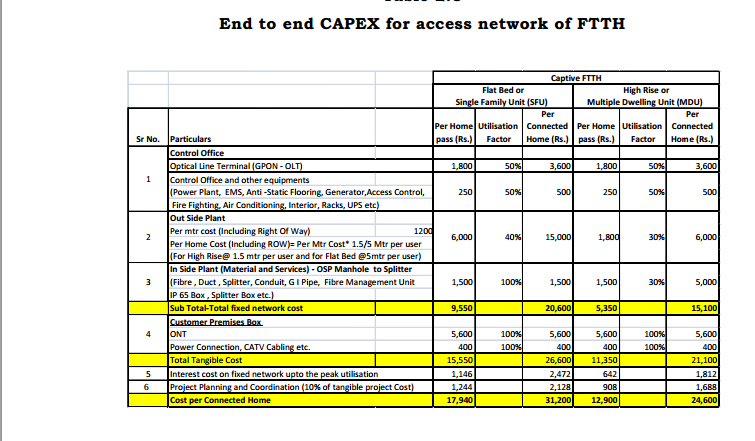
The "cost of laying fiber in some cities is as high as Rs 1.92 crore (about US$308,000 million per kilometer or $493,000 per mile) for a kilometer apart from cost of fiber,” said TRAI Chairman Rahul Khullar. “The fiber itself costs Rs 65,000 a kilometer (about US$1039 per kilometer, or $1662 per mile).”

“This issue needs to be resolved otherwise who will lay fiber," Khullar said.


Friday, April 17, 2015

Verizon Probably Looked North to Create Custom TV

The new Verizon Custom TV bundle, allowing FiOS customers to buy a simple, affordable 35-channel service, with the option to add on theme packs of channels for about $10 each, is a clear reaction to market demand for less-costly, more customized ways to buy entertainment video.

But the new Custom TV, similar in many ways to Sling TV and other over the top packages yet to come, most resembles a “pick and pay” model instituted in Canada.

Cable TV channel unbundling--though not complete unbundling--is coming to the Canadian market. By the end of 2016, subscription TV customers in Canada will be able to buy many channels they want, one by one or in small packages, the Canadian Radio-Television and Communications Commission has ruled.

By the end of 2016, TV subscribers will have the option to add those networks to a “skinny” basic cable package that will cost no more than $25 a month. But consumers can buy a traditional bundle of channels if they choose.

Distributors must have the “skinny” basic service announced Thursday in place by March, 2016.

That tier must include all local and regional stations, public interest channels such as the Aboriginal Peoples Television Network (APTN), education and community channels, plus provincial legislature networks.

If distributors wish, they can add national over-the-air stations such as CTV, City and Global, or U.S. networks ABC, CBS, NBC, FOX and PBS. But they cannot raise the price beyond $25 a month.

By December of 2016, other channels must be available a la carte. But those channels also can be sold in a small bundle of perhaps five or 10 channels, which might be built by the viewer or the distributor.

Access Network Limitations are Not the Performance Gate, Anymore

In the communications connectivity business, mobile or fixed, “more bandwidth” is an unchallenged good. And, to be sure, higher speeds have ...