Friday, August 14, 2015

Netflix Shuts Down Last Data Center

Content companies are prime candidates for cloud computing, and Netflix provides a good example.

Netflix is shutting down its last owned data center, making it a leader among large enterprises relying fully on public cloud computing.

Netflix has been 100 percent cloud-based for customer facing systems for some time.

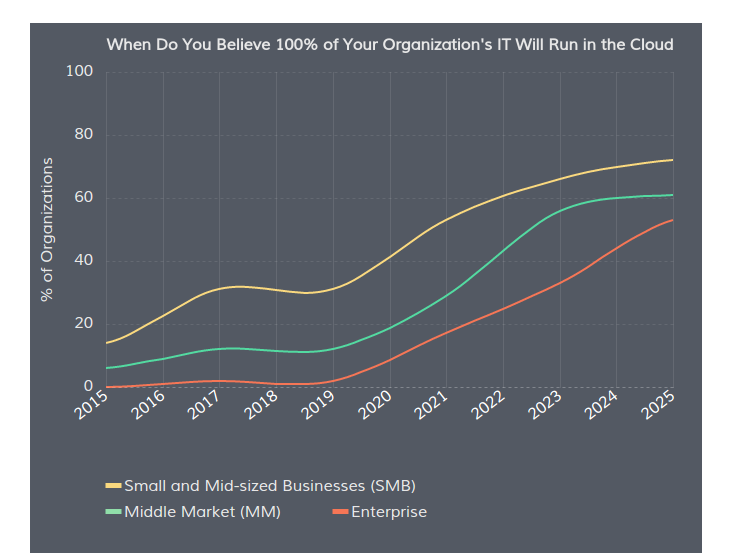
About 12 percent of companies run information technology operations entirely in the cloud, according to a recent survey of 1,500 IT professionals by BetterCloud.

In five years almost 50% of our respondents said they will be moving their IT entirely to the cloud; in 10 years, that number will climb to nearly 70 percent.

Nearly all of those companies are small or medium-sized businesses. By 2022, just slightly more than 20 percent of large enterprise companies are expected to operate entirely in the cloud.


Mobile Operators Looking at How to Monetize Wi-Fi

Where it comes to Wi-Fi networks, the revenue model always has been an issue. 


For most mobile operators, fixed telephone networks and cable TV operators, public hotspot Wi-Fi originally was an amenity, a useful feature for buyers of either mobile or fixed Internet access service. That has meant there was very little direct revenue. 


The upside came from better marketing platforms and lower churn rates. 


In-home Wi-Fi was a feature that made wiring chores to support in-home signal distribution easier and less costly. That arguably had operating cost and some capital cost savings, but did not directly create a clear revenue stream.


Also, Wi-Fi access for mobile and other devices has been a means of providing better signal coverage and access speed. Valuable, to be sure, but not a direct revenue contributor. 


More recently, Wi-Fi has been a means of offloading traffic from mobile to fixed networks, improving user experience, slowing the rate at which mobile network capacity upgrades were required, and boosting subscriber satisfaction by reducing the hit to mobile Internet usage buckets.


It remains to be seen whether mobile network ability to use Wi-Fi can be directly monetized, but it appears some mobile operators will try to do so.

New AT&T Mobile Value Share Plans Cut Cost per Gigabyte

AT&T is launching new Mobile Value Share plans Aug. 15, 2015 featuring bigger Internet data allotments. More notably, prices per GB are lower.

The changes to the Mobile Share Value plans include the elimination of the current one gigabyte plan for $25, 3 GB plan for $40 and 6 GB plan for $70. Under that pricing scheme, price per GB started at $25 and dropped to $12 per GB.

Replacing those plans are a 2 GB plan for $30 and a 5 GB plan for $50. Those plans have a device attachment cost of $25 a month. Under the new plans, price per GB starts at $15 and drops to about $7 per GB.

The new 15 GB plan costs $100 per month and the 20 GB plan costs $140 per month. Both plans also now include unlimited voice calling and text messaging from the U.S. to Mexico and Canada as well as the $15 charge per smartphone.

AT&T Value Share Plan Mobility Cost Per Gigabyte
Legacy cost
$25
40
70

Legacy plan data
1
3
6

$/GB
$25
$13
$12


New plan data
2
5
15
20
New plan cost
$30
$50
$100
$140
$/GB
$15
$10
$7
$7


“Tomorrow, we roll out new plans for everyone, including a plan that gives 50 percent more data than on our most popular plan,” said David Christopher, chief marketing officer, AT&T Mobility.

Customers on a new 15GB plan or higher will also receive unlimited talk and text to Mexico and Canada.

Monthly Plan Charge
Data
Monthly Device Access Charge3
Unlimited Talk/Text to Mexico and Canada
$20
300MB
+$25/Line with
AT&T Next
$30
2GB
$50
5GB
$100
15GB
+$15/Line with
AT&T Next
included
$140
20GB

Thursday, August 13, 2015

New Delhi Plans Free Public Wi-Fi

Officials in New Delhi are formulating plans for public Wi-Fi, offering residents up to 1 GB per month of free Wi-Fi access, at a minimum speed of 1 Mbps, supplied by private operators.

In the first phase, expected to be completed in a year, public Wi-Fi would be deployed in government and private colleges, according to the Times of India.

Ashish Khetan, vice-chairman of Delhi Dialogue Commission, said that in a second phase, public Wi-Fi will be provided in rural areas, followed by some urban areas.

There are roughly 275 rural and urban villages which don't have Internet access.

The business model is not clear, but it seems as if the Delhi government will pay a fee of some sort to the providers, based on end user consumption.

New Delhi Plans Free Public Wi-Fi

Officials in New Delhi are formulating plans for public Wi-Fi, offering residents up to 1 GB per month of free Wi-Fi access, at a minimum speed of 1 Mbps, supplied by private operators.

In the first phase, expected to be completed in a year, public Wi-Fi would be deployed in government and private colleges, according to the Times of India.

Ashish Khetan, vice-chairman of Delhi Dialogue Commission, said that in a second phase, public Wi-Fi will be provided in rural areas, followed by some urban areas.

There are roughly 275 rural and urban villages which don't have Internet access.

The business model is not clear, but it seems as if the Delhi government will pay a fee of some sort to the providers, based on end user consumption.

Which Way for Sprint?

Was SoftBank’s acquisition of Sprint a mistake? Some, possibly even including SoftBank CEO Masayoshi Son, might agree with that assessment. The growing view is that SoftBank believed it could swiftly merge Sprint with T-Mobile US, creating a more-hefty competitor in the U.S. mobile market.

Perhaps that, more than any ability to replicate in the U.S. market what SoftBank had done in the Japanese market, was key to the strategy.

If so, a misreading of U.S. telecom policy doomed the initial strategy. Some believe, based on Son’s own statements, that SoftBank would have sold Sprint, if were there any bidders. It appears there have not been any such potential buyers.

Some believe Sprint might get another shot at a merger with T-Mobile US after the U.S. presidential elections. Others believe a buyer or partner could yet emerge. But many think the size of Sprint’s debt and it’s on-going financial losses will be a big barrier.

Sprint recently has generated some $8 billion in quarterly revenue, but lost $2 billion on those sales. It has cumulative losses of $50 billion since about 2007.

What will Sprint (or SoftBank) do next, in its effort to regain financial value? Options appear to be more limited than when Sprint first was acquired by SoftBank.

Sprint cannot grow through acquisition, and likely cannot be sold, at the moment. That leaves mostly the difficult task of turning the business around, on an operating basis. As has been the case for years, reversing Sprint’s sales subscriber growth and profit picture is a fundamental requirement for any other positive outcome: acquisition, sale, merger or organic growth as an independent company.

Rival T-Mobile US, in fact, points the way. Having achieved robust organic growth, T-Mobile US arguably has become a more attractive acquisition.

At this point, a merger between Sprint and T-Mobile US, as logical as that might seem to many, is a less likely outcome than the acquisition of both firms by other entities. Dish Network and Comcast are the names most often raised in that regard.

Most of Dish Network's value now resides in its spectrum licenses, not its operating business. And Dish will forfeit that value if it does not somehow create an operating network using those frequencies, or sell them.

Comcast, for its part, will move deliberately. It is unlikely to buy a troubled asset, and even less likely to want to enter the mobile business without some clear sense of differentiation.

For the  moment, that likely means Sprint will have to work on organically reshaping its business, for any eventual sale. .
Wednesday, August 12, 2015

No Sustainable Advantage on Canada-U.S.-Mexico Calling

Sustainable advantage is quite difficult in any competitive market. So it is in the U.S. mobile market. Some might debate who moved first to lower tariffs across Canada, the United States  and Mexico.

A reasonable person might say it was AT&T, promising to make calling between the United States and Mexico as seamless as calling within the United States or Mexico, that prompted T-Mobile US to launch its own offer.

Within short order, Sprint and Verizon Wireless all responded with offers offers of their own.

At Alphabet, AI Correlates with Higher Revenue

Though many of the revenue-lifting impacts of artificial intelligence arguably are indirect, as AI fuels the performance of products using ...