Wednesday, October 21, 2015

AT&T, Verizon Video Strategies Fit Their Revenue Sources

Differentiating business strategies are among the key features of a global telecom business since the wave of privatization and deregulation starting in the 1980s. Where monopoly telecom service providers once looked remarkably alike, in terms of customer bases, products and strategies, they now are beginning to diverge.

In the U.S. market, some now say the clearest example of differentiation between Verizon Communications and AT&T lies in their approach to video entertainment services. Where AT&T bought DirecTV, increasing its exposure to linear TV distribution, Verizon purchased AOL and launched a mobile video service (Go90).

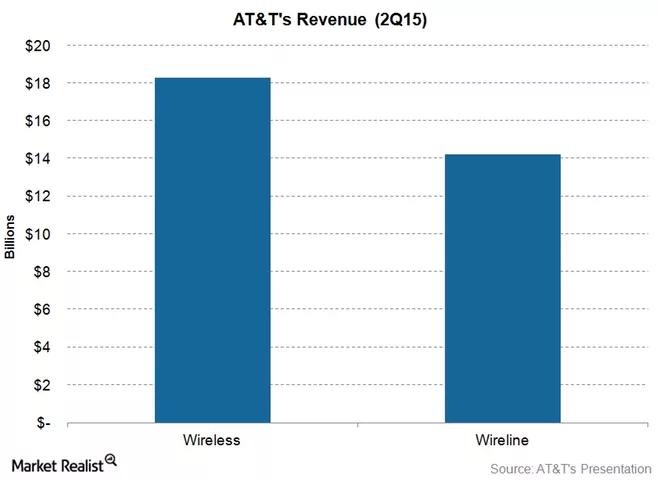
Actually, that divergence arguably is based on other earlier divergences. Verizon, with a smaller fixed network footprint, has become a mobile service provider with about 15 percent of revenues generated by all fixed network operations.

AT&T remains far more “balanced,” earning 44 percent of total revenue from fixed services. Given that profile, it makes sense for Verizon to focus on mobile video, and for AT&T to focus on linear video.

While DirecTV, as a satellite-delivered service, is not strictly “landline,” nor is it “mobile” service. Functionally, however, DirecTV will resemble a “fixed” service, sold to fixed locations.

Both company strategies, though, focus on the ability to sell an entertainment video services that matches its network assets (Verizon earns 85 percent of revenue from its mobile platform; AT&T earns 44 percent of revenue from fixed services).

Bharti Airtel, Idea Cellular Could Lose 5% of Profits from New Call Drop Rules

Bharti Airtel and Idea Cellular could lose up to five percent of their pre-tax profits as a result of new Telecom Regulatory Authority of India (TRAI) rules about compensation to consumers for dropped mobile calls.

Under the new rules announced by TRA,, mobile users will get a compensation of Re 1 for every dropped call, starting on  January 1, 2016.

The thinking is that the penalties will be larger than actual earnings on many calls. Whether that is literally the case, or not, some of us might argue that billing costs will be a material factor.

In other words, the time and expense of verifying whether a specific refund is to be applied, and then applying the credit, will be larger than the profit margin on any specific call. Nor is it entirely clear that all “call drops” can be accurately measured.

Part of the difficulty is determining when a “dropped call” has occurred. That is a judgment call, to some extent.

The reason is the definition used by mobile operators is very different from what a customer understands as a dropped call, said Kartik Raja, founder and managing director of Phimetrics Technologies.

“When I can’t hear you and the line just goes mute, but my phone shows that the call is still on, from a network point of view it is not a call drop,” he said. “For the network, only when they receive a message saying the call is dropped, it is counted as a call drop.”

Phimetrics conducted a study of telecom voice services, which began by defining a dropped call from a customer’s point of view rather than use a telecom company’s definition.

Using that method–when two users can’t hear each other for more than 10 seconds–the dropped call rates of two percent and three percent looked more like five percent and 15 percent, respectively.

"We consider this regulation as hard to implement in the current form and expect telcos to contest this ruling,” said Bank of America Merrill Lynch.

Tuesday, October 20, 2015

Dish Network Will Not Allow its Mobile Spectrum Assets to Fall to "Zero"

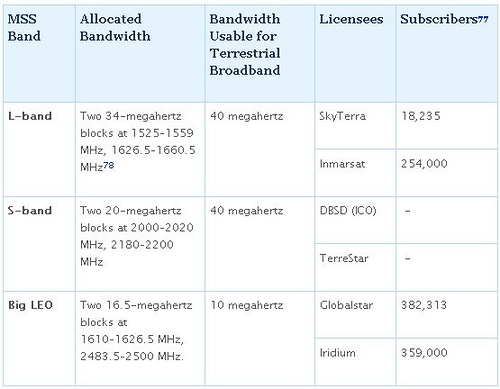
The only certainty, where it comes to what Dish Network might do with its mobile spectrum assets, is that the firm will never allow the value of those assets to fall to zero. Beyond that, almost any monetiztion strategy is conceivable.

Despite the difficulties, some analysts think Dish Network might finally move to create a mobile business by first striking a long-term spectrum leasing deal with Verizon before the start of the 600-MHz incentive auctions planned for the first quarter or second quarter of 2016.

In general, any such deal would have Verizon trading long-term spectrum rights obtained from Dish Network for turned-up mobile capacity Dish Network could use to launch its mobile service.

Another scenario is Dish creating a spectrum leasing company that supplies different spectrum assets to different customers, including Verizon, AT&T and Sprint.

Though one cannot completely discount Dish doing a deal of some sort with either T-Mobile US or Sprint, neither of those companies could easily consider any major cash deals, and neither company really needs more spectrum right now.

In principle, a spectrum deal, or creation of a spectrum leasing company, would not necessarily prevent Dish from inking other deals with other carriers. Dish might well require retail store support, for example.

Perhaps Dish’s business plan would combine both mobile and fixed access. About the only scenario not conceivable is that Dish Network would allow the value of its spectrum holdings to fall to zero.

And though any such deals are logically discrete from the upcoming 600-MHz incentive auction, any such deals would affect contestant interest in that auction.

In addition to the decision by Sprint to sit out the auctions entirely, removing a major bidder for the reserve spectrum, now Verizon is hinting that it sees less value in the 600-MHz bands, because it already relies on 700-MHz spectrum.

And Verizon’s thinking would definitely shape its need and willingness to bid in the 600-MHz auctions.

Verizon has said it does plan to bid for 600-MHz spectrum, but Verizon also seems to be signaling that it has other options, and might not bid as aggressively as some had thought likely.

To be sure, such statements might, aside from other reasons, be positioning tactics, designed in part to dampen expectations that Verizon would be forced to bid “whatever it took” to acquire spectrum in the 600-MHz auction.

Perhaps Verizon also is signaling that it is less interested in 600-MHz spectrum than some had hoped Verizon would be, perhaps tempering expectations of license sellers and containing prices.

On the other hand, such statements also signal that a potential deal with Dish Network for wholesale access to its spectrum at 2-GHz is perhaps more interesting. That might also dampen price expectations for 600-MHz spectrum.

"Higher frequency spectrum is capacity and that's really what we need at this point in time," said Fran Shammo, Verizon CFO.

But it also would be necessary for Verizon to conclude any such deals before the 600-MHz auctions start, to comply with anti-collusion rules.

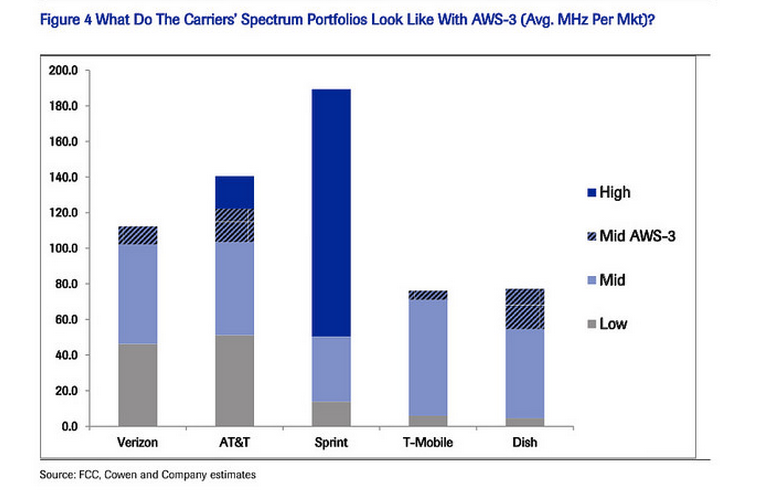
Most mobile spectrum is valued on either its coverage or its capacity dimensions, the basic trade off being that lower-frequency spectrum is better for coverage, but less valuable for capacity, while higher-frequency spectrum is better for capacity than coverage.

Verizon arguably has a reasonable amount of “coverage” spectrum, but not so much “capacity” spectrum.


The Force Awakens


Because you need to relax, sometimes. 

66% Mobile Broadband Adoption in Middle East, North Africa by 2020

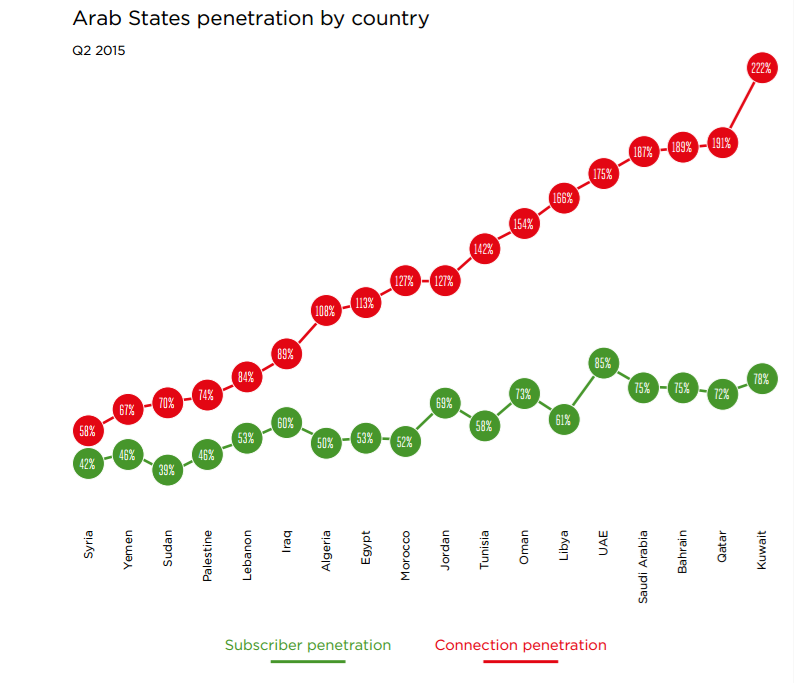
Mobile broadband networks will support more than 66 percent of all mobile connections across the Arab States of the Middle East and North Africa by 2020, according to a new GSMA study.

The study predicts there will be 350 million 3G or 4G mobile broadband connections in the Arab States by 2020, accounting for 69 per cent of the region’s total connections by 2020, up from just 34 per cent at the end of 2014.

The number of smartphones connections in the region is forecast to almost triple between 2014 and 2020, reaching 327 million.

Many Large Public Hotspot Networks Will Be Carrier Grade (and Use QoS) by 2020

It would have been easy to predict, in advance of the promulgation of network neutrality rules, that such rules would simply push suppliers in other directions, either to improve business models or introduce differentiated new services.

That appears to be happening.

Despite the existence of network neutrality regulations--which apply to consumer access services--it appears quality of service mechanisms are going to be quite a prevalent feature of end user experience on many public hotspot networks, as such rules are enablers of new services and revenue streams.

Some important consumer applications actually benefit from, and under conditions of congestion, might require, quality of service (packet prioritization) mechanisms. And public Wi-Fi hotspot networks now are emerging as one expression of support for such QoS-enabled services.

That apparent contradiction is easy to explain, if one thinks about the matter. Though retail consumer Internet access services are covered by present network neutrality rules, business services are not covered.

A public hotspot is a business service, not consumer service. Whether the buyer is a hotel or coffee shop, or part of a network of public hotspot services, amenity Wi-Fi is a business service, not “consumer Internet access.”

So there is no violation of network neutrality rules, if a public hotspot is used to support QoS-enabled services such as carrier voice.

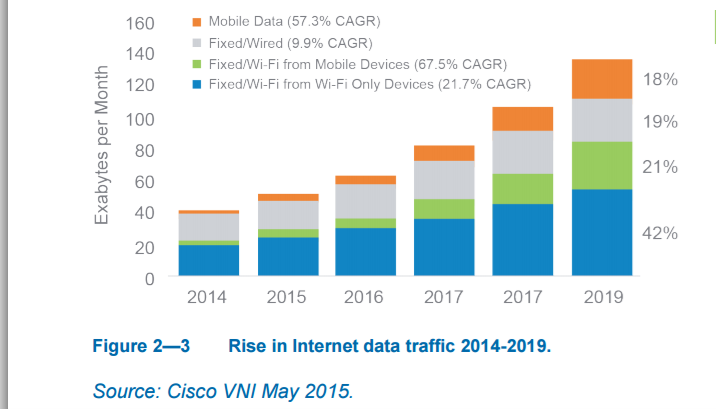
Juniper Research estimates that Wi-Fi networks will be carrying 60 percent of mobile data traffic by 2019. Cisco estimates that Wi-Fi will handle 63 percent of all traffic that year. And some of those services will benefit from quality assurances.

Separately, says the Wireless Broadband Alliance, among operators with hotspot networks in place, 57 percent have a timeline in place to deploy a next generation hotspot (Passpoint) standard network. By definition, Passpoint employs quality of service mechanisms.

Some 61.5 percent of respondents already have NGH or plan to deploy it over the coming year, while a further 29.5 percent will roll it out in 2017 or 2018.

The dominant business driver is the need to enhance or guarantee customer experience for revenue streams such as  TV everywhere or enterprise services.


The Wireless Broadband Alliance, which created the Passpoint standard, also has promulgated quality of service mechanisms. Wi-Fi Certified WMM added quality of service (QoS) functionality in Wi‑Fi networks.

With WMM, introduced in 2004, network administrators and residential users can assign higher priority to real-time traffic such as voice and video, while assigning other data traffic to either best-effort or background priority levels.

Introduced in 2012, WMM-Admission Control further improves the performance of Wi‑Fi networks for real-time data such as voice and video by preventing oversubscription of bandwidth.

Prioritization of traffic includes categories for voice, video, best effort data, and background data, managing access based on those categories.

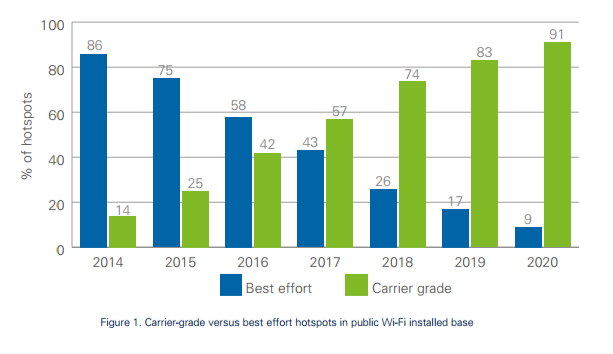
And many large hotspot network operators presently believe carrier-grade hotspots will represent 57 percent of all their locations, with carrier-grade hotspots accounting for 90 percent of locations by 2020.

Despite network neutrality rules, support for such apps likely is coming. All the technology tools are there to do so on big Wi-Fi hotspot networks.

Monday, October 19, 2015

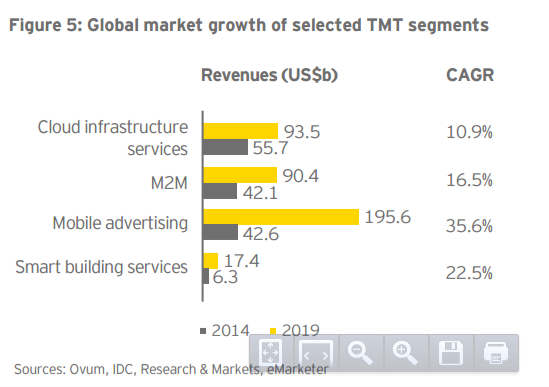
Most Incremental Revenue Opportunities are Enterprise Focused, Not Direct Consumer Services

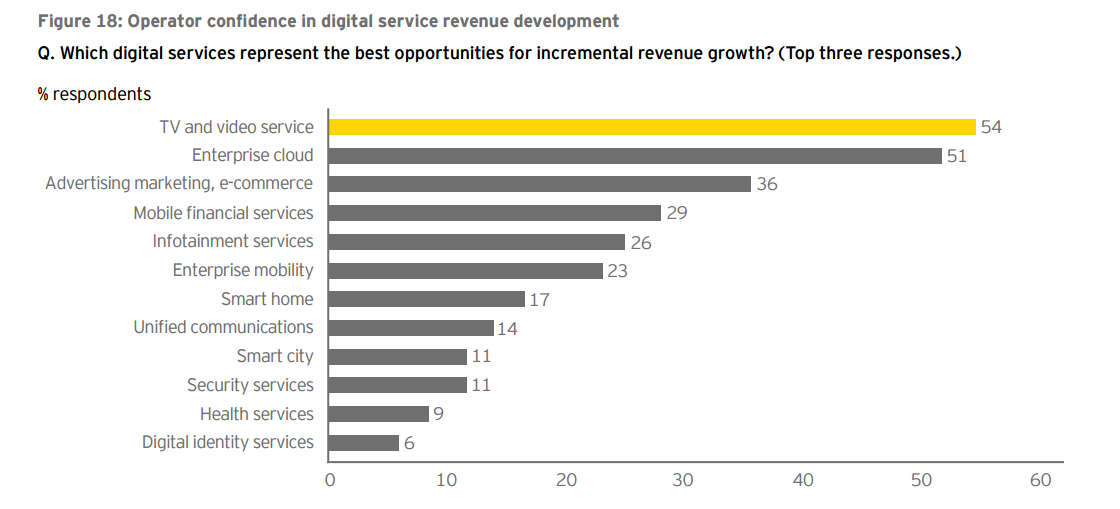
With one notable exception, a panel of global service provider executives surveyed by E&Y expects enterprise services--not consumer services--to drive future revenue growth.


That notable exception is video entertainment services, expected by 54 percent of respondents to be the service with best opportunities for incremental revenue growth. Among the more-promising fields identified by the executives, 51 percent saw enterprise cloud opportunities as most promising.

Also notably missing from the list of expected revenue contributors are Internet of Things apps. In large part, that might speak to a structural fact of life, namely that most IoT apps driving significant revenue might require sponsorship and involvement by third party app providers. Also, even most large service providers will not have the scale to drive significant success.


There was much less consensus about many of the other services deemed drivers of future revenue growth. And though some of the services could be marketed directly to consumers, most of the opportunities seem logically to involve an enterprise partner.


At Alphabet, AI Correlates with Higher Revenue

Though many of the revenue-lifting impacts of artificial intelligence arguably are indirect, as AI fuels the performance of products using ...