Thursday, October 29, 2015

Reliance Jio Plans Big Push into Fixed Services

Reliance Jio, about to launch a major challenge in the Indian mobile communications business, also hopes to enter the fixed network business as well, as a cable TV operator. In June 2016, Reliance Jio Media Pvt. Ltd, a subsidiary of Reliance Jio, received approval to launch a pan-India cable TV company.

That would be an expensive, time-consuming and daunting exercise under the best of conditions. So it is not surprising that Reliance Jio would consider growth by partnership and acquisition.

The company is said to be in talks with a number of cable TV operators, particularly in large and densely packed cities, such as Mumbai and Bangalore, to supply the platform. At the moment, cable TV operators represent about 100 million connected homes.

As in the past in other markets, Reliance Jio might discover it will have to upgrade the cable TV facilities, both in terms of reliability (network uptime) as well as ability to support two-way operations.


Wednesday, October 28, 2015

Google Fiber Formally Asks 3 More Cities to Work on Qualifying for Google Fiber

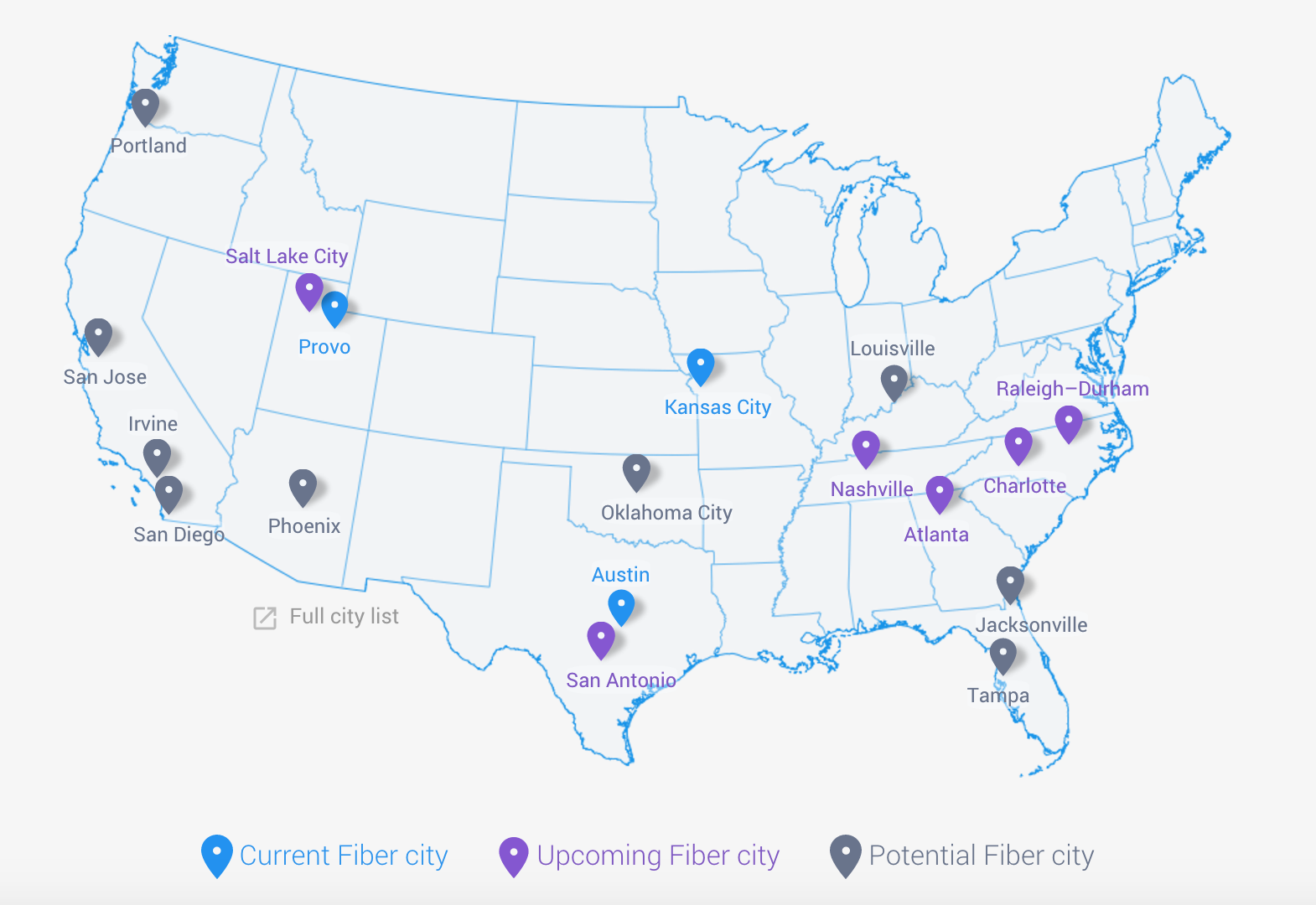
Google Fiber says it has  invited Oklahoma City, Okla., Jacksonville, Fla. and Tampa, Fla. to explore bringing Google Fiber to their communities, as it did in September, inviting officials in Irvine, Calif., Louisville and San Diego to work with Google on a standard checklist of items Google Fiber uses to assess market viability.

That normally includes a detailed study of matters that affect construction, such as local topography, housing density, and the condition of existing infrastructure.

Cities also must complete a checklist of items—such as providing a map of utility lines—that Google Fiber insists are prerequisites.

Those of you familiar with the history of the U.S. competitive local exchange carrier business will see the pattern here. Many U.S. CLECs, exploring communities where it was favorable to commence operations, also stayed away from the major metro areas (“NFL cities”) and instead picked tier two cities.

The same logic appears to make sense for Google Fiber.


What is Harder than Being an Indian Mobile Operator?

It might be easier to thread a camel through the eye of a needle than to succeed wildly and easily in the Indian mobile communications market. It would not be unusual in any big market for four providers to control 95 percent share of the mobile services market.

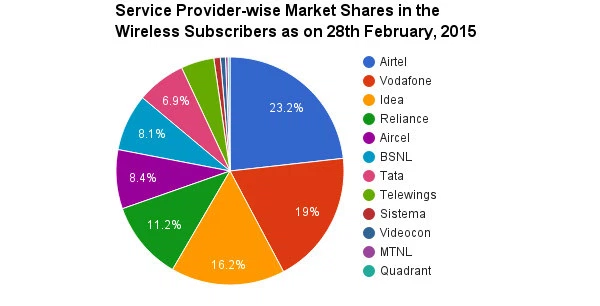
In India, though four providers have about 70 percent share, five providers have 86 percent share, while six providers have 93 percent share. Structurally, the Indian mobile market is more fragmented than most.


For reasons I do not claim to understand, mobile operator infrastructure costs some 30 percent more than global averages, says Rajan Mathews, Cellular Operators Association of India director general.

That is not all. Spectrum prices range from 30 percent to 35 percent higher than global averages as well.

And Indian mobile operators labor with less spectrum. “Every mobile operator in India has, on average, 12 MHz to 15 MHz of spectrum,” said Mathews. “Globally, every operator has 45 MHz to 50 MHz.”

There other important observation is that the Indian government has an interest in the mobile business that arguably is more concentrated than regulators elsewhere might have.

In developed markets, there are five access networks, including landline, satellite, cable TV, government networks and mobile. “India has one network: the mobile network,” says Mathews.

There are other implications. “The government has a proprietary interest, so spectrum is going to be licensed,” says Mathews. “The network is a sovereign national imperative as we are the only network in town.”

"Dig Once" is More Useful to Some Than to Others

In principle, it is helpful to some communications service providers when conduit suitable for installing new optical fiber cable already is in place. That is the attraction of “dig once” policies that install conduit whenever other construction projects are undertaken.


That is the thinking behind a ”dig once bill introduced in the U.S. Congress. Of course, the measure balances “more” value for future potential Internet service or app providers and less value for users of federal highways, since the cost of installing the conduit means “less highway.”


That will be deemed a reasonable tradeoff in many instances, with the greatest value if the conduit is laid along important and recognized routes useful for path-diverse long haul transport, or passing population centers or other sites where close access to long haul facilities is useful.


The conduit will have less value if it merely is installed along existing long-haul routes where conduit already exists, or where there is little incremental demand that cannot be met by already-installed cables.

“Who” benefits also will be an issue. Incumbent suppliers of capacity--with no capacity constraints--on those routes will not necessarily welcome potential new competition. Potential new suppliers will get the advantage.

Chorus to Outsource Network Management to Alcatel-Lucent

New Zealand wholesale network operator Chorus has awarded Alcatel-Lucent a five-year managed services contract covering 24/7 monitoring of the operator's nationwide wholesale copper network.

Under the agreement, Alcatel-Lucent will provide real-time monitoring and analysis services from a new network operation center in Hamilton working with an additional NOC in Bangalore, India to provide monitoring aimed at preventing faults, improving network availability and ensuring continuous service quality of the copper network.

The contract is part of a long-standing trend in telecommunications, where service providers outsource network management functions to third parties, or actually divest assets such as networks of cell towers, or, in the case of Telecom New Zealand, the entire network.

That throws light on an old question (largely rhetorical) about what the typical telecom operator’s core competence might be. It remains hard to answer with precision. The question concerns not merely “what things do you believe you are good at” but ideally “what is the distinguishing core competence, not possessed by those who compete against you?”

Few are able to boil the answer down to a single, unitary and fundamental core competence. Perhaps there is not a unitary answer, in most cases. But few executives historically would have omitted “we know how to build and run big communications networks” from a short list of “things we are really good at.”

Telcos historically might be deemed to be good at such functions. But the issue is whether such skills constitute a “uniquely important” competence that other competitors cannot match. Perhaps it is too difficult for any firm to say there actually is one single “core” advantage others cannot duplicate.

Some might indeed say it has been “we can run a network” that is core. Others might say it is “ownership of spectrum licenses,” scale or capital resources that are close to being the unique assets. Some might argue it is knowledge and scale of the regulatory apparatus.

But that’s the difficulty of the exercise: not listing many attributes that are helpful, but the salient and distinguishing advantage others cannot copy. Perhaps nothing, anymore, provides that sort of a “moat” against competitors.

Recent history, with massive global adoption of Internet Protocol, encouragement of competition and growing access to spectrum, might suggest any historic advantages are systematically being stripped away. That, after all, is what the goal of competitive policies has been.

Perhaps about all one can say is that there is one attribute some members of a class tend to possess. In the U.S. market, perhaps only AT&T and Verizon might be said to possess a sometimes overwhelming regulatory apparatus. That is not to say Comcast, Sprint, T-Mobile US and Charter Communications do not have such an apparatus, simply that it might not be a distinguishing and unique advantage.

In fact, recent developments suggest even that advantage, if it can be said to be a core competence, is as much an advantage as it once was. In recent days, it can be noted that few key policy battles have actually been won by “telcos,” when opposed by “Internet app providers.”

That might not be the case elsewhere. In Europe, India and elsewhere, for example, telcos seem to retain the old advantages.

So the frightening prospect for most telcos, strategically, is that they are moving to a business environment where every believed source of advantage diminishes to the point where there might someday be no core competence; no characteristic that is unique.

Firms operating without such characteristics will nearly always fail. One different way of asking the core competence question is to ask “what do customers believe you are uniquely good at?”

The ability to answer clearly will be an important test of how things are going, in the future.

Tuesday, October 27, 2015

T-Mobile US Adds 2.3 Million Net New Customers

T-Mobile US third quarter 2015 results continued a recent streak of subscriber, revenue and earnings growth.


T-Mobile US added 2.3 million total net customers, grew service revenue 11 percent and “adjusted earnings” 42 percent, quarter over quarter. T-Mobile’s total revenues for the third quarter of 2015 grew by 6.8% year-over-year


T-Mobile US added 2.3 million total net adds, the 10th consecutive quarter when T-Mobile US added more than one million net new accounts.


Of the total net adds, 1.1 million were branded postpaid net adds, of which 843,000 were branded postpaid phone net adds. T-Mobile US also added 595,000 branded prepaid accounts.

Verizon added 430,000 net accounts during the same quarter, while AT&T lost 333,000 postpaid accounts.  

European Parliament Sets Network Neutrality Rules

The European Parliament has ratified net neutrality rules applying across the European Union. Blocking of lawful apps has been an issue.  

In 2012, the Body of European Regulators of Electronic Communications (BEREC) reported that between 21 percent and 36 percent of Internet access subscribers were affected by blocking or throttling depending on the type of application.

The new rules forbid blocking or throttling of lawful online content, applications and services, on mobile or fixed networks. That will have possible implications for Skype, Facetime or other apps sometimes blocked by ISPs. Nor will it be lawful to charge a fee to “unblock” those apps.

No traffic can be prioritized, whether on a paid or unpaid basis. At the same time, equal treatment allows reasonable day-to-day traffic management according to justified technical requirements, and which must be independent of the origin or destination of the traffic and of any commercial considerations.

The rules also clarify the conditions under which “Internet” and “managed services” can be offered.
Basically, managed services only might be offered where and if sufficient capacity for internet access remains available.

The rules forbid any special treatment of different classes of Internet traffic except for “reasonable traffic management” to optimize overall transmission quality.

Reasonable traffic management therefore cannot be used to discriminate against specific categories of content or services such as peer-to-peer (P2P) traffic.

The legislation allows operators, under very strict conditions, to take action in the network that may affect certain types of traffic in order to mitigate the effects of congestion. Such measures are only permitted if congestion is "exceptional" or "temporary", and provided all traffic of the same category is treated alike.

Zero rating, also called sponsored connectivity, is a commercial practice used by some providers of internet access, especially mobile operators, not to count the data volume of particular applications or services against the user's limited monthly data volume. Zero rating is not forbidden, but must comply with the other provisions of the rules, in particular those on non-discriminatory traffic management.

The rules on net neutrality will apply starting 30 April 2016.

Are ISPs Overselling the Value of Higher Speeds?

In the communications connectivity business, mobile or fixed, “more bandwidth” is an unchallenged good. And, to be sure, higher speeds have ...