Tuesday, August 23, 2016

From 10 Mbps to 1,000 Mbps in 15 Years

Consolidated Communications has launched gigabit Internet access in Roseville, Calif., just after
AT&T has launched its GigaPower gigabit Internet access service in the Sacramento market, in parts of Placer County (Roseville, Rocklin, Lincoln, and their surrounding communities).

That is notable in some ways because the Roseville market was one of the first in the United to get fiber to the home services from SureWest Communications, formerly Roseville Telephone Company, back in 2002. Back then, state of the art was symmetrical 10 Mbps service.

These days, that doesn’t even qualify as “broadband,” according to the Federal Communications Commission.

In roughly a decade and a half, we have gone from state of the art as 10 Mbps to 1,000 Mbps, two orders of magnitude.

Careful market selection, plus operating cost advantages, arguably are key to all the independent gigabit Internet access provider efforts springing up around the United States. That is as true for Google Fiber as for AT&T, Rocket Fiber, Ting or any other independent entity.

By definition, capital cost is basically not a source of material advantage: all technology is available to all potential buyers. Construction costs, with some exceptions, also are what they are, for all would-be suppliers. The difference is that some suppliers arguably must use union labor, while others have a choice.

Of all choices, it is the market geography which is most important, at the moment. When Google Fiber decided to build in Portland, Ore., there were no other gigabit ISPs in the market. Now, both CenturyLink and Comcast are doing so, making Google Fiber the possible third supplier in the market.

Some observers think Google Fiber’s decision to delay the Portland, Ore. build, and some in the San Francisco Bay Area, are driven by changing competitive dynamics. Google Fiber arguably once aimed--among other things--to spur key ISPs to upgrade their services.

But now that the ISPs are doing so, it apparently is more difficult for Google Fiber itself to sustain its own operations. Google Fiber arguably has succeeded in getting major U.S. ISPs to boost access speeds. So much so that Google Fiber itself has to rethink its own prospects and business model in many markets, apparently.


Have FTTH Costs Mostly Hit a Limit?

“A decade has passed since the first FTTH network deployments, yet the cost of building
a network remains the primary obstacle to ubiquitous fiber connectivity for every household,” says Commscope.

From 2005 to 2015, the cost per home passed dropped from $1,021 to just under $700, Commscope notes. Those costs likely are fairly standard, no matter how big or small a firm might be.

The problem is that most of the cost of building a fiber-to-home network comes from civil engineering, not network elements.

Construction, civil works engineering, obtaining permits and right-of-ways account for roughly 67 percent of total cost, while the equipment accounts for about 33 percent.

So while GPON and fiber equipment costs have indeed fallen, skilled labor rates have risen.

In other words, a fiber-to-home network mostly represents construction costs, not network element cost.

My simple way of explaining this is that most of FTTH cost comes from “digging holes, then closing the holes back up.”

If so, then the cost of FTTH cannot be reduced too much more.

That is a key reason for the resurgence in interest in fixed wireless, which now is on the cusp of reaching gigabit speeds, and also soon will reap the benefits of new research efforts related to radios.

Also, spectrum costs will drop, partly from spectrum sharing, partly from use of unlicensed spectrum, partly from huge new allocations of spectrum that can support fixed wireless.

That is why fixed wireless and millimeter wave will be such a big focus at the upcoming Spectrum Futures conference. It is possible, perhaps highly likely, that fixed wireless will upstage fiber as a means for supplying consumer gigabit Internet access.

Here’s a  fact sheet and Spectrum Futures schedule, illustrating the planned discussion of access network business issues.

Verizon Still Leads U.S. Mobile Market Performance, RootMetrics Finds

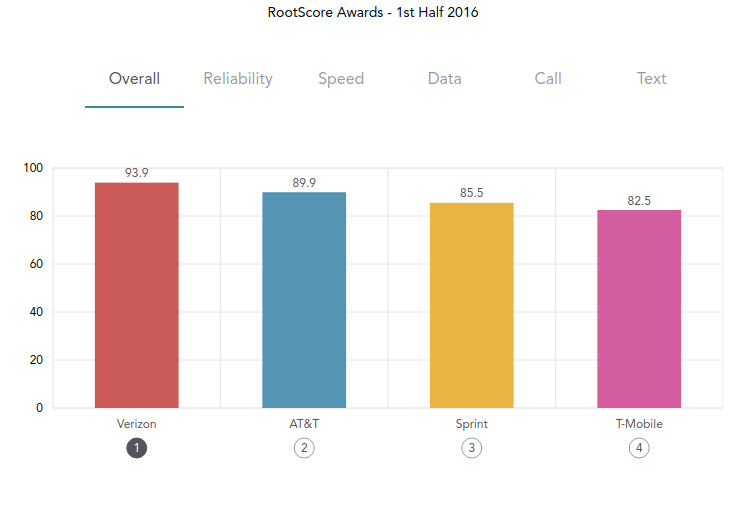
All marketing hype aside, Verizon still leads U.S. mobile service provider performance, according to Rootmetrics studies.

“Verizon’s performance in our testing of the United States was outstanding,” RootMetrics says.

For the first time since we began testing the whole of the US in the second half of 2013, Verizon won United States RootScore Awards outright across all six RootScore categories: Overall performance, Network Reliability, Network Speed, Data performance, Call performance, and Text performance.

Perhaps just as impressive is that Verizon won the United States Overall RootScore Award for the sixth consecutive time.

AT&T finished second to Verizon in five out of six categories at the national level, including overall performance, network reliability, network speed, and data performance.

The only area in which AT&T didn’t rank second behind Verizon was in the Call RootScore category. There, Sprint again narrowly edged past AT&T to finish second.

This marks the first time in five test periods that AT&T didn’t win or share the United States Text RootScore Award.

AT&T has remained a strong number-two performer behind Verizon in our United States RootScore testing for six consecutive test periods.

OTT is a Perennial Strategy Issue for Access Providers

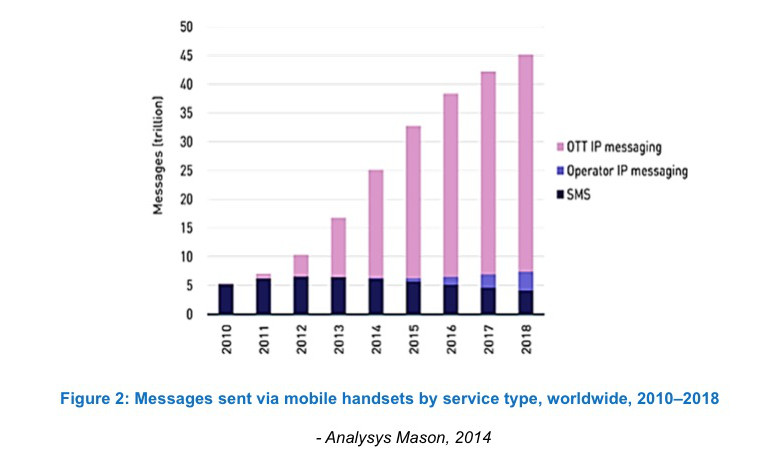
Over the top apps are a perennial issue for access providers, even if OTT success has been very rare in the broader telecom business, for one key reason: OTT represents product substitution for core telecom products. That is most evident in voice and messaging, but starting to be seen in video entertainment services as well.

OTT voice now represents a major form of product substitution for carrier voice, and the same is happening to text messaging.

That noted, some argue OTT actually is not a direct competitor, a statement most true for Internet apps other than those related to communications.

source: Vision Mobile
“As OTT players put increasing pressure on traditional telco profit centers, it is tempting to see them as direct competitors,” Vision Mobile says. “Yet, OTTs do not compete for telco service revenues; instead, they compete to control key links in the digital value chain, with business models that span consumer electronics, online advertising, software licensing, e-commerce and more.”

That might not strictly be true: in a growing number of cases, app providers do compete for telco service revenues. But the larger point remains valid. App providers work mostly in different parts of the ecosystem.

But competition generally exists in the content, distribution and access parts of the Internet ecosystem, between “telcos” and app providers, to some extent.
source: Analysys Mason


It is easy to say telcos must “compete” with app providers. It is hard to do, and likely virtually impossible in consumer realms.

Better prospects arguably lie in any number of potential business areas, where it is easier to identify opportunities and arguably easier to create services. That is why connected car and industrial Internet of Things businesses have made sense to tier one service providers such as AT&T and Verizon.

It will make more sense for other app and device providers to pioneer consumer apps, in areas such as health and wellness, for example.

That is why app development will be such a big focus at the upcoming Spectrum Futures conference. Apps now are created mostly by third parties, so access providers mostly have to partner to create bundles of value featuring apps.

Here’s a  fact sheet and Spectrum Futures schedule, illustrating the planned discussion of how and where ISPs and app providers can partner, as well as the business issues to be confronted.

Venture capitalists will explain what they are looking for, as well.

Monday, August 22, 2016

What Happens to "Unused Data?"

Yield management (differential prices) always seems to make sense in markets for perishable goods, ranging from grocery store produce to airline seats to electricity or mobile data.  


The point is that a retailer often sells products that have no value past a certain point in time. Airline seats are worth “zero” when the plane takes off. Electricity not consumed and paid for by a customer is lost, as it cannot be stored.


The same is true for data capacity now used by customers in any block of time. What can be “rolled over” are usage rights.

But here's a funny look at what happens to unused data.

New Reality: Gigabit Providers Have to Pick Their Markets

Careful market selection, plus operating cost advantages, arguably are key to all the independent gigabit Internet access provider efforts springing up around the United States. That is as true for Google Fiber as for Rocket Fiber, Ting or any other independent entity.

By definition, capital cost is basically not a source of material advantage: all technology is available to all potential buyers. Construction costs, with some exceptions, also are what they are, for all would-be suppliers. The difference is that some suppliers arguably must use union labor, while others have a choice.

Of all choices, it is the market geography which is most important, at the moment. When Google Fiber decided to build in Portland, Ore., there were no other gigabit ISPs in the market. Now, both CenturyLink and Comcast are doing so, making Google Fiber the possible third supplier in the market.

Some observers think Google Fiber’s decision to delay the Portland, Ore. build, and some in the San Francisco Bay Area, are driven by changing competitive dynamics. Google Fiber arguably once aimed--among other things--to spur key ISPs to upgrade their services.

But now that the ISPs are doing so, it apparently is more difficult for Google Fiber itself to sustain its own operations. Google Fiber arguably has succeeded in getting major U.S. ISPs to boost access speeds. So much so that Google Fiber itself has to rethink its own prospects and business model in many markets, apparently.
In the wake of the Telecommunications Act of 1996, many would-be competitors launched operations where they believed the incumbents would be most vulnerable. For some, that was business customers in tier-two markets. For others, customers in adjacent markets were the obvious targets.
It l
For a brief period, even consumer customers who could be reached using wholesale discounts were viewed as a viable target.

The point is that new gigabit Internet access businesses likely cannot be built "anywhere." Would-be suppliers now must pick their markets, mostly avoiding tougher markets where the incumbents have chosen to upgrade to gigabit speeds.

Market selection always is important for competitive service providers. It likely now is the most-important consideration.

Saturday, August 20, 2016

Serving "Last Couple of Billion" Customers Will Always Require Subsidies of Some Sort

Internet service providers normally and naturally are most concerned about how to create facilities allowing people to get access to the Internet. App providers normally and naturally are more concerned with the usability of their products under challenging circumstances.  
So Google’s Next One Billion Project involves app adaptations for markets where Internet access might be spotty, sometimes non-existent and slow. Offline maps that allow users keep track of where they are going, even with no internet service, are one example.

“Light” searchers that will let users in areas with low connectivity do a streamlined search, as well as save and retry their search for when they can get a better internet connection.

Project Link also uses Wi-Fi as a last-mile access media, not simply an in-building distribution media. That approach--using a platform in a new way, not originally intended--is a recurring theme in communications. Wi-Fi now is a major mobile device access method, cable TV now supports

Of course, it is reasonable to point out that 5G, reliant as it will be on capacity supplied by millimeter wave spectrum, will work far better in urban areas than rural areas.

In large part, that is why Google, Facebook and a number of would-be low earth orbit satellite constellations, as well as the existing medium earth orbit O3b, are set to provide new access platforms.

It is highly possible that mobile networks will “always” have a difficult time sustaining operations in rural areas.

But that is why earning high profits some places, to support money-losing operations in other areas, will remain a key task of business strategy for access providers.

Subsidies are going to be as necessary in the future as they are today. That includes third party mechanisms such as advertising and other two-sided revenue models.

At Alphabet, AI Correlates with Higher Revenue

Though many of the revenue-lifting impacts of artificial intelligence arguably are indirect, as AI fuels the performance of products using ...