Tuesday, June 13, 2017

What is Better for Consumers: Fewer or More Suppliers?

Would mobile operator consolidation produce more--or less--competition, in U.S. and other markets, and is less competition better for consumers? Such questions will, and perhaps must be asked, as market consolidation happens in at least some markets. India’s market already has begun the process, and the U.S. market is on the cusp of possible change of that sort as well.

The empirical record cannot be understood in advance of any changes, but arguments will be made--for and against--regarding consolidation of the number of market suppliers. In other words, some will argue, with some justification, that consolidation will lead to stronger and more robust competition.

The issue is that only a few providers actually can sustain themselves, long term, in mobile or fixed networks facilities business.


So the trick is creating a policy environment where enough competition exists to drive lower prices and consumer benefits, but also innovation and investment. You need both competition and investment.

What is Better for Consumers: Fewer or More Suppliers?

Would mobile operator consolidation produce more--or less--competition, in U.S. and other markets, and is less competition better for consumers? Such questions will, and perhaps must be asked, as market consolidation happens in at least some markets. India’s market already has begun the process, and the U.S. market is on the cusp of possible change of that sort as well.

The empirical record cannot be understood in advance of any changes, but arguments will be made--for and against--regarding consolidation of the number of market suppliers. In other words, some will argue, with some justification, that consolidation will lead to stronger and more robust competition.

The issue is that only a few providers actually can sustain themselves, long term, in mobile or fixed networks facilities business.


So the trick is creating a policy environment where enough competition exists to drive lower prices and consumer benefits, but also innovation and investment. You need both competition and investment.

5G Will be Driven by Enterprise, Pervasive Computing

You would expect an organization such as GSMA to argue that “5G is more than just a generational step; it represents a fundamental transformation of the role that mobile technology plays in society.”

But it is not in any way incorrect for GSMA to argue that 5G “is an opportunity for operators to move beyond connectivity.” In other words, one big attraction of 5G is that presents a new way for mobile operators to “move up the stack” in terms of role within the ecosystem.

Specifically, 5G--built to support pervasive computing--”will mark an inflection point in the future of communications, bringing instantaneous high-powered connectivity to billions of devices” and “enable machines to communicate without human intervention,” says GSMA.

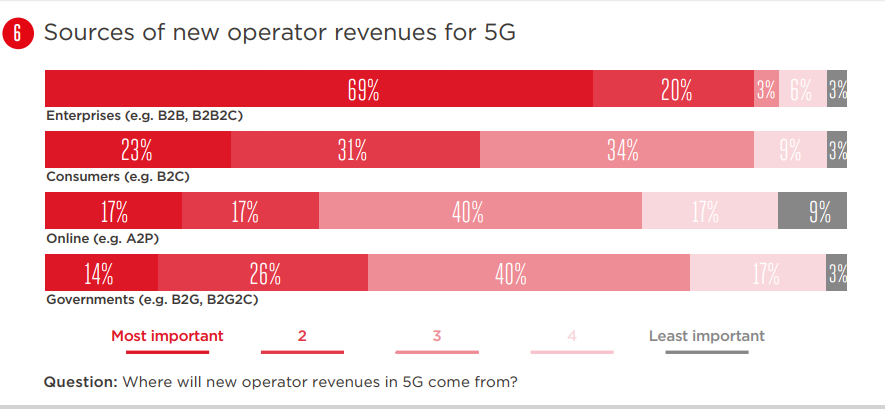
That is important. To the extent 5G actually enables service providers to move up the stack and occupy new and additional roles within the ecosystem, it will be by enabling new use cases, business models and revenue streams principally driven by enterprise customers not consumers.

That is among the big potential changes 5G will bring. To be sure, 5G is expected to enable new uses for the mobile network in supporting consumer internet access, including substitution for fixed network connections.

But the dramatic change is expected to come from revenues generated by enterprises, which will deploy most of the new pervasive computing services, apps and business models.

If 5G develops as most expect (we cannot be sure of that), there will be some historic differences: new revenue sources will be driven by enterprise customers and applications involving machines (pervasive computing).


source: GSMA

Monday, June 12, 2017

Will Internet Access Produce More Revenue Than Content, to 2021?

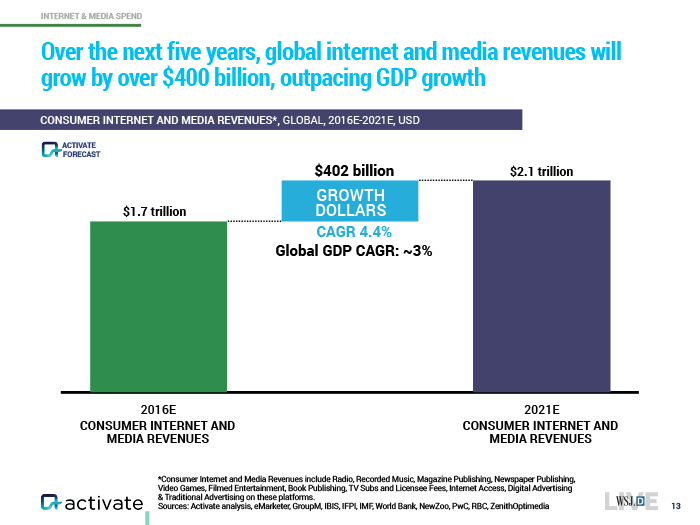
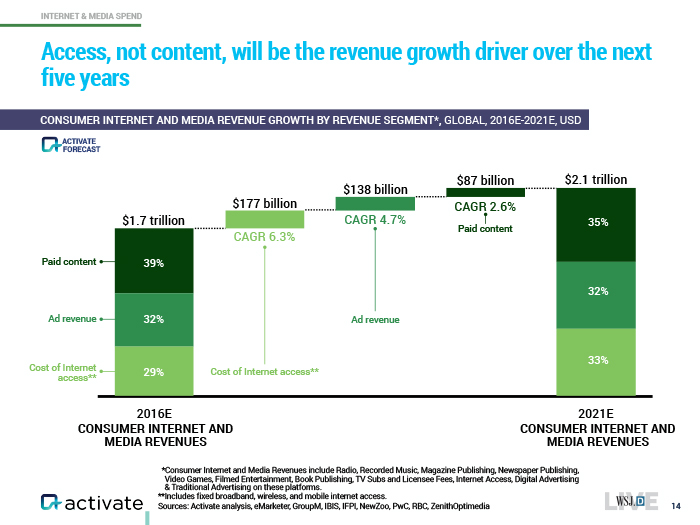
With the caveat that individual markets can vary dramatically, at least some observers believe that internet access services (on a global basis) will produce more revenue growth by 2020 than will content.

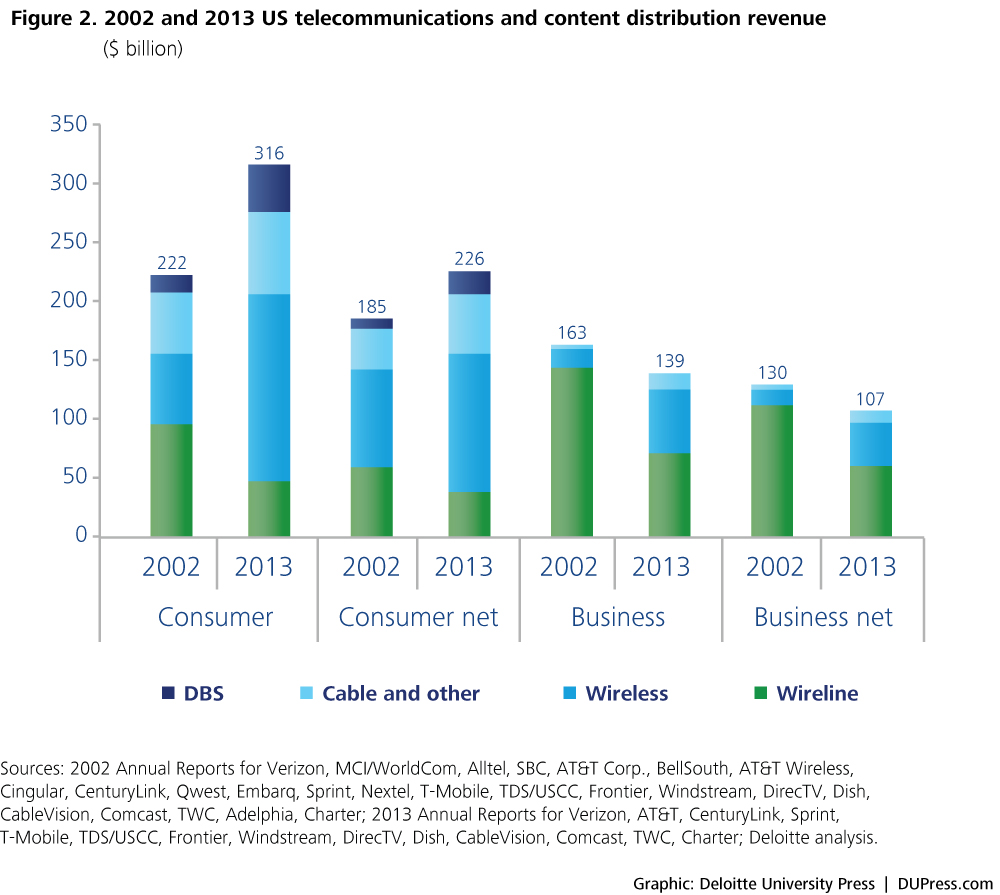
That might initially strike you as somewhat odd, but it is not as odd as you might think. In the past, telecom revenues were a bigger revenue category than “content” services such as linear video or subscription  music services, for example. That is especially true when considering both business and consumer revenues, as business customers contribute very little in terms of linear video revenue, for example.  

Also, in part, that might be the case even if the telecom revenue base is more challenged than content, advertising or transaction revenues.


Internet access will grow at about a 6.3 percent compound annual growth rate to 2021, while ad revenue grows at 4.7 percent and paid content services at about 2.6 percent CAGR.

As with all such forecasts, keep in mind that segment growth prospects can be quite different. The “paid content” segment includes radio, magazine publishing, newspaper publishing, prerecorded music and book publishing, in addition to linear video subscriptions and over the top video subscriptions.

The same caveat holds for internet access revenues, which clearly are set to grow in developing regions, with flat or declining revenue in developed markets.


It is not yet completely clear whether mobile internet access revenue growth will happen in all, most or only some markets.

Even in some markets that are saturated, or approaching saturation, in terms of take rates, the possibility remains that average revenue per user could grow, as users upgrade to faster services.

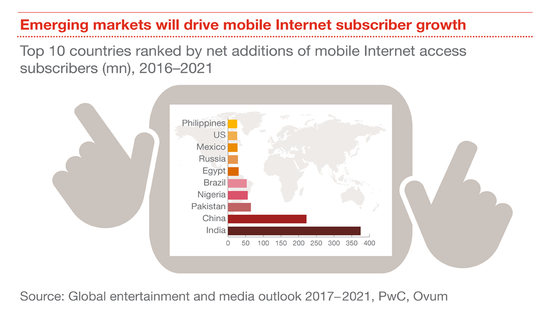
Some observers believe internet access revenues will grow faster than content revenues, on a global  basis, through 2021. That is easy enough to foresee in many developing markets, where both subscriptions and mobile internet subscriptions will grow significantly, or very significantly.

What is less clear are potential revenue trends in developed markets, where subscription growth is limited, and revenue growth mostly must come from higher ARPU. Some, including PwC analysts,  forecast modest growth in the fixed segment, but relatively  robust growth near nine percent on a compound basis for mobile internet access.

The caveat is that it also is not clear how much of that growth will come from new internet of things applications, and what percentage of growth could come from human users.


source: Activate

Sunday, June 11, 2017

Video Drives 67% of Global Internet Traffic

The evolution of capacity demand in the telecom business is very easy to describe: voice, tlso hen data, now video.

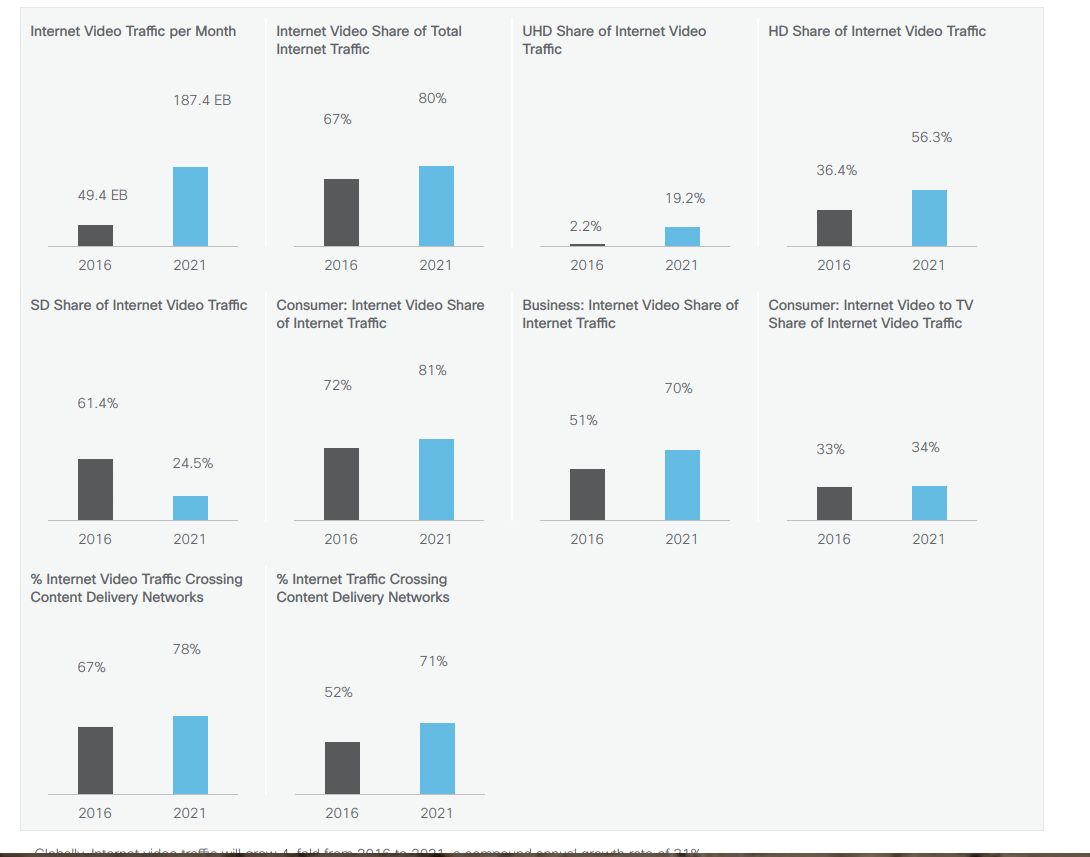
Video will represent 80 percent of all Internet traffic by 2021, up from 67 percent in 2016, says Cisco.

Globally, there will be nearly 1.9 billion Internet video users (excluding mobile-only) by 2021, up from 1.4 billion in 2016. The world also will reach three trillion Internet video minutes per month by 2021, which is five million years of video per month, or about one million video minutes every second.

Emerging mediums such as live Internet video will increase 15-fold and reach 13 percent of Internet video traffic by 2021 -- meaning more streaming of TV apps and personal live streaming on social networks. While live streaming video is reshaping today's online entertainment patterns, virtual reality (VR) and augmented reality (AR) are also gaining traction. By 2021, VR/AR traffic will increase 20-fold and represent one percent of global entertainment traffic.

source: Cisco

IoT Will Drive More than Half of All Mobile Device Connections by 2021

For the first time ever, the Cisco Visual Networking Index predicts machine-to-machine connections that support internet of things (IoT) applications will be more than half of the total 27.1 billion devices and connections by 2021.

M2M services and devices will grow by 2.4-fold, from 5.8 billion in 2016 to 13.7 billion, by 2021, Cisco forecasts.


The health vertical will be fastest-growing industry segment with a 30 percent compound annual rate of growth. The connected car and connected cities applications will have the second-fastest growth, with 29 percent CAGRs.

5G Could Make Verizon and AT&T Fixed Network Service Providers Across the Entire U.S. Market

Fixed wireless is a bigger deal for Verizon than it is for AT&T. But  fixed wireless is a big deal for both firms.

The reason is partly regulatory in nature. No U.S. fixed network telecom service provider (including cable TV companies) ever has been allowed to reach more than about a third of all U.S. homes.

Verizon’s fixed network reaches far fewer than that. Assume there are about 118.3 million U.S. homes. Assume Verizon passes about 23 million of those locations (after the sale of about 3.7 million voice connections, 2.2 million high-speed data customers and 1.2 million video customers. or about 19 percent of U.S. homes.

AT&T, in contrast, passes about 62 million U.S. homes, or roughly 52 percent of U.S. homes.

So fixed wireless, enabled by 5G, dramatically changes each firm’s reach. Where Verizon could only sell to about 19 percent of U.S. homes on a fixed network basis, while AT&T could reach about 52 percent of homes, 5G fixed wireless could, in principle, allow each firm to sell fixed network services (internet access, video, fixed network voice) to nearly every U.S. home, for the very first time.

That could be hugely significant, if you assume each firm has done about as well as it possibly can, in their fixed network service territories. As often is the case in telecommunications, growth can be gotten only by moving “out of region.”

In the 5G era, both Verizon and AT&T will have the ability to add new “fixed network equivalent” accounts in half to 80 percent of the U.S. territory, for the first time.

So it might be a virtual certainty that AT&T and Verizon will gain market share “out of region.”

“We could be a significant player for delivering broadband and video over-the-top, over that exact same network, and it's almost I mean incrementally and the cost is miniscule to be able to address a very large market outside of the Washington and the Boston corridors,” said Lowell McAdam, Verizon CEO. “You are then a broadband provider and a TV provider outside of your franchise footprint.”

That is a big reason Verizon is so big on fixed wireless enabled by 5G. " We did not need to wait for all of the mobile standards, we didn't have to wait for it to be...crammed into an iPhone or a Samsung Galaxy device,” said McAdam. “You can use basically your home router that you have today, just put some different chips in it, and we're working with Intel on that, and you are then a broadband provider and a TV provider outside of your franchise footprint.”


But fixed wireless also will have the same attraction for AT&T, which operates a fixed network reaching about 52 percent of U.S. homes. In much the same way, the DirecTV acquisition now allows AT&T to sell linear video to nearly 100 percent of U.S. homes.
Access Network Limitations are Not the Performance Gate, Anymore

In the communications connectivity business, mobile or fixed, “more bandwidth” is an unchallenged good. And, to be sure, higher speeds have ...