Saturday, November 19, 2022

Fixed Wireless is the Clear Early Example of New 5G Revenue

At the moment, 5G fixed wireless is the clear contributor to new revenue sources earned by 5G networks. No other use case has produced the volume of new revenue. 


Revenues from 5G fixed wireless, in the near term, will dwarf internet of things, private networks, network slicing  and edge computing, for example. 5G fixed wireless might, in some markets, represent as much as eight percent of home broadband revenues, for example. None of the other sources is likely to hit as much as one percent of total revenues in the near term. 


The center of gravity of demand for 5G fixed wireless is households In the U.S. market who will not buy speeds above 300 Mbps, or pay much more than $50 a month, at least in the early going. T-Mobile targets speeds up to 200 Mbps. 


Verizon fixed wireless service plans also suggest that existing Verizon mobile customers are key targets. In the meantime, there is 4G fixed wireless, which will have to be aimed at a lower-speed portion of the market, albeit at about the same price points as 5G fixed wireless. 


Up to this point, Verizon 4G fixed wireless, available in some rural areas, offers speeds between 25 Mbps and 50 Mbps. That might appeal to consumers unable to buy a comparable fixed network service. 


By some estimates, U.S. home broadband generates $60 billion to more than $130 billion in annual revenues


If 5G fixed wireless accounts and revenue grow as fast as some envision, $14 billion to $24 billion in fixed wireless home broadband revenue would be created in 2025. 


5G Fixed Wireless Forecast


2019

2020

2021

2022

2023

2024

2025

Revenue $ M @99% growth rate

389

774

1540

3066

6100

12,140

24,158

Revenue $ M @ 16% growth rate

1.16

451

898

1787

3556

7077

14,082

source: IP Carrier estimate


If the market is valued at $60 billion in 2021 and grows at four percent annually, then home broadband revenue could reach $73 billion by 2026.


2022

2023

2024

2025

2026

Home Broadband Revenue $B

60

62

65

67

70

73

Growth Rate 4%


Higher Revenue $B

110

114

119

124

129

134

source: IP Carrier estimate


If we use the higher revenue base and the lower growth rate, then 5G fixed wireless might represent about 10 percent of the installed base, which will seem more reasonable to many observers. 


Assuming $50 per month in revenue, with no price increases at all by 2026, 5G fixed wireless still would amount to about $10.6 billion in annual revenue by 2026 or so. That would have 5G fixed wireless representing about 14 percent of home broadband revenue, assuming a total 2026 market of $73 billion.


If the home broadband market were $134 billion in 2026, then 5G fixed wireless would represent about eight percent of home broadband revenue. 


Fixed wireless might be even more important elsewhere in global markets.  


Critics are correct that 5G fixed wireless--at least in the medium term--has capacity limitations compared either to fiber-to-home or advanced hybrid fiber networks. But it also is true that the home broadband market has a value segment for whom fixed wireless seems to be in demand. 


According to the latest data from Leichtman Research Group, during the third quarter of 2022, some 825,000 net new home broadband accounts were added in the U.S. market. But the two major fixed wireless service providers--T-Mobile and Verizon--added 920,000 net accounts during the quarter. 


Fixed Wireless Services, Third Quarter 2022

Fixed Wireless Supplier

Total Accounts

Net Additions

T-Mobile

2,122,000

578,000

Verizon

1,063,000

342,000

source: Leichtman Research Group


Total cable industry net adds were about 39,000, while telcos collectively lost about 136,000 fixed network accounts. 


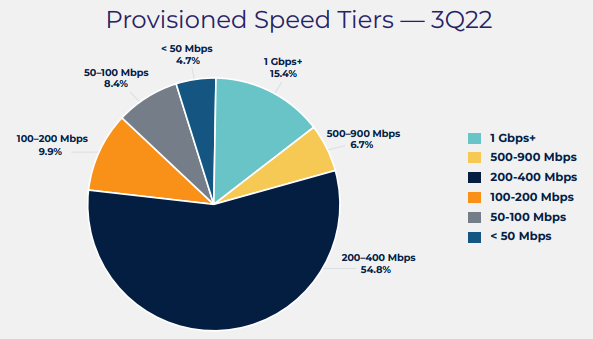
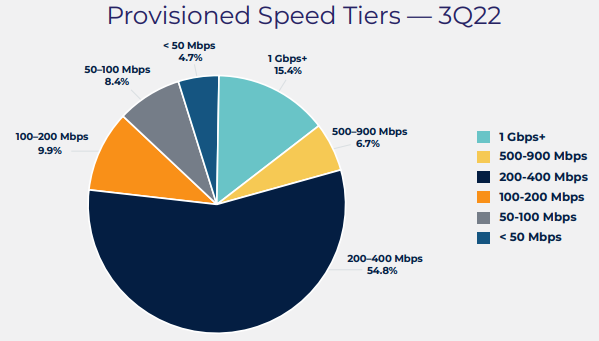
During the third quarter, about 22 percent of U.S. customers bought service at speeds of 200 Mbps or below. In other words, perhaps a fifth of the home broadband market is willing to buy service at speeds supported by fixed wireless. 

source: Openvault  


Predictably, supporters and detractors offer the expected defense of advantages and weaknesses. Cable operators note the bandwidth limitations. Verizon and T-Mobile point to the ease of installing and price advantages. In some cases fixed wireless might actually be faster than the other alternatives available from other local home broadband providers. 


Critics do correctly note that fixed wireless home broadband is carefully marketed in areas where new 5G networks have spare capacity. That capacity will disappear as 5G adoption increases, the critics say.


But Verizon and T-Mobile might argue they have ways to boost capacity over time, as 5G networks are used more heavily and as bandwidth demand keeps increasing. Higher-capacity millimeter wave spectrum is the obvious early answer. 


Longer term, Verizon and T-Mobile are likely to explore ways to add fiber to home coverage as well. For Verizon, that means finding new says to secure FTTH capacity outside its historic fixed network footprint. For T-Mobile, that means getting into FTTH for the first time. 


Up to this point, T-Mobile has been focused on areas where there is less competition, such as rural markets. 


Verizon’s geography is the roughly 80 percent of U.S. homes outside Verizon’s fixed network service territory, as well as its own mobile customer base, who are encouraged to bundle fixed wireless with existing mobile service. 


The point is that the near-term market is substantial for both T-Mobile and Verizon in “out of region” geographies. For T-Mobile that is 100 percent of U.S. homes. For Verizon that is about 80 percent of U.S. homes. 


Friday, November 18, 2022

Will Digital Infra Privatization Rates Slow?

Higher interest rates affect most parts of any economy. What we will have to see is the impact on digital infrastructure ownership in the near term. If interest rates climb to five percent or more, it is going to affect the payback model for taking digital infra (towers, data centers, distribution networks) private.


The wave of private equity purchases of formerly public infrastructure from service providers would slow. How much slower is the issue, and for how long. Observers do not expect five-percent (or higher) interest rates for the long term, but activity will hinge on the level of rates and their duration. 


In fact, the whole digital infra privatization business has been fueled by near-zero “real” interest rates. Inflation rates also matter, as they affect “real” interest rates. For the whole class of “alternative” infrastructure (power utilities, roads, airports, oil and gas, renewable energy and data centers, towers and fiber infrastructure), expected returns have been dropping, and specific returns for digital infra might arguably be closer to five percent than 10 percent. 


source: McKinsey 


But that is why five-percent interest rates slow activity. If the expected return is five percent, borrowing costs are five percent and inflation rates are high, investments no longer make sense. 


The point is that it would not be unexpected to see a slowdown in digital infra privatizations for a while. The business case--with higher interest rates--does get worse.


Comcast Expects 10-Gbps Downstream Upgrade to Cost "Less than $200 Per Passing"

Comcast says it can initially upgrade its network to eventually handle symmetrical 10-Gbps internet access (supporting 10 Gbps initially) for “less than $200 a home passed,” according to Elad Nafshi, Comcast EVP and chief network officer. 


It is a nuanced statement. 


That initial upgrade cost includes revamping networks from low-split to mid-split, including changes to active and passive network elements when necessary to support an upgrade to DOCSIS 4.0 10-Gbps downstream bandwidth. Upstream will increase to perhaps 1 Gbps. 


Significantly, Comcast’s initial deployment does not require full fiber distribution, but can accommodate as many as four amplifiers in cascade. 


That means the upgrade to 10-Gbps downstream service can be done without upgrading the whole network to fiber, which uses passive coaxial cable only for the last 100 feet or so of drop cable. 


Upgrading to symmetrical 10-Gbps service will require replacing all the radio frequency amplifiers. Typically, Comcast has built out fiber to an optical node, then delivered signals to home using a string (cascade) of up to four amplifiers running on coaxial cable. 


In the first stage of DOCSIS 4.0 deployment,  most of Comcast’s facilities can continue to operate with fiber distribution to a node, then retain as many as four RF  amplifiers for service to homes. There are huge cost implications for retaining that capability, since Comcast can continue to use the in-place amplifiers and coaxial cable. 


Future “Node + 0 amplifier” networks will transition to Full-Duplex (FDX) DOCSIS, to significantly increase the upstream bandwidth to multi-gigabit speeds, such as symmetrical 10-Gbps service. But that also will require deploying a full fiber network, using coaxial cable only for the drops. 


The first step will be a shift to a 5-MHz to 204-MHz upstream bandwidth and 1218 MHz downstream bandwidth, supporting a 1 Gbps upstream tier and multi-Gbps downstream. In the following illustration, blue frequencies are available for downstream traffic, while red frequencies are available for upstream traffic. 


As usual, the upgrades can be implemented incrementally, in stages, with incremental capital investment. . 


source: Comcast 


Then overlapping bidirectional spectrum from 108 to 204 MHz can be activated. that eventually increases up to the full 108-MHz  to 684-MHz FDX limit. In that implementation DOCSIS 3.0 can be supported up to the 1002 MHz limit and legacy DOCSIS 3.1 to the 1218-MHz limit.


The point is that Comcast still believes it can upgrade its bandwidth over time to symmetrical 10-Gbps service while remaining the low-cost provider compared to rival fiber-to-home networks.


Thursday, November 17, 2022

Without Hedonic Adjustment, You Can't Tell What Has Happened to Home Broadband Prices

It is hard to answer the question “have home broadband prices risen since 2009?” with using hedonic adjustment and also adjusting for inflation. The Bureau of Labor Statistics uses hedonic adjustment to track producer prices for home broadband, for example, since speed and other attributes change over time. 


The rationale is that a dial-up internet connection is not a comparable service to home broadband at various speeds (10 Mbps, 100 Mbps, 1 Gbps, for example). Since prices tend to stay about the same over time while speeds have increased for the “most bought” tiers of service, BLS adjusts prices to account for quality improvements. 

source: Bureau of Labor Statistics 


Trends for voice services are harder to track, as that feature is included in the recurring cost of both mobile and fixed network services. Over a few decades, the cost of fixed network voice services has tended to rise (as actual costs cannot be easily subsidized by higher-profit services, as once was the case). 


The cost of mobile service has tended to drop over time. In October 2022, for example, the U.S. Bureau of Labor Statistics said the cost of mobile service dropped 1.4 percent, hedonically adjusted. 


Home broadband also appears to have gotten cheaper by a bit in the September 2022 CPI report. That figure has to be interpreted, however, as the internet services category includes both internet access and other “electronic information providers.” 


That includes subscriber fees for residential internet access, but also other online services such as web hosting, domain names, and file hosting for non-business use. 


Also, this category includes service bundles that might include telephone and TV services bundled with residential internet service and mobile internet access. Obviously, each of those separate services has a distinct retail cost profile that can skew the figure for what we assume “home broadband” actually costs. 


Other monthly subscriber fees are also included in the  but are not limited to internet rental equipment, Wi-Fi service fees, installation and activation fees, and other associated taxes and fees.  


That noted, we might note that service bundles mean lower prices per product, even when some components such as home telephone service might have rising cost profiles. 


Determining what most customers actually pay does require some analysis of the service plans people actually buy, not simply the posted retail prices. If most customers buy bundles, their costs per service are lower than if they purchased each component separately. 


Still, using the BLS data, we can see a dramatic fall in U.S. internet access prices since about 2017, when hedonically adjusted.


Wednesday, November 16, 2022

FTX, Enron, Lehman Brothers

The collapse of FTX has some commentators suggesting the bankrupt cryptocurrency exchange could produce investor losses or wider fianncial damage on the scale of Lehman Brothers in 2008.


Perhaps others might be tempted to compare FTX bankruptcy impact to  investor losses from Enron the early years of the century. I just cannot see that. 


source: Banking Exchange 


FTX had perhaps $32 billion in equity value a year ago. Enron investors lost perhaps $74 billion.  Lehman Brothers had equity losses of about $60 billion (by some accounting $46 billion in equity destruction) although debt holdings were far larger, up to $613 billion or so, balanced against assets. 


But Lehman equity and debt losses, in total, might have reached as much as $135 billion.  


At least so far, FTX does not begin to approach the damage triggered by Enron’s collapse or Lehman Brothers demise. Enron’s bankruptcy occurred at about the time of the “Dot Com Collapse” around the turn of the century, which destroyed hundreds of billions of dollars of equity value in telecommunications and technology and app firms. 


Lehman’s bankruptcy helped bring on the global Great Recession of 2008. So far, FTX appears to pose none of that magnitude of danger.


Gigabit Services are Right on Schedule According to Edholm's Law and Nielsen's Law

U.S. home broadband customers buying gigabit tiers of service grew 35 percent year over year in the third quarter of 2022, according to Openvault. At the moment, more than 15 percent of U.S. home broadband accounts use gigabit connections. 


Also, more than half of home broadband accounts buy service in the 200 Mbps to 400 Mbps range. That group grew 100 percent year over year. 


A little more than a year ago about half of households were buying service in the 100 Mbps to 200 Mbps range, showing that Nielsen’s Law and Edholm’s Law of bandwidth supply continue to operate. 


source: Openvault 


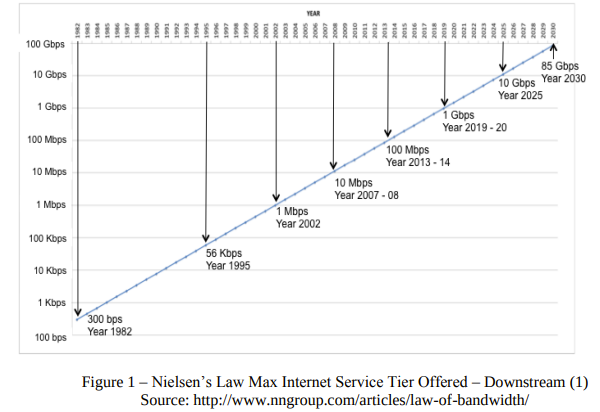
Edholm’s Law states that internet access bandwidth at the top end increases at about the same rate as Moore’s Law suggests computing power will increase. Nielsen's Law essentially is the same as Edholm’s Law, predicting an increase in the headline speed of about 50 percent per year. 


Nielsen's Law, like Edholm’s Law, suggests a headline speed of 10 Gbps will be commercially available by about 2025, so the commercial offering of 2-Gbps and 5-Gbps is right on the path to 10 Gbps. 

source: NCTA  


Headline speeds in the 100-Gbps range should be commercial sometime around 2030. 


How fast will the headline speed be in most countries by 2050? Terabits per second is the logical conclusion. Though the average or typical consumer does not buy the “fastest possible” tier of service, the steady growth of headline tier speed since the time of dial-up access is quite linear. 


Gigabit tier subscribers hit an inflection point last year. The rule of thumb is that any successful and widely-bought consumer technology enters its mass adoption phase when about 10 percent of homes are users. For U.S. gigabit adoption, that happened in 2021. 


Some might attribute the Covid pandemic and work from home as driving the change, but adoption rates would have taken off in 2021 in any case, as predicted by the 10-percent-of-homes adoption theory. 


It also is easy to predict that 2 Gbps to 4 Gbps is the next evolution, as speeds at the top end continue to increase by 50 percent a year. Ny 2025 we should start seeing the first 10-Gbps services deployed at scale.


Tuesday, November 15, 2022

What Business are You In?

From time to time, "telcos" and "access providers" (ISPs, cable companies, satellite firms and system integrators) essentially ask themselves "what business are we in?" and "what business should we be in?" In nearly all cases, those questions are answered in a way that suggests the solution is "we need to be in X, in addition to our present business." X can be marketing, advertising, internet of things, private networks, edge computing, content ownership, content retailing or some enterprise vertical.


In the past, telcos have tried to be in computing hardware and software, app stores, data centers or consumer hardware. Success has been mixed at best. In the internet era, when all access service providers have adopted internet platforms as their next-generation network, almost all efforts to find X will require moving into some different part of the internet ecosystem.


But startups often face tougher issues. Telcos at least know who their customers are, where they are located, why they buy, what the minimum viable product is, where price points must be set, competitor strengths and weaknesses, how distribution channels work at scale, and so forth.


New industries or product categories sometimes are hard to pinpoint, when defining contestants in a “market.” Kyte, for example, says it is in the “on-demand vehicle rental business.” But its business model includes having a Kyte driver deliver the vehicle to the renter’s location. So Kyte might be competing with Uber, Lyft or other ride hailing apps to an extent. 


In a larger sense, as ride hailing competes with use of taxis and public transportation and car ownership, Kyte might be viewed within a larger transportation market. 


Such market definitions remain even for contestants in more-established markets. Is Amazon a contestant in cloud computing? Yes. Is it also a contestant in online retailing or retailing in general? Yes. Is it a competitor in video and audio streaming? Also yes. Is it a retailer of consumer electronics devices? Yes, again. 


Defining a market matters for startups. It matters for market researchers, who must decide who the participants are in a market before quantifying their market shares. It matters for business leaders who must benchmark against their key competitors and craft growth strategies to match.  


A firm must define its market to understand where to compete, who its cusotmers are and who are the key trading partners. Defining markets also helps firms focus on what their customers value.


Perhaps the classic example is railroad operators. “The railroads  did not stop growing because the need for passenger and freight transportation declined,” noted marketing professor 

Theodore Levitt. “The railroads are in trouble today not because that need was filled by others (cars, trucks, airplanes, and even telephones) but because it was not filled by the railroads themselves.”


In other words, they saw themselves as in the “railroad” business, not the “transportation” business.


Access Network Limitations are Not the Performance Gate, Anymore

In the communications connectivity business, mobile or fixed, “more bandwidth” is an unchallenged good. And, to be sure, higher speeds have ...