Thursday, March 31, 2011
Blogger is Changing

 Gary Kim was cited as a global "Power Mobile Influencer" by Forbes, ranked second in the world for coverage of the mobile business, and as a "top 10" telecom analyst. He is a member of Mensa, the international organization for people with IQs in the top two percent.
0.05% of Entities Produce Tweets Read by 50% of Twiiter Users
On Twitter, roughly 50 percent of tweets consumed are generated by just 20,000 elite users including celebrities, large media and other organizations and some bloggers, a study by Yahoo Research has found. In other words, 20,000 users, comprising less than 0.05 percent of the user population, attracts almost 50 percent of all attention within Twitter. read more here
Gary Kim was cited as a global "Power Mobile Influencer" by Forbes, ranked second in the world for coverage of the mobile business, and as a "top 10" telecom analyst. He is a member of Mensa, the international organization for people with IQs in the top two percent.
39% of SMBs Will be Buying Cloud Services by 2014, Study Suggests
Some 39 percent of small and medium-sized businesses expect to be paying for one or more cloud services within three years, an increase of 34 percent from the current 29 percent, a study conducted by Edge Strategies has found. The study also found that respondents expect to almost double their use of cloud services over the next three years.
The global survey of 3,258 firms that employ up to 250 employees included respondents from Australia, Canada, China, France, Germany, India, Japan, the Netherlands, Norway, Russia, Singapore, South Africa, South Korea, Spain, the U.K. and the U.S.
Collaboration, data storage and backup and business-class email are some cloud-based services that hold promise for channel partners and other sales entities. SMBs paying for cloud services will be using 3.3 services, up from fewer than two services today, over the next few years, the study suggests.
The larger the business, the more likely it is to pay for cloud services. The study suggests 56 percent of companies with 51 to 250 employees will pay for an average of 3.7 services within three years.
Within three years, 43 percent of workloads will become paid cloud services, but 28 percent will remain on-premises, and 29 percent will be free or bundled with other services.
http://www.microsoft.com/presspass/emea/presscentre/pressreleases/MSSMBCloudAdoption.mspx
The global survey of 3,258 firms that employ up to 250 employees included respondents from Australia, Canada, China, France, Germany, India, Japan, the Netherlands, Norway, Russia, Singapore, South Africa, South Korea, Spain, the U.K. and the U.S.
Collaboration, data storage and backup and business-class email are some cloud-based services that hold promise for channel partners and other sales entities. SMBs paying for cloud services will be using 3.3 services, up from fewer than two services today, over the next few years, the study suggests.
The larger the business, the more likely it is to pay for cloud services. The study suggests 56 percent of companies with 51 to 250 employees will pay for an average of 3.7 services within three years.
Within three years, 43 percent of workloads will become paid cloud services, but 28 percent will remain on-premises, and 29 percent will be free or bundled with other services.
http://www.microsoft.com/presspass/emea/presscentre/pressreleases/MSSMBCloudAdoption.mspx
Gary Kim was cited as a global "Power Mobile Influencer" by Forbes, ranked second in the world for coverage of the mobile business, and as a "top 10" telecom analyst. He is a member of Mensa, the international organization for people with IQs in the top two percent.
Wednesday, March 30, 2011
Consumerization of Enterprise IT Continues
Workers now report using an average of four consumer devices and multiple third-party applications, such as social networking sites, in the course of their day, according to a study sponsored by Unisys. Also, workers in the survey reported that they are using their own smartphones, laptops and mobile phones in the workplace at nearly twice the rate reported by employers.
In fact, 95 percent of respondents reported that they use at least one self-purchased device for work. Another big change is that where enterprise IT staffs used to assume they were responsible for training and supporting users on enterprise technology, these days many users simply will go ahead and train themselves to use tools they prefer. That also is a big change.
That 'consumerization' of technology is quite a big shift. Decades ago, the pattern of technology diffusion was fairly straightforward. The latest new technology was purchased by large enterprises and large government entities. Over time medium-sized businesses and organizations started to buy the same technology. Later, small businesses and organizations adopted the tools. Finally, some consumers 'brought the technology home' and used it as well.
All of that has changed over the last two decades. These days, many enterprise tools actually were brought into the enterprise by consumers who already had adopted the technology for home use.
In fact, 95 percent of respondents reported that they use at least one self-purchased device for work. Another big change is that where enterprise IT staffs used to assume they were responsible for training and supporting users on enterprise technology, these days many users simply will go ahead and train themselves to use tools they prefer. That also is a big change.
That 'consumerization' of technology is quite a big shift. Decades ago, the pattern of technology diffusion was fairly straightforward. The latest new technology was purchased by large enterprises and large government entities. Over time medium-sized businesses and organizations started to buy the same technology. Later, small businesses and organizations adopted the tools. Finally, some consumers 'brought the technology home' and used it as well.
All of that has changed over the last two decades. These days, many enterprise tools actually were brought into the enterprise by consumers who already had adopted the technology for home use.
Gary Kim was cited as a global "Power Mobile Influencer" by Forbes, ranked second in the world for coverage of the mobile business, and as a "top 10" telecom analyst. He is a member of Mensa, the international organization for people with IQs in the top two percent.
Net Neutrality Positions Hinge on Assumptions
Sir Tim Berners-Lee, inventor of the World Wide Web, has told Internet service providers that their plans for a two-tier Internet go against the principle of net neutrality. Berners-Lee said that Internet users should have free and open access to all content, and that content providers should also have unrestrained access to customers.
That sort of points up the confusion around the whole notion of network neutrality, understood as the idea that every user and entity should be able to communicate with every other user, for "free."
Even the original thinking that every entity should be able to communicate with every other entity no longer is possible. China will not allow some communications, on some subjects, by any Chinese user, no matter what a content or application provider might think. Many governments will not allow the use of Skype or other VoIP services and applications.
That sort of points up the confusion around the whole notion of network neutrality, understood as the idea that every user and entity should be able to communicate with every other user, for "free."
Even the original thinking that every entity should be able to communicate with every other entity no longer is possible. China will not allow some communications, on some subjects, by any Chinese user, no matter what a content or application provider might think. Many governments will not allow the use of Skype or other VoIP services and applications.
Gary Kim was cited as a global "Power Mobile Influencer" by Forbes, ranked second in the world for coverage of the mobile business, and as a "top 10" telecom analyst. He is a member of Mensa, the international organization for people with IQs in the top two percent.
Watch for Significant Cord Cutting in 2012
Nearly 25 million U.S. households have watched online video on their standard TVs, Forrester Research reports. The U.S. online adults Forrester Research surveyed reported that 14 percent of their total video viewing was coming from the Internet, on average. Assuming a typical user watches five hours a day worth of video, which implies about 42 minutes a day of online video consumption using TVs, PCs or other devices.
When the results are sorted to include only respondents who say they watch online video on a TV, 28 percent of total viewing time—about an hour and 24 minutes a day—is online video.
In about 56 percent of cases, consumers are using their videogame consoles as the gateway to online viewing that is displayed on a TV. That makes sense, as the game players are, by definition, already connected to the TV and to a broadband connection.
The personal computer is the second most common gateway device used to view online video on a standard TV, Forrester Research reports that 10.9 million homes currently connect a PC to a TV at least occasionally, representing about 44 percent of the gateway devices used to watch online video on a TV display.
When the results are sorted to include only respondents who say they watch online video on a TV, 28 percent of total viewing time—about an hour and 24 minutes a day—is online video.
In about 56 percent of cases, consumers are using their videogame consoles as the gateway to online viewing that is displayed on a TV. That makes sense, as the game players are, by definition, already connected to the TV and to a broadband connection.
The personal computer is the second most common gateway device used to view online video on a standard TV, Forrester Research reports that 10.9 million homes currently connect a PC to a TV at least occasionally, representing about 44 percent of the gateway devices used to watch online video on a TV display.
Gary Kim was cited as a global "Power Mobile Influencer" by Forbes, ranked second in the world for coverage of the mobile business, and as a "top 10" telecom analyst. He is a member of Mensa, the international organization for people with IQs in the top two percent.
Half of Mobile Subscribers Use Their Phones to Shop
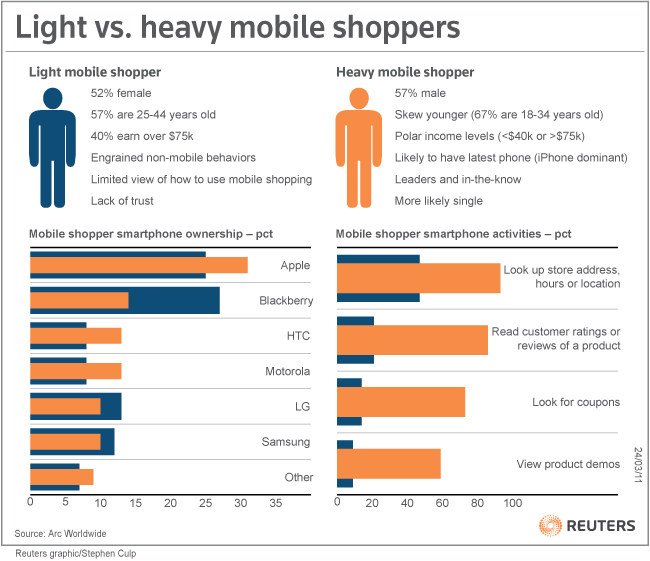 About half of mobile phone owners use their devices when shopping, to one extent or another.
While 89.7 percent of the U.S. population aged 18 to 64 have mobile phones, only 49.1 percent are using their phones to shop, according to Arc Worldwide, the marketing services arm of advertising agency Leo Burnett.
Mobile shoppers are using phone-friendly versions of websites and apps to compare prices, read reviews, check out product features, download coupons and make purchases.
read more here
Gary Kim was cited as a global "Power Mobile Influencer" by Forbes, ranked second in the world for coverage of the mobile business, and as a "top 10" telecom analyst. He is a member of Mensa, the international organization for people with IQs in the top two percent.
Half of U.S. Mobile Users Buy Mobile Broadband, Parks Associates Says
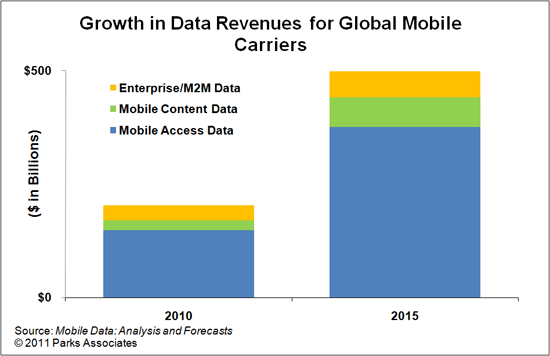 "Almost 50 percent of U.S. mobile phone users pay for mobile Internet access, according to Parks Associates. Some 95 percent pay for SMS, 92 percent pay for Internet access, 83 percent pay for mobile email, 63 percent pay for mobile navigation, and 43 percent pay for mobile video.
Gary Kim was cited as a global "Power Mobile Influencer" by Forbes, ranked second in the world for coverage of the mobile business, and as a "top 10" telecom analyst. He is a member of Mensa, the international organization for people with IQs in the top two percent.
"Almost 50 percent of U.S. mobile phone users pay for mobile Internet access, according to Parks Associates. Some 95 percent pay for SMS, 92 percent pay for Internet access, 83 percent pay for mobile email, 63 percent pay for mobile navigation, and 43 percent pay for mobile video.
Gary Kim was cited as a global "Power Mobile Influencer" by Forbes, ranked second in the world for coverage of the mobile business, and as a "top 10" telecom analyst. He is a member of Mensa, the international organization for people with IQs in the top two percent.
Tablet Sales Could Drive Significant Mobile Broadband Sales
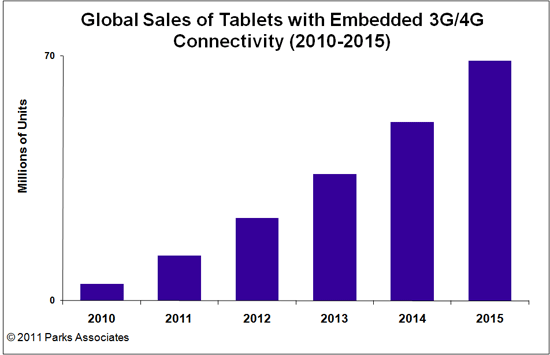 In yet another sign that connected devices other than smartphones are starting to drive demand for mobile broadband service, Parks Associates forecasts more than 68 million of the 126 million tablets sold worldwide in 2015 will have 3G or greater technology. That only means that users have the ability to buy mobile broadband, not that they will, of course.
 Some 29 percent of the 16.5 million tablets sold in 2010 featured embedded 3G technology, while tablets with 3G or 4G technology will account for over half of all tablets sold in 2015.
Gary Kim was cited as a global "Power Mobile Influencer" by Forbes, ranked second in the world for coverage of the mobile business, and as a "top 10" telecom analyst. He is a member of Mensa, the international organization for people with IQs in the top two percent.
U.S. SMBs Highly Likely to Buy Tech Support Services for Tablets, Other IT
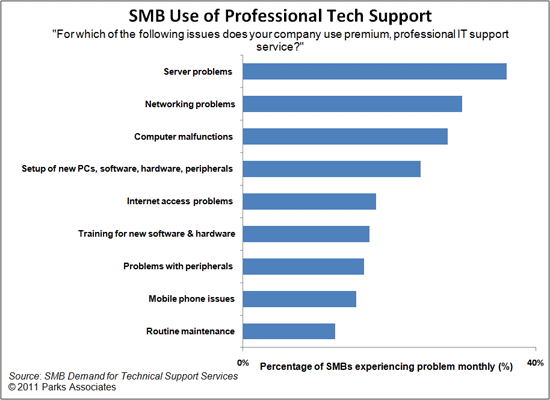 U.S. small businesses are three times more likely than average consumers to use professional computer-related technical support services, compared to consumers, and significantly more likely to purchase additional support features when acquiring new equipment, Parks Associates says.
 "SMBs waste dozens of hours per month troubleshooting technology issues," said Kurt Scherf, VP, principal analyst, Parks Associates. "Over 70 percent are involved with ongoing computer maintenance on a monthly basis."
About half deal with Internet access issues, 44 percent troubleshoot computer problems, 31 percent troubleshoot networking issues, and 27 percent deal with server problems.'"
There might be new opportunities for a variety of companies and channels. Apple, for example. recently announced JointVenture, a new support network for small businesses that combines remote and retail support for its iPads and Macs.
Gary Kim was cited as a global "Power Mobile Influencer" by Forbes, ranked second in the world for coverage of the mobile business, and as a "top 10" telecom analyst. He is a member of Mensa, the international organization for people with IQs in the top two percent.
Tech Company Valuation: 1999 and 2011

It is clear there is an enormous wave of Internet innovation going on at the moment. But there will be excesses and failures, as well as some big new market leaders.
But one difference seems to be that all the emerging companies are applications and software firms. You'd be hard pressed to name a hardware company that is among the emerging firms.
Gary Kim was cited as a global "Power Mobile Influencer" by Forbes, ranked second in the world for coverage of the mobile business, and as a "top 10" telecom analyst. He is a member of Mensa, the international organization for people with IQs in the top two percent.
Microsoft Strategy Chief: Tablets May Just Be A Fad
Microsoft's chief technical officer and strategic leader Craig Mundie told an audience in Australia that he's not sure if tablets are here to stay. Steve Jobs agrees with Mundie on one point: the iPad is not a PC. Beyond that, Apple and Microsoft do not seem to agree on much else.
Gary Kim was cited as a global "Power Mobile Influencer" by Forbes, ranked second in the world for coverage of the mobile business, and as a "top 10" telecom analyst. He is a member of Mensa, the international organization for people with IQs in the top two percent.
Google "Plus One" is Another Way Users Can Annotate the Web
Gary Kim was cited as a global "Power Mobile Influencer" by Forbes, ranked second in the world for coverage of the mobile business, and as a "top 10" telecom analyst. He is a member of Mensa, the international organization for people with IQs in the top two percent.
NFC is Overhyped, says Sybase
Sybase is a leader in text messaging based mobile payments, so Sybase might be forgiven its public view that mobile payments using near field communications are over-hyped at the moment. The general observation is correct, as always is the case. Enthusiasm always outruns actual adoption when brand-new technologies are introduced.
Sybase says text-based payments more than doubled in 2010, so “mobile commerce is exploding." But the skeptical view about NFC is both a realistic assessment of what can happen in 2011, and a rational response for a leader using a rival method.
Gary Kim was cited as a global "Power Mobile Influencer" by Forbes, ranked second in the world for coverage of the mobile business, and as a "top 10" telecom analyst. He is a member of Mensa, the international organization for people with IQs in the top two percent.
Microsoft Planning Mobile Payments Support
Microsoft Corp. is working on a version of its Windows Phone software with near field communications support, allowing creation and use of NFC-based mobile payments applications and services. What isn't immediately clear is whether Microsoft wants to provide NFC support without creating its own mobile payments solution, or will try to compete as a supplier of mobile payments or related services.
Gary Kim was cited as a global "Power Mobile Influencer" by Forbes, ranked second in the world for coverage of the mobile business, and as a "top 10" telecom analyst. He is a member of Mensa, the international organization for people with IQs in the top two percent.
Subscribe to:
Comments (Atom)
-
We have all repeatedly seen comparisons of equity value of hyperscale app providers compared to the value of connectivity providers, which s...
-
It really is surprising how often a Pareto distribution--the “80/20 rule--appears in business life, or in life, generally. Basically, the...
-
Financial analysts typically express concern when any firm’s customer base is too concentrated. Consider that, In 2024, CoreWeave’s top two ...

