Tuesday, April 5, 2011

7% Of Video Subs Thinking About Dropping Service?

Though perhaps just 1.4 percent of consumers have "cut the cord" in the last two years, abandoning multichannel TV services, about seven percent of current subscribers are considering canceling their service, according to a survey to be published in the May issue of Consumer Reports. See Survey: 7% Of Pay-TV Subs Pondering Pulling The Plug - 2011-04-05 12:32:28 | Multichannel News.

But L.E.K. surveys recently found little actual evidence of increased cord cutting, though. To date, only two percent of
L.E.K. survey respondents are cord cutting.

A more serious issue facing cable and satellite providers is “cord trimming,” the term for consumers who keep – but reduce –
their monthly cable or satellite TV services. L.E.K. found that 16% of consumers reported reducing their monthly pay TV bills
during the past year. Those cord trimmers reduced their pay TV bills by an average of 25 percent.

Mobile Data Sharing Under Review

Internet applications are lightly regulated. But that is not to say regulation will not occur, albeit taking the form of antitrust investigations or consumer protection. With talk of Google becoming "too big," and Pandora being looked at as part of a wider probe, it appears a potential new wave of application regulation might be coming.

LivingSocial Raises $400 Million

LivingSocial, the number two player in the burgeoning daily coupon website market, has raised $400 million to help fuel its expansion and keep up with rival Groupon Inc., the Wall Street Journal reports.

The investment round, raised from existing investors Lightspeed Venture Partners and Amazon.com, and new ones such as Institutional Venture Partners, values the three-year old company at around $ 3 billion.

You can argue there is a "bubble" going on for Internet ventures, or you can argue that the next great wave of Internet companies is coming into view. You might argue both propositions are true. Even if there is a valuation bubble, the last great Internet bubble nevertheless produced the current leading companies of the Internet application space. That is likely to be the case for some companies of the current wave, even if current valuations do not hold up, over the longer term.

Monday, April 4, 2011

Tests inaccurate, Sprint says

It's own tests do not confirm recent tests suggesting its 4G network isn't so fast.

http://www.google.com/reader/i/?source=mog&gl=us#stream/user%2F05579064408535224496%2Fstate%2Fcom.google%2Freading-list

Gmail Ads Get "More Targeted"

Google plans changes to the way it inserts ads in Gmail user messages, and should result in fewer ads being shown, use of Gmail’s importance ranking applied to ads and a new emphasis or availability on offers and coupons for Gmail recipients in their local area.

Sprint Plans 2011 Launch of Mobile Payments

Sprint Nextel Corp. plans to launch its own mobile payments system using near field communications in 2011, beating Isis, the consortium of AT&T, Verizon Wireless and T-Mobile USA by possibly six months or more, Bloomberg reports.

Perhaps significantly, Sprint is evaluating a business model that would not take a percentage of each transaction, as Isis plans. Instead, Sprint might decide to focus on marketing services and advertising, perhaps taking a share in revenue from sales of coupons sent to its customers’ handsets or targeted advertising.

It appears Sprint has decided to partner with credit card and debit card issuers for handling the money transfer parts of the service.

Google Bids on Nortel Patent Portfolio

Google is bidding to acquire Nortel's patent portfolio, in a move that tells you quite a lot about the state of patent litigation in the technology space these days.

"One of a company’s best defenses against patent litigation is to have a formidable patent portfolio, Google says.

So Google has decided to bid for Nortel’s patent portfolio in the company’s bankruptcy auction. Nortel further has selected the Google bid as the “stalking-horse bid," which is the starting point against which others will bid prior to the auction.

"If successful, we hope this portfolio will not only create a disincentive for others to sue Google, but also help us, our partners and the open source community—which is integrally involved in projects like Android and Chrome—continue to innovate," Google says on its blog.

Vodafone exits France, takes control in India

Vodafone has announced two major deals, offloading its stake in its French SFR, the second-largest French telecom provider, and taking full control of its Indian operator.

This continues the giant's strategy of streamlining its international holdings, divesting minority stakes and seeking full ownership of ventures where it takes the lead.

That doesn't provide much guidance or clarity about what Vodafone might ultimately want to do about its stake in Verizon Wireless. Some think it might divest, others think it might prefer a full merger with all of Verizon. Either step seems possible, based on what Vodafone already has done.

EMC Cloud Backup Service Arrives On iPad, iPhone

In one sense, the ability to use cloud-based applications as easily on a smartphone or tablet as on a PC is not that big a deal. Most observers would agree that the movement of apps to mobile devices is on-going and likely an irresistible trend.

Mozy, a cloud-based storage service, now allows mobile apps to run as native applications on smart phones and tablets. Consumer subscribers to the storage service are able to access all their files independently in their "MozyHome" storage holders. For example, users can view documents and open them in other applications, such as a browser.

On another level, though, the app might be the precursor of something much more strategic. First, the move to cloud-based apps accessible on any common computing device means that the user interface and the installation process should be dramatically simpler than before. Installation now means "download from app store" and the user interface is a simple web browser app.

That could ultimately have huge implications for the entire value chain and ecosystem that sells and supports business applications, software and services.

Consider just one implication: the smart phone "brings its own broadband." We are used to the idea that apps can be used over any standard broadband connection. With growing use of tablets and smart phones, business users already might be supplying their own broadband. That isn't to say businesses have less need to buy fixed location broadband; simply to note that a large category of "broadband access" services already have been "sold."

As with many other types of business applications, services and appliances, the "pitch" increasingly is a "replace what you already have" decision, not a "buy something new" decision. Also, mobile "broadband" is a secondary feature of the primary product, which is the smart phone and the apps it supports.

Likely more important is a shift of selling and provisioning context. In the future, buying a business app might be nearly as simple as going to a web store and downloading an app. Some way to simplify uploading of enterprise data also will be required in some cases, of course.

Sunday, April 3, 2011

AT&T Buying T-Mobile Won’t Matter, Says Pinger

The AT&T acquisition of T-Mobile USA won't make a dent in either innovation, competition or consumer welfare, because wireless innovation now lies in all the applications now available "over the top," says Pinger co-founder Joe Sipher.

For instance, my company, Pinger, now moves over a billion text messages every month and millions of minutes of voice calls. And we are only a fraction the size of Skype. There are many more companies like ours out there too. Increasingly, users pay nothing for calls because these new over-the-top services apply internet monetization methodologies to communication services. Advertising based communication services mean no contracts, no calling plans, no overage fees.

The "AOL" Approach to Content Generation

Twenty years ago, large corporations had to deal with a bunch of clearly identified specialized journalists from the mainstream media. Today, a large chunk of the news cycle is controlled by many diverse opinion shapers.

The "AOL" approach to producing content is one example of how much content and news production has changed, for the worse, many would argue. For better or worse, content producers and journalists, as well as those who try to get attention in the media, might as well know what is happening.

Microsoft on Tablets

“The tablet takes cutting-edge PC technology and makes it available whenever you want it…It’s a PC that is virtually without limits — and within five years I predict it will be the most popular form of PC sold in America.”

--Bill Gates in 2001

"...not sure whether tablets "would remain with us or not."

--Craig Mundie, Microsoft Research, 2011

One suspects the latest statements are made only because Microsoft needs more time to ready its own approach and offering.

1/2 of Twitter Users Follow 2 or More People

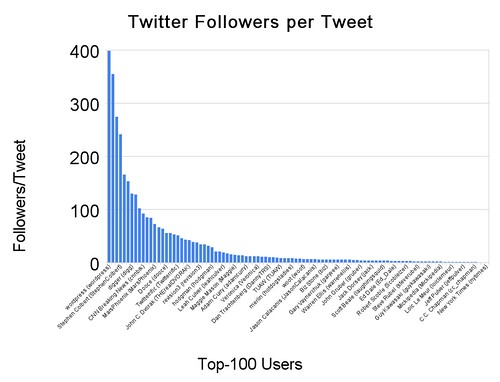
How Many Users Does Twitter REALLY Have?Perhaps the first thing that strikes you, looking at this graph, is its familiarity. As it turns out, when using Twitter, a relatively small number of users actually "follow" many other people. In fact, just about half of Twitter users follow two or more people.  About 10 percent of Twitter users follow 50 people or more, and an infinitesimal number follow more than 500 people.

That's basically the flip side of a graph you might also be familiar with, the number of followers a Twitter user has. As you would expect, it's the same graph: a very small number of Twitter entities get a disproportionately high number of followers.

Both of those graphs would be expected in a Pareto distribution, sometimes popularly known as the "80/20" rule.

Saturday, April 2, 2011

Amazon.com Considering Mobile Payments Service

Amazon.com is considering the introduction of a service that would let consumers pay for goods in brick-and-mortar stores using their mobile phones, according to Bloomberg.

The company’s “Amazon Payments” unit is said to be exploring whether to start a service based on near field communications.

Amazon.com Said to Be Considering Mobile-Payment Service for Smartphones – Bloomberg

Mobile Broadband to Produce Majority of Subscriber Growth to 2014

The number of mobile broadband subscribers passed the number of fixed broadband subscribers, globally, in 2010, says Infonetics Research. A goodly part of the growth now is coming from smart phones, tablets and other devices, leading Infonetics to forecast that 1.5 billion connected devices will be in use by 2014.

As a consequence, fixed broadband will show slower growth as mobile broadband becomes the broadband of choice, on a global basis. That doesn't mean fixed line services will be abandoned, but simply that mobility is a "personal" service, used by people and sensors, where fixed line service is generally to a location. Since there are more people and sensors than homes or offices or factories, the unit growth will tend, over time, to be for mobile devices and sensors.

read more here

Yes, Follow the Data. Even if it Does Not Fit Your Agenda

When people argue we need to “follow the science” that should be true in all cases, not only in cases where the data fits one’s political pr...