Thursday, April 7, 2011

Sprint to Sign Network Sharing Deals with LightSquared, Clearwire: Analyst - International Business Times

Sprint soon will sign network sharing agreements with LightSquared and Clearwire that will have Clearwire and Lightsquared paying Sprint $2400 per base station, per month, to provide local radio facilities.

"We have assumed the same basic deal terms for both LightSquared and Clearwire in the analysis that follows: We assume partners pay Sprint $2,400 per base station per month," says Jonathan Chaplin, Credit Suisse analyst.

LightSquared and Clearwire are expected to pay 50 percent in cash and 50 percent in capacity. "We assume $700 per site per month per partner in incremental operating expenditure," said Chaplin.

Chaplin assumes Sprint incurs additional upfront capital expenditure of $2.2 billion in total ($1.4 billion for LightSquared; $0.8 billion for Clearwire), with the bulk of the spend occurring in 2012 and 2013.

In some ways, the deal represents a bit of a turn around for Sprint and Clearwire. Up to this point, Sprint has been relying on Clearwire to build out the fourth generation network for Sprint. Now Sprint will be helping Clearwire, at least in some instances. The network sharing deal with LightSquared is a bit more straightforward capacity deal for LightSquared, which needs to rapidly construct a national network.

"We assume LightSquared leases access to all 45,000 Sprint base stations, giving them a nationwide network," says Chaplin. "We assume they lease base stations at the pace that Sprint installs them, with lease payments starting at the beginning of 2012 and covering all 45,000 base stations by the end of 2013," said Chaplin.

"We assume Clearwire leases 28,000 base stations to expand coverage to another 70 million potential customers and replaces some of their existing base stations," said Chaplin.


Data Helps U.K. Carriers Maintain Revenue Amidst Voice Decline

LR-55866-EX03.jpgData revenues clearly have become the antidote to declining mobile voice revenues, in the United Kingdom and elsewhere.

Mobile data will compensate for the declines in the voice business during the next five years.Vodafone achieved growth of 30 percent during the fourth quarter of  2010.

Telefónica O2 achieved a similar result, reporting growth of 32 percent in its non-P2P SMS revenue year-on-year to December 2010. This refers to data excluding revenue from person-to-person SMS messages, in other words, mobile data revenue other than from text messaging.

Still, average revenue per user continues to dip slightly, and the mobile data replacement of voice can only go so far. At some point, mobile operators will have to find other avenues for revenue growth.

Prime Time for iPad is Different from PC

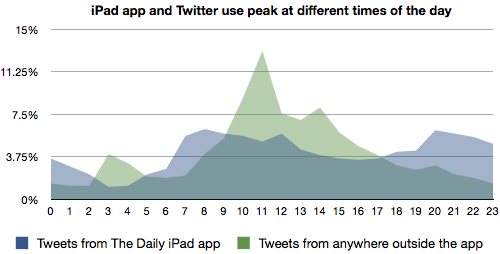
An analysis suggests that iPads get used differently than PCs and notebooks or netbooks. Tweets from the iPad app peak in the morning (around the 7:00 and 8:00 am) and again in the evening (around 8:00, 9:00, and 10:00 pm).

The non-iPad app tweets follow a very different pattern: They match up with the work day, highest from 9-to-5 and peaking just before and after lunch. read more here

24% of IT Buyers Use Social Media

When asked, only 12 percent of people buying information technology said they use social media to inform their choices. But respondents are dramatically understating the extent to which social media is used.

“At least double this number are heavy users of social media and make use of it in ways which support their IT decisions,” said Net Media Europe research director Camelia Nita. “It is possible that the very transparency and ease of use of social media has masked the extent to which people use them.”

One in eight IT decision makers consciously use social media for purchasing, though about and one in four actually does. Also, about 25 percent use social media for support.

Will Cisco Sell Scientific-Atlanta, Linksys Assets?

Cisco looks set to reduce its areas of key focus from over 40 to just five, plus three or four more experimental units with high growth potential.

The big five will be maintaining leadership in core routing, switching and services; collaboration; data center virtualization and cloud; architectures; and video.

Many observers suggest that the retrenchment could see a spin-off or sale of some consumer units, including the set-top box and home networking businesses based on the acquisitions of Scientific Atlanta and Linksys.

Can Netflix Pull Off the Next Great Transformation?

Netflix has been viewed as "toast" so many times it might be easy to argue that Netflix now will run into trouble as it starts to spend serious money on original or at least high-quality new content deals.

The argument is that Netflix simply cannot afford to do so. Deals such as the recent agreement allowing Netflix to stream "Mad Men" are the sort of thing that will add "billions of dollars" to the company cost structure.

"Simply put, Netflix is in over its head," some will argue. If it does not collect impressive content with frequency, its brand -- its image -- takes a serious hit. But, as it attempts to keep up the pace required to retain its top spot in the hearts and minds of streamers, it spends itself into a future it cannot afford.

Perhaps Netflix has run into a wall it cannot climb. But that has been said, repeatedly, about Netflix in the past. To be sure, content owners recently have concluded that Netflix has grown "too powerful," so it won't be easy for Netflix to keep getting access to content at lower rates.

Some would argue that if Netflix owned the infrastructure or technology that makes streaming possible it would have something. "But, it doesn't." Of course, some service providers that do own lots of technology and infrastructure, such as Dish Network and Echostar, disagree. Dish Network CEO Charlie Ergen recently has mused that, if he were starting today, he might choose the Netflix model for distribution, instead of building, launching and owning fleets of satellites.

Netflix faces challenges, of course. But so do all video distributors. Netflix has faced concern in the past, and successfully defied all the naysayers. That is no guarantee it can continue to do so. But the company has beaten the odds for quite some time. And some might argue that Netflix or YouTube could emerge as the next generation of video distributors, ultimately.

Mobile's Evolution

The evolution of mobility, as seen by Vodafone.

HTC Market Value Passes Nokia

HTC surpasses Nokia in market capitalizationHTC Corp., Asia’s second-largest maker of smartphones, passed Nokia’s market value.

The 5.3 percent gain of HTC shares in Taipei trading yesterday took the Taoyuan, Taiwan-based company’s market value to $33.8 billion, exceeding the $33.6 billion value of its competitor. Nokia climbed 1.1 percent to 6.26 euros. HTC shares closed unchanged today.

HTC stock tripled in the past year as smartphone shipments grew at more than twice the pace of the wider market for mobile handsets.

Smartphone subsidies hit Canadian mobile profit margins

While rising smart phone penetration has led to higher average revenue per user, and increased mobile data revenue at the three main Canadian operators (Bell Mobility, Telus Mobility and Rogers Wireless), a Wireless Intelligence study found that, in most cases, operational expenses also have increased, resulting in a contraction of profit margins (earnings before interest, taxes, depreciation and amortization).

Opex costs are higher in large part because of increased handset subsidy costs for new smart phone customers and retention of existing customers who upgrade to smart phones.

That might not be the case in markets where handsets are not subsidized, typically in exchange for a two-year contract.

The study suggests s that the cost of acquisition per subscriber at Bell rose 13.4 percent between 2009 and 2010 and by 3.9 percent at Telus over the same period. There were similar trends in retention spending, which (as a percentage of service revenue) increased by 2.4 percentage points at Bell and 0.7 percentage points at Telus year-on-year, and by 7 percentage points at Rogers in Q4 2010. Opex also increased at all three operators during the period.

Mobile Financial Services Up 54%

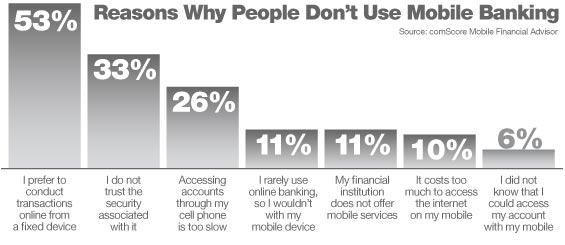
comScore Reasons Why People Don't Use Mobile BankingThe report found that In the fourth quarter of 2010, 29.8 million Americans accessed financial services accounts (bank, credit card, or brokerage) using their mobile device, an increase of 54 percent from the fourth quarter of 2009, according to comScore.

Some 18.6 million users accessed their financial accounts via mobile browser in Q4 2010, up 58 percent from the previous year, 10.8 million accessed their accounts via applications, up 120 percent. SMS (text message) represented the smallest access point for financial service audiences with 8.1 million users, up 35 percent.


Mobile Financial Service Audience (Accessed Bank, Credit Card or Brokerage Account)
3 Month Avg. Ending Dec-2010 vs. 3 Month Avg. Ending Dec-2009
Total U.S. Mobile Subscribers Ages 13+
Source: comScore MobiLens
Total Unique Audience (MM)
Q4 2009Q4 2010Percent Change
Accessed Mobile Financial Services*19.329.854%
Accessed via Mobile Browser11.818.658%
Accessed via Application4.910.8120%
Accessed via SMS6.08.135%

Will Hotspots Kill LTE?

For as long as public Wi-Fi has been an issue, some have argued that public Wi-Fi would compete with 3G mobile broadband. These days, that same argument might be made about Wi-Fi cannibalizing fourth generation networks as well.

"With most of the public WiFi hotspots in the U.K. being offered by fixed operators, there is a potential value shift from mobile to fixed networks," says Telco 2.0. "As the hotspots grow and critically, once they become interconnected, there is an increasing risk to mobile operators in terms of the value of investment in expensive ‘4G’ and LTE spectrum."

It's just a guess at the moment, but I suspect the concern about cannibalization will be no more correct for 4G than it has proven to be for 3G. Wi-Fi used to be a radio tail to a fixed line network. These days, it might also be a radio tail to a radio network (mobile hotspot). There will continue to be application scenarios for fixed access, fixed access using a radio tail circuit, fully mobile broadband and untethered but not mobile access.

People will use "all of the above." In some markets, where a smartphone purchase also requires a minimal data plan, that will be even more true.

Infrastructure as a Service $10.5 Billion in 2014

Cloud infrastructure as a service (IaaS) is more likely to be purchased by an enterprise, while small businesses are more likely to buy "applications as a service." Still, the market for all types of cloud services is seminal. Today there is no standard, "one size fits all" offering and no single provider successfully addresses all segments of the market, according to Gartner. That is what one would expect in a new market.

Worldwide IaaS revenues were about $3.7 billion in 2011 and will reach $10.5 billion in 2014, Gartner now forecasts.

"We are still at the beginning of the adoption cycle for cloud compute IaaS," said Lydia Leong, Gartner research VP.

Cloud IaaS is the capability provided to the consumer to provision processing, storage, networks and other fundamental computing resources where the consumer is able to deploy and run arbitrary software, which can include operating systems and applications.

Wednesday, April 6, 2011

Dish to Compete with Netflix?

YouTube to Create Channels

YouTube is getting ready to launch new "channels" featuring premium content, around topics such as arts and sports. YouTube is looking to introduce 20 or so "premium channels" that would each feature five to 10 hours of professionally-produced original programming a week.
YoutTube also is planning to spend as much as $100 million to commission the creation of original content for the premium channels.

Plan to Address LightSquared GPS Interference Issues Due June 15

Signal interference issues are not uncommon for any services using over-the-air spectrum. LightSquared, as part of its waiver to operate a hybrid satellite and terrestrial 4G network, has to work with other users of satellite spectrum that could face interference from the planned LightSquared network.

The Pentagon is among users concerned about LightSquared interference with GPS applications, for example.

The LightSquared L-Band terrestrial base stations broadcast on the adjacent frequency to the GPS satellites. The worry is that the much stronger signals from the earthbound LTE radios will stop terrestrial GPS receivers from locking on to the weaker signals from space. That is a well-founded concern.

By June 15, 2011, a working group report on such interference and how LightSquared will address the issues must be submitted. Typically, such interference issues are rectified using frequency filters or adjusting power levels or both. It might be difficult to reduce transmitting power from a terrestrial cell site enough to avoid interference with relatively-weak GPS signals, though. So filtering would seem to be the logical solution.

Is Private Equity "Good" for the Housing Market?

Even many who support allowing market forces to work might question whether private equity involvement in the U.S. housing market “has bee...