Motorola led the "Mobile Phones" category, followed by HTC and Sony Ericsson. Nokia is fourth and Apple, ranked just above industry average, is fifth. Those results might surprise many, but the Harris Poll includes both smart and feature phones. Apple does not sell a feature phone.
Thursday, April 14, 2011
Motorola, Verizon Top Harris Poll Survey
Verizon is the "Mobile Networks Brand of the Year" among consumers surveyed by the Harris Poll EquiTrend study. In the Mobile Networks category, Verizon is highest ranked for the second-year running over archrival AT&T.
Motorola led the "Mobile Phones" category, followed by HTC and Sony Ericsson. Nokia is fourth and Apple, ranked just above industry average, is fifth. Those results might surprise many, but the Harris Poll includes both smart and feature phones. Apple does not sell a feature phone.
Motorola led the "Mobile Phones" category, followed by HTC and Sony Ericsson. Nokia is fourth and Apple, ranked just above industry average, is fifth. Those results might surprise many, but the Harris Poll includes both smart and feature phones. Apple does not sell a feature phone.

 Gary Kim was cited as a global "Power Mobile Influencer" by Forbes, ranked second in the world for coverage of the mobile business, and as a "top 10" telecom analyst. He is a member of Mensa, the international organization for people with IQs in the top two percent.
6 Ways Telcos Can Grow
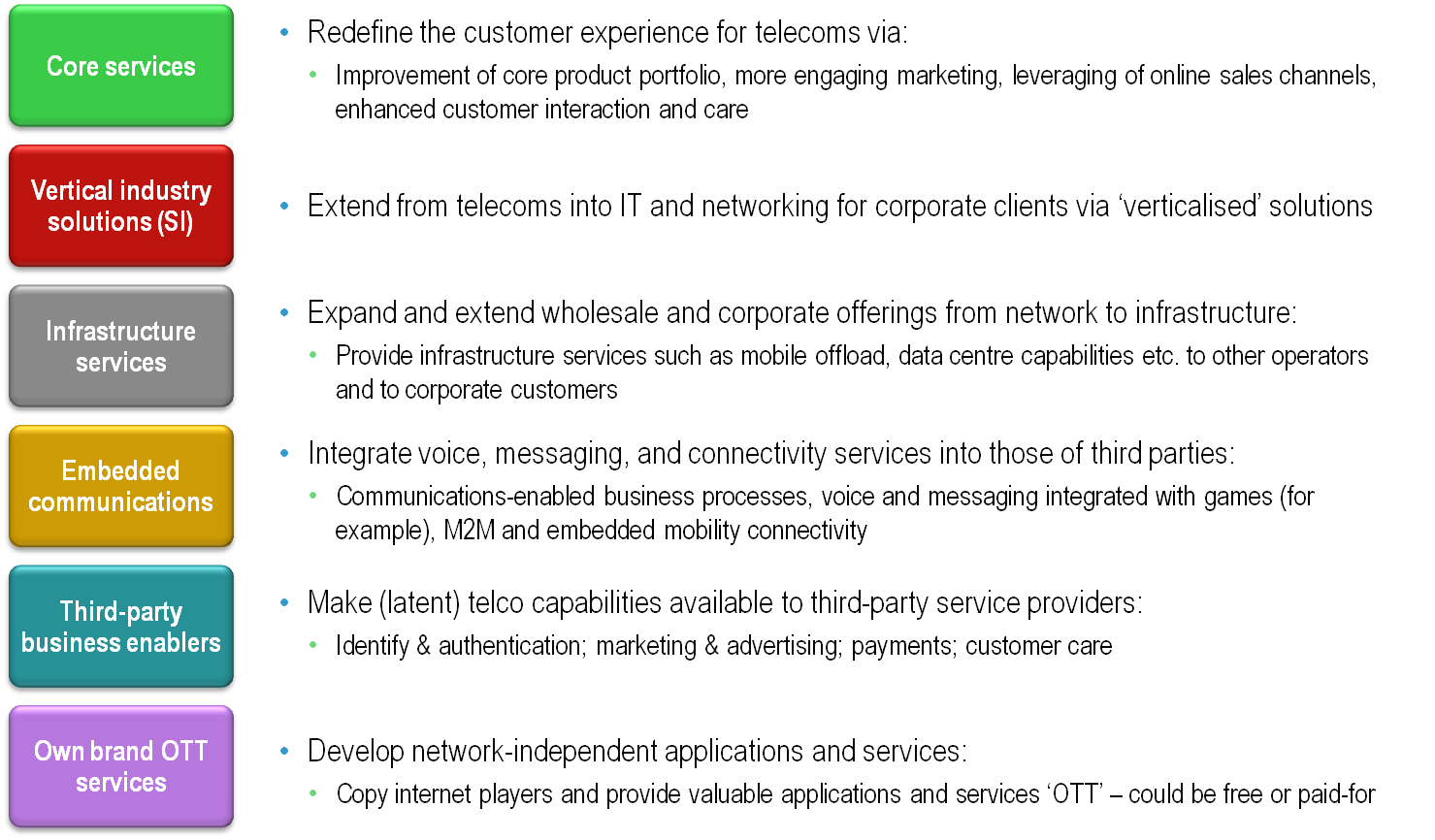
There are six fundamental ways incumbent telcos can attain significant revenue growth, on the way to becoming "Telco 2.0" organizations, according to a new report by STL Partners. Some of the strategies are process oriented, and aim to enhance what service providers already are doing. That might include such things as better marketing, better use of sales channels or core product enhancements.
 Other strategies require a bit more, or substantially different profiles. Among the more far-reaching, one might argue, is the strategy of becoming an over-the-top application provider. That move essentially breaks the "territorial" model by severing the tight connection between access services and applications. Whether this ultimately will prove more strategic for fixed line providers or mobile providers might be debatable, in some markets.
Where widespread and easy access to incumbent facilities is possible, "footprint" extension for a facilities-based strategy is easier. In other markets, where wholesale is more expensive and harder to negotiate, facilities-based approaches using wholesale access might be more difficult. Most European markets are examples of the former, the U.S. market an example of the latter.
But most of the six major strategies will make sense as logical extensions of what service providers already do, with significant new emphasis. Providing more targeted solutions to business customers in some verticals, as well as providing other infrastructure-type services such as data center or hosting services, will not be foreign suggestions for most service provider executives.
Likewise, the suggestion that service providers can generate revenue by exposing network features to third parties will resonate.
read more here
 Other strategies require a bit more, or substantially different profiles. Among the more far-reaching, one might argue, is the strategy of becoming an over-the-top application provider. That move essentially breaks the "territorial" model by severing the tight connection between access services and applications. Whether this ultimately will prove more strategic for fixed line providers or mobile providers might be debatable, in some markets.
Where widespread and easy access to incumbent facilities is possible, "footprint" extension for a facilities-based strategy is easier. In other markets, where wholesale is more expensive and harder to negotiate, facilities-based approaches using wholesale access might be more difficult. Most European markets are examples of the former, the U.S. market an example of the latter.
But most of the six major strategies will make sense as logical extensions of what service providers already do, with significant new emphasis. Providing more targeted solutions to business customers in some verticals, as well as providing other infrastructure-type services such as data center or hosting services, will not be foreign suggestions for most service provider executives.
Likewise, the suggestion that service providers can generate revenue by exposing network features to third parties will resonate.
read more here
Gary Kim was cited as a global "Power Mobile Influencer" by Forbes, ranked second in the world for coverage of the mobile business, and as a "top 10" telecom analyst. He is a member of Mensa, the international organization for people with IQs in the top two percent.
Wednesday, April 13, 2011
Payfone Gets $19M, Alliance with American Express
Payfone has gotten $19 million in a new funding round, led by American Express with additional investment from Verizon Investments, Rogers Ventures and existing investors Opus Capital, BlackBerry Partners Fund and RRE Ventures.
Payfone says it will use the new funds to continue innovations in its market approach and to support its global expansion across North America, EMEA, Latin America and Asia.
"The payments industry is going through a fundamental transformation, with the move to digital payments becoming the primary driver," said Dan Schulman, Group President, Enterprise Growth, American Expres
American Express and Payfone are getting together to create and power a new global mobile checkout service. Payfone will combine its mobile authorization and payment services with American Express' digital payments platform, Serve.
Payfone says it will use the new funds to continue innovations in its market approach and to support its global expansion across North America, EMEA, Latin America and Asia.
"The payments industry is going through a fundamental transformation, with the move to digital payments becoming the primary driver," said Dan Schulman, Group President, Enterprise Growth, American Expres
American Express and Payfone are getting together to create and power a new global mobile checkout service. Payfone will combine its mobile authorization and payment services with American Express' digital payments platform, Serve.
Gary Kim was cited as a global "Power Mobile Influencer" by Forbes, ranked second in the world for coverage of the mobile business, and as a "top 10" telecom analyst. He is a member of Mensa, the international organization for people with IQs in the top two percent.
What is 'Better Broadband' and Who Should Pay for It?
People will disagree about what "better broadband" might mean, but it probably remains the case that "more" is better. There still seems to be huge disagreement about how to fund 'much better' broadband, though. Better broadband. 'What does the customer want to do?' asked Jack Weixel, who heads up Google's service provider markets (enterprise) efforts. Better broadband means that users are able to do the things they want to do, he said. 'At the end of the day, speed does matter,' said Weixel.
Raymond Henagen, CEO, Rock Port Telephone, had another practical perspective on faster broadband: 'who is going to pay as users keep demanding more capacity?"
Raymond Henagen, CEO, Rock Port Telephone, had another practical perspective on faster broadband: 'who is going to pay as users keep demanding more capacity?"
Former Federal Communications Commission Chairman Kevin Martin noted that "speed matters," where it comes to broadband. Specifically, faster broadband leads to applications innovation. Developers always create applications that take advantage of faster broadband, and people seem to learn to rely on those apps.
That basically is why Google is building a symmetrical 1-Gbps fiber network in Kansas City, Kansas. Google wants to see what will happen once that level of broadband is available to developers and users.
Gary Kim was cited as a global "Power Mobile Influencer" by Forbes, ranked second in the world for coverage of the mobile business, and as a "top 10" telecom analyst. He is a member of Mensa, the international organization for people with IQs in the top two percent.
Mobile Operators in Western Europe See Earnings Erosion, Opex Increases in 4Q 2010
Mobile operators in Western Europe recorded further revenue losses and earnings (earnings before interest, taxes, depreciation and amortization) erosion in the fourth quarter of 2010, according to new research from Strategy Analytics. Gains those operators had made in operating expenditures in the first half of 2010 were reversed by year-end.
Looking at financial data from 200 mobile operators serving over 77 percent of global subscribers, Strategy Analytics found found that mobile service revenues fell by 1.3 percent in the fourth quarter of 2010 in Western Europe. Meanwhile, mobile operators worldwide saw revenue grew by 6.1 percent.
“This weak performance is less about the after-shocks of the global recession and more about the changing data-centric market environment," Strategy Analytics says.
Subsidies associated with smartphone sales and upgrades, and the relentless growth in data traffic from these devices, reversed the long-term trend of falling operating expenses per subscriber,” said Phil Kendall, Director, Wireless Operator Strategies. “For example, the average cost to retain a customer has increased for T-Mobile in several countries: Germany (26 percent), Austria (57 percent) and the Netherlands (12 percent). Orange customer retention costs have increased in France (11 percent) and Spain (14 percent)."
Read more here
Looking at financial data from 200 mobile operators serving over 77 percent of global subscribers, Strategy Analytics found found that mobile service revenues fell by 1.3 percent in the fourth quarter of 2010 in Western Europe. Meanwhile, mobile operators worldwide saw revenue grew by 6.1 percent.
“This weak performance is less about the after-shocks of the global recession and more about the changing data-centric market environment," Strategy Analytics says.
Subsidies associated with smartphone sales and upgrades, and the relentless growth in data traffic from these devices, reversed the long-term trend of falling operating expenses per subscriber,” said Phil Kendall, Director, Wireless Operator Strategies. “For example, the average cost to retain a customer has increased for T-Mobile in several countries: Germany (26 percent), Austria (57 percent) and the Netherlands (12 percent). Orange customer retention costs have increased in France (11 percent) and Spain (14 percent)."
Read more here
Gary Kim was cited as a global "Power Mobile Influencer" by Forbes, ranked second in the world for coverage of the mobile business, and as a "top 10" telecom analyst. He is a member of Mensa, the international organization for people with IQs in the top two percent.
Steve Jobs Hid iPad From Google

Steven Levy’s book “In the Plex” apparently reveals that Steve Jobs hid development of the iPad from Eric Schmidt while Schmidt was still on Apple’s board of directors.
Jobs reportedly didn’t like how Google’s OS was starting to match up blow for blow to iOS and didn’t want the same to happen with tablets. Jobs was angry because he felt that Android was ripping off the key features of the iPhone.
Read more here
Gary Kim was cited as a global "Power Mobile Influencer" by Forbes, ranked second in the world for coverage of the mobile business, and as a "top 10" telecom analyst. He is a member of Mensa, the international organization for people with IQs in the top two percent.
Explicit Search Versus Search Share: Market Share Depends on How You Count

One can count Google slideshows, contextual search in places like Yahoo News, and Google Instant, or one can count only search terms entered into search boxes.
Using the former technique, every time you go through a slideshow on Yahoo, for instance, related search results appear below, inflating the numbers.
The latter approach strips out those numbers to come up with what it calls “explicit search,” which counts only those searches triggered when someone actually types a query into a search box.
Gary Kim was cited as a global "Power Mobile Influencer" by Forbes, ranked second in the world for coverage of the mobile business, and as a "top 10" telecom analyst. He is a member of Mensa, the international organization for people with IQs in the top two percent.
New HTC Sensation Offers Improved Video, Audio, Sense Interface
The new HTC "Sensation" will be available on the T-Mobile USA network, and is said to offer better video and audio quality, plus a new version of the "Sense" interface.
Gary Kim was cited as a global "Power Mobile Influencer" by Forbes, ranked second in the world for coverage of the mobile business, and as a "top 10" telecom analyst. He is a member of Mensa, the international organization for people with IQs in the top two percent.
Tuesday, April 12, 2011
Over-the-Top Video Seen as a DVR, Accenture Survey Shows
Users seem to using much of their non-TV viewing, especially over-the-top, as a substitute for digital video recorders. That is to say, they see online video as a 'catch up' service that allows them to watch a program they have missed when it was shown on some linear TV service, according to a new Accenture survey.
When it comes to choosing their favorite Internet broadband features, the largest number of respondents (40 percent) said "catch-up TV," which enables them to watch content that they may have missed, provided the greatest value. Only 14 percent of respondents said the top feature was Web surfing on their televisions and only 11 percent desire interactive and social networking functionality on a TV.
Those findings might surprise some, who have suggested that large numbers of consumers want advanced new interactive features on TVs. The survey actually indicates what people want is the ability to watch programs on their own schedule, which arguably has been a high driver of end user value for decades, with VCRs being an early indicator.
The Accenture survey suggests that, by whatever means, viewers want to "watch what they want, when they want it," a trend that has been clear for decades.
When it comes to choosing their favorite Internet broadband features, the largest number of respondents (40 percent) said "catch-up TV," which enables them to watch content that they may have missed, provided the greatest value. Only 14 percent of respondents said the top feature was Web surfing on their televisions and only 11 percent desire interactive and social networking functionality on a TV.
Those findings might surprise some, who have suggested that large numbers of consumers want advanced new interactive features on TVs. The survey actually indicates what people want is the ability to watch programs on their own schedule, which arguably has been a high driver of end user value for decades, with VCRs being an early indicator.
The Accenture survey suggests that, by whatever means, viewers want to "watch what they want, when they want it," a trend that has been clear for decades.
Gary Kim was cited as a global "Power Mobile Influencer" by Forbes, ranked second in the world for coverage of the mobile business, and as a "top 10" telecom analyst. He is a member of Mensa, the international organization for people with IQs in the top two percent.
Apple Ready To Launch Video Service?
Apple is preparing to launch a video service taking on Netflix, argues Jefferies analyst Peter Misek. Misek says Apple will use its new massive data center in North Carolina to offer an advanced web-based video subscription product, and likely will use a revenue sharing model similar to the App Store, giving content owners 70 percent of the revenue.
Apple will likely prove a formidable competitor if it does so, for one reason. As it has done in the past, Apple is likely to use the service to sell more of its devices. As elsewhere these days, the most dangerous competitors are those who are willing to essentially give away or merchandise something of value because doing so helps a firm sell more of what it really make its money doing. In Apple's case, music, apps and video are just interesting bits of software that help it sell more devices.
That obviously is dangerous for other providers, including cable companies and Netflix, that make their money from video subscriptions.
HTC also is launching its own mobile video service, for the same reasons.
Gary Kim was cited as a global "Power Mobile Influencer" by Forbes, ranked second in the world for coverage of the mobile business, and as a "top 10" telecom analyst. He is a member of Mensa, the international organization for people with IQs in the top two percent.
LivingSocial & Next Jump Partner
Within the next few months, LivingSocial deals will be available through Next Jump's loyalty and rewards programs, currently in place with more than 90,000 networks such as MasterCard MarketPlace and Hilton HHonors. The deal gives LivingSocial reach of more than 100 million eligible users.
In addition to handpicked deals, customers will also have the opportunity to earn Next Jump "WOWPoints" for each offer.
Gary Kim was cited as a global "Power Mobile Influencer" by Forbes, ranked second in the world for coverage of the mobile business, and as a "top 10" telecom analyst. He is a member of Mensa, the international organization for people with IQs in the top two percent.
HTC to launch new mobile video service
HTC is launching its own mobile video on demand service, with Vodafone in Europe and T-Mobile USA.
The "HTC Watch" service enables users to watch videos from a library of the latest movies and TV shows without having to wait for the content to finish downloading. The service will offer the choice of renting or buying videos, and, if purchased, lets users watch them on up to five different HTC devices.
The "HTC Watch" service enables users to watch videos from a library of the latest movies and TV shows without having to wait for the content to finish downloading. The service will offer the choice of renting or buying videos, and, if purchased, lets users watch them on up to five different HTC devices.
Gary Kim was cited as a global "Power Mobile Influencer" by Forbes, ranked second in the world for coverage of the mobile business, and as a "top 10" telecom analyst. He is a member of Mensa, the international organization for people with IQs in the top two percent.
LTE "As Good as Fixed Line"
 Tests recently conducted by Epitiro on TeliaSonera Finland's Long Term Evolution network confirm what some hope, and some fear: “Based on our observations, this LTE rollout is directly comparable to high-speed fixed line services,” said Jon Curley, CTO, Epitiro. “Further, the low latency times measured indicate the Finnish LTE service is capable of handling the most demanding of web-based applications including VoIP, video streaming and even HD IPTV."
In other words, given enough bandwidth, an LTE network performs as well as a fixed-line network.
Thw rests recorded peak broadband download speeds of 48Mbps (36.1Mbps mean). Mean latency was just 23 milliseconds.
Epitiro simultaneously tested TeliaSonera’s legacy 3G network and found that LTE delivered mean download speeds nine times faster (3G=4.1Mbps) and its latency was five times better (3G=117 ms).
Analysis of IP calls to the United Kingdom, made using voice over LTE (VoLTE), found the quality to be ‘excellent’ on average; measured according to ITU-T PESQ MOS analysis algorithms, with only 1 call in 298 being of inferior quality.
Thw rests recorded peak broadband download speeds of 48Mbps (36.1Mbps mean). Mean latency was just 23 milliseconds.
Epitiro simultaneously tested TeliaSonera’s legacy 3G network and found that LTE delivered mean download speeds nine times faster (3G=4.1Mbps) and its latency was five times better (3G=117 ms).
Analysis of IP calls to the United Kingdom, made using voice over LTE (VoLTE), found the quality to be ‘excellent’ on average; measured according to ITU-T PESQ MOS analysis algorithms, with only 1 call in 298 being of inferior quality.
Gary Kim was cited as a global "Power Mobile Influencer" by Forbes, ranked second in the world for coverage of the mobile business, and as a "top 10" telecom analyst. He is a member of Mensa, the international organization for people with IQs in the top two percent.
Monday, April 11, 2011
Starbucks by the Numbers
Gary Kim was cited as a global "Power Mobile Influencer" by Forbes, ranked second in the world for coverage of the mobile business, and as a "top 10" telecom analyst. He is a member of Mensa, the international organization for people with IQs in the top two percent.
Small Businesses Own 9 Million Tablets
Small businesses are using 8.9 million tablets, according to Techaisle, surveyed 1,356 small and medium businesses before making its estimate. Techaisle estimates that slightly over half of tablets have been purchased by consumers and used for business purposes.
Surprisingly, given the rather informal way smaller businesses handle information technology decisions, 48 percent of respondents said they already have policies in place regarding tablets.
The Apple iPad, given its early launch, dominates among very-small businesses but Android is making inroads among medium-sized organizations. About 64 percent of respondents say they use only a single operating system.
You might not be surprised that 71 percent of respondents are using tablets as a supplement to existing PCs, rather than as a replacement. Mid-sized organizations, on the other hand, report a greater willingness to replace PCs with tablets.
The survey suggests that lighter notebooks, with better battery life and instant-on capabilities will be seen as direct substitutes for tablets. That is an interesting finding. More than anything else, the instant-on feature, plus longer battery life and light weight seem to be key advantages that business owners and managers seem to clearly understand.
But security, lack of a keyboard and compatibility with the rest of existing software and hardware also seem to be key inhibitors to more-robust tablet adoption.
So far, as you also might expect, initial purchases have been for the use of owners and top managers.
read more here
Surprisingly, given the rather informal way smaller businesses handle information technology decisions, 48 percent of respondents said they already have policies in place regarding tablets.
The Apple iPad, given its early launch, dominates among very-small businesses but Android is making inroads among medium-sized organizations. About 64 percent of respondents say they use only a single operating system.
You might not be surprised that 71 percent of respondents are using tablets as a supplement to existing PCs, rather than as a replacement. Mid-sized organizations, on the other hand, report a greater willingness to replace PCs with tablets.
The survey suggests that lighter notebooks, with better battery life and instant-on capabilities will be seen as direct substitutes for tablets. That is an interesting finding. More than anything else, the instant-on feature, plus longer battery life and light weight seem to be key advantages that business owners and managers seem to clearly understand.
But security, lack of a keyboard and compatibility with the rest of existing software and hardware also seem to be key inhibitors to more-robust tablet adoption.
So far, as you also might expect, initial purchases have been for the use of owners and top managers.
read more here
Gary Kim was cited as a global "Power Mobile Influencer" by Forbes, ranked second in the world for coverage of the mobile business, and as a "top 10" telecom analyst. He is a member of Mensa, the international organization for people with IQs in the top two percent.
Subscribe to:
Posts (Atom)
-
We have all repeatedly seen comparisons of equity value of hyperscale app providers compared to the value of connectivity providers, which s...
-
It really is surprising how often a Pareto distribution--the “80/20 rule--appears in business life, or in life, generally. Basically, the...
-
Financial analysts typically express concern when any firm’s customer base is too concentrated. Consider that, In 2024, CoreWeave’s top two ...

