Monday, April 25, 2011

Mobile Banking Growing; Still in Single Digits

By 2015, more than 50 million U.S. adults could be using mobile banking services, says Emmett Higdon, Forrester Research analyst.

In a survey of 5,500 U.S. consumers Javelin conducted in November, 29 percent of respondents said they call their bank and 30 percent log into online banking when they receive an alert about their financial status from their bank, says James Van Dyke, Javelin Strategy and Research president.

Only four percent said they log into mobile banking. By comparison, of the survey respondents that were customers of Bank of America, 25 percent said they call their bank and 38 percent log into online banking. Another seven percent said they log into mobile banking.

"UC is Free!" Might be Going Too Far

Per-seat costs for unified communications are down 50 percent since 2010, a comparison suggests. At Enterprise Connect 2011, 11 major vendors presented UC solutions, each with the four UC building blocks: IM/presence, conferencing (audio, web and video), mobility and extensibility.

Each supplier presented its UC pricing for the standard configuration. The per-user-per-year average prices for the UC-only configurations were down more than 50 percent from last year, to $38 per user per year (software, hardware and maintenance for 2,000 users for three years). Costs are dropping, no doubt.

Storage Failures Hamper Cloud Foundry

Cloud Foundry, the new cloud platform hosted by VMware, experienced problems with its storage infrastructure April 25, 2011. Cloud Foundry says the issues have affected its cloud controller system, limiting users’ ability to log in and manage their applications. Existing applications will continue to run, but are unable to recover if they experience problems.

“Early this morning we experienced multiple failures in a portion of our storage infrastructure,” CloudFoundry said in a notice on its web site.

Coming on the heels of the Amazon Web Services outage, at least some potential users will be reassessing their options.

Netflix Now Has More Subs Than Comcast

If all that mattered was subscribers, Netflix would be a bigger company than Comcast, the largest U.S. cable company. In the first quarter of 2011, Netflix added 3.6 million subscribers, ending the period with more than 23.6 million subscribers in total. That was up 69 percent from the 14 million subscribers it had a year ago.

Comcast ended 2010 with 22.8 million pay TV subscribers. Of course, subscriber numbers are not the only metric. Comcast's average revenue per user is much higher. Netflix ARPU is about $12 per subscriber, per month. Comcast ARPU is somewhere north of about $82 a month.

read more here

Netflix Earnings Up 88 Percent, Adds 3.3 Million U.S. Subscribers

Netflix added 3.3 million U.S. subscribers in the first quarter of 2011, plus another 290,000 interantionally, to end at 23.6 million, which is slightly below the 3.7 million analayts were hoping for but still double the growth from a year ago.


Netflix saw a rise in domestic operating margins to 16 percent, from 14.9 percent in the fourth quarter, largely due to an increase in streaming-only subscribers and price increases on hybrid subscriptions. Margins should fall back to around 14 percent as streaming and marketing costs continue to rise (offset by declines in DVD shipping).

Content or Context? Both, but Context Might be More Important than You Think

Startups Often Succeed After Failing

One of the certainties about startups is that the initial idea fails, to be replaced by something else that does result in success.

Initial idea: Allow groups of people to band together to accomplish a goal called ThePoint
Eventually: Groupon

Initial idea: Web-based massively multiplayer online game called Game Neverending
Eventually: Flickr

Initial idea: Compare two people’s pictures and rate which one was more attractive
Eventually: Facebook

In-Store Marketing Begins at Home

The Internet has changed many things, including shopping. Among the bigger changes is the amount of research shoppers do before they actually go to a retail location. In other words, a shopper's "buying" process begins before any retailer's "selling process" begins. The implication is that the sales process has to catch people when they are conducting buying research, not after they have finished that research.

Since shoppers now conduct research before they enter a store, retailers have to move up their promotional activities to match the buyer's process, instead of waiting until a shopper is physically on the premises. Saatchi X, for example, used to find that 10 percent of client projects included an online component. Now, virtually 100 percent include an online presence.

Some 62 percent of shoppers surveyed by Booz & Co. report they searched online for deals before they began shopping trips, the Wall Street Journal reports. That might explain why there is new interest in content marketing, where brands invest in various types of online content. It no longer makes sense to be invisible when shoppers are making choices. Rather, brands need to be visible online, when buying processes already are occurring.

It's well known that consumers research expensive products like electronics online, but coming out of the recession, consumers are more scrupulous about researching their everyday products such as diapers and detergent, too, the Wall Street Journal reports.

More than 20 percent of them also research food and beverages, nearly a third research pet products and 39 percent research baby products, even though they ultimately tend to buy those products in stores, according to WSL Strategic Retail, a consulting firm.

The importance of online communications obviously is much higher, and more necessary, if one assumes that key decisions are being made in the virtual sphere. If buyers are making more decisions before they go to a store, then it is important to try and steer traffic towards stores before the more traditional promotion campaigns retailers often have relied upon, in store, can take place.

Content marketing then becomes the first step in the sales process.

Proof that Shoppers are "Shopping" at Home, 8 PM to 10 PM

A study by Compete illustrates the increasing disconnect between many forms of marketing persuasion that are part of the selling process, and the increasingly disarticulated shopper buying process. In other words, people are shopping long before they ever set out to visit a retail store, and at non-traditional retail hours when shopping online.

category visitation by hour march 2011Visits  to most retail categories peaks in the evening hours, around 8 pm to 10 pm. There is a steady increase throughout the day (from about 9 am on), and it drops off around 11 pm. The lowest levels occur in the early morning hours—between 3 am and 5 am, when the fewest people are awake.

Sporting goods retailers see a concentrated peak around 8 pm, after fairly low levels throughout the day. Home improvement sites peak in the morning and remain steady through the afternoon, with an early drop-off at night.

All of that is instructive in terms of its implications for online and mobile promotion, marketing and advertising.

read more here

KPN to Introduce New IM, Skype, Video Plans

One can argue that mobile pricing plans which charge separately for certain applications such as Skype, instant messaging or streaming video would be "consumer surly" by definition. But Netherlands regulators appear to believe that such "per application" charges could be consumer friendly, in particular if they lead to consumer ability to construct customized service packages that correspond to their unique usage patterns and preferences.

KPN has announced plans to charge mobile phone users separate fees for using VoIP services like Skype, instant messaging programs, and streaming video, but specific new rate plans haven't yet been announced. The way it might work is that consumers would buy those sorts of services on plans, just as they now buy voice or text messaging buckets or plans. See http://translate.google.com/translate?js=n&prev=_t&hl=en&ie=UTF-8&layout=2&eotf=1&sl=nl&tl=en&u=http%3A%2F%2Fwww.telegraaf.nl%2Fdigitaal%2F9600864%2F__Extra_heffingen_datadiensten_KPN__.html%3Fsn%3Ddigitaal
.
Dutch regulator OPTA has already said publicly that it's fine with the move, so long as KPN is transparent about how it charges. In fact, an OPTA spokesperson said she would "cheer such a development," since it provides more choice for consumers to put together a subscription package that meets their needs.

Will Netflix Add Family Plans?

Netflix will introduce additional streaming plans later this year that will offer the ability to stream to multiple devices simultaneously, GigaOm suggests. The offering could look like a mobile phone family plan, with an option to add additional accounts at a lower price point.

“One option would be to allow an account to add additional concurrent streams (using the analogy of our DVD business, it would be like choosing a higher-priced plan that allows a subscriber to have more DVDs at home)," Netflix states. "Or it could be that there is a price point that would encourage multiple accounts in one household."

The change potentially is important, as it is a step in the direction of "service for people," rather than "service to a location." That also was the difference between mobile and fixed-line adoption. People bought one phone line per home, but each person has a mobile device.

Netflix might be looking a shift towards "personal" consumption rather than "household" consumption. The "personal consumption" market is much bigger than the "household subscription" market.

Businesses Up Tablet, Notebook, E-Reader Spending 30%

Business spending on 3G and 4G devices such as tablets, notebooks, and e-readers was up nearly 30 percent in 2010, compared to 2009.

“A key take away from the research is that the non-handset spending increase trend seems to be universal across all sizes of business,” says Greg Potter, research analyst.  “There are some slight variations in some of the vertical segments but, they too, share a robust 2010 and have a very healthy five-year forecast.”

Enterprise spending makes up over 62 percent of business spending on non-handset data services, spending over $1.9 billion in 2010.

Enterprise (1,000 to 4,999 employees) will increase spending in 2011 by 19.5 percent in the professional services vertical. Small office and home office spending will surpass $275 billion by 2014, In-Stat projects.

The healthcare and social services vertical represents the largest share of spending, over $400 million in 2010.

"Apps as Games" Pointers

There is at the moment heightened interest in building apps that act like games. There are a few good guidelines when attempting to build "game-like" apps.

First and foremost, the apps have to be fun. If it isn't fun, it isn't a game. If it doesn't entertain, it isn't a game. Some apps try to create a game-like feel by awarding points to app users, but that's inadequate, in many cases.

Gaming has to take advantage of the unique aspects of the technology platform. If an app is entirely web-based, it should be socially-connected, interactive, persistent, and take advantage of the comparatively larger screens (and often higher-powered graphics) offered by desktops, laptops, and tablet computers.

If an app is mobile, it should take advantage of location-based services, video and audio recording capabilities of smartphones, the ability to send messages to people no matter where they are, the ability to integrate the telephone, and maybe even how the accelerometer can be used to measure behavior or integrate with the game experience.

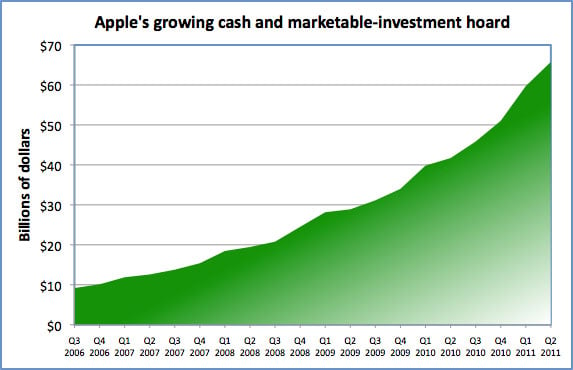
Apple has $66 Billion in Cash, and Growing

Apple's growing cash and marketable-securities hoardApple's $66 billion in cash is a nice problem to have.

From time to time investors clamor for Apple to "do something" with the cash, but Apple invariably responds that it simply wants to make sure it has the ability to make big moves if it has to, or wants to.

So far, Apple hasn't ever made a big acquisition, though.

How SmugMug survived the Amazon Outage

SmugMug, a photo-sharing site, says four simple things allowed it to survive the recent Amazon Web Services outage, despite its reliance on Amazon and cloud computing infrastructure. Geographical dispersion is the first principle. SmugMug uses "multiple Availability Zones." When there is a problem at one of the three centers, service continues from the other sites. The company also "designed for failure," assuming there would be a major outage at some point, requiring backup systems and components.

SmugMug does not use "Elastic Block Storage," which failed during the recent outage. SmugMug also does not rely completely on cloud computing. "The exact types of data that would have potentially been disabled by the EBS meltdown don’t actually live at AWS at all; it all still lives in our own datacenters," says company CEO Don MacAskill.

The advice is obvious. When using cloud computing facilities, an organization requires the same level of redundancy as when using facilities on the premises, or in an owned data center.

On the Use and Misuse of Principles, Theorems and Concepts

When financial commentators compile lists of "potential black swans," they misunderstand the concept. As explained by Taleb Nasim ...