Sunday, May 1, 2011

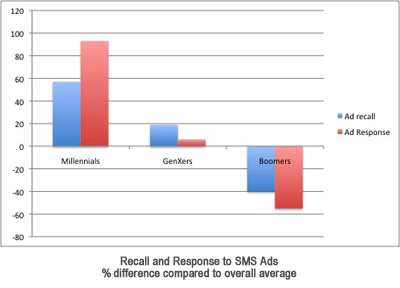
Millennials Most Responsive To Text Ads

ad-response-by-age.gifGFK MRI has found that the Millennials (born between 1977 and 1994) are 57 percent more likely to recall seeing a text message ad on their mobile device, compared with the average mobile phone user. More importantly, they are 93 percent more likely to have responded to a text ad or made a purchase using text messaging.

Overall, the study found that about 6.2 percent of adults with a mobile phone had looked at an ad sent by SMS. In terms of response, 2.65 percent had used SMS to respond to an ad or make a purchase during the last 30 days.


Google, MasterCard, Citibank Team for Mobile Payments

Google is working with MasterCard and Citibank on mobile payments.

Saturday, April 30, 2011

How Social Drives Shopping

Mobile Content Ecosystem to Shift?

Mobile operators in emerging markets need to make urgent adjustments to content strategies if they are to adapt to rapid shifts in the market, according to Ovum analysts.

While mobile service providers currently are the dominant force in the emerging markets mobile content space, this is set to change due to strong competition from new platforms such as application stores.

“Unless telcos make rapid changes to their strategy and execution, their dominance is set to be challenged,' says Angel Dobardziev, Ovum analyst.

Some might argue that no matter what telcos do, that will happen anyway, given that the leading application stores are operated by device manufacturers such as Apple, independent providers such as GetJar or operating system providers such as Google.

“We have found that once a consumer has bought a data access plan, they begin to move away from telco services,' says Dobardziev. 'This will ultimately reduce the role of mobile operators to little more than providers of bandwidth.”

Some might argue that Dobardziev already has answered the original question.

Forrester Finds Most Enterprises Still Buy Phone Systems, Not Hosted IP Telephony

A recent Forrester Research survey of 567 enterprise and smaller business users that already have adopted IP telephony shows that most buyers so far have chosen premises-based solutions.

Just four percent of respondents say they have adopted a 'hosted' IP telephony service. Another four percent reported they had adopted a 'telephony as a service solution. About five percent said their IP telephony solution was outsourced. Taking all three as a group, just 13 percent of IP telephony solutions were hosted, cloud-based or outsourced.

That might make a great deal of sense. The economics of IP telephony tend to suggest that small users can benefit from hosted or cloud-based solutions, while enterprises often can justify owning their own solutions.

The study lends credence to the cable operator strategy of targeting businesses with 20 or fewer employees, as those are the venues where the economics of buying a service are best, compared to buying a premises-based solution.

About 71 percent said their IP telephony solutions were self maintained, while 16 percent said they owned their solution, but that it also was managed by a third party.

Telepresence ROI Still an Issue, According to CDW Survey

Return on investment continues to be an issue information technology staffs struggle with when trying to justify new investments in videoconferencing or telepresence, a survey sponsored by CDW has found.

Just slightly more than half of medium and large businesses currently track ROI, the report has found. Some 56 percent of respondents said they track hard dollar ROI and 58 percent track soft (productivity) ROI.

Of the medium and large businesses that track hard ROI, the majority are looking at dollars saved from trips avoided. Nearly half of medium and large businesses that track soft ROI are looking at employee productivity.

Still, half of medium and large businesses use video conferencing today, while another quarter plan to implement the technology within the next two years. Some eight percent plan to adopt within a year, while 17 said they would adopt in one to two years."

Tablets Used Like PCs, Canalys Says

Do users view tablets as functional replacements for PCs or e-readers? Is the tablet category a “new” consumer electronics product, or the latest form factor for PCs? The answers are more complicated than one might think.

A recent consumer survey by Canalys of consumers in Western Europe suggests that current tablet usage resembles that of a PC, rather than a media player or e-book reader. After web browsing, both tablet owners and non-owners in Western Europe said they viewed tablets as devices for email, messaging and social networking.

Of course, that set of applications also fits the smart phone usage profile as well, with the exception of voice apps, of course. And even email, messaging and social networking are likely relatively soon to become features of some e-readers. To the extent that tablets shifts consumption of some common PC apps, it is a “PC substitute."

Dumb Pipe: Get Over It

Nothing bothers telecom or Internet access provider executives more than the fear of becoming a “dumb pipe” provider. The fear is that value, revenue and margin will migrate elsewhere in the value chain. So the big fear is the unstated set of assumptions that go with “dumb pipe,” more than the actual phrase.

What tends to be left unsaid in all discussions of “dumb pipe” are implied adjectives such as “low margin, commodity status, low value, low revenue or low price.” In other words, it is not “dumb pipe” in principle, but low value, low revenue, low margin, low price “dumb pipe” that drives the concern.

The problem is that there is fundamentally no way access and transport providers can actually avoid being suppliers of some key "dumb pipe" services. That isn't to say the only thing access providers can do is provide simple access, but neither can they escape that unique role in the applications ecosystem. In some ways, you have to play the cards you were dealt.

OnSwipe: Web Content on Tablets That Behaves Like an App

Up to this point, content intended primarily for consumption on a tablet device would be created for the Apple iPad and use the App Store for distribution to end users. Self-executing apps such as games are ideal for that format. But such apps are less than ideal for content distribution, the founders of OnSwipe argue.

"With HTML5, however, content publishers can have the swipe features, the page movement, the rich graphics and all the other things that apps provide, and still be open and easily portable to other tablets or platforms," says co-founder Jason Baptiste.

OnSwipe gives content publishers the ability to mimic many of the user interface and features that apps provide, but on the open web. That promises a way of authoring that works for web, tablet and small-screen devices.

At first, the company figured it would just license its software platform to publishers who wanted to create a quick app-like experience for the iPad. “But that would just be a services business, not a really big company,” says Baptiste. “Not that that’s bad, but we wanted to do something really big — there’s so much potential there. So we decided to give the software away, and have as many people publish in an infinitely customizable way, and we would build a thread that pulls them all together.”

The idea now, Baptiste says, is to create a kind of networked layer on top of the OnSwipe publishing tools, to turn those tools into more of an ecosystem.

Friday, April 29, 2011

PCs Getting Less Use at Small Businesses

A survey of 2,223 owners and managers at companies with less than 500 employees, most of them with between five and 499 workers, suggests that "PC" use is declining, while other digital devices, including tablets and smartphones are taking up the slack.

Beyond the finding that nine percent of business owners were using iPads (as of November 2010), the study found that 79 percent of small- and midsize-business owners used a desktop computer, down from 83 percent in 2010.

Some 16 percent used a netbook or notebook, down from 21 percent earlier in 2010.  About 60 percent used a laptop, down from 65 percent.

Note the trend: tablets up, desktop PCs, netbooks down, notebooks down.

About 37 percent used a smartphone or other personal digital assistant, up from 27 percent the prior year.

Fully 31 percent were using mobile applications, a category that wasn’t even measured the previous year, on smartphones, cell phones, or tablet computers.

What all of that might mean is that many business and work tasks really do not require much in the way of content creation, beyond replying to emails or social media messages.

read more here

Rabobank’s iPhone App: Take a Picture, Pay a Bill

Rabobank’s iPhone app allows customers to pay bills by taking a picture of the bill.

About 30 percent of Dutch consumers pay their bills by using "acceptgiros," standard yellow payment forms that merchants sent to them together with their bills. These forms are prefilled with all relevant information that is required to make the payment. The customer can pay the bill by simply signing the acceptgiro and dropping it into the letterbox of his bank, or by paying it directly using online banking.

Dutch Rabobank has added a new functionality to its iPhone mobile banking app which it calls "acceptgiroscan." Users of the app can pay bills by simply taking a picture of the acceptgiro with the phone’s built-in camera.

Fiber to the Home in Shanghai

Summary of the Amazon EC2 and Amazon RDS Service Disruption

"The issues affecting EC2 customers last week primarily involved a subset of the Amazon Elastic Block Store (“EBS”) volumes in a single Availability Zone within the US East Region that became unable to service read and write operations," Amazon says.

This caused instances trying to use these affected volumes to also get “stuck” when they attempted to read or write to them. In order to restore these volumes and stabilize the EBS cluster in that Availability Zone, Amazon disabled all control APIs (e.g. Create Volume, Attach Volume, Detach Volume, and Create Snapshot) for EBS in the affected Availability Zone for much of the duration of the event.

For two periods during the first day of the issue, the degraded EBS cluster affected the EBS APIs and caused high error rates and latencies for EBS calls to these APIs across the entire US East Region, Amazon says.

Summary of the Amazon EC2 and Amazon RDS Service Disruption

"The issues affecting EC2 customers last week primarily involved a subset of the Amazon Elastic Block Store (“EBS”) volumes in a single Availability Zone within the US East Region that became unable to service read and write operations," Amazon says.

This caused instances trying to use these affected volumes to also get “stuck” when they attempted to read or write to them. In order to restore these volumes and stabilize the EBS cluster in that Availability Zone, Amazon disabled all control APIs (e.g. Create Volume, Attach Volume, Detach Volume, and Create Snapshot) for EBS in the affected Availability Zone for much of the duration of the event.

For two periods during the first day of the issue, the degraded EBS cluster affected the EBS APIs and caused high error rates and latencies for EBS calls to these APIs across the entire US East Region, Amazon says.

Consumers Feel Smart Phone Obsolescence

When asked, 62 percent of respondents to a Retrevo survey said they currently feel their smart phone already is "out of date," or will be before their service contracts expire. That speaks both to the rapid pace of smart device innovation and the upside for providers of the latest smart phone models.

The solution, some would argue, are shorter contracts, or no contracts. One is reminded of the surveys taken to assess consumer receptivity to advertising. Those surveys virtually always find that people don't really like ads. But they like the idea of paying more for their desired content even less.

That's essentially what the Retrevo survey found as well.

When asked if they would be willing to pay extra for a shorter contract, most responded as you would guess, with a "no." But some would pay as much as $100 extra to get a one-year contract rather than a two-year contract.

Those sorts of questions and answers are instructive, but also hinge on consumer desire, at least in the U.S. market, for high subsidies on their devices. Few consumers really want to pay $400 to $500 for their devices, to get a contract-free service plan. Most put up with contracts so they can buy those devices for $200 to $250.

You can argue all you want about the wisdom of those preferences. Most of the money a consumer spends over the length of the relationship is service fees. The device cost is a relatively small matter in comparison. But consumers have voted with their wallets, and service providers, though not enamored of the operating expense the subsidies represent, do not seem likely to abandon the model, simply because it works.

One also might argue that the subsidies, which encourage users to swap out their devices more frequently, are one reason the U.S. market now is the world leader in terms of application innovation. A user that has invested $500 to $600 in a mobile device is likely to feel obligated to use that device as long as possible.

A user that has invested only $200 to $250 is less likely to be wedded to any particular device, and is likely to feel that investing in another, updated device makes sense.

http://www.retrevo.com/content/blog/2011/04/are-you-prisoner-your-phone-carrier
Clear AI Productivity? Remember History: It Will Take Time

History is quite useful for many things. For example, when some argue that AI adoption still lags , that observation, even when accurate, ig...