Tuesday, June 21, 2011

Were it Not for Legacy, Enterprises Would Get Rid of Phones, Use Skype

After surveying 277 enterprises, consultant Tom Nolle says legacy infrastructure has a profound effect on how enterprise technology managers think about what is possible with their voice infrastructure, and the results indicate what might be possible for competitors, or threats to established business communications suppliers.

The survey shows a preference for a "no phones" approach and software that acts like Skype, but with more features and security.

Asked what they would do with voice technology if you could start over, over 70 percent of businesses in the survey said that their unified communications investment plan was constrained based on their investment in legacy voice equipment, their "black phones" in particular.

If somehow all that gear was whisked away, they believed they'd very likely scrap phones completely and move to a PC-based form of communication based on headsets.

The other 30 percent said that they needed to have their mobile workers tied into their UC, and because they couldn’t get mobile VoIP they would "wait" until mobile technology caught up. The service model they like best? It's Skype, but the way Skype works now isn't how they'd want their future UC platform to work, says Nolle.

In terms of truly incremental features, businesses wanted the UC features that are today available from third-party firms using Skype extensions built in and made part of the standard package. That included the ability to send files via IM as attachments, to support conference calling in both voice and video (one-to-many and pass-the-baton mediation should control who is seen). Whiteboard capability wasn't as interesting as desktop sharing. Call logging was viewed as important, particularly logging of video calls, and IM logging was needed both as a general compliance tool and to trace file exchanges for security purposes.

The survey results should prove worrisome for some in the UC space, positive for others. Though I'm not so sure Nolle would draw the same conclusions, it does appear that many enterprises would just as soon be done with desk phones and phone systems, and use feature-enhanced software like Skype.

So Far, it Appears Nothing is Better than an iPad

Every competitor's fear in the PC devices space is that Apple will own the tablet market like it owns the iPod market.

Most people might argue that no Apple competitor has started selling anything that clearly answers a fundamental question: “Why should somebody buy this instead of an iPad?”

Sales figures for tablets show that when consumers compare the iPad to other choices, an overwhelming percentage conclude that the iPad is the best option. You can probably point to a number of differences between iPads and specific other tablets, but many would argue that nothing so far is distinctive enough to drive a breakthrough.

Android Share in U.S. to Drop?

After Google's Android experienced its first loss of market share in a region since 2009 during the March quarter, Needham & Co. analyst Charlie Wolf predicted Android would regain share in the June and September quarters before a "material decline" in the December quarter following the expected launch of the iPhone 5. "In our opinion, this is just the beginning of Android’s share loss in the U.S.," Wolf says.

Android's share of the U.S. smartphone market fell from 52.4 percent in the December quarter to 49.5 percent last quarter. It could be worse. Look at what has happened to Research in Motion.

Verizon Moving to Tiered Data Plans in July 2011

Verizon Wireless says new tiered mobile data plans will be standard, beginning about July 7, 2011.

Droid Life reports that Verizon will offer plans ranging from $30 a month for 2 GBytes of data to $80 a month for 10 GBytes of data, with tethering to other devices available for an additional $20, including an extra 2 GBytes of data.

Executive Summary: Reimagining IT: The 2011 CIO Agenda

Figure 2.Public and private sector organizations have relatively low levels of digitization"Becoming a next-generation digital enterprise means generating a greater percentage of enterprise revenue via information and Internet technologies," say analysts at Gartner. It might be hard to find anybody who would disagree with the general formulation.

This contrasts with the first wave of the digital revolution, which measured how digital an enterprise was based on its Web presence, Gartner says.

By the new definition, most enterprises have to become digital from the front office to the back office, which gives them the opportunity to reimagine IT as the center of the next digital revolution.

XConnect Launches Video Interconnection Exchange

XConnect has launched a global "Video Interconnection Exchange" (VIE) said to be the world's first neutral federation for exchanging video calls across networks, operators, service providers, B2B exchanges and vendors.

Video calling is a service where network effects are key, meaning that unless it is easy to make a video call with just about anyone, there are big barriers to adoption. Today, video calling is fragmented among many communities, exchanges, networks and devices, and XConnect believes VIE will help.

VIE hopes to make video calling as easy as making a voice call, whether using a laptop, desktop, tablet or mobile phone, from anywhere in the world. VIE launches with five operators, based in the United States and EMEA. Members include telepresence providers, as well as fixed, mobile and Web 2.0 video service providers."

Monday, June 20, 2011

LightSquared Says it Can Fix GPS Interference Problem

LightSquared says it has a solution to the problem of interference with Global Positioning System (GPS) receivers that will allow LightSquared to proceed with its business plan. 


LightSquared says 99.5 percent of U.S. GPS receivers will be interference-free, while there are technical solutions for the other 0.5 percent Of GPS receivers. 


One of LightSquared’s 10-MHz blocks of frequencies poses interference to many GPS receivers, and happens to be the spectrum LightSquared originally hoped to use to launch it service initially. 
GPS-&-LightSquared-spec
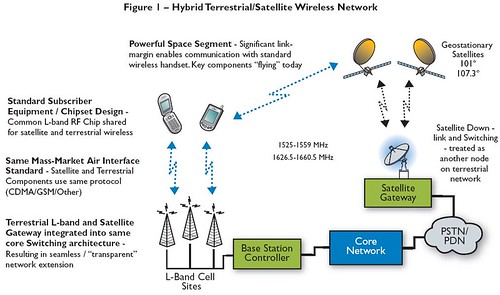
LightSquared says it can use another 10-MHz block of the spectrum lower on the spectrum band and located further away from the GPS frequencies, greatly reducing the risk for interference. That move requires negotiations with Inmarsat, the satellite company that controls the alternative block of spectrum in the L Band, but LIghtSquared says it has such agreeement. If I understand correctly, that means shifting to the left hand red frequencies, rather than the right hand red frequencies, as illustrated in the first chart. 


See http://www.lightsquared.com/press-room/press-releases/


The generic problem is that radio signals, even when carrying digital information, are analog sine waves. As the second chart shows, a signal on a center frequency also emits lesser amounts of energy off frequency. If LightSquared shifts its frequencies away from any of the GPS center frequencies, it will reduce the amount of potential interference. 


LightSquared also says it will modify its Federal Communications Commission license to reduce the maximum authorized power of its base-station transmitters by over 50 percent. This move will provide additional protection to GPS receivers. 


LightSquared believes it still will have enough spectrum to serve its customer base for the next several years.


See also  http://www.engadget.com/2011/06/20/lightsquared-announces-solution-for-gps-issue-says-lte-networ/

One Billion Tweets Every 6 Days

It took three years to send the first billion tweets; today, one billion tweets are sent every six days.


Read more here

HTC Tries on Google Goggles

HTC is taking a step beyond quick response codes with its new ad campaign for the "Sensation 4G." Consumers can interact with the ads using Google Goggles.

People who view the outdoor, print and TV ad can use the Google app to capture an image and get extra content.

For instance, if you scan a scene from the TV spot, you can download a video of YouTube star Maria Aragon

HTC Tries on Google Goggles for New Ad Campaign

Facebook Display Revenues to Nearly Double in 2011

Net US Online Display Ad Revenue Growth at Top Five Ad-Selling Companies, 2009-2012 (% change)Facebook will grow its net U.S. display revenues in 2011 by another 81 percent to $2.19 billion, eMarketer estimates. If the prediction proves correct, Facebook will pass Yahoo! to become the top seller of display ads in the U.S. market.

Net US Online Display Ad Revenues at Top 5 Ad-Selling Companies as a Percent of Total Display Ad Revenues, 2009-2012This near-doubling of display ad revenues is a slowdown in growth for Facebook, which posted triple-digit display ad revenue growth in 2009 and 2010 when its display revenues were at relatively low levels. Next year, growth will slow further to just 31.3 percent.

Social Software Still a Developing Art

Bridge The Gap – Learn Social Media at Exploring Social MediaTypical users should not have to care about "understanding" social applications or how brands and businesses might want to use social software to run their businesses.

But it still is true that most businesses and brands are just starting to experiment with, and use, social software and social networking.

It should come as no surprise that brands and businesses are unsure about whether such tools are effective. Nor should it come as a surprise if lots of those entities are disappointed with the results.

It might be fair to say that all enterprises are subject to the temptation of believing that any new tool is a magic bullet.

We should not be looking for such things.

It always takes time for people to learn how to use important new technology.

And social software, many believe, will ultimately be transforming. But it will take time.

http://exploringsocialmedia.com/social-media-bridging-the-gap-infographic/

Social Media and the End of CRM.

"It is not too soon to call the end of the business process known as CRM as we have known it, says Michael Maoz of Gartner. "It is the “management” part that kills it, he says, referring to the centralized way CRM tends to work.

Those will not be welcome words for firms that sell customer relationship management solutions, but does indicate how social media and networking are changing the context within which enterprise sales, marketing and contact management processes might be changing.

Simply, there are simply too many moving parts for traditional CRM applications to provide the promised value, he argues.

Enterprises and brands are exhorted to monitor, listen, poll, create and monitor feeds, tweets, posts, support mobile platforms, tablets and forums. Brands are urged to crowd source, support voting and other ways of gathering consumer insight. All of that is at least partly unstructured data that has to be processed in more structured ways to provide insight. But it is nearly impossible to do that within the scope of traditional CRM.

Businesses are attempting to add the new tools and processes, keep the legacy efforts for marketing, sales and customer service, while moving all of the business applications supporting the existing customer initiatives to the cloud.

That represents a lot of moving parts. So organizations have come to the tacit (not stated, not explicit) conclusion that they cannot accomplish the goal of managing the customer relationship centrally, he argues.

Just as certainly, CRM will become part of a wider set of activities; it has to.

Mobile Apps Mostly Used for Games, Social Networking

For the first time ever, daily time spent in mobile apps surpasses web consumption, according to a new analysis by Flurry. It has taken less than three years for native mobile apps to achieve this level of usage, driven primarily by the popularity of iOS and Android platforms, Flurry says.

The average user now spends nine percent more time using mobile apps than the Internet. In 2010, the average user spent just under 43 minutes a day using mobile applications versus an average 64 minutes using the Internet.

As is the case for tablet devices, new form factors and user interfaces are surfacing user behavior habits that might have been partially obscured in the past As it seems to be turning out, most users, in their work or consumer roles, do not typically need many of the "content creation" capabilities PCs provide, with the exception of simple ability to post photos, annotate content or create short text messages.

In a similar manner, mobile or PC app usage shows that apps most often are used to play games, not to interact with content or information on the web.

Games and social networking categories capture the significant majority of consumers’ time. Consumers spend nearly half their time using games, and a third in social networking apps.

Combined, these two categories represent 79 percent of consumers’ total app time. Consumers use these two categories more frequently, and for longer average session lengths, compared to other categories. Tablets really are content consumption devices, primarily, with text-based communications, photo posting and content sharing representing most of the remaining usage.

Mobile App vs. Web Consumption, Daily Time Spent

Growing at 91 percent over the last year, users now spend over 81 minutes on mobile applications per day. This growth has come primarily from more sessions per user, per day rather than a large growth in average session lengths.

Time spent on the Internet has grown at a much slower rate, 16 percent over the last year, with users now spending 74 minutes on the Internet a day.Facebook has increasingly taken its share of time spent on the Internet, now making up 14 of the 74 minutes spent per day by consumers, or about one sixth of all Internet minutes.

Mobile App Consumption by Category

The predominant content consumption and social networking profile appears to a growing business issue as well. Beyond Apple's preference for apps, and Google's preference for native web access, other application providers seem to be angling for more control as well.

It appears the "app versus web" issue is becoming a matter of control for Facebook. Facebook’s "Project Spartan" is an effort to run apps within its service on top of the mobile Safari browser, thus undermining Apple's attempt to maintain control over its app experiences.

Still, the intriguing insight is how new devices and application formats are highlighting what users really want to do, and therefore require, from their apps and devices.

21% Want Mobile Payments or Mobile Wallet

Here's a marketing question for you: if you conducted a survey about a product almost nobody has ever used, using terms they've never heard, and 21 percent of survey respondents said they would buy it, is that encouraging or discouraging?

As it turns out, 21 percent of 1,000 polled consumers indicated they already were waiting for a mobile phone with near field communications features that allow them to use the phone as a payment device in retail locations. The survey, sponsored by Retrevo, also found that 79 percent of respondents are not interested in mobile wallets or don’t know what a mobile wallet is.

You might wonder how valid a survey can be when it asks people about something they don't understand, or haven't experienced before. One might wonder what the results would have been if respondents had been asked whether they were interested in an "easy to use" mobile phone," as if Apple had asked respondents (it never did) whether they were interested in an easy to use personal computer.

Some might say the fact that 21 percent actually want a phone that can function as a payments vehicle, with no other features indicated, is a high percentage of users. Some might say the additional value of a contactless mobile payment app or service is actually fairly low.

You can argue it saves time, and it might do that. But credit or debit card swipes don't take too long, either. and a few seconds at a checkout counter is hard to quantify, in terms of additional value.

The other problem is that we don't yet know what set of values will ultimately prove attractive enough to make NFC-based payments highly popular. Some will argue, and with good reason, that other values, including discounts and other rewards, will be the drivers for wider adoption.

As you likely would expect, younger users express more interest. Some 28 percent of respondents 18 to 35 were interested in mobile payments.

About 75 percent of respondents 50 or older indicated they did not want to use their mobiles as payment devices.
The Retrovo study does also indicate that, at the moment, consumer notions of "logical providers" of mobile payments services are mixed. Application and device providers, credit and debit card companies or banks, and mobile service providers all are seen, within fairly close ranges, as suitable providers of mobile payments services.

Sunday, June 19, 2011

What Will LightSquared Deal with Sprint Mean?

LightSquared reportedly has reached a 15-year deal with Sprint Nextel Corp. to share network expansion costs and equipment for the planned wholesale LightSquared Long Term Evolution network.

The deal, valued at as much as $20 billion over the length of the contract, would provide revenue for Sprint, a faster buildout for the LightSquared national LTE network, and also makes Sprint a wholesale customer of LightSquared as well. Early reports had suggested that Sprint would receive both cash and capacity on the LTE network as part of the deal. Read more here.

Beyond the important tactical considerations (revenue for Sprint, faster buildout at lower cost for LightSquared), there are potential strategic angles as well. The deal immediately confirms that Sprint will migrate at least some of its services to the LTE air interface.


But that also raises more questions about the fate of its Clearwire investment and strategy. See Report: Sprint consummates LTE network-sharing deal with LightSquared - FierceWireless.


There is some growing speculation that Clearwire is getting ready to sell itself in any case. So what might that mean? Would Sprint abandon Clearwire and work with LightSquared instead? Would Sprint acquire the remainder of Clearwire it does not already own?


And would any such moves signal that Sprint, facing formidably large competitors in an AT&T fortified with T-Mobile USA's assets, plus Verizon Wireless, again try to create a bigger presence in the wholesale LTE market?


>Both Clearwire and LightSquared have formal wholesale business plans, while Sprint arguably has been the most willing of the national mobile carriers to explore wholesale business models. There are some indications Clearwire intends to sell itself. Sprint already owns 54 percent of Clearwire. Would Sprint acquire the remainder of the firm?


Or is there some way for Sprint to leverage both Clearwire and LightSquared in some way to create a pre-eminent LTE or 4G wholesale role in the market? In the past, Sprint has been willing to forge multiple partnerships with cable operators, for example, embracing wholesale in a way that neither AT&T nor Verizon Wireless have preferred.


Might Sprint once again try to become the carrier of choice for "all the rest of us" in the competitive space? If the AT&T acquisition of T-Mobile USA is approved, Sprint will have to do something more dramatic. Riskier moves, or innovative moves, are what underdogs typically can be expected to try, in just about any market.

AI is Solow Paradox at Work

An analysis of 4,500 work-related artificial intelligence use cases suggests we are only in the very-early stages of applying AI at work a...