Monday, July 18, 2011

Dell Could Use Google+ "Hangouts" for Customer Service

Consumer tools have become a growing part of enterprise thinking about software and services, and that seems to be the case for Google+ "Hangouts," a group video conferencing app. Dell says it could soon use Google’s new group video chat platform Google Hangouts as an alternative to the traditional customer service call, according to the company’s chairman and CEO, Michael Dell.

Dell posted aquestion on Google+: "I am thinking about hangouts for business. Would you like to be able to connect with your Dell service and sale teams via video directly from Dell.com?"

Apparently hundreds of people agreed. Hangouts obviously could be a substitute for "enterprise" video collaboration systems and tools.

Mobile Ads Still "Annoying"

About 79 percent of smart phone users find mobile ads intrusive and annoying, according to new research from YouGov. Some 88 percent also say they ignore ads on applications. To no surprise, 86 percent said that they’ve ignored mobile ads. So despite all talk of personalization and targeting, it appears that brands still are not able to deliver consistently valuable messages.

As often is the case, consumers indicate they "don't like ads." Just five percent of consumers think that mobile ads are a good idea. It long has been true that advertising is considered an annoyance, tolerable only because consumers "get something" from the experience, typically lower=priced content.

For smart phone users in particular, basic banners remain the most recognized formats. About 87 percent report see them while browsing, and 80 percent notice3 them while using apps. When browsing, recommended links to search (63 percent), rollover banners (51 percent), and special offers (47 percent), attract the most attention.

Sunday, July 17, 2011

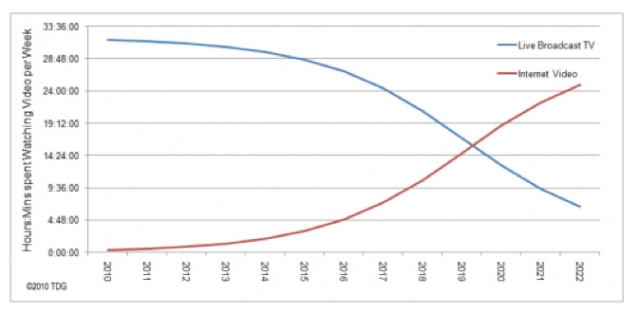
User Generated Content Has Not (Yet) Disrupted the Video Business

This looks like a disruption. to be sure. But what kind of disruption? Ten years ago, some would have argued that user-generated video would disrupt a substantial part of the "professional media" market.

One doesn't hear that argument so much anymore.

On the other hand, one might argue that user-generated text and image content has disrupted the business of "publishing" in rather direct fashion. One might argue that it is a lot harder to create rival video entertainment than it is to create useful "text" content.

The business dynamics of entertainment video and publishing also have been on different trajectories for decades. Video has continued to add revenue almost without exception, year in and year out. Newspapers and magazines have not been that successful, and arguably have been shrinking. "Online" and user-generated substitutes seem to have accelerated the print decline, but so far have largely been incrementally a factor in online video.

What Causes Telco or Cable Customer Service Issues?


Most telcos and  cable companies have gotten much better at customer service over the last decade. That isn't to say most surveys show people think the service is "outstanding," or "best," but that more effort is being put into customer service.

That said, most customers will, at least on occasion, find themselves angry, frustrated or exasperated with telco and cable execution.

As this graphic suggests, complexity can be an issue. As most consumers will recognize, using more than one channel, or more than one agent in any channel, will require providing information at the beginning of each session. Different actors a consumer might interact with to solve one problem might require different data base operations, some of which will not seem to be coordinated, or which can take months to reconcile.

In my own experience as a consumer, most of the larger service providers do a decent job providing what it was they sold me. That is partly a reflection of the objective and subjective parts of the experience. Nearly always, what I bought "works." But they tend to cause friction in other areas, ranging from their business policies to data base integration, though I tend to think even the data base integration issues could be related to business policies.

That does not mean I do not anticipate dropped mobile calls from time to time, or slower mobile broadband in some locations, at some times of day. While none of those characteristics of the service tends to make me categorize communications service providers as "excellent," there are known performance issues, and I can deal with it. One might say I am a "tolerant" consumer in some ways: what I buy from ISPs, mobile companies and video companies works well enough, and for the most part provides sufficient value, that the actual delivery isn't a big sore point.

On a more subjective level, value and price are generally in line for some features and services, generally relating to broadband access, always in line for voice, and almost perennially out of line for multi-channel video entertainment, which is the product which has the biggest gaps between value and price alignment.

Keep in mind that I am a heavy "mobile everything" user, so the "slower" speed and "greater latency" or higher cost per bit issues are simply a trade-off I am willing to make. My usage is either "mobile mostly" to "mobile exclusively," with the exception of entertainment video, which remains "tethered" for the most part.

I understand what "best effort" means, what "contention ratios" are, and, in a general sense, what the sources of "latency" are.

My point is that delivery of service generally is not where service providers fall down. In my experience, that tends to happen with billing-related or data base issues. In fact, as a rule I'd say the delivery is generally (within the context of my expectation that calls will sometimes drop, speeds will slow or latency be a bit of an issue) not an irritation. But the apparently "not integrated" data bases, and access to those data bases, almost always is an issue, which means I typically anticipate some level of friction.

I realize service providers struggle to maintain consistency, compliance with regulations, while protecting security and privacy. I realize a service provider cannot actually afford to spend too much on "customer service."  But I also will note that interactions with two of the four major service providers in the United States, though satisfactory to good during the four to five years I used them, were decidedly unpleasant during the termination period, and not because I was breaking a contract. I am always "out of contract" when any service is terminated.

For whatever reason, the issue is trailing disagreements about the "final bill" which seem to be unnecessary, or can't be fixed immediately and fully, without escalating the process. So a relationship that had been trouble free became a memorable issue when stopping one particular service (though generally I continue to buy other services from the same provider).

This is important for a simple reason. I have over the last decade simultaneously used services from four to five major service providers at a time, at multiple locations, for different reasons. I might change one account (mobile and broadband, typically) from time to time, but the relationships tend to remain.

Most of the major providers tend to claim they are the "best" at one or another aspects of network quality. Sadly, few can claim to be consistently as good at the customer service ends of their businesses, at least for consumer-facing services. That probably is one reason why cable companies and telcos tend to run in the middle of the pack, or worse, in most consumer opinion surveys.

I understand that consumer service providers cannot afford to spend much money on consumer customer service. I would also say that when buying business services, the experience tends to be different. When service providers make enough money from an account, they are better at most forms of service.

Of course, the services worked well enough that my preferred interaction with my providers is "no interaction." Terminating service, even when a contract is not involved, has not been universally pleasant, and it seems to be related to data base or business rule issues and call center interactions. I would add that the front line retail store personnel, across the board in the mobile space, are doing fine. It's the call center processes you worry about.

read more here.

Saturday, July 16, 2011

The ‘Psychology Of Sharing’

In an online survey of 2,500 self-identified “medium-to-heavy content sharers,” Latitude Research and the New York Times found that users generally fall into six “personas”: altruists (mostly female, attached to causes), careerists (it’s all about the job), hipsters (younger altruists and careerists), boomerangs (people who share simply to stir up controversy), connectors and selectives (related to careerists and altruists, respectively).

While people who are younger and view themselves as more tech-savvy have begun to forego e-mail as a communications tool, for the most part, e-mail remains the most popular way users choose to share news. Email also is viewed as more secure and private and therefore more “personal.”

As such, people tend to want to have a one-to-one conversation about news that moves them rather than a one-to-many. Social media, the study says, is all about “serendipity,” where a post can lost in the shuffle of a Twitter or Facebook stream.

Friday, July 15, 2011

Verizon LTE Phones Probably Incompatible With AT&T

Verizon Wireless says its LTE phones will not be compatible on other LTE networks in the United States because "the phones will be on different frequencies," according to Verizon spokeswoman Brenda Raney. Of course, in principle, and at some risk of cost or complexity, the range of supported frequencies could include the AT&T bands. But that would lessen the customer lock in, and it is a rare company that really wants to make it too easy for a customer to defect to another.

The new 4G LTE system used by Verizon, MetroPCS, and soon AT&T runs on SIM cards much like the ones for GSM networks, and GSM phone owners are used to being able to switch phones from network to network, as long as they're unlocked.

But Verizon may be designing its phones to only run on Verizon's very specific wireless frequency, locking out all other possible carriers.

Mobile and E-Commerce Get U.K. Retailer Attention

For the first time ever, top retailers' priority for information technology investment is e-commerce and mobile commerce, according to the latest annual IT in Retail research of the UK's leading 100 retailers by Martec International, sponsored by BT Expedite.

The study of retailers with annual sales totalling more than
£180 billion, representing 50,000 stores and 71 per cent of the total UK retail sector, which is valued at £254 billion.

The main IT investment priority for leading retailers is e-commerce and mobile commerce, growing from 17 per cent last year to 23 per cent this year, outdoing investment in store systems, which has been the focus for the previous nine years.

In many ways, those moves are the inverse of the growing efforts by many other companies, inside and outside the ecosystem, to shift from online commerce to physical location retailing. Retailers, in part, want to harvest more sales from the online channel. Many other participants want to create new sales platforms that use online tools and applications to capture more of the retail transaction volume.

In many ways, both trends represent a deepening of the "bricks and clicks" strategy that developed in the wake of the first big wave of e-commerce starting in 1999.


Consumers Embrace Social Media for Brand Feedback - eMarketer

Reasons that US Social Network Users Discuss Products/Services on Social Network Sites, April 2011 (% of respondents)Many social network users are using channels such as Twitter and Facebook to discuss shopping decisions and experiences with their peers. Although often this means they are using social networks as another channel to hunt down the best deals, consumers are also turning to those sites to provide feedback about their experiences with brands, according to ROI Research.

The majority of respondents to a recent survey said that when discussing products and services, they are comparing prices and talking about sales and specials with their social network friends and followers. Fifty-three percent of the surveyed social network users said they provide feedback to the brand or retailer via social network sites and 47 percent said they express disappointment with the brand when they see fit.

So every brand should be using social media, right? Probably. But not every brand likely has the opportunity or "downside" from negative reviews. Social media seems to work best, across the board, for consumer products and services. It isn't so clear how well it generally works for most business to business brands, especially when those brands are not household names.

Google+ Email Address Changes an Issue?

Some will note that the email address used to set up a service, such as Google+, is a "forever" issue, in the sense that Google+ apparently does not support changing an email address later. The obvious example is signing up using a work address, instead of a web mail account.

"Another issue I ran into is that I got my initial invitation to Google , and built my Google network around a Gmail address (s3kur3@gmail.com). Whenever an update posts from one of my circles, or someone sends me a message, or some new person adds me to one of their Circles, Google sends me an update. The problem is that I don't use Gmail, and I don't want to use Gmail, so I never see those updates."

Of course, some of us decided to use Gmail, as the permanent address of record, precisely for that reason. When I use any other work-related email, I always have the mail automatically resent to my Gmail account. I do have some work addresses that are active, but unused simply because I don't even want to bother setting up the forwarding.

Address permanence is an issue for lots of people, though. So be careful, if you haven't already joined.

Opposition to Telco-Lead Mobile Payments in Nigeria

Government permission always plays an important role in just about any fundamental role a telecom service provider wishes to play, everywhere in the world. Against the backdrop of plans by some telecommunications companies (telcos) to go into mobile payment services, some analysts say the move is against Central Bank of Nigeria (CBN) regulations.

The analysts cited regulatory framework for mobile payment services in Nigeria issued by the CBN in 2009 which identifies three acceptable models for the implementation of mobile payment services: bank-focused, bank-led, and third party-led. Mobile service providers would seem to fall into the third category. Predictably, though, some think the mobile service providers cannot be allowed to lead the mobile money business, as it will mean putting two major segments of Nigeria’s economy in the hands of a few companies.

Is Innovation a Process or a Skill?

"Not long ago, creativity guru Todd Henry recommended to one of his consulting clients, a high-ranking manager, that he set aside one hour a week to generate new ideas -- 'one hour, predictably scheduled, no exceptions and no violations,' Henry says in his book, The Accidental Creative: How to Be Brilliant at a Moment's Notice. 'This is not time to do work. This is time to think about work."

That executive's reaction, Henry recalls: 'He fired back at me, 'What?! You just want me to sit around and think?!'

In today's wired, 24/7 business climate, most people can relate. Who has time to sit and ponder? Yet, Henry writes, companies pay employees, particularly leaders, for the value they create, and 'you can create infinitely greater value for the company in an hour of skilled, focused thought about critical problems than by responding to your email slightly faster.

It would be helpful indeed if innovation were a process, not an innate ability. Still, there's a difference between Steve Jobs and most people, one would have to argue.

Is Google+ Similar to Facebook, or Something Else?

Is Google+ an improved or different version of Facebook, or is it something else? And if it is something else, what sort of "something else" might lead to financial success or failure? One view, probably the most popular, is that Google+ will succeed or fail as an alternative to Facebook. Read more.

Another view might be that Google+ is something different, but might be the "wrong" something different. See Read more..

It's likely too early to tell, either way.

Apple Offers App Volume Purchasing To Businesses

Apple has launched an App Store "Volume Purchase Program" for businesses.

The business VPP represents an expansion of the Volume Purchasing Program introduced last August for schools.

That program allows educational institutions to acquire apps by purchasing "Volume Vouchers," fixed value cards offered in denominations of $100, $500, $1,000, $5,000, or $10,000 that be redeemed only by an authorized program manager or program facilitator. Purchases of 20 or more apps by educational institutions are eligible for volume discounts, offered at the discretion of the developer selling the app in question.

Thursday, July 14, 2011

Ericsson to Launch Mobile Money Service in Phillippines

Ericsson is launching a money transfer business in the Philippines, connecting Filipinos to networks in seven European nations.

Ericsson Money Services began in February 2011, and the new extension will allow mobile phone users in the Philippines to send and receive money to and from their families and friends in some countries in Europe.

The service also can also be accessed online through a dedicated website and through Facebook and Twitter, but in the Phillippines, virtually everybody seems to use a mobile.

Indian Mobile Money $350 Billion in Activity in 2015

Mobile phones are now poised to usher in mobile money as an everyday form of currency in India, with $350 billion of payments and banking transactions flowing through them by 2015.

However, mobile money will not be a large generator of fees for telecom operators, as the total fee pool of $4.5 billion will be split across several entities, according to the Boston Consulting Group (BCG).

Just over $235 billion of annual credit and debit card transactions occur in India today, a figure dominated by around $215 billion of cash withdrawals at ATMs.

Which Language Model Do You Prefer?

Our choices of “favored” language models will probably remain somewhat idiosyncratic for a while, until some winnowing of market leaders occ...