Wednesday, October 19, 2011

Android 4.0 Will Unify Tablet, Smart Phone

The new Android 4.0, aside from a striking new visual feel, will be the first version that encompasses both tablets and smart phones.

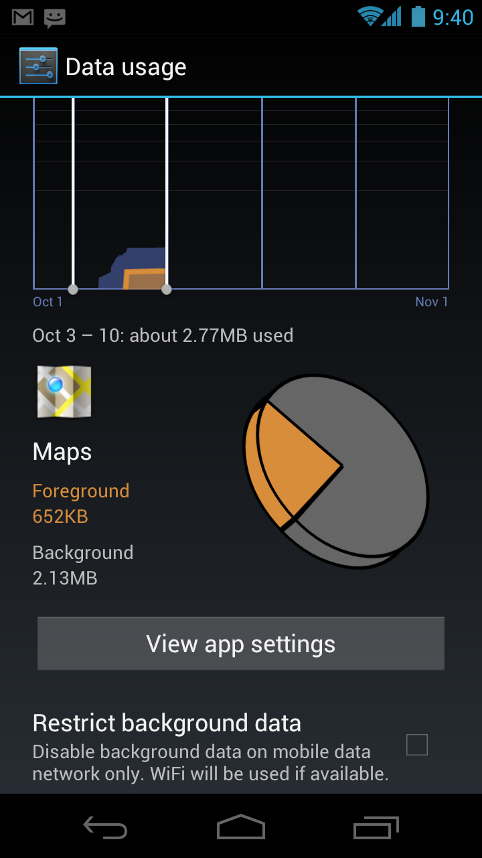
To meet the needs of users with tiered or metered data plans, Android 4.0 adds new controls for managing network data usage. In the Settings app, colorful charts show the total data usage on each network type (mobile or Wi-Fi), as well as amount of data used by each running application.

Google says Android 4.0 makes common actions more visible and lets users navigate with simple, intuitive gestures. Refined animations and feedback throughout the system make interactions engaging and interesting, Google says. An entirely new typeface optimized for high-resolution screens improves readability and brings a polished, modern feel to the user interface.

Virtual buttons in the System Bar let users navigate instantly to Back, Home, and Recent Apps. The System Bar and virtual buttons are present across all apps, but can be dimmed by applications for full-screen viewing. Users can access each application's contextual options in the Action Bar, displayed at the top (and sometimes also at the bottom) of the screen.

Multitasking is a key strength of Android and it's made even easier and more visual on Android 4.0. The Recent Apps button lets users jump instantly from one task to another using the list in the System Bar.

Bearish View of The Smart Phone Business

1Here's a bearish view about the smart phone business. Microsoft and Apple are extracting royalty payments from Google Android suppliers, squeezing their margins.

Apple missed targets for iPhone sales and sales of Research In Motion’s BlackBerry have "collapsed," not to mention the recent multi-day global outage.

Analysts may argue that the rise of products like powerful tablets have hurt smart phone sales. Some of us think that is partly true. Tablet sales have grown much faster than did sales of Apple iPhones or iPods.

4So attention now has been diverted to tablets, to some extent. But Mary Meeker, Kleiner Perkins Caufield Byers partner doesn't appear to share the pessimism.

But lower-cost smart phones now are about to pour onto the market, and the high penetration of mobiles means there still is a huge replacement market.

New Facebook Features Get Mixed Reviews from Teens


Teens have mixed reviews about the recent changes on Facebook, according to a survey by GrownUpThinking.

Overwhelmingly, teens are openly and seriously considering spending less time on Facebook as a direct result of the recent changes. Only four percent of teens plan to spend more time on Facebook. According to the  research, 47 percent will maintain the same level of usage, electing to “put up with the annoyances” in order to access the features that made the platform valuable to them in the first place: visiting friend pages, commenting on walls and engaging in chats.

The survey of 2,000 (14-17 year old) teens suggests many find the changes “confusing, annoying, disappointing and useless,” (among comments made repeatedly in our discussion forums).

Teens mention Facebook’s biggest strength is its simplicity and ease of use. Only 19 percent of teens felt that the interface was easier to navigate, with 45 percent saying the page feels cluttered by all of the new features.

Social media fatigue may become a bigger problem, with an onslaught of updates streaming through the newly-added ticker, causing 35 percent of teens to feel “uncomfortable” with the new level of sharing.

But “Timeline” gets a big thumbs up. Timeline received the most praise from teens in our study (27 percent said it was their favorite above all Facebook features). Securing a position on a teen’s Timeline will have meant that your brand achieved a defining connection in the life of a teen. In contrast, apps that are currently auto-posting their way on to Timelines of unsuspecting teens will need to quickly adapt in order to maintain long-term relevance and placement.

Since most teens have between 100 and 500 friends, the ticker scrolls too-fast to provide meaningful updates. The ticker is seen as a distraction, over-communicating their activities without providing any real value. Only 17 percent see any value in viewing friend activity this way, with 31 percent of teens trying to ignore its very existence on the page. They worry that a ticker provides information that “is not theirs to see” in the first place, with the word “stalker” being mentioned on several occasions.

Teens have mixed reviews about the recent changes on Facebook, according to a survey by GrownUpThinking.

Overwhelmingly, teens are openly and seriously considering spending less time on Facebook as a direct result of the recent changes. Only four percent of teens plan to spend more time on Facebook. According to the  research, 47 percent will maintain the same level of usage, electing to “put up with the annoyances” in order to access the features that made the platform valuable to them in the first place: visiting friend pages, commenting on walls and engaging in chats.

The survey of 2,000 (14-17 year old) teens suggests many find the changes “confusing, annoying, disappointing and useless,” (among comments made repeatedly in our discussion forums).

Teens mention Facebook’s biggest strength is its simplicity and ease of use. Only 19 percent of teens felt that the interface was easier to navigate, with 45 percent saying the page feels cluttered by all of the new features.

Social media fatigue may become a bigger problem, with an onslaught of updates streaming through the newly-added ticker, causing 35 percent of teens to feel “uncomfortable” with the new level of sharing.

But “Timeline” gets a big thumbs up. Timeline received the most praise from teens in our study (27 percent said it was their favorite above all Facebook features). Securing a position on a teen’s Timeline will have meant that your brand achieved a defining connection in the life of a teen. In contrast, apps that are currently auto-posting their way on to Timelines of unsuspecting teens will need to quickly adapt in order to maintain long-term relevance and placement.

Since most teens have between 100 and 500 friends, the ticker scrolls too-fast to provide meaningful updates. The ticker is seen as a distraction, over-communicating their activities without providing any real value. Only 17 percent see any value in viewing friend activity this way, with 31 percent of teens trying to ignore its very existence on the page. They worry that a ticker provides information that “is not theirs to see” in the first place, with the word “stalker” being mentioned on several occasions.

Overwhelmingly, teens view apps as not adding value to their news feed. They view apps as “clogging” their wall with “spam” and an unnecessary level of communication. At best, “it depends” on the type of app being used. The top apps on Facebook with teens are Twitter (27 percent), Ticketmaster (21 percent), Yahoo (24 percent), Netflix (20 percent) and Spotify (15 percent).

According to the survey, 25 percent of teens will be using Facebook less and Google+ more, with 10 percent saying they would drop Facebook completely. Among teens that are already using Google+, they rave about the platform as being cleaner and “more social” than Facebook.

Lack of knowledge about Google+ seems to be the biggest barrier to entry among teens who express interest in staying loyal to Facebook. Also, teens have opted for staying with Facebook over Google+ because the majority of their friends are already on it.

Screen Shot 2011-10-11 at 10.25.36 AM
Overwhelmingly, teens view apps as not adding value to their news feed. They view apps as “clogging” their wall with “spam” and an unnecessary level of communication. At best, “it depends” on the type of app being used. The top apps on Facebook with teens are Twitter (27 percent), Ticketmaster (21 percent), Yahoo (24 percent), Netflix (20 percent) and Spotify (15 percent).

According to the survey, 25 percent of teens will be using Facebook less and Google+ more, with 10 percent saying they would drop Facebook completely. Among teens that are already using Google+, they rave about the platform as being cleaner and “more social” than Facebook.

Lack of knowledge about Google+ seems to be the biggest barrier to entry among teens who express interest in staying loyal to Facebook. Also, teens have opted for staying with Facebook over Google+ because the majority of their friends are already on it.

Teens react to Facebook changes


Social Media Drives Restaurant Spending

A study of restaurant consumers by Ogilvy and ChatThreads shows that individuals exposed to social content are significantly more likely to increase their spending and consumption than those who aren't exposed.


There was a 2-7 times greater likelihood of higher spending or consumption depending on the media encountered by the study group. The sales impact was most pervasive when social content was combined with other types of media such as press releases, out-of-home media and TV advertising.

Additionally, out of over 20 channels studied, social content exposure was associated with the largest shift in brand perception during a seven-day period.


Despite these strong social content impact findings, consumers are seeing relatively little branded social content during their daily routine. Only 24 percent  of the study group reported exposure to social content, compared to a 69 percent exposure rate to TV ads.

The final report is available  here.


Tuesday, October 18, 2011

Chime.in Will Try to Solve Relevance, Monetization Problems

Marketers might not be too terribly excited to learn that yet one more social network is launching. Chime.in will use a 250-character plus one image format, plus a topical format that organizes information contributed to the social network based on interests. 


A user might follow a particular person, but only some posts, on certain topics. Chime.in also will try to sort posts so that more-relevant or "better" content rises to the top of the feed. 


Existing social networks have two problems: relevance and monetization, founder Bill Gross argues. There’s a signal-to-noise problem, and there’s no way to monetize that attention unless you send them to your website. What we’ve created is a new interest-based network, he argues.


You can see what we call a “chime-line” on your page, which you can sort by time or by the number of “likes” or the number of comments. 


That way, the good stuff rises to the top, Gross argues. One of the problems with Twitter is that there is no way for me to filter my tweetstream by the most thoughtful or the most interesting, so that’s what we are trying to do with Chime. 


You can also follow people — but instead of just following everything, you can do what we call a “selective follow,” and choose just the topics you want to follow in their stream. So with Robert Scoble, I might want to follow his tech posts but not the ones about his day at the beach, so I can choose to do that. 


We allow anyone — individuals, celebrities, brands — to create a rich-media page and monetize that themselves. So if someone wants to sell ads on their page, the real estate adjacent to that content is his, and 100 percent of the revenue from those ad sales goes to him. If he wants us to sell the ads for him, then it’s a 50-percent revenue share. 


Verizon Wireless and Motorola Launch Droid RAZR

DROIDRAZRFront<br />HomeVZWMotorola Mobility and Verizon Wireless announced Droid RAZR, described as the world’s thinnest 4G LTE smartphone.

Measuring 7.1 mm thin, it is made with Kevlar fiber for strength and Corning "Gorilla Glass" for scratch resistance, and runs on the new Verizon Wireless 4G Long Term Evolution network.

The new RAZR works with the Motorola Lapdock 500 Pro or Lapdock 100, giving you the power to edit documents and browse the Web with a desktop-class Firefox browser.

Or, plug your Motorola RAZR into the HD Dock or HD Station to connect to your HDTV, speakers and other productivity peripherals for large-screen entertainment.

Users also can browse the web and use Android apps using the Smart Controller. The built in touch-pad lets you zoom, pinch and rotate content just like a touchscreen.

You can also connect a navigation dock for GPS and directions, battery pack for extra life, Bluetooth-enabled keyboard and the Motorola Elite Sliver headset.

Mobile Broadband is Ramping Fast

1Smart phones now seem to be driving mobile broadband activity, not PC dongles. 


“We’re in the middle of one of those once-in-every 10-20 year shifts,” says Mary Meeker, Kleiner Perkins partner. “Mobile connectivity is at the center of that, and mobile devices just nearly outshipped PCs.”


Mobile broadband growing fast


Against All Odds, U.S. Is Leader In Smart Phone Market

Despite a recession and competition from foreign smartphone manufacturers and developers, the United States has become the leader in the smart phone market, says Mary Meeker, partner at VC firm Kleiner Perkins.

"In what looked like a market the U.S. was not gonna lead in, America is winning in a big way.

Software and applications likely would be credited with some of the reasons for leadership, since most observers would say the U.S. market also leads in Web apps.

  U.S. Is Leader In Smartphone Market

Apple earnings miss

As usual, investors had high expectations for Apple quarterly earnings, especially after smashing iPhone sales records. 


But Apple missed expectations today. Apple reported third-quarter earnings of $7.05 a share, on revenue of $28.3 billion. Analysts, on average, expected Apple to earn $7.22 a share on revenue of $29.5 billion.

Apple has not missed earnings forecasts since the second quarter of 2002, according to FactSet data.


It might be too early to say Apple already has begun its descent from its heights under Steve Jobs. Some say there is no worry. Others say it will be a few years until people notice something is different. 


Skeptics might say things already are different. 

Microsoft Launches Xbox Promotions: New Platform on the Way

Microsoft announced on Tuesday its Xbox 360 Christmas and holiday bundles, one with Kinect, one without.

The first bundle contains an Xbox 360 with a 250GB HDD, Kinect, the games Kinect Adventures and Carnival Games: Monkey See Monkey Do, plus 3-months of Xbox LIVE Gold for a suggested retail price of MRP $399. Microsoft bundles

The second bundle is equipped with a 250GB HDD, Fable III and Halo: Reach, plus 3-months of Xbox LIVE Gold for a suggested retail price of MRP $299. New platform

Steve Jobs Was Like Thomas Edison, Says Ben Horowitz

Was Steve Jobs more like Thomas Edison or more like Walt Disney? So far, most people seem to think Edison is the better metaphor. 


"People have compared him to Thomas Edison and I think that's right." Steve Jobs Was Like Thomas Edison 


Personally, I prefer Disney. Edison was a prodigious inventor. But Disney was all about delighting people with experiences. 


The "Magic Kingdom" somehow feels more like something Steve Jobs was obsessive about. 


And if you know anything about how Disney runs its theme parks, you know they are obsessive about illusion and immersion in an experience.  


Companies Moving Away from Outsourcing?

If there is anything like a pattern to enterprise information technology and communications strategies, it is that strategies oscillate between the "do it yourself" and "outsource it" poles. There are periods when the trend swings one way, and other times when the trend reverses.

Consider the ways enterprises source IT expertise. With all the talk about companies becoming more “agile,” many have taken the tack of outsourcing their IT operations to service providers of various types. But you always can expect a counter move at some point.

So it is that companies in some sectors such as healthcare and retail are moving to build their own IT teams, in some cases reversing course on a strategy of outsourcing.

Best Buy has announced that it will triple the size of the company's in-house IT staff by hiring 200 more tech professionals in 2012. Best Buy had largely outsourced IT operations, but the company's recently-hired CIO Jody Davis has reversed course.

Some attribute the oscillation to the logical value proposition any new CIO might want to bring to the table, which is that "what we have done does not provide enough value." It almost doesn't matter whether the current approach is "outsourcing" or "insourcing." What a new CIO often wants to do is prove his or her own value by changing course. You can argue about the ultimate value for any enterprise where that happens. But it seems to happen often enough that the oscillation pattern remains intact.

Google Wallet Users Make First Purchases

Customers make their first purchases with Google Wallet in San Francisco and New York.

Is Apple Working on 7.85-inch iPads?

Apple is currently testing 7.85-inch iPad displays from Taiwanese panel maker AU Optronics, according to The Economic Daily News. That is interesting because it would contradict earlier and emphatic statements from Apple that 10-inch screens were the "minimum" for a tablet device. 


But Amazon's Kindle Fire and Samsung's Galaxy Tab might have Apple "thinking differently" about smaller-screen devices.

The Economic Daily News predicts that Apple will launch a 7.85-inch iPad early in 2012.


Former Apple CEO Steve Jobs said in 2010 that screens smaller than 10 inches were too small to support great tablet apps.


Is Apple testing 7.85-inch iPad displays?

Twitter Is At 250 Million Tweets Per Day

In September 2010 Twitter was seeing 90 million tweets per day. By January 2011 tweets were up to 100 million. at In October 2011 tweets were up to 250 million, says Twitter CEO Dick Costolo.


The company has gone from having 30 percent of its 100 million users active every day in January 2011 to over 50 percent active daily users in October 2011. . The recent Apple iOS 5 Twitter integration has notably increased signups 300 percent. 

Has AI Use Reached an Inflection Point, or Not?

As always, we might well disagree about the latest statistics on AI usage. The proportion of U.S. employees who report using artificial inte...