Monday, December 26, 2011

Are 4G Sales Slow or Not?


What adoption curve will fourth generation mobile networks take, especially the new Long Term Evolution networks? Right now, only one service provider in the United States, Verizon Wireless, has a full year of operation to talk about. 

Of course, Clearwire has been in operation since 2005, but key differences in business model and markets render the comparison inexact.
Clearwire, which mostly has grown on the strength of its WiMAX 4G network, ended the second quarter 2011 with approximately 7.65 million total subscribers, up 365 percent from 1.64 million subscribers in the second quarter 2010. Clearwire subscribers 

But some would note that Clearwire has made significant changes in its business plan, from fixed to mobile, from rural markets to all markets, and from a mix of retail and wholesale to wholesale-only. Along the way, Clearwire also has merged its spectrum with that of Sprint. All of those changes make an "apples to apples" comparison challenging.

So keep in mind that Clearwire had a five year to six year period where its growth was rather measured, not to mention that it began life offering a fixed-only wireless alternative to fixed network broadband. The inflection point for growth didn't come until 2010, when a variety of factors, ranging from Android adoption to overall smart phone growth to arguably better marketing seem to have made a difference.


The Clearwire subscriber base consists of 1.29 million retail subscribers and 6.36 million wholesale subscribers. The key point is that although the analogy is not precise, since Clearwire started out as a fixed network alternative, and only later changed to mobile broadband, early demand might not be reflective of what might have happened if it had focused on mobile broadband, or if Clearwire had been able to focus on mainstream mobile customers rather than largely-rural potential customers.

The initial focus on smaller and more-rural markets would, in and of itself, been the cause of slower growth than a nationwide smart phone mobile service, at a time when smart phone adoption is robust.
One year after its launch, Verizon Wireless's 4G LTE network has failed to capture the imagination of the public, who still seem to prefer the slower-connecting Apple iPhone by large margins, argues Paul Kapustka of Sidecut Reports. Sidecut report

With data-download speeds up to 10 times faster than previous technologies, it might seem that Verizon's "fourth generation," or 4G wireless network, would be a hot commodity in a mobile device-crazed world, says Kapustka.

But lack of a compelling new "4G-only" application is one possible reason why Verizon had sold fewer than two million 4G LTE-capable smart phones during the first nine months of 2011. he argues. Some of us also would argue that 3G is quite good enough for most smart phone users, at the moment.

The other complicating issue is that it is in most cases the rule that devices drive subscriptions, and the popular Apple iPhone only works on 3G networks. As it has been the case that ability to get the iPhone seems to drive the subsidiary choice of service provider, so it might continue to be the case that overall demand for iPhones, which only work on 3G networks, is affecting the choice of network, though less so service providers, these days.

By way of comparison, more than four million people bought the new Apple iPhone 4S the first weekend it went on sale, from Verizon as well as from AT&T and Sprint, Kapustka argues.

One might not consider Verizon 4G sales "slow," in the context of rather-slow 3G adoption, and the long run-up of Clearwire 4G sales.


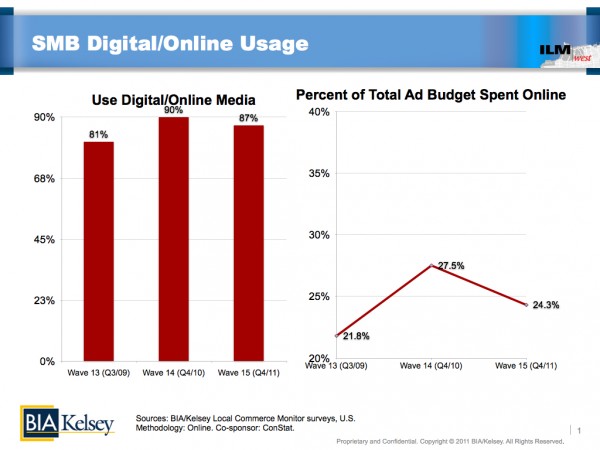
SMBs Have Embraced Online Marketing Channels, Local Will Grow

Small businesses are not unlike other businesses where it comes to using various online and web-based marketing channels, with 81 percent to 90 percent of respondents surveyed by BIA/Kelsey saying they use those channels.


One would suspect that the volume of efforts could change, over time, though. As more users on smart phones make active use of web-based information when about to shop, or while shopping, it is going to become more important for many local and smaller businesses to maximize their ability to found easily by users who have access to location information.


Also, the usefulness of information will become more important, as will promotion efforts. 


Mobile Apps Now Top Web Use

Chart MobileApp vs DesktopWeb Consumption resized 600Smart phones are changing how people use "web" resources. For the first time ever, daily time spent in mobile apps surpasses desktop and mobile web consumption, according to Flurry. Also, it took less than three years for native mobile apps to achieve this level of usage. Mobile apps used more than web

All of that is going to significantly change the ways people use applications and devices, from navigation to web behavior. For starters, smaller screens and out of the home usage mean that the types of information people are looking for, when mobile, are different from desktop modes. More purposeful searches are one example.

When out and about, people are more likely to be looking for someplace to go, something to do, places to eat and drink or shop. So one consequence is that mobile users are more directly interested in commerce apps than PC users. The latency between search operation and "buying" is more direct, and more frequent.

That explains why there is so much more activity around mobile commerce, mobile payments, mobile banking and mobile wallets.

Sunday, December 25, 2011

For our Jewish relatives and friends....

A humorous look at the Christmas holiday, from a Jewish perspective.

Glory to God in the Highest...

Thursday, December 22, 2011

Tim Tebow Interview

 In the first minute, he answers some questions about his touchdown celebration and pre-game routine. About a minute in, a bit of comedy.
.

Financial Advisors Think Social Media Doesn't Work


Financial advisers in the United States are seeing fewer benefits from their use of social media, a survey by Aite Group suggests.

Out of the 437 advisers surveyed, only 19 percent said social media was useful for reaching new prospective clients, roughly half the number from two years ago, when it was considered a leading benefit.

"Social media has been over-hyped and the benefits just aren't there for a lot of advisers," said Aite senior analyst Ron Shevlin. Fewer leads?

In fact, there seem to be no benefits ranked more highly in 2011 than in 2010 by the surveyed respondents. 

The most frequently cited objective for using social media was to build brand awareness and differentiation. But the percentage of advisers who credit social media with helping them differentiate their practice from competitors dropped to nine percent this year, from 21 percent in 2009.

Are business social media users really becoming “fatigued,” have they simply reaped most of the rewards, or is there some other explanation for why “results” seem to be slipping, at least in this one survey?

One can think of all sorts of reasons why social media doesn't always "work."  Poor execution, inadequate resources, lack of executive support and fuzzy business objectives can cause issues, no doubt.

There also are lots of reasons why it would be difficult to measure success, even if social media did “work.” All the metrics measured by Aite Group are subjective. Also unknown is whether the same executives were interviewed in both years. It is conceivable that a new sample population held different views than the former sample. 

The one social media tool that saw an increase in advisers' professional use was LinkedIn, up 10 percent since 2009. Comparatively, professional use of Facebook fell 10 percent, Twitter dropped eight  percent and personal blogging declined nine percent.

There was a Time Before the Internet....

And who knows how people were able to get anything done at work, research and write their papers or communicate!
 

Some Retailers Use QR Codes; Others Might Ask Why


Quick response codes are used by retailers and others to turn an "offline" experience into an "online experience." Smart phone users can point their cameras at the codes and then be taken directly to a website.

According to new research by Nellymoser, 7.2 percent, or about 1 in 14 stores are using QR codes during the 2011 Christmas and holiday shopping season, with fashion retailers the heaviest users.

Nellymoser looked at more than 700 individual stores and 318 brands in the five largest shopping malls in the greater Boston area, including Best Buy, J.C. Penney, Macy, Neiman-Marcus, Nordstrom and Sears.

When it comes to placement, Nellymoser found a majority of the 23 chains using QR codes displayed them in their front store windows to lure shoppers with the prospect of a special deal or discount. Typically, the QR codes were applied in the form of a decal in the lower right or left corner of a window. Retailer use of QR codes

But QR codes failing to gain consumer acceptance or traction, some would say. In fact, most people probably don't even know what they are. It might be that the rapid adoption of smart phones is obviating the reason QR codes were thought to be an advantage.

There was a time when QR codes made some sense: feature phones without keyboards made typing universal resource locators quite difficult. So the QR code was supposed to allow users to go straight to a website without fumbling around typing.

As more users get smart phones with better browsers and keyboards, the need for the QR code as a shortcut is undercut.

To have gotten huge traction, one might argue, feature phones would have had to remain the staple of user mobile web access. But smart phones rapidly are becoming the devices of choice for most people, making the QR a rather less useful way of getting to a web page.


Web Pages Getting "Bigger"

Typical page size seems to be growing, according to data supplied by HTTP Archive.

Over the last year the typical web page seems to have grown from about 700 kilobytes of data to nearly 1 megabyte.

The data also suggests that, for any given amount of pages viewed by a typical web browsing consumer, total bytes consumed will keep climbing.


Less VC Investment, More Progress in Mobile


Though venture capitalists are investing far less money in mobile companies in 2011 than they did in 2000, most of the payoff from two decades of investments will come over the next decade.

In other words, though it is possible less money will be invested by VCs in start ups in 2010 to 2019 than was invested fromn 2000 to 2009, the economic and social impact will undoubtedly be greater in the latter period, than in the former period.

One major reason is simply that the essential background environment, including processor power, cost of memory, cost of application development and adoption of broadband is qualitatively different

In 2000, for example, the total number of U.S. broadband lines totalled 7.1 million, according to the Federal Communications Commission. In 2011, that number is about 86 million to 87 million. About 84 percent of U.S. homes using the Internet do so using broadband connections.

In 2000 there were about 97 million U.S. mobile accounts in service. In 2011 there were 323 million U.S. mobile accounts in service. More significantly, few mobile users had smart phones, or broadband data connections in 2000, and nobody had a faster 4G connection.

Those physical limitations of devices, access speeds and users mean that what was possible in 2000 was simply an order or magnitude, or two orders of magnitude, worse than what is possible in 2011.

In fact, looking only investment with only a five-year lens, investment levels are up. Over a longer 10-year period, though, investments are down sharply. So 2009 was not a turning point for venture capital in the mobile space, though it might appear so, looking only at the 2006 to 2010 period. 
 

Still, one might argue that much of the investment 10 years ago was “too early,” with much of the infrastructure required to support a huge mobile transformation of business, commerce, entertainment and content simply too undeveloped.

In 2000, the sum of equity invested in the wireless industry peaked at $3.79 billion, according to The MoneyTree Report by PwC and the National Venture Capital Association.

And 2011 investment is likely to be lower than 2010. The average amount invested between 2000 and 2010 was $1.18 billion a year. But not since 2007 has equity invested even passed $1 billion. Mobile investment up or down? 

Also, the rapid rise of the iPhone, iPad and other mobile devices has fueled a mad rush of venture funding into consumer-facing mobile companies, rather than enterprise apps.

During the 2011 first half, according to Rutberg & Co., venture capitalists invested $3 billion into 358 mobile companies, with $960 million going to the “media and applications” sector, defined as social networks, mobile games, mobile advertising, app platforms, news aggregation, photo sharing and group messaging.

VC investment in enterprise mobile companies has been more tepid. According to Rutberg, VCs invested just $254 million into “enterprise IT” mobile companies over the same span. Consumer investments more popular

Keep in mind that venture capital is only one source of investment in mobile initiatives, with arguably more investment being made by established ecosystem participants, ranging from firms such as Google and Apple to RIM, Nokia, HTC and mobile service providers.

"We are in the beginning of a 10-year cycle in which mobile computing will reshape the way consumers live and businesses operate," wrote Rutberg researchers in their July 2011 mobile report. "PC Internet is a ‘dress rehearsal' for what will come with mobile, and the unforeseen applications in mobile computing will exceed those from the Internet thus far."
Mobile decade coming

Mobile commerce will be one expression of the change, as will the subsidiary mobile payment, mobile wallet, mobile remittance, mobile shopping, mobile promotion and mobile advertising businesses.

Netflix Gains Viewership in 2011, Hulu Loses, Amazon Up

Netflix continues to lead all streaming services in viewership, and would appear to have a huge lead where it comes to "subscription streaming" revenue. Many of the sites create revenue by showing ads, or even more indirectly by "gluing" a subscriber to some other service, such as a video subscription service. Netflix Citi survey

Wednesday, December 21, 2011

AT&T Cash Will Not Help T-Mobile USA

The $3 billion cash payment AT&T has to pay to Deutsche Telekom as part of a break-up fee for the collapse of the deal whereby AT&T was to buy T-Mobile USA will not help T-Mobile USA at all. All of that cash will be used by parent Deutsche Telekom to pay down debt. 

As part of the break-up fee, T-Mobile USA will receive a large package of  mobile spectrum in 128 “Cellular Market Areas,” including 12 of the top 20 markets (Los Angeles, Dallas, Houston, Atlanta, Washington, Boston, San Francisco, Phoenix, San Diego, Denver, Baltimore and Seattle).
 

Likely of greater immediate importance is a seven-year roaming agreement that will allow T-Mobile USA to improve its footprint significantly. Population coverage will increase from 230 million potential customers at present to 280 million.

As a result of the agreement with AT&T, coverage will be extended to many regions of the United States in which T-Mobile USA previously had neither its own high-speed mobile communications network nor the associated roaming agreements. AT&T cash won't help T-Mobile USA

The cash component of the break-up fee directly reduces Deutsche Telekom’s net debt, thereby by strengthening the financial performance indicators affecting the company’s rating.


Amazon weighed buying RIM

rimazonResearch In Motion Ltd apparently has turned down takeover overtures from Amazon.com and other potential buyers because the BlackBerry maker prefers to fix its problems on its own, according to a report by Reuters. 


Amazon reportedly hired an investment bank this summer to review a potential merger with RIM, but it did not make a formal offer. It is not clear whether informal discussions between Amazon and RIM ever led to specific price talk, or who else had approached RIM about a takeover. Amazon weighed buying RIM

That such ideas were considered shows how volatile the mobile space has gotten recently, as content providers, video entertainment companies, many consumer electronics manufacturers, advertising concerns, banks, transaction processors and retailers ponder the growing, and in many cases, strategic role mobility is playing across a broad range of industries. 


For Amazon, the draw likely was a way to get its services and content onto smart phones, as Amazon now is able to leverage tablet screens to support its e-commerce and e-content initiatives. 


Some might speculate that RIM's patents could have been interesting, as well. Patents have become increasingly important in the smart phone business, and any future move by Amazon in that direction might well be on surer footing if Amazon could acquire both a patent portfolio and an existing manufacturing capability, brand awareness and customer base. 

Cable Operator Competition Puts Pressure on Other CLECs

Some years ago, I recall having a conversation with an experienced veteran executive in the competitive local exchange carrier industry, who was convinced cable operators would not prove a threat in the CLEC business, a point of view I never have agreed with. 

To be fair, the executive at the time was running a CLEC that focused more on multiple-site businesses than single-site organizations. 

You can argue that both points of view are correct, that cable companies have indeed proven successful in the small business segment (perhaps 16 voice lines or fewer), but have yet to make an assault on the mid-market or enterprise segments of the market. Cable ops have succeeded in small business market

Integra Telecom, the Portland, Ore.-based CLEC that had in the past focused primarily on smaller accounts, might agree that cable companies are indeed a threat. In fact, Integra Telecom now hopes to focus most of its attention on larger customers. 

Integra Telecom revenues, which peaked at $683 million in 2008, fell to $616 million in 2010, in part because of continuing impact of the Great Recession and in part because some smaller businesses went out of business.

But company executives would also say that new competitive threats from rivals including Comcast Corp. were a key factor.

So Integra began targeting larger customers. Integra Telecom's challenges not unique 

That same decision-making context is certain to affect other CLECs, and sales partners for CLECs, as cable operators now only continue to show they are effective in the small business market, but as they slowly gear up to tackle larger accounts as well. 

Unless you believe the deal Comcast, Cox Communications, Time Warner Cable and Bright House Networks have to resell Verizon services is somehow invalidated by regulatory authorities, those cable operators now have many of the tools they will need to succeed in sales of products to larger organizations, not limited to wireless services. 


On the Use and Misuse of Principles, Theorems and Concepts

When financial commentators compile lists of "potential black swans," they misunderstand the concept. As explained by Taleb Nasim ...