Saturday, December 31, 2011

No Killer App for Verizon LTE?

One year after its launch, Verizon Wireless's 4G LTE network has failed to capture the imagination of the cell phone-buying masses, who still prefer the slower-connecting Apple iPhone by large margins, argues Paul Kapustka of Sidecut Reports.

With data-download speeds up to 10 times faster than previous technologies, it might seem that Verizon's "fourth generation," or 4G wireless network, would be a hot commodity in a mobile device-crazed world, says Kapustka.

But lack of a compelling new "4G-only" application is one possible reason why Verizon had sold fewer than 2 million 4G LTE-capable smart phones during the first nine months of 2011. he argues. Some of us also would argue that 3G is quite good enough for most smart phone users, at the moment.

By way of comparison, more than four million people bought the new Apple iPhone 4S the first weekend it went on sale, from Verizon as well as from AT&T and Sprint, Kapustka argues.

But we should not underestimate sales, either. Verizon sold more than a quarter-million units of its first 4G LTE phone, the HTC ThunderBolt, in just two weeks after its mid-March 2011debut. Those sales arguably were made to “early adopters” who had a reason to buy.

No Significant Cord Cutting Yet, But Maybe Serious Cord Avoidance

You can typically get a good argument about the imminent danger of video cord cutting (people giving up their entertainment video subscriptions) just about any day. Lots of observers warn about people substituting online and other sources for their TV and movie viewing, but a substantial number also would argue that there is a relatively insignificant amount of that sort of activity at the moment.


So far, the numbers seem to be on the side of doubters. Keeping matters in perspective, Comcast Corp., lost 442,000 video subscribers in the first nine months of 2011, fewer than in the same period last year. But Comcast also has about 22.4 million video customers and 49.4 million accounts if you include buyers of Comcast voice and high-speed broadband products.


Time Warner Cable Inc. lost 319,000 over the same period, according to the Wall Street Journal. Losing cable customers

But at the end of the third quarter of 2011, Time Warner Cable had 11.7 million video customers and 26.2 milliion buyers of its video, voice or broadband products.


Also, losses at cable companies are mostly defections of customers to rival satellite or telco providers, rather than outright defections from the ranks of video service providers. So the actual amount of abandonment arguably remains fairly low. No Significant Cord Cutting Yet, But Maybe Serious Cord Avoidance - Carrier Evolution

Friday, December 30, 2011

Verizon says LTE outages are IMS related

Recent multiple outages on the new Verizon Long Term Evolution network were caused by software bugs in the IMS core, according to Verizon Wireless VP of network engineering Mike Haberman. Verizon says IMS is culprit behind LTE outages

All three outages were caused by problems in Verizon’s service delivery core, the IP Multimedia Subsystem (IMS) which is used for signaling on the LTE network.

While IMS has been around for some time, Verizon’s is the first implementation in an LTE network and it has continued to be a problem spot ever since April 2011, when a software bug originating deep within the IMS core led to a complete failure, kicking LTE customers off both Verizon’s 3G and 4G networks nationwide.


Verizon to Charge Customers $2 Fee, NOT

Verizon Wireless, in an apparently ill considered move, announced and then rescinded a plan that would have added a $2 surcharge whenever customers made one-time credit care payments using either online or voice customer service channels. Verizon to Charge Customers $2 Fee When Paying Bills Online


Virtually immediate consumer opposition, plus the apparent dislike of the move at the Federal Communications Commission, lead Verizon to withdraw the plan soon after it was announced.

The plan, which would have begun January 15, 2012, would have applied to customers who make single bill payments online or by telephone.

Thursday, December 29, 2011

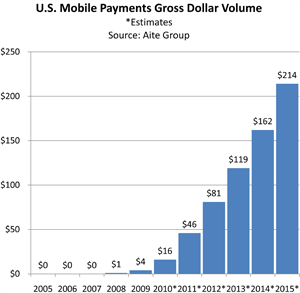
Mobile Payment Value Elusive, So Far

One common assumption about using mobile devices in a "wave and pay" application is that such alternate ways of paying for retail and other transactions necessarily will "cost retailers less" than existing methods such as paying by credit card or debit card, providing a business model for retailer adoption.

Specifically, there is some hope or expectation that retailers might be charged less money for each transaction than they now pay for supporting credit card payments. The transaction fee of about 3.5 percent is the typical target.

So far, these hopes have proven difficult. In fact, though many observers would note problems, debit card fees recently have been slashed by the Durbin Amendment to the Dodd-Frank financial services reform law, and not by any change in technological method. Debit card issuers have lost revenue, retailers have gotten lower transaction fees, but issuers still will have to make up the lost revenue some way, by raising other fees, cutting costs, or both.

Beyond that, in many cases, alternative methods, including putting charges on cell phone monthly statements, or alternative methods such as Square, actually do not save money, or even cost more than using credit card payments. Mobile money and transaction fees


Common expectations about value for end users likewise have proven elusive, to date. One advantage of "wave and pay" is the time savings. At some point, with volume deployment and consumer experience, that will be true. Right now, it is arguably the case that consumer inexperience means more friction at the point of sale. So even the hoped-for transaction time savings might not be seen, in practice. That will change over time, with greater experience.

Still, the point is that mobile payments, which largely are in early deployment or testing stages, have not yet created an obvious and significant value proposition either for retailers or end users, with the notable exception of the Starbucks mobile payment system. So 2011 was not the "year of mobile payments," nor will 2012 be that year. There will be significant progress, though.


Wednesday, December 28, 2011

Facebook was Made for Mobile

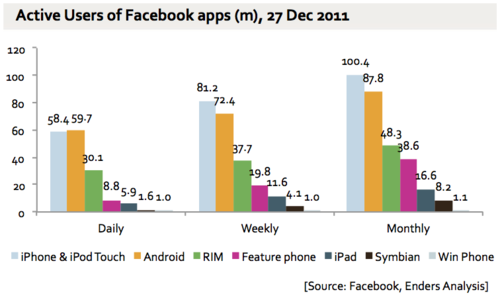
Sometime in the last couple of days, the monthly active users of Facebook’s mobile apps passed 300 million, says analyst Benedict Evans.


That is 37.5 percent of the 800 million total monthly active users Facebook disclosed in September 2011, when Facebook said there were 350 million monthly active mobile users, making Facebook one of the most mobile-centric online services out there.


Facebook's 300 million app users

"Latency" Issues Not Under Full Service Provider Control

Network service providers can do many things to optimize bandwidth and latency on their networks. But it also is true that networks cannot optimize most end points on their networks, nor can they control peak load.


That means that latency as a problem can be remedied only partially by steps network service providers can take. 

First person shooter games such as Call of Duty rely on low network latency in order to keep pace with players’ reaction times, and can offer a competitive advantage in multiplayer games.


"Hardcore gamers" often recognize latency as a key criterion when selecting their network provider. That, in turn, poses questions for service providers. How gaming is changing the data center

There are some known ways to reduce latency, such as reducing distance packets travel, for example. Beyond that, one might argue that most latency results from the devices and servers used in sessions, which are, by definition, not under the control of a network operator.

Still, minimizing distance packets must travel, or unnecessary protocol conversions, will help improve latency performance. Peak bandwidth demand, on the other hand, has to be approached differently. Adding new capacity, convincing users to regulate their usage or traffic shaping are potential tools in that regard. But adding capacity does not always automatically improve latency performance.

That implies that the techniques used to improve performance of a network under congestion are different from the tools used to manage latency performance. Caching and other techniques that put server resources "closer" to users are one way networks can be designed to minimize latency issues.


But those decisions have to be made by application providers. 

Amazon Gains, Netflix Loses, on Satisfaction Scores

Amazon appears to have made major gains on Netflix in the “customer satisfaction” area, as  Netflix dropped six points (from 85 to 79); while Amazon gained two points to achieve a score of 88, for a net swing of eight percentage points, in ForeSee’s survey of Christmas and holiday period customer satisfaction in December 2011.

The two companies, who have long been together atop the Index, are starting to diverge, signaling a strong year to come for Amazon and a difficult one for Netflix, ForeSee predicts.

The survey data is based on more than 8,500 customer surveys collected during prime holiday shopping time between Thanksgiving and Christmas of 2011.  Amazon gains, Hulu loses in satisfaction scores

Google+ Surpasses 62 Million Users


Google+ is adding new users at a very rapid pace, and seems to have surpassed 62 million users, according to Paul Allen, who has been estimating Google+ usage since the summer of 2011. 


In the summer of 2011, Google+ users were unusually weighted in the direction of technology, especially software-related job titles. That might be expected for an "early adopter" product.
“Each week my team from elance runs hundreds of queries on various surnames which we have been tracking since July,” he says.  “We revised our model based on the actual user announcements made by Google on July 13th and Oct 13th.” Google+ subscribers
 
July 13 - 10 million
August 1 - 20.5 million
September 1 - 24.7 million
October 1 - 38 million (Larry Page announced "more than 40m users" on Oct 13th)
November 1 - 43 million
December 1 - 50 million
December 27 - 62 million
January 1 - 65.8 million (forecast)
February 1 - 85.2 million (forecast)

Tuesday, December 27, 2011

894 Million Mobile Banking Users by 2015

Mobile banking and related services are expected to grow from 55 million users in 2009 (at a CAGR of 59.2 percent) to reach 894 million users in 2015, according to Berg Insight, The Asia-Pacific region is expected to become the most important market region, accounting for more than half of the total user base. 894 Million Mobile Banking Users by 2015

Monday, December 26, 2011

Are 4G Sales Slow or Not?


What adoption curve will fourth generation mobile networks take, especially the new Long Term Evolution networks? Right now, only one service provider in the United States, Verizon Wireless, has a full year of operation to talk about. 

Of course, Clearwire has been in operation since 2005, but key differences in business model and markets render the comparison inexact.
Clearwire, which mostly has grown on the strength of its WiMAX 4G network, ended the second quarter 2011 with approximately 7.65 million total subscribers, up 365 percent from 1.64 million subscribers in the second quarter 2010. Clearwire subscribers 

But some would note that Clearwire has made significant changes in its business plan, from fixed to mobile, from rural markets to all markets, and from a mix of retail and wholesale to wholesale-only. Along the way, Clearwire also has merged its spectrum with that of Sprint. All of those changes make an "apples to apples" comparison challenging.

So keep in mind that Clearwire had a five year to six year period where its growth was rather measured, not to mention that it began life offering a fixed-only wireless alternative to fixed network broadband. The inflection point for growth didn't come until 2010, when a variety of factors, ranging from Android adoption to overall smart phone growth to arguably better marketing seem to have made a difference.


The Clearwire subscriber base consists of 1.29 million retail subscribers and 6.36 million wholesale subscribers. The key point is that although the analogy is not precise, since Clearwire started out as a fixed network alternative, and only later changed to mobile broadband, early demand might not be reflective of what might have happened if it had focused on mobile broadband, or if Clearwire had been able to focus on mainstream mobile customers rather than largely-rural potential customers.

The initial focus on smaller and more-rural markets would, in and of itself, been the cause of slower growth than a nationwide smart phone mobile service, at a time when smart phone adoption is robust.
One year after its launch, Verizon Wireless's 4G LTE network has failed to capture the imagination of the public, who still seem to prefer the slower-connecting Apple iPhone by large margins, argues Paul Kapustka of Sidecut Reports. Sidecut report

With data-download speeds up to 10 times faster than previous technologies, it might seem that Verizon's "fourth generation," or 4G wireless network, would be a hot commodity in a mobile device-crazed world, says Kapustka.

But lack of a compelling new "4G-only" application is one possible reason why Verizon had sold fewer than two million 4G LTE-capable smart phones during the first nine months of 2011. he argues. Some of us also would argue that 3G is quite good enough for most smart phone users, at the moment.

The other complicating issue is that it is in most cases the rule that devices drive subscriptions, and the popular Apple iPhone only works on 3G networks. As it has been the case that ability to get the iPhone seems to drive the subsidiary choice of service provider, so it might continue to be the case that overall demand for iPhones, which only work on 3G networks, is affecting the choice of network, though less so service providers, these days.

By way of comparison, more than four million people bought the new Apple iPhone 4S the first weekend it went on sale, from Verizon as well as from AT&T and Sprint, Kapustka argues.

One might not consider Verizon 4G sales "slow," in the context of rather-slow 3G adoption, and the long run-up of Clearwire 4G sales.

SMBs Have Embraced Online Marketing Channels, Local Will Grow

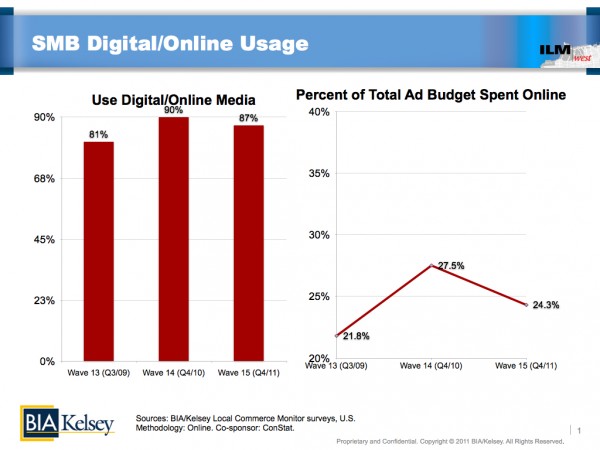
Small businesses are not unlike other businesses where it comes to using various online and web-based marketing channels, with 81 percent to 90 percent of respondents surveyed by BIA/Kelsey saying they use those channels.


One would suspect that the volume of efforts could change, over time, though. As more users on smart phones make active use of web-based information when about to shop, or while shopping, it is going to become more important for many local and smaller businesses to maximize their ability to found easily by users who have access to location information.


Also, the usefulness of information will become more important, as will promotion efforts. 


Mobile Apps Now Top Web Use

Chart MobileApp vs DesktopWeb Consumption resized 600Smart phones are changing how people use "web" resources. For the first time ever, daily time spent in mobile apps surpasses desktop and mobile web consumption, according to Flurry. Also, it took less than three years for native mobile apps to achieve this level of usage. Mobile apps used more than web

All of that is going to significantly change the ways people use applications and devices, from navigation to web behavior. For starters, smaller screens and out of the home usage mean that the types of information people are looking for, when mobile, are different from desktop modes. More purposeful searches are one example.

When out and about, people are more likely to be looking for someplace to go, something to do, places to eat and drink or shop. So one consequence is that mobile users are more directly interested in commerce apps than PC users. The latency between search operation and "buying" is more direct, and more frequent.

That explains why there is so much more activity around mobile commerce, mobile payments, mobile banking and mobile wallets.

Sunday, December 25, 2011

For our Jewish relatives and friends....

A humorous look at the Christmas holiday, from a Jewish perspective.

Glory to God in the Highest...

"Lean Back" and "Lean Forward" Differences Might Always Condition VR or Metaverse Adoption

By now, it is hard to argue against the idea that the commercial adoption of “ metaverse ” and “ virtual reality ” for consumer media was in...