Monday, February 13, 2012

Consumers Shifting Spending to Tablets, E-Readers?


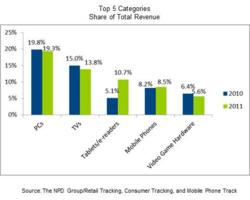
PCs and TVs still represent the two largest categories of U.S. consumer technology hardware and consumables sold in 2011.
But tablets and and mobile phones are the third and fourth largest product categories, by revenue.

Revenue from products was about $144 billion according to The NPD Group.
PCs represented the most revenue with nearly $28 billion in sales, accounting for almost 20 percent of sales.

Tablets and e-readers were the clear growth categories in 2011, nearly doubling sales to $15 billion in 2011.

And it appears that consumers are shifting spending from other categories toward the top-five categories.

“U.S. hardware sales growth is becoming harder and harder to achieve at the broad industry level,” said Stephen Baker, Vice President of Industry Analysis at NPD. “Sales outside of the top five categories fell by eight percent in 2011 as consumers shifted spending from older technologies to a narrow range of products.”

Apple was the leading consumer electronics brand for the second year in a row. Among the top five brands Apple was the only one to experience a sales increase, posting a 36 percent rise over 2010.
Sales through online, direct mail, and TV shopping channels jumped seven percent and accounted for 24 percent of all sales, up from 22 percent in 2010.
Sales through these non-retail channels captured 25 percent of industry revenue in the fourth quarter of 2011.

Some Forms of Smart Phone Commerce Were Nearly Ubiquitous Last Christmas, Holiday Shopping Season

Smart phones took center stage in the consumer shopping experience during the fourth quarter of 2011, according to NPD Group. Both websites and apps got serious use during the most-recent Christmas and holiday shopping season. 

In December alone, the proportion of U.S. Android smart phone users engaged in shopping websites rose nine percent from November, to almost 80 percent of smart phone users accessing shopping related websites on their devices.

Shopping apps also played an important part of the overall shopping experience, rising five percentage points in December to 59 percent usage.

It would be fair to say that, up to this point, people have been using mobiles for research and sharing with friends. There arguably was less comparison shopping, but that sort of behavior is growing, by all accounts.

Still, such surveys probably overestimate the direct activity related to products users are shopping for, from inside retail locations. And it is applications and behavior on the part of users just before they go to a retail location, and what they do while inside a retail location, that probably has the greatest potential impact on retail sales, for better or worse.

So far, though mobile shopping activities are growing, much of the activity is not too dissimilar from the shopping apps and behavior we have become familiar with on PCs. The big potential changes are how smart phone based commerce behaviors happen while consumers actually are inside stores, shopping.


Source: NPD Connected Intelligence SmartMeter


PayPal Deemphasizing NFC at Point of Sale

PayPal is conducting a major test of ways to integrate PayPal into standard Home Depot point of sale systems. But PayPal continues to believe that near field communications is "too early" in its life cycle to be useful, at least at the moment.

In fact, eBay CEO John Donohue has quipped that "near field communications" stands for "not for commerce." It therefore is not surprising that PayPal appears to be discontinuing, its efforts to supportpmobile payments at the Point of sale using NFC.

PayPal doesn't seem to see enough merchant interest, at least not enough where PayPal is concerned. So far, it appears there is greater retailer interest in adding PayPal payment methods in ways that do not even require use of a mobile device. Merchants bigger on PayPal than NFC


Millennial Males Seem to Like Mobile Ads More than Millennial Women


Among Millennials (some would say that includes people 18 to 29, others would put the range as something more like 18 to 35 or so) men were significantly more likely than women to recall having seen a mobile ad on their mobile phone.

Some 69 percent of Millennial men reported recalling having seen an ad on their mobile devices. 

Less than half of women the same age remembered seeing mobile advertisements. Overall, 59 percent  of smart phone owners of any age or gender reported seeing mobile ads, according to InsightExpress.

US Mobile Phone Owners Ages 18-29 Who Have Seen Mobile Ads, by Gender, Jan 2012 (% of total)


Among women ages 18 to 29, just 12 percent said they liked mobile ads at least somewhat, while a plurality were ambivalent. But fully 40 percent of men report actively enjoying mobile advertising, including 20 percent who said they liked it “very much.” 

On average, across all smart phone owners, a quarter liked mobile ads at least somewhat. It isn't clear what the findings indicate. It could be that more attention has been paid to the creative elements for ads aimed at men, or that it is easier to create such elements for advertising aimed at men. 

There could be "respondent bias" of some sort. It is possible that people think they recall specific ads, when they actually do not. It is possible the Millennial women respondents were simply more honest. 

Perhaps the most important finding is that advertising is an enjoyable form of content at all. It appears advertisers are producing more entertaining content. 

Attitude Toward Mobile Ads According to US Mobile Phone Owners Ages 18-29, by Gender, Jan 2012 (% of total)

Sunday, February 12, 2012

LTE Drives Global Network Equipment Spending

Mobile Communications Factory Revenue
Equipment purchased to support mobile networks will reach $398 billion in 2012, up 17 percent from $340.8 billion in 2011, according to an IHS iSuppli.

A substantial portion of the spending is for fourth generation networks, especially based on use of Long Term Evolution. 


Although growth this year is down somewhat from the 32 percent growth rate of 2011, the market is expected to grow at  double-digit rates until about 2015. 

MEF Launches Mobile Backhaul Initiative

The Metro Ethernet Forum has launched a “Mobile Backhaul Initiative for 4G/LTE,” aiming to create standards for backhaul that could provide a potential 25 percent backhaul savings for mobile operators.

The initiative seems to build on support for multiple classes of service (Multi-CoS) contained in the MEF 23.1 Multi-CoS Implementation Agreement.

“Mobile Operators all agree that the industry’s single biggest challenge and operating cost is in delivering the bandwidth needed for 4G/LTE backhaul” says MEF President, Nan Chen.

The “Mobile Backhaul Initiative” will feature an integrated suite consisting of the MEF 22.1 Mobile Backhaul implementation agreement, MEF 23.1 Multi-CoS implementation agreement, and a technical business paper clarifying the urgency and justification of migrating to Multi-CoS.

The program focuses on providing technical guidance on best practices and a new paper on packet-based frequency synchronization as well.

Why Data Consumption Forecasts So Often are Wrong

Bandwidth planning has become a tricky business since data traffic completely displaced voice as the driver of consumption. Not only is demand more variable and uncertain, growth is more dynamic, by an order of magnitude or two.

That raises an obvious question for mobile service providers: how much bandwidth do they need to be ready to supply to customers? The question might be easier to answer if demand were not if end user demand was predictable, but demand is not predictable. Sometimes growth is "only" 40 percent a year; sometimes it is higher.

Some might say, for example, that over the past year, AT&T has revised its own forecasts of bandwidth consumption in significant ways.

In a March 2011 presentation AT&T projected that data volumes would grow by eight to 10 times between the end of 2010 and the end of 2015.

That forecast appears to be based on an expectation that volumes would roughly double in 2011 and then increase by a further 65 percent in 2012.

Consider this 2008 forecast, which presents a not-unusual rate of growth in potential speeds, which has a direct bearing on consumption, since faster speeds tend to be associated with higher consumption.

Keep in mind that access speeds are different from consumed gigabytes. But the former drives the latter. And nobody currently predicts anything but a continual shift to higher potential access speeds on fixed and mobile networks.

Instead, AT&T now seems to be seeing 40 percent annual growth. Now, 40 percent annual growth is significant. It means bandwidth consumption doubles about every two to three years.  But annual bandwidth growth of 50 percent a year would be well within historical ranges, on an aggregate basis, in terms of long-haul bandwidth consumption. But policies and end user behavior can change the demand curve.

The most-recent AT&T forecast would mean that data volumes would increase by five to six times by 2015. Whether that means existing spectrum, and newer methods for handling traffic using that spectrum, are sufficient to handle future growth is debatable. Some might argue additional spectrum is not required.

Others might say the possible growth of between 500 percent and 1,000 percent, in just four years, is challenging enough that additional spectrum is likely to be needed, especially if the higher range of growth turns out to be the case.

Network planners might point out that supplying additional bandwidth takes prodigious amounts of capital and significant time.

Some might speculate that AT&T’s forecasts about data growth have changed because supplier policies and end user behavior have changed.

Perhaps users have become quite sophisticated about offloading their data usage to Wi-Fi, as service providers have been urging them to do.

Or, perhaps the heaviest users, with "prodding" from the carriers, are modifying their own behavior. Why it is so hard to make accurate bandwidth forecasts

Some observers would not be sanguine about moderating rates of bandwidth consumption. It is true that carriers can provide incentives and dis-incentives for consumption. But it also is the case that video consumption keeps growing, and it is video that drives bandwidth demand.


Use a Smart Phone as a Desktop PC?

A sufficiently motivated researcher can, in fact, use a smart phone as a desktop PC. The results might be "sort of" reasonable.

But such experiments simply point out that behavior is, and ought to be, different on devices with different form factors, user interfaces, screen sizes and software loads.

To use an analogy, in the history of media, we always tend to begin using a new medium on the pattern of the older medium. So, when "stage" was the dominant mass performance medium, and the movie business began, what did movies look like?

The experience was pretty much the same as a live performance, only captured on film. In fact, the new medium arguably was less rich, as an experience, since the "audio track" was missing.

In the realm of devices, we likely have a tendency to envision "how to use" a new category of devices  through the prism of older devices we already are familiar with, as well.

The point is not so much that some common experiences (using email or messaging) will be common to most or all of the platforms. Beyond that, we will eventually discover that each device category creates a distinctive "highest and best use," despite the common features.


Saturday, February 11, 2012

You Have to See This

Friday, February 10, 2012

What Drives Enterprise Tablet Adoption?

An informal survey of 70 enterprise executives suggests a number of reasons why enterprises are adopting tablets. One driver is increasing amounts of work conducted by workers outside normal working hours and outside the office.

That trend isn't new, but workers are telling information technology staffs that they would prefer replacements for bulky laptops, and smart phones aren’t quite meeting their needs.

Business partners, especially independent sales representatives, also are asking for content support for iPads from partner sales organizations, as well.

To bring down costs, retailers are looking for ways to reduce space, and are replacing training kiosks with tablets.
By providing employees with tablets, companies can significantly reduce the use of paper and improve their efforts to "go green," as well. Enterprise tablet adoption drivers


Google May Open Retail Store

Google may open its first stand-alone retail store at its European headquarters in Dublin, Bloomberg reports. The move follows reports that Amazon will open its first retail outlet as well, in its home city of Seattle.

The Google Store would be open to the public and sell unspecified “Google merchandise,” Google’s Irish unit said in a local planning application. Google May Open Retail Store

There is a decades-long history of PC manufacturers, especially those selling heavily online, to open branded retail locations, Dell being among the firms that have done so, and retreated. Apple itself was heavily criticized for opening its Apple Stores, the thinking being that Apple earnings would be harmed.

But with Apple's wild success, even Microsoft and Sony have committed to retail outlets.

So retail may be a new front in Google’s competition with Apple Inc., whose 361 stores have fueled sales of iPods, iPhones and iPad tablet computers.

Google earlier opened a store inside of a London branch of Currys and PC World, units of Dixons Retail Plc, as a trial for selling laptop computers, some would also note.

Retail stores, though not a feature of the network-based video entertainment business or fixed line services (cable TV and satellite TV, or landline telephone services, for example), have become essential for sales of mobile services. Apple has shown how retail can help sales of devices. What remains to be seen is if similar results are possible for intangible "services and apps," or whether the winning formula will wind up being devices such as Kindles for Amazon, and smart phones for Google.

Thursday, February 9, 2012

New Mobile Devices are Changing Behavior


Wireless and untethered devices are starting to change the ways people interact with, and consume, all sorts of media and content.

In 2011, the majority of all mobile phone owners consumed mobile media on their smart phones and tablet devices, marking an important milestone in the evolution of mobile from primarily a communication device to a content consumption tool. At the end of 2011, more than eight percent of all digital traffic was consumed beyond the “classic web” across devices such as smart phones and tablets.  Content consumption is the big change

To put the rapid uptake of tablets in perspective, it took seven years to reach nearly 40 million smart phones compared to less than two years to reach nearly 40 million tablets, demonstrating the vast appeal of these devices and consumers’ desire for connection.

It would not be stretching matters to argue that widespread adoption of smart phones and now tablets has significantly changed digital media consumption patterns.

In December 2011, 8.2 percent of all web page views occurred on devices other than PCs, for example, with mobile devices accounting for 5.2 percent of traffic, tablets driving 2.5 percent.

Americans spend more than 33 hours per week watching video across their available screens, according to the latest Nielsen Cross-Platform Report.

The shift to wireless (using the mobile networks) and connected devices (using Wi-Fi) also seems to be accelerating. It is no secret that sales volumes in consumer electronics and computing devices now have shifted strongly to smart phones, tablets and e-readers, and away from PCs.

As but one example, PC shipments in Western Europe totaled 16.3 million units in the fourth quarter of 2011, a 16 per cent decline from the same period of 2010, according to Gartner.

For the full year, PC shipments also declined 16 percent from 2010, dropping for four straight quarters.

"Despite aggressive pricing and special holiday deals for PCs, consumers' attention was caught by other devices, such as smart phones, media tablets and e-readers," said Meike Escherich, principal analyst at Gartner. And those devices are changing the way people behave.

One of Google’s studies of tablet use over a two-week period, which had users recording every occasion that they used their tablet, shows that tablets really are not PCs, any more than smart phones are used in the same way that PCs are used.

Most consumers use their tablets for fun, entertainment and relaxation while they use their desktop computer or laptop for work, Google User Experience Researchers Jenny Gove and John Webb say. About 91 percent of the time that people spend on their tablet devices is for personal rather than work related activities.

And, as it turns out, when a consumer gets a tablet,  they quickly migrate many of their entertainment activities from laptops and smart phones to this new device.

The most frequent tablet activities are checking email, playing games and social networking. The study also found that people are doing more activities in shorter bursts on weekdays (social networking, email) while engaging in longer usage sessions on weekends (watching videos/TV/movies).

Tablets are multi-tasking devices with at least 42 percent of activities occurring while doing another task or engaging with another entertainment medium. Tablets aren't PCs

As it turns out, lots of things people can do on PCs don’t “need” to be done on PCs. Content consumption, email and other communications actually represent most of what many business users really “have to do” on a PC.

Also, tablets are more accurately described as “untethered” devices than “mobile” devices, to the extent that tablets primarily are used at home. Unlike smart phones that go everywhere and laptops that travel between work and home, few consumers take their tablets with them when they leave the house.

That shipments of tablets are expected to grow from 72.7 million units in 2011 to 383.3 million units by 2017, according to NPD, would not surprise many observers.

Growth in emerging markets, expected to account for up to 46 percent of worldwide shipments by 2017, an increase from the 36 percent share in 2011, might be more surprising.

The tablet forecast also illustrates an important change in connected appliance trends. In the past, “PCs” have been one category of appliances, while MP-3 players, phones and digital organizers, game devices, cameras and e-reading devices have been distinctly different categories.

These days, many of those devices have overlapping functions. Taken as a whole, the changes suggest the crucial role “content consumption” now plays as a lead application for most devices. Though PCs, cameras and organizers still largely have “work or business” use cases, virtually all the other devices are oriented around content consumption.

If results of a U.K. consumer poll are any indication, tablet PCs are about to change Web browsing, gaming and reading preferences.

According to survey conducted by Cooper Murphy Webb, Apple’s iPad is the preferred method of reading newspapers and magazines among consumers already owning the device. Tablets change behavior

The poll also found that a plurality of iPad owners prefer the device for reading books and gaming. Perhaps surprisingly, respondents indicated they used their dedicated gaming consoles and iPads about equally when gaming. If that holds up, it could mean trouble for game console suppliers.

And a significant percentage prefer the iPad for Web browsing as well. That finding is less surprising, if one assumes the tablet device is designed to be used as a content consumption device.

Google to Sell Branded Home Entertainment System

Google is developing a home entertainment system that streams music wirelessly throughout the home and would be marketed under the company's own brand, according to the Wall Street Journal. One obvious implication is that Google now will enter the consumer electronics business in a more significant way.

The Google Nexus smart phone has been positioned as a bit of a "demonstration project," to show what Android ideally can provide in a device experience. Google is more centrally involved as a backer of the Android mobile operating system. And, most recently, Google has acquired Motorola Mobility, which has put Google into the mobile handset business.

Many will worry about the potential implications for Google, which now will face at least some potential channel conflict with at least some potential licensees, though not in the mobile handset business.

The effort does put Google into the branded consumer electronics business in a new way. But in a broad sense, the move indicates the arguably growing degree of competition between Google and Apple. Apple has been masterful at using content to drive hardware sales, and future lines of business for both Google and Apple might overlap more centrally as hardware, software and revenue models built on content and transactions using hardware become more important. Apple, Google competition heating up

Global Fixed Broadband Revenue: $191 Billion in 2012

Global fixed broadband revenue expected to generate $191 billion and reaching $217 billion in 2012, according to ABI Research.

If one assumes 2012 global telecom revenue will be $2.1 trillion, then fixed broadband would represent about nine percent of total revenue. 

Google to Launch Cloud Service

Google is rumored to be launching a cloud-storage service that would compete head-to-head with Dropbox, SugarSync and others.

The search giant’s cloud service will be called Drive and it’ll not only be free to consumers up to a certain size limit but it will also be folded into Google Apps for enterprise customers. Google to launch cloud service

How Electricity Charging Might Change

It now is easy to argue that U.S. electricity pricing might have to evolve in ways similar to the change in retail pricing of communication...