Saturday, February 18, 2012

EU to Clear Some 800 MHz Spectrum for LTE in 2012?

Every country in Europe will be required to clear TV transmissions out of the higher frequencies of 800MHz band by the end of 2012, the European Parliament has ruled.

That might not mean it actually happens that soon, but at least that's the goal. The expectation is that spectrum auctions then could follow, with networks being built after the completed auctions. All that means much of Europe will not see LTE in the next few years.

The 800MHz band is being cleared as part of the switch to digital television, freeing up some spectrum at the top and bottom of the band. The EU proposal concerns the higher frequencies in the 800-MHz band. By some estimates even that new spectrum will not be enough to meet mobile data demand by 2015. EU to clear 800 MHz band

Why LTE Kills Batteries

Devices running on Long Term Evolution and other 4G networks consume battery life, most users have discovered. Nokia Siemens Networks did some preliminary studies on LTE phone’s power drain versus their equivalent 3G models and found that LTE devices consume from five percent to 20 percent more than previous-generation phones, depending on the application used.

Some of you will instinctively guess that battery drain is worse than that.

In its review of the Samsung Galaxy Nexus, Engadget found that the Google Navigation running over the LTE network ate battery power faster than the Nexus’ car charger could restore it, for example. Why LTE drains batteries

Some us have started carrying extra batteries. Recently, some of us have been turning off both the 4G and 3G radios most of the time when out and about, using the devices only for voice and text.

And more of the time, the devices simply get turned off. That originally struck me as a complete waste of device capabilities. But we all learn to make trade offs. Increasingly, the only way to stretch battery life is simply not to use the data network at all, much of the time, so your batteries are available when you really need the power.


1% of Mobile Users Consume 1/2 of Bandwidth

A new study sponsored byArieso finds that extremely-heavy users of mobile bandwidth are becoming even heavier users.

About one percent of subscribers now consumes 50 percent of all downloaded data. Arieso reveals latest trends in smartphone data use:

1/2 of U.S. Adults Will Use Mobile Banking by 2016

By 2016, about half of U.S. adults will be using mobile banking, predicts. About 92 percent of the top-25 largest banks offer mobile banking, says Javelin. 


A study by Javelin Strategy and Research suggests that larger banks, armed with greater resources, have jumped into the mobile banking applications area at a level that small banks and credit unions have not generally been able to match, says Mary Monahan, Javelin Strategy and Research EVP and Research Director, Mobile.

Also, the complexity of mobile banking, with the many devices to support, as well as text messaging, mobile apps and web channels, smart phones, tablets and PCs, make it harder for smaller institutions to respond, says Monahan.

And there are key challenges to be faced. For one thing, younger consumers “are migrating to the larger banks” that do offer the mobile banking features, says Monahan. “As a result, the small bank clientele is older.” If younger customers are the bulk of future customers, you seen the danger.

About 11 percent of users have switched from smaller institutions to larger institutions, the study found. To be sure, about 20 percent of switchers say they moved because of “fees.”

But mobile banking users also tend to be younger, disproportionately in the 18 to 34 age bracket, and also tend to be wealthier, says Monahan. “They are more likely to have incomes over $100,000 a year, for example. And about half of tablet owners already are using mobile banking, suggesting that tablets will become an important new platform.

Of the top 25 banks, 30 percent already have developed tablet apps, the survey suggests. And Monahan notes that tablet apps have to be custom built for tablets, not ported over from existing PC apps.

As you might expect, users check balances, search for ATM locations and shift money between accounts. The coming new app, though, is peer-to-peer money transfer, and about 26 percent of banks already support that function in some way.

In many cases, users take advantage of that feature to do things such as splitting restaurant bills, for example. About 27 percent of survey respondents say they are interested in mobile P2P payments.

About 22 percent of institutions already support remote check deposit as well. But half the survey respondents say they will be adding remote check deposit within a year.

After a pause in 2010, mobile banking adoption surged by 63 percent  in 2011, rising to 57 million from 35 million U.S. adults, representing 22 million consumers in one year, according to a new study by Javelin Strategy and Research.

Over the next five years, mobile banking is projected to increase at a steady compound annual growth rate (CAGR) of 10.3 percent as financial institutions roll out new offerings and the pent-up backlog of demand is eased, says Monahan.

Smart phones are the immediate platform to be accommodated. Over the next five years, it is estimated that 68 million consumers will become new smart phone users, rising to 72 percent of the mobile phone user base. Smart phone adoption from 2011 to 2016 is projected to rise at a CAGR of 11.9 percent .

Smart phones currently drive mobile banking: Half of smart phone owners use mobile
banking versus 14 percent of non-smart phone owners, Javelin notes.

Tablets are the next frontier. The number of tablet users in the U.S. is expected to more than double over the coming year from its current base of 16 million (for an increase of 113 percent).

The number of adults using tablets is estimated to increase at a CAGR of 40.3 percent over the next five years.

By 2016, it is projected that 40 percent  of mobile consumers, or 87 million people, will have adopted a tablet.

And it is new applications both smart phones and tablets enable that could emerge as important new mobile banking capabilities, Javelin argues.

Video messaging provided by Microsoft Skype, video chat services such as Apple FaceTime and Google Talk allow for easy face-to-face messaging between devices that could provide much of the personal feeling of face-to-face communication.

Fears related to security and uncertainty about value are the main
roadblocks to initial consumer adoption of mobile banking. Also, perception of the value of mobile banking is a factor of age: Younger consumers are more likely to understand its worth, Javelin says.

Mobile P2P, mobile offers, mobile remote deposit, and all features that use the inherent nature of the phone will build the value proposition. And faster mobile networks will help. Lack of speed was the most common reason for dissatisfaction among customers who adopted the technology.

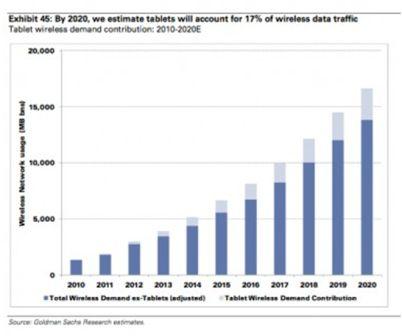
What is Tablet Impact on Mobile Networks?

Mobile network planning is never easy, these days. Unlike fixed networks, that generally exhibit clear and stable usage patterns, mobile network demand can fluctuate unpredictability. 


Tablets are the new factor, as most mobile network bandwidth demand has been driven by PC dongles and increasingly by smart phones.


But tablets add a new unknown element. The simple answer is that, over time, "more" bandwidth will be consumed by tablet devices.


The issue is how much new demand will be created, and just as importantly, where and when that demand occurs.


And there arguably are significant differences in the way people use bandwidth, when out and about and when at home or in the office.

On one hand, possibly nine percent of mobile usage occurs when people are out and about. 


About nine percent of usage occurs when users are moving, the balance occurring either at stationary locations such as home or work.


As early as 2007, about 40 percent of total mobile traffic was generated in the home environment Informa Telecoms & Media has said. By 2013 in-home usage is expected to reach 58 percent, with about eight percent of total mobile traffic offloaded to fixed broadband, Informa predicted at that time.


In 2008, the home environment represented more than 43 percent of total mobile data traffic and Informa revised its forecast, estimating that in-home mobile usage would climb to 60 percent by 2013.


Mobile voice minutes of use in the home environment represented about 42 percent of total mobile voice traffic by the end of 2008. Mobile voice usage at home would gradually increase to reach 49 percent by 2013, Informa estimated.


Mobile use at work was estimated to represent 30 percent of usage, with nine percent of calls initiated while users were moving. About 21 percent of calls would be generated from other public environments. All of that makes planning difficult.


The good news is that users often simply do not have time to engage with applications that consume lots of  when on the move. On the other hand, at-home usage probably will look more like PC behavior. 

The new question is what impact tablets will have. Since most tablets now in the user base rely on Wi-Fi connections, the impact on mobile networks might be very slight. But it would be reasonable enough to assume that, over time, tablet consumption might start to resemble smart phone patterns. 

The good news there, for mobile network capacity planners, is that Wi-Fi usage will be offloaded traffic, and will have minimal mobile network impact. 

At-home tablet mobile network usage, though more substantial than "on the go" usage, at least will be more predictable. 


iZettle, "Square of Europe," Adds New Features

Most of the time, we seem to focus on mobile payments as a value for end users. 


But iZettle seems to have approached it as a payments system with built-in value for the retailers who have to support the systems.


Some call iZettle the "Square of Europe," and that's a reasonable enough way to describe it. 


The company has released a brand new app with new features that help sellers manage inventory. 


The latest version, iZettle 1.7,  comes with product folders. Some retailers have libraries with tens or even hundreds of products. 


Now you can drag and drop products on one another to gather them all in a single product folder. Users also can also move your products around simply by pressing and holding. 


The latest version also adds a feature called "Product variants" that allows retailers to better support sale of clothing, food items or other products that come in different sizes, colors or price ranges, for example. 

Friday, February 17, 2012

Mobile Now "Is Communications"

About 85 percent of U.S. consumers use mobile devices for communications. For many, mobile is the way they generally use voice, even when they have access to a landline service.

In 2011, 202 million adults own mobile phones

Mobile usage has surpassed landline usage as well. Today, approximately 28 percent of American consumers do not have a landline phone whereas just 15 percent do not have a mobile phone. In addition, mobile usage has surpassed online usage (85 percent of people, compared to 78 percent of people who use landline services.


Another New Social Network Revenue Model" Affiliate Fees

Pinterest, the social networking site, has the typical problem any software or application provider often has: no immediate revenue model.

Traffic to the Pinterest website has grown by a factor of 10 over the past six months.  In January 2012, the number of visitors on Pinterest.com was almost a third of that on Twitter.com. That’s a lot of users.

"Pinterest's monetization strategy isn't in the oven and it's not even off the baking table," says Jeremy Levine, a board member of Pinterest and a venture capitalist at Bessemer Venture Partners. "We have one hundred ideas but no execution as of yet."

But Josh Davis  says that isn’t quite true. Highly unusually for a start-up social network, Pinterest does seem to have an existing revenue stream that is different from all the other monetization schemes other major social networks have developed.

Twitter has “promoted tweets.” Facebook has display ads. LinkedIn had the same “no revenue” problem years ago, but now makes money from subscriptions, advertising sales, and hiring solutions.

LinkedIn gets  25 percent of its revenue from premium subscriptions; 33 percent from text and display advertising and 42 percent from LinkedIn Jobs, a job-matching or automated headhunting service.

Pinterest apparently already has develooped an affiliate revenue stream. If you post a pin to Pinterest, and it links to an e-commerce site that happens to have an affiliate program, Pinterest modifies the link to add their own affiliate tracking code.

If a user clicks through the picture from Pinterest and makes a purchase, Pinterest gets paid. So add “affiliate links” to the list of possible revenue models for a “free to use” social network.

Pinterest apparently is using a service called SkimLinks. SkimLinks' software looks at links users post to websites, determines if there is an affiliate program to which they can be linked, and appends a code that ensures Pinterest gets credit for (and data from) the referral.

That is highly unusual for a young social network. But it tends to validate the notion that users are the “product” that underlies all social network revenue models, at the end of the day.

Some would argue that Pinterest already is driving truly massive traffic to retail sites, by some accounts more than YouTube, LinkedIn, and Google+ combined, and the affiliate links model should be meaningful.

Commissions on sales for affiliate links vary widely, but they average around five percent. After SkimLinks gets paid, Pinterest might be looking at 3.75 percent net revenue. That will not be enough, by itself, to keep Pinterest in business over the long term. But it is more revenue than virtually all the other big social networks had when they started.

Consumer Group asks Federal Trade Commission to Take Action Against Google


Consumer Watchdog has asked the Federal Trade Commission to take immediate action against Google for tracking user web browsing on Apple Mac PCs,  even though Apple allows Safari operating system users to disable tracking. Precisely what action the FTC could take is not clear, since Google has stopped the tracking already.

Consumer Watchdog did not mention iPhone or iPad devices in its complaint, but the insertion of cookies to track behavior apparently could affect users of iPhones or iPads as well.

The complaint illustrates a growing business issue Google faces, namely regulator scrutiny of the sort that lead to the breakup of the AT&T system in the early 1980s and the consent decree Microsoft battled and lived with for two decades.

And dare one mention that Apple now is bigger than both Google and Microsoft put together? The point is that Google now faces the sort of mounting scrutiny of just about any significant move it makes, and there is historical precedent for arguing that, eventually, “something” will be done to limit Google’s further expansion into new lines of business.

The issue of Google bypassing built-in security settings on the Safari web browser on iPhones and iPads, which Google now has discontinued, or the FTC complaint, is not the biggest problem.

The danger is that Google has provided regulators one more bit of evidence that it might now be time to start regulating Google, as antitrust regulators earlier had placed limits on Microsoft’s own freedom to bundle applications and essentially enter new businesses.

Some might note that Microsoft has spent 21 years fighting antitrust battles with the U.S. government and similar battles with regulators for the European Community.

Most do not remember that there was serious talk of splitting Microsoft up into separate companies in 2000. Microsoft agreed to a court settlement in 2002 that ended that threat, but at a price. Microsoft essentially was placed in hand cuffs.

In April 2000 U.S. District Judge Thomas Penfield Jackson ruleed that  Microsoft unlawfully maintained a monopoly in Windows and unlawfully tied its browser to Windows. The proposed remedy was a breakup of Microsoft into two different companies, one for apps and the other for operating systems.

The Department of Justice and Microsoft agreed on a proposed settlement for the antitrust case in 2001.
In November 2002, U.S. District Judge Colleen Kollar-Kotelly approved the settlement, which included a five-year consent decree on the part of Microsoft. That deal was extended in 2006 to 2009 and then again in 2009 unitl May 2011.

The consent decree barred Microsoft from entering into Windows agreements that excluded competitors from new computers, and forced the company to make Windows interoperable with non-Microsoft software. In addition, an independent technical committee would field complaints that might arise from competitors.

But some would argue that the tedious litigation made Microsoft more cautious as a company.

Some now say growing scrutiny of Google is not helped when Google takes actions that raise the perception that it now might require similar throttling.

The problem for Google is going to be growing antitrust scrutiny that, sooner or later, is likely to be applied.

So far, little discussion of that sort seems to have occurred about Apple. History suggests such scrutiny ultimately will happen. Apple already is a bigger company that Google and Microsoft put together.

Sooner or later, should Apple continue to grow, antitrust scrutiny will start to happen.

The point is that Google cannot, henceforth, take the risk of appearing “too big, too cavalier or too influential.” Dumb mistakes will have consequences.

Mobile Continues to Reshape Computing

We continue to see, on a continuing basis, more evidence that mobility is reshaping the telecom, computing, content and marketing and advertising businesses. 


Apple’s mobile operating system, iOS now has surpassed the desktop operating system (Mac OS) in web browsing market for the first time in history. 
IDC reports that in 2011, Apple shipped 93.2 iPhone units and 40 million iPad units. 

Nor is Apple the only example of that trend. According to new research from Canalys, smart phone shipments overtook personal computers in 2011, moving 487.7 million units over the course of the year, compared to 414.6 million PCs. 


Without much doubt, these changes illustrate the importance of mobile trends in consumer behavior that indicate a clear shift towards a more mobile, on-the-go lifestyles and devices. 
It is possible that the shift to mobile devices now is having clear impact even on the use of specific browsers and operating systems. Over the last seven months, for example, Chitika Research has noted a steady decline in Windows browser share, at the same time that iOS surpassed Mac OS in terms of browsing share. 
Since August 2011, Windows has declined in share by almost 10 percent, Chitika notes. 

How Much Money Can Facebook Make from Mobile Advertising in a Year?


Facebook could generate over $1.2 billion from mobile advertising in its first year from just the United States, United Kingdom, France, Germany, Italy and Spain, analysts at mobileSquared predict. 

Facebook could earn an average revenue oer user of about $6.50 a year.

Based on a further assumption that Facebook will serve an ad every 20 seconds via its mobile sites or apps, and using  using a cost per thousand impressions model of $0.25, Facebook would generate $653.7 million in revenues from mobile advertising in the United States alone over a 12 month period.

Facebook also could generate mobile advertising revenues of $166.6 million in its first year in the UK, around $100 million in France, Germany, and Italy, and around $70 million in Spain.

Walgreens Mobile App Drives 40% of Online Transactions

Walgreens says 40 percent of its online transactions came from its one-year-old mobile app, where the most active customers are tapping through to shop, order prescription refills or find nearby stores to get flu shots. 

The Walgreens mobile commerce experience shows what can be done using mobile devices, mobile apps when harnessed to marketing and mobile commerce. 

All Devices Now are Content Consumption Devices


Mobile devices increasingly are content consumption devices. “As these device categories evolve and new ones come into being, consumers will continue to expect digital content to be available on all screens, at all times, in all locations,” says Paul Verna, eMarketer senior analyst.

In the United States,  over the next two years, eMarketer expects more than 26 million mobile phone users to turn to smartphones, helping put the devices in the hands of more than half of all US mobile users by 2014. That will dramatically expand the "small screen" audience for content consumption to about 133 million people. 


By any measure, that is a potent potential audience. 

US Smartphone Users and Penetration


But smart phones are not the only fast-growing new screen. Tablet penetration will increase even more quickly in the United States, from a user base of nearly 55 million by the end of 2012 to almost 90 million in the next two years. By 2014, more than one in three U.S. internet users will have a tablet device, eMarketer predicts. 


Those new screens will join the 75 percent of U.S. households that own either a desktop or notebook computer, a potential audience of about 100 million homes. 


Those statistics indicate why mobile devices increasingly are important. Smart phones already outnumber PC screens, and tablets will, at some point, rival the installed base of PC devices. 

US Tablet Users and Penetration


“Without movies, TV shows, games, photos, books, magazines, newspapers, video clips and music, few would care to own a tablet, a touchscreen smartphone, a connected console or an internet-enabled TV,” says Verna. “As consumers continue to gravitate toward digital media consumption, and as content owners and device manufacturers continue to find ways to meet the demand for it, more content will become available in the digital domain.”


The shift of user activities toward content consumption explains, in part, why tablets have become such a "hot" product category. Over time, PCs have become platforms for content consumption, rather than "work" tools. 


In a similar way, smart phones have become content consumption platforms as much as communication devices. Tablets, on the other hand, might primarily be called content consumption devices, even though some amount of communications activity (email, messaging) and "work" activity (mostly related to web surfing and mobile apps). 


Adult gadget ownership over time 2006-2012

Apple Is Making Over the Top Streaming to TVs Much Easier

AirPlay, a feature of Apple's new "Mountain Lion" operating system, allows users to wirelessly beam what's on the screen of your iPhone, iPad, or Mac to your TV, if you have an AppleTV.

That means suitably-equipped users can send "webpages, YouTube videos, iTunes rentals or anything else you can think of onto an AppleTV unit without wires," says Jason Snell at MacWorld. Apple AirPlay will boost OTT video

To be sure, the ability to do so does not automatically mean all the content people prefer is available. That is a matter of content licensing. But the capability will mean it is much easier to view any web content directly on a TV, which means the user experience for any over the top TV viewing is vastly better.

Some might say the issue, going forward, is how long it takes for "piracy" to become a big enough issue that content owners will have different incentives to permit lawful viewing of movies and licensed TV content without having to do so illegally.

Hulu, for example, apparently blocks display of its content on a TV, even though it obviously allows such viewing on a web device. ABC, CBS and NBC also do so.

AirPlay on the Mac doesn't materially change the economics of entertainment video, at least for the moment. But it is one more building block for the eventual infrastructure that will pressure the existing economics of the video entertainment business.

NEC Sets Out Vision for Small Cell Wireless Backhaul for Small Cells

NEC Corporation says it will build its small cell backhaul system using unlicensed 60 Ghz spectrum. NEC has identified 60GHz radio as the key technology behind its Backhaul for Small Cells proposition. Bandwidth availability at 60GHz and the uniquely high channel re-use characteristics of this spectrum are ideally suited to deliver high capacity and low latency connections to hundreds of cell sites, which will be rapidly deployed in concentrated coverage areas of busy city squares and avenues. NEC Wireless Backhaul for Small Cells

NEC's small cell system aims to provide significant reductions in the cost of ownership compared to existing macro-cellular backhaul networks.

The choice of the zero-cost 60GHz spectrum allows the design of compact products, which can be easily installed and aesthetically concealed within a wide variety of urban environments. Furthermore, NEC has developed features for intelligent provisioning of backhaul resources and protection against performance degradations, resulting in improved capacity efficiency and elimination of costly manual maintenance and troubleshooting.

How Electricity Charging Might Change

It now is easy to argue that U.S. electricity pricing might have to evolve in ways similar to the change in retail pricing of communication...