With the caveat that government reports are not policy, and that many such efforts have no ability to affect changes in policy, a report by the Select Committee on Communications of the U.K. House of Lords does suggest some potential new ways to structure the upgrade of the U.K. fixed network. Whether it is feasible or not remains to be seen.
Indeed, critics might say it is financially unworkable. It might arguably be politically unworkable. But it is different. Basically, the study suggests focusing fiber upgrades on the middle mile of the network, deploying new wholesale fiber to “open access hubs” within reach of every community, says the study by the U.K. House of Lords.
The idea is to encourage multiple providers to connect to the “hubs” to provide local access. That is not architecturally so different from what planners originally have proposed. There has been general agreement on extending fiber to cabinets, where it is not feasible to run fiber all the way to each premises.
What is different is the degree of wholesale network access points, and the way the access network is owned and paid for. Among the provisions with the greatest cost implications is the notion that perhaps end users should build and own more of the access plant.
Engineers immediately will grasp the cost implications. Service providers will immediately grasp the competitive implications.
The open access fiber optic hub “refers to a physical object—in all likelihood a box—situated in the vicinity of a community,” the report says. “Its job is to act as a way station between that community and the broadband infrastructure that spreads out across the rest of the country,” the report says.
Engineers immediately will wonder whether the hubs are equivalent to “central office” locations, or are positioned deeper in the distribution network. The report does not make that distinction unmistakably clear, though one assumes the hubs generally will be deeper in the access network than a central office.
Running into the hub from the wider network would be an ample number of “dark” fiberoptic cables, available on an “open access” basis. Retailers would then build local access networks of their own, between customer locations and the hubs.
Engineers will see some pitfalls. As a rule of thumb, it is precisely the local access portion of the network that drives half of the total cost of a fixed line network. That generally includes all plant between a central office and the actual customer.
The House of Lords report might include fiber pulled much closer to the customer, in which case the access portion of the plant that any competitor might have to supply could represent less investment than generally has been required.
One analogy might be the “fiber to node” designs used by cable operators, which position the termination of the fiber network at a point where 500 to 1,000 homes are served. Perhaps an open access hub is comparable to a fiber node, in a cable TV sense.
What is unclear is whether the report envisions the hubs to be the equivalent of passive optical network locations, which feed perhaps 30 to 100 homes or locations. There are serious cost implications to using either of those wholesale termination points.
Most potential competitors will find the costs of building their own local access all the way from any customer back to the central office. Many more would find the prospect of building only to a hub serving 30 to 100 locations much more palatable.
There are some physical issues, either way. Availability of underground duct facilities or space on aerial poles will put limits on the number of competitors that actually could build new facilities to reach a hub, much less a central office location.
The study also suggests a potentially different way of looking at connection costs, though. “Currently, most people’s conception of broadband infrastructure derives from their conception of the telephone network or other utilities whose termination point is at the curtilage of the household, after which ownership of the network is taken over by the owner of the premises.”
In other words, the provider’s network stops at the side of the house. The study says a different approach would entail the customer owning more of the drop and access network.
“An alternative way of thinking about the network might be that broadband rollout has more in common with the railways: the traveller has to get him/herself to the station and once there the train takes the train,” the report says.
The open access fibre-optic hub model would make it possible for individual property owners to build out the access network themselves, or at least have it built for them.
Marketers immediately will object that most users will be quite unwilling to undertake such investments themselves.
One alternative way of thinking of ownership structure is if the network is “a home with a tail,” where the household owns the last bit of fiber.”
Instead of having competition among suppliers to serve those homes, a reverse model would have a household auctioning the ability to connect with the backhaul and to the network.
That likely would be a harder sale than many suspect, as it could entail customers spending $500 or more to reach a neighborhood cabinet.
While providing an eventual upgrade path to fiber to home, the study also recommends placement of optical splitters at a central office location, presumably thereby allowing competitors to lease an entire access network, rather than building their own.
In any event, the study argues that “a reorientation is required in government policy away from the absolute edges of the network and towards that part of it which brings optical network closer into communities.” For some, that might mean funding the “middle mile,” but that arguably is less accurate than saying the report recommends funding open access facilities deeper into the access network, with unbundling at a level where any retail competitor has to supply a link from any location back to an optical hub serving 30 to 100 locations.
Whether the report will have an impact is perhaps highly questionable. Aside from some potential BT objections, and possibly some BT support, there are highly uncertain cost implications for retail competitors, as well as revenue implications if wholesale network access locations make it easier for competitors to enter markets on a facilities-based basis.
Saturday, August 4, 2012
U.K. House of Lords Proposes "Radical" Change in Broadband Policy

 Gary Kim was cited as a global "Power Mobile Influencer" by Forbes, ranked second in the world for coverage of the mobile business, and as a "top 10" telecom analyst. He is a member of Mensa, the international organization for people with IQs in the top two percent.
How Big an Opportunity is "Mobile Banking?"
Is "mobile banking" a key revenue opportunity, or not? The answer is that "it depends" on what you mean by "mobile banking" and where those operations are conducted.
According to recently conducted survey by ACI Worldwide, 76 percent of Indian mobile respondents used their mobiles for mobile banking in last six months.
Comparatively, only 38 percent of respondents from the United States, and 31 percent from the United Kingdom said they had used mobile banking in last six months.
China, came in after India with 70 percent of users using mobile banking followed by South Africa (61 percent). The global average for Mobile Banking adoption rate stands at 35 percent of mobile users.
But there are key differences. Where both online banking using PCs, and branch bank infrastructure are highly developed, people tend to use mobile banking to check balances or move money between accounts.
In regions where the banking infrastructure is undeveloped, and availability of PCs and Internet access is limited, people more often use mobile banking as a way to move money from one person to another, or from person to organization (to pay a utility or school bill, for example).
As you would guess, the revenue opportunity for a "mobile banking" services supplier is greater, and more direct, in scenarios where peer to peer payments are involved. As people pay fees to Western Union to move money, so mobile banking in a P2P context represents per-transaction fees that are easy to measure.
That is not the case for "softer" mobile banking transactions conducted in regions where the banking infrastructure is highly developed. In Western Europe or North America, for example, mobile banking more often is used in place of an online session to check balances, rather than as a way to move money from person to person, or person to organization.
That means "mobile banking" is a clearer revenue generating activity and business in developing region, than in developed regions.
In India, 64 percent of ACI Worldwide survey respondents used their mobile phones to make payment at least once in last six months, while in China 66 percent said they had done so.
Only 30 percent of U.S. respondents and 23 percent of U.K. respondents reported they had made payments on mobile in last six months. Keep in mind that all the data includes content and virtual goods purchases (remote payments), as well as peer to peer money transfers or other mobile payments such as in-store purchases.
So it is likely that mobile banking activity in developed regions is "checking my balance," while mobile payments activity is "remote payments" (buying a game or app).
Some 25 per cent of U.K. mobile internet users now use mobile banking services, according to Antenna Technologies.
Likewise, the mobile commerce market is expected to account for 24.4 percent of overall e-commerce revenues by the end of 2017.
This represents the result of some spectacular growth in 2011, when the mobile online commerce market doubled in size to $65.6 billion, according to to ABI Research. If you assume that transaction fees amounted to 1.75 percent of the value of the transactions, then mobile payments provider revenue amounted to something like $1.1 billion in 2011.
The potential revenue is bigger if you assume an average of 2.75 percent transaction fees. In that case, the transaction fee revenue was about $1.8 billion in 2011.
But there are many other segments of the mobile commerce business, including hardware and software to support commerce, advertising, loyalty, marketing. In that sense, the mobile commerce opportunity is bigger, and affects more suppliers, than the mobile payments business.


According to the ACI Worldwide survey, the countries with highest levels of mobile payment adoption also display highest importance on mobile payments and money movement. Roughly two-thirds of Indian consumers consider making payments and moving money using their mobile phone in the next three years to be “very important” to them —in contrast only one in 10 French and Canadian consumers think mobile payment is “Very Important”.
In Brazil, for example, although 39 percent of consumers consider mobile payment and money movement to be “very important,” 75 percent would use their mobile phone to replace cards. That points up a key difference between “developed” and “developing” regions.
The ability to use a mobile phone as a payment channel is of clear value in settings where the banking structure is undeveloped. That function offers less value in markets where both online banking by PC and the branch banking infrastructure are highly developed.

The point is that "mobile banking" represents different opportunities in developed and developing regions. In the former markets, it is broader mobile commerce, including point of sale payments, where the revenue gains lie. In developing regions, it is peer to peer money transfers, for the most part.
According to recently conducted survey by ACI Worldwide, 76 percent of Indian mobile respondents used their mobiles for mobile banking in last six months.
Comparatively, only 38 percent of respondents from the United States, and 31 percent from the United Kingdom said they had used mobile banking in last six months.
China, came in after India with 70 percent of users using mobile banking followed by South Africa (61 percent). The global average for Mobile Banking adoption rate stands at 35 percent of mobile users.
But there are key differences. Where both online banking using PCs, and branch bank infrastructure are highly developed, people tend to use mobile banking to check balances or move money between accounts.
In regions where the banking infrastructure is undeveloped, and availability of PCs and Internet access is limited, people more often use mobile banking as a way to move money from one person to another, or from person to organization (to pay a utility or school bill, for example).
As you would guess, the revenue opportunity for a "mobile banking" services supplier is greater, and more direct, in scenarios where peer to peer payments are involved. As people pay fees to Western Union to move money, so mobile banking in a P2P context represents per-transaction fees that are easy to measure.
That is not the case for "softer" mobile banking transactions conducted in regions where the banking infrastructure is highly developed. In Western Europe or North America, for example, mobile banking more often is used in place of an online session to check balances, rather than as a way to move money from person to person, or person to organization.
That means "mobile banking" is a clearer revenue generating activity and business in developing region, than in developed regions.
In India, 64 percent of ACI Worldwide survey respondents used their mobile phones to make payment at least once in last six months, while in China 66 percent said they had done so.
Only 30 percent of U.S. respondents and 23 percent of U.K. respondents reported they had made payments on mobile in last six months. Keep in mind that all the data includes content and virtual goods purchases (remote payments), as well as peer to peer money transfers or other mobile payments such as in-store purchases.
So it is likely that mobile banking activity in developed regions is "checking my balance," while mobile payments activity is "remote payments" (buying a game or app).
Some 25 per cent of U.K. mobile internet users now use mobile banking services, according to Antenna Technologies.
Likewise, the mobile commerce market is expected to account for 24.4 percent of overall e-commerce revenues by the end of 2017.
This represents the result of some spectacular growth in 2011, when the mobile online commerce market doubled in size to $65.6 billion, according to to ABI Research. If you assume that transaction fees amounted to 1.75 percent of the value of the transactions, then mobile payments provider revenue amounted to something like $1.1 billion in 2011.
The potential revenue is bigger if you assume an average of 2.75 percent transaction fees. In that case, the transaction fee revenue was about $1.8 billion in 2011.
But there are many other segments of the mobile commerce business, including hardware and software to support commerce, advertising, loyalty, marketing. In that sense, the mobile commerce opportunity is bigger, and affects more suppliers, than the mobile payments business.
According to the ACI Worldwide survey, the countries with highest levels of mobile payment adoption also display highest importance on mobile payments and money movement. Roughly two-thirds of Indian consumers consider making payments and moving money using their mobile phone in the next three years to be “very important” to them —in contrast only one in 10 French and Canadian consumers think mobile payment is “Very Important”.
In Brazil, for example, although 39 percent of consumers consider mobile payment and money movement to be “very important,” 75 percent would use their mobile phone to replace cards. That points up a key difference between “developed” and “developing” regions.
The ability to use a mobile phone as a payment channel is of clear value in settings where the banking structure is undeveloped. That function offers less value in markets where both online banking by PC and the branch banking infrastructure are highly developed.
The point is that "mobile banking" represents different opportunities in developed and developing regions. In the former markets, it is broader mobile commerce, including point of sale payments, where the revenue gains lie. In developing regions, it is peer to peer money transfers, for the most part.
Gary Kim was cited as a global "Power Mobile Influencer" by Forbes, ranked second in the world for coverage of the mobile business, and as a "top 10" telecom analyst. He is a member of Mensa, the international organization for people with IQs in the top two percent.
Friday, August 3, 2012
Smart Phone Adoption Correlates with Household Income, Except in China
Generally speaking, smart phone adoption is directly related to household income. But there are exceptions, such as the Chinese market, which "over indexes" for smart phone penetration.
One suspects that subsequent generations of lower-cost smart phones and new retail plans are going to allow smart phone penetration rates to over index more like the Chinese market already does.
In fact, you might argue that, despite lower per-capita monthly income, users in some "developing" markets already over index for smart phone penetration.

Source data: International Labor Organization, MobiThinking

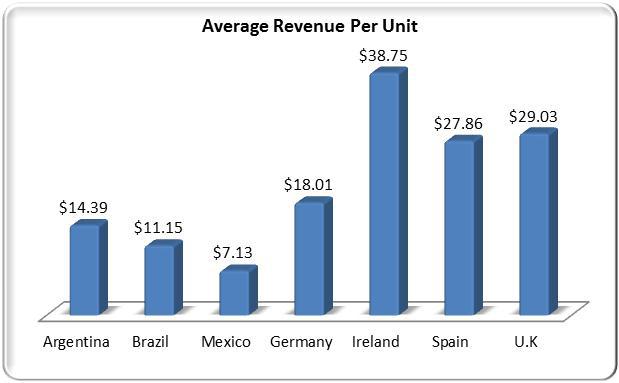
Source data: Telefonica January to June 2012 Results
One suspects that subsequent generations of lower-cost smart phones and new retail plans are going to allow smart phone penetration rates to over index more like the Chinese market already does.
In fact, you might argue that, despite lower per-capita monthly income, users in some "developing" markets already over index for smart phone penetration.
Source data: International Labor Organization, MobiThinking
Source data: Telefonica January to June 2012 Results
Gary Kim was cited as a global "Power Mobile Influencer" by Forbes, ranked second in the world for coverage of the mobile business, and as a "top 10" telecom analyst. He is a member of Mensa, the international organization for people with IQs in the top two percent.
AT&T to Shut Down 2G network by 2017
In a Securities and Exchange Commission "10Q" filing, AT&T said that it will it will shutting down its second generation network so that it can concentrate on upgrading infrastructure to better technologies for the future.
The network shutdown will occur by January 1, 2017, and the spectrum used by 2G services will be reallocated for 3G and 4G use. Currently, about 12 percent of its customers under contract are still using handsets that do not support 3G.
The network shutdown will occur by January 1, 2017, and the spectrum used by 2G services will be reallocated for 3G and 4G use. Currently, about 12 percent of its customers under contract are still using handsets that do not support 3G.
Gary Kim was cited as a global "Power Mobile Influencer" by Forbes, ranked second in the world for coverage of the mobile business, and as a "top 10" telecom analyst. He is a member of Mensa, the international organization for people with IQs in the top two percent.
When 95% Fiber Connections are Not a Good Thing
T-Mobile USA has "enhanced backhaul" covering 100 percent of its 4G (HSPA+) network, 95 percent of which is fiber backhaul, says T-Mobile USA.
For T-Mobile USA and its customers, that is a good thing. For suppliers of those fiber backhaul connections, that is a good thing.
The only ecosystem provider for whom that is not a good thing are the other suppliers of fiber backhaul services to mobile service providers who are not currently supplying the connections.
And T-Mobile USA is going to need that bandwidth as it introduces the Samsung Galaxy S, It is said to be one of T-Mobile’s fastest devices.
For T-Mobile USA and its customers, that is a good thing. For suppliers of those fiber backhaul connections, that is a good thing.
The only ecosystem provider for whom that is not a good thing are the other suppliers of fiber backhaul services to mobile service providers who are not currently supplying the connections.
And T-Mobile USA is going to need that bandwidth as it introduces the Samsung Galaxy S, It is said to be one of T-Mobile’s fastest devices.
The Samsung Galaxy Note also offers the T-Mobile 4G Pro App Pack, a collection of apps and services including Dropbox, Evernote, Square, TripIt, CamScanner and LinkedIn.
The Galaxy Note also offers a variety of entertainment experiences, such as T-Mobile TV in mobile HD for watching live TV programming, Samsung Media Hub for renting and buying the latest movies and TV shows, and Google Play Music.
The Galaxy Note also features an 8-megapixel rear camera and a 2-megapixel front-facing camera, to capture pictures and HD videos to share with friends, family and social networks.
Many of those applications will require lots of bandwidth.
Gary Kim was cited as a global "Power Mobile Influencer" by Forbes, ranked second in the world for coverage of the mobile business, and as a "top 10" telecom analyst. He is a member of Mensa, the international organization for people with IQs in the top two percent.
MetroPCS Launches "Dyle" TV Service on Samsung Galaxy S Lightray 4G
MetroPCS Communications has enabled the Dyle broadcast TV service on the Samsung Galaxy S Lightray 4G handset, the first smart phone in the U.S. market to offer live, local broadcast television using the Dyle mobile TV service.
Dyle offers content from broadcasters NBC, Fox, ABC, CBS Television, LIN Media, Telemundo, Univision, Ion, Belo, Cox Media, E.W. Scripps, Gannett Broadcasting, Hearst, Media General, Meredith, Post-Newsweek Stations and Raycom Media. In total, 92 stations have agreed to work with MCV.
Dyle offers content from broadcasters NBC, Fox, ABC, CBS Television, LIN Media, Telemundo, Univision, Ion, Belo, Cox Media, E.W. Scripps, Gannett Broadcasting, Hearst, Media General, Meredith, Post-Newsweek Stations and Raycom Media. In total, 92 stations have agreed to work with MCV.
The Mobile Content Venture that owns the Dyle service hopes people will want to watch linear TV on their smart phones, but some are skeptical, though Dyle says its research shows people will watch.
Dyle research suggests that up to 61 percent of respondents to a survey would be very likely to switch service providers, or somewhat likely to switch service providers, to use such a service.
One advantage of Dyle is that it does not use Internet bandwidth, simply adding direct ability to display a standard TV broadcast signal on a mobile device.
Access to the Dyle mobile TV service will be offered in select markets and at no additional charge to customers on a MetroPCS 4G LTE service plan. In some other cases, Dyle has talked about charging a fee to use the service.
Gary Kim was cited as a global "Power Mobile Influencer" by Forbes, ranked second in the world for coverage of the mobile business, and as a "top 10" telecom analyst. He is a member of Mensa, the international organization for people with IQs in the top two percent.
Is Business Bandwidth a Problem?
Most U.S. businesses still use low-speed, 1.5 Mbps T1 connections to run their businesses, despite the fact that consumers routinely have connections running at 20 Mbps to 30 Mbps.
But is that a problem?
That is a matter of opinion. Ignore for the moment the growing ability businesses have to buy faster services, supplied by fixed networks, mobile or even satellite providers. There is a difference between "availability" and "purchase," even in instances where the higher speeds are available. In many, if not most cases, businesses are buying the services required to support their businesses.
And in most cases, 1.5 Mbps might be sufficient for business buyers, as odd as that might sound. For starters, most smaller businesses are not often required to consume much bandwidth as part of their daily operations. Most small businesses use bandwidth in an ancillary way, unlike an Internet or applications business that might well require lots of bandwidth.
Retailers, for example, typically do not require much bandwidth to run their businesses. Office-based businesses that provide services often do need more bandwidth, but anecdotal evidence suggests such businesses generally are able to buy affordable broadband, when they need it, at least in urban areas.
It arguably remains true that many smaller businesses are not served by optical fiber facilities. As of March 2012, fiber facilities were only available to 20.5 percent of commercial buildings across Europe, and to 31.8 percent of commercial buildings in the United States, according to Vertical Systems Group.
But that doesn't automatically mean that smaller businesses cannot buy bandwidth services of 10 Mbps to 20 Mbps, for example, to support web surfing requirements. But that application typically is not mission critical in the same way that voice services or credit card authorizations are important.
In that sense, the current lack of "fiber optic" access, rather than bandwidth, is not a "problem." There are areas, especially in rural settings, where that is not true. But many smaller businesses might be able to buy the levels of bandwidth they require, without much problem.
At least in terms of anecdotal evidence, one doesn't hear of smaller businesses complaining that lack of bandwidth poses peril to their businesses.
But is that a problem?
That is a matter of opinion. Ignore for the moment the growing ability businesses have to buy faster services, supplied by fixed networks, mobile or even satellite providers. There is a difference between "availability" and "purchase," even in instances where the higher speeds are available. In many, if not most cases, businesses are buying the services required to support their businesses.
And in most cases, 1.5 Mbps might be sufficient for business buyers, as odd as that might sound. For starters, most smaller businesses are not often required to consume much bandwidth as part of their daily operations. Most small businesses use bandwidth in an ancillary way, unlike an Internet or applications business that might well require lots of bandwidth.
Retailers, for example, typically do not require much bandwidth to run their businesses. Office-based businesses that provide services often do need more bandwidth, but anecdotal evidence suggests such businesses generally are able to buy affordable broadband, when they need it, at least in urban areas.
It arguably remains true that many smaller businesses are not served by optical fiber facilities. As of March 2012, fiber facilities were only available to 20.5 percent of commercial buildings across Europe, and to 31.8 percent of commercial buildings in the United States, according to Vertical Systems Group.
But that doesn't automatically mean that smaller businesses cannot buy bandwidth services of 10 Mbps to 20 Mbps, for example, to support web surfing requirements. But that application typically is not mission critical in the same way that voice services or credit card authorizations are important.
In that sense, the current lack of "fiber optic" access, rather than bandwidth, is not a "problem." There are areas, especially in rural settings, where that is not true. But many smaller businesses might be able to buy the levels of bandwidth they require, without much problem.
At least in terms of anecdotal evidence, one doesn't hear of smaller businesses complaining that lack of bandwidth poses peril to their businesses.
Gary Kim was cited as a global "Power Mobile Influencer" by Forbes, ranked second in the world for coverage of the mobile business, and as a "top 10" telecom analyst. He is a member of Mensa, the international organization for people with IQs in the top two percent.
Mediacom Consumption Caps Won't be a Problem for 98% of Users
Bandwidth caps are a contentious issue in some quarters, the argument being that it is somehow injurious to customers when "reasonable" usage quotas are a normal condition of service.
There seems to be no such resistance to the notion that consumption of many other products, including electricity, water, gasoline, natural gas, soap, vegetables, salt, sugar or meat is consumption based.
New consumption caps for Mediacom high-speed access customers arguably are not going to be a problem for 98 percent of Mediacom customers. Those new plans will be an issue for perhaps two percent of the highest users.
•Mediacom Launch 150GB (3 Mbps)
•Mediacom Prime 250GB (12-15 Mbps)
•Mediacom Prime Plus 350GB (20 Mbps)
•Mediacom Ultra 999GB (50 Mbps)
•Mediacom Ultra Plus 999GB (105 Mbps)
There seems to be no such resistance to the notion that consumption of many other products, including electricity, water, gasoline, natural gas, soap, vegetables, salt, sugar or meat is consumption based.
New consumption caps for Mediacom high-speed access customers arguably are not going to be a problem for 98 percent of Mediacom customers. Those new plans will be an issue for perhaps two percent of the highest users.
•Mediacom Launch 150GB (3 Mbps)
•Mediacom Prime 250GB (12-15 Mbps)
•Mediacom Prime Plus 350GB (20 Mbps)
•Mediacom Ultra 999GB (50 Mbps)
•Mediacom Ultra Plus 999GB (105 Mbps)
Gary Kim was cited as a global "Power Mobile Influencer" by Forbes, ranked second in the world for coverage of the mobile business, and as a "top 10" telecom analyst. He is a member of Mensa, the international organization for people with IQs in the top two percent.
Do UTOPIA Failures Mean Anything for Google Fiber?
It isn't easy to build a wholesale or retail fiber access business when competing with entrenched cable and telco competitors, as Google Fiber will do in Kansas City, Mo. and Kansas City, Kan. But Google Fiber at least has a couple of advantages.
Its symmetrical 1-Gbps access speed, plus free 5-Mbps service, can be differentiated from what cable and telco providers offer in the Kansas City markets. Where rival service providers cannot do that, they sometimes run into trouble. UTOPIA provides a possible case in point.
The Utah Telecommunication Open Infrastructure Agency (UTOPIA) is building a wholesale fiber-optic network that offers its users access to high-speed video, data, and phone services. Operational mistakes aside, UTOPIA might have made a fundamental mistake, namely building a network that, although pitched as a "faster" alternative at the time, has fallen behind as cable and telco competitors have boosted their access speeds, in response.
To be sure, UTOPIA says it offers a symmetrical 50 Mbps service costing $35 a month, far less than the 50 Mbps service offered by Comcast in Salt Lake City, for example. Still, some would argue that differentiation is less the issue than the degree of difference. At that level, UTOPIA access prices are an order of magnitude better than offered by Comcast.
All venture capitalists are familiar with the problem, namely that a new contestant challenging market leaders has to offer user experience benefits that are perhaps 10 times better than what currently is available. Those benefits can include pricing or performance improvements, but the point is that an order of magnitude better experience is necessary for an upstart to have a chance of unseating a market leader.
In part, the reason is that incumbents, faced with significant new competition, typically will boost their offers, slicing the advantage the new upstart offers, before the upstart has a chance to gain critical mass. That might be the case for Utah's UTOPIA effort.
A new audit shows the agency was unable to complete construction of the network as quickly as
planned. UTOPIA originally planned to build a broadband network in three years and to achieve a positive cash flow in five years.
“However, it has not met that schedule,” the audit says. “Instead, the cost of financing and operating the network increased before UTOPIA could provide a substantial number of
customers with service.”
As a result, revenues have not been sufficient to cover its costs. Year after year, as operating deficits have accrued and the agency has developed a large negative asset balance.
UTOPIA has issued $185 million in bonds to pay the cost of building its network, “but most of the bond proceeds have been invested in poorly utilized and partially completed sections of network,” the report says.
“As a result, the network is not generating sufficient revenue for the agency to cover its annual debt service and operating costs,” the report notes.
Worse, UTOPIA has had to use a large portion of its bond proceeds to cover operating deficits and debt service costs. “The use of debt to cover the cost of operations and debt service is
symptomatic of an organization facing serious financial challenges,” the audit says.
Since 2003, when UTOPIA began work, only one third of the network has been completed. Buit that might not even be the biggest problem. “One underlying challenge is that UTOPIA’s infrastructure investment is not producing sufficient revenue,” the study notes. “In most areas where construction has been completed, UTOPIA has insufficient subscribers
to cover the cost of building and operating the infrastructure.”
Though backers had expected to get adoption (penetration) rates of about 35 percent, so far the network has gotten penetration of only about 16 percent.
That has huge implications. A competitive network, facing both entrenched cable and telco suppliers, has economics that are hugely dependent on penetration rate. At 16 percent penetration, UTOPIA is getting half the revenue it had projected, and manhy would argue, as a rule of thumb, that penetration in the 20 percent to 30 percent range is probably requires for long term success, in the absence of additional revenues from voice or video entertainment services.
Among other problems, UTOPIA has used a wholesale model, and therefore has been highly dependent on its retail partners for sales success. And it turns out that many of its retail customers have defaulted on owed payments, which further puts pressure on UTOPIA revenues.
As a direct result, UTOPIA now also has switched to selling retail services directly.
Though the audit attributes much of the difficulty to management failures, and though that likely is an issue, the larger issue might simply be that customer demand for UTOPIA services is simply not as strong as expected, when there are other suppliers with a vested interest in meeting existing demand for high-speed access.
That might not be quite as big an issue for Google Fiber in Kansas City, Kan. and Kansas City, Mo., given the huge difference in access speed Google fiber is able to offer.
UTOPIA uses a “fiber to curb” network architecture that offers speeds similar to AT&T’s U-verse, but arguably less than what cable operators can offer, using DOCSIS and bonded channels.
Some might argue that UTOPIA’s market offer is not “better” than telco or cable offers, in terms of speed and experience. Venture capitalists are familiar with that problem. UTOPIA did not offer an order of magnitude better experience, when it started.
Google Fiber, on the other hand, does have that advantage, clearly, in terms of "speed," and arguably in terms of price, as well. That means Google Fiber might have a better chance of taking 30 percent share, than UTOPIA has been able to do, at least so far.
Its symmetrical 1-Gbps access speed, plus free 5-Mbps service, can be differentiated from what cable and telco providers offer in the Kansas City markets. Where rival service providers cannot do that, they sometimes run into trouble. UTOPIA provides a possible case in point.
The Utah Telecommunication Open Infrastructure Agency (UTOPIA) is building a wholesale fiber-optic network that offers its users access to high-speed video, data, and phone services. Operational mistakes aside, UTOPIA might have made a fundamental mistake, namely building a network that, although pitched as a "faster" alternative at the time, has fallen behind as cable and telco competitors have boosted their access speeds, in response.
To be sure, UTOPIA says it offers a symmetrical 50 Mbps service costing $35 a month, far less than the 50 Mbps service offered by Comcast in Salt Lake City, for example. Still, some would argue that differentiation is less the issue than the degree of difference. At that level, UTOPIA access prices are an order of magnitude better than offered by Comcast.
All venture capitalists are familiar with the problem, namely that a new contestant challenging market leaders has to offer user experience benefits that are perhaps 10 times better than what currently is available. Those benefits can include pricing or performance improvements, but the point is that an order of magnitude better experience is necessary for an upstart to have a chance of unseating a market leader.
In part, the reason is that incumbents, faced with significant new competition, typically will boost their offers, slicing the advantage the new upstart offers, before the upstart has a chance to gain critical mass. That might be the case for Utah's UTOPIA effort.
A new audit shows the agency was unable to complete construction of the network as quickly as
planned. UTOPIA originally planned to build a broadband network in three years and to achieve a positive cash flow in five years.
“However, it has not met that schedule,” the audit says. “Instead, the cost of financing and operating the network increased before UTOPIA could provide a substantial number of
customers with service.”
As a result, revenues have not been sufficient to cover its costs. Year after year, as operating deficits have accrued and the agency has developed a large negative asset balance.
UTOPIA has issued $185 million in bonds to pay the cost of building its network, “but most of the bond proceeds have been invested in poorly utilized and partially completed sections of network,” the report says.
“As a result, the network is not generating sufficient revenue for the agency to cover its annual debt service and operating costs,” the report notes.
Worse, UTOPIA has had to use a large portion of its bond proceeds to cover operating deficits and debt service costs. “The use of debt to cover the cost of operations and debt service is
symptomatic of an organization facing serious financial challenges,” the audit says.
Since 2003, when UTOPIA began work, only one third of the network has been completed. Buit that might not even be the biggest problem. “One underlying challenge is that UTOPIA’s infrastructure investment is not producing sufficient revenue,” the study notes. “In most areas where construction has been completed, UTOPIA has insufficient subscribers
to cover the cost of building and operating the infrastructure.”
Though backers had expected to get adoption (penetration) rates of about 35 percent, so far the network has gotten penetration of only about 16 percent.
That has huge implications. A competitive network, facing both entrenched cable and telco suppliers, has economics that are hugely dependent on penetration rate. At 16 percent penetration, UTOPIA is getting half the revenue it had projected, and manhy would argue, as a rule of thumb, that penetration in the 20 percent to 30 percent range is probably requires for long term success, in the absence of additional revenues from voice or video entertainment services.
Among other problems, UTOPIA has used a wholesale model, and therefore has been highly dependent on its retail partners for sales success. And it turns out that many of its retail customers have defaulted on owed payments, which further puts pressure on UTOPIA revenues.
As a direct result, UTOPIA now also has switched to selling retail services directly.
Though the audit attributes much of the difficulty to management failures, and though that likely is an issue, the larger issue might simply be that customer demand for UTOPIA services is simply not as strong as expected, when there are other suppliers with a vested interest in meeting existing demand for high-speed access.
That might not be quite as big an issue for Google Fiber in Kansas City, Kan. and Kansas City, Mo., given the huge difference in access speed Google fiber is able to offer.
UTOPIA uses a “fiber to curb” network architecture that offers speeds similar to AT&T’s U-verse, but arguably less than what cable operators can offer, using DOCSIS and bonded channels.
Some might argue that UTOPIA’s market offer is not “better” than telco or cable offers, in terms of speed and experience. Venture capitalists are familiar with that problem. UTOPIA did not offer an order of magnitude better experience, when it started.
Google Fiber, on the other hand, does have that advantage, clearly, in terms of "speed," and arguably in terms of price, as well. That means Google Fiber might have a better chance of taking 30 percent share, than UTOPIA has been able to do, at least so far.
Gary Kim was cited as a global "Power Mobile Influencer" by Forbes, ranked second in the world for coverage of the mobile business, and as a "top 10" telecom analyst. He is a member of Mensa, the international organization for people with IQs in the top two percent.
"Millennials" Now are Global, Mobile
“Millennials” now represent a mobile-oriented demographic on a global scale, not a specifically U.S. generation, says Troy Brown, one50one founder and president. “Millennials globally are nearly identical in their thoughts, habits and values, worldwide.”
The Internet, and mobile, largely are responsible for a growing “psychographic” similarity, worldwide, for “working class” youth, especially in the 21 to 29 age range, he says.
All of that puts a new “spin” on “multicultural” marketing. In the mobile realm, when dealing with Millennials anywhere in the world. Whatever their specific circumstances, “multicultural mobile users generally over-index their use of SMS, mobile web, and mobile advertising, as well as smartphone adoption, says Brown.
“We have identified three market dynamics that will impact multicultural mobile targeting in the next 18 to 24 months,” Brown says.
Two of the trends are directly related to mobile services. Brown says 4G services and devices that can use 4G, location-based services and the need for brands to “blend” all digital, social and mobile campaign elements to drive a personalized experience, are the key trends.
4G networks represent higher speeds, and will drive usage among multicultural demographics in one primary area: video sharing and streaming.
Despite the generality that global Millennials over-index in the use of their mobile devices, each individual accesses the Internet in his or her own personalized way, says Brown. Thus, brands and marketers need to cover all the bases across digital, social, and mobile domains.
The Internet, and mobile, largely are responsible for a growing “psychographic” similarity, worldwide, for “working class” youth, especially in the 21 to 29 age range, he says.
All of that puts a new “spin” on “multicultural” marketing. In the mobile realm, when dealing with Millennials anywhere in the world. Whatever their specific circumstances, “multicultural mobile users generally over-index their use of SMS, mobile web, and mobile advertising, as well as smartphone adoption, says Brown.
“We have identified three market dynamics that will impact multicultural mobile targeting in the next 18 to 24 months,” Brown says.
Two of the trends are directly related to mobile services. Brown says 4G services and devices that can use 4G, location-based services and the need for brands to “blend” all digital, social and mobile campaign elements to drive a personalized experience, are the key trends.
4G networks represent higher speeds, and will drive usage among multicultural demographics in one primary area: video sharing and streaming.
Despite the generality that global Millennials over-index in the use of their mobile devices, each individual accesses the Internet in his or her own personalized way, says Brown. Thus, brands and marketers need to cover all the bases across digital, social, and mobile domains.
Gary Kim was cited as a global "Power Mobile Influencer" by Forbes, ranked second in the world for coverage of the mobile business, and as a "top 10" telecom analyst. He is a member of Mensa, the international organization for people with IQs in the top two percent.
AT&T Stores to get an Apple Style Feel
AT&T is planning to drastically change the way its stores look starting in the year 2013, replacing fixed point of sale terminals with use of smart phones and tablets.
In large part, AT&T wants to create a retail experience more akin to the Apple Stores, and one has to wonder how many other retailers will decide the more-informal, check out without standing in line experience is workable as well.
That could lead to rather large changes in the design of retail locations, some would argue, showing one more unexpected change from the shift to mobile payments technology.

Telstra, the Australian communications services provider, also is considering a similar change in retail store format.
After a successful test project in a Washington supermarket, Qthru is officially launching its mobile platform allowing shoppers to scan items with their smart phone as they shop to facilitate a more efficient checkout using their phone. The Qthru approach retains the traditional POS terminal locations, but speeds checkout because the scanning of products already has been done.
In large part, AT&T wants to create a retail experience more akin to the Apple Stores, and one has to wonder how many other retailers will decide the more-informal, check out without standing in line experience is workable as well.
That could lead to rather large changes in the design of retail locations, some would argue, showing one more unexpected change from the shift to mobile payments technology.
Telstra, the Australian communications services provider, also is considering a similar change in retail store format.
After a successful test project in a Washington supermarket, Qthru is officially launching its mobile platform allowing shoppers to scan items with their smart phone as they shop to facilitate a more efficient checkout using their phone. The Qthru approach retains the traditional POS terminal locations, but speeds checkout because the scanning of products already has been done.
"Given recent advancements in technology, consumers are realizing there is a better way to check out of a retail store without standing in a long line," Aaron Roberts, founder and CEO of QThru, says.
Gary Kim was cited as a global "Power Mobile Influencer" by Forbes, ranked second in the world for coverage of the mobile business, and as a "top 10" telecom analyst. He is a member of Mensa, the international organization for people with IQs in the top two percent.
Google Wallet Makes Big Change of Mobile Payments Strategy
Google has changed iits digital wallet strategy in a significant way, one might argue. In the past, Google Wallet has stayed out of the “interchange fees” part of the revenue stream, in favor of an exclusive reliance on loyalty, advertising, offers and other marketing and advertising functions.
But with the decision to support virtually all the major branded cards inside Google Wallet, a shift of revenue strategy could occur. A new cloud storage strategy does a couple of things. First, all major card brands can be accomodated, even if the resident application on a Google Wallet device is the prepaid MasterCard account.
The new approach is closer to that of PayPal than was the case for Google Wallet’s initial positioning, says Zilvinas Bareisis, Celent consultant. And the change makes Google Wallet a venture that makes money from transactions, something the older Google Wallet did not attempt to do.
The cloud-based credentials still require use of the MasterCard PayPass terminals and software loaded on each Google Wallet device. But since the MasterCard prepaid account is linked (in the cloud) to MasterCard, Visa, Amex and Discover accounts, Google Wallet users can use the wallet in much the same way as PayPal.
That would be a fundamental shift of strategy. Before, Google Wallet was not a transaction processor in the same way as PayPal functions. Now, Google Wallet will, in effect, become a transaction processor, in an indirect way.
More accurately, it has become a merchant of record. Google sits in the middle of its Wallet transactions, rather than just passing through plastic credentials to an NFC enabled smartphone.
The new approach also bypasses the need to cooperate with mobile service providers, and allows Google Wallet to be provided “over the top,” without using the mobile service provider secure elements. Card issuers might like that angle, since it means they are relieved of the obligation of paying fees to any mobile service providers who want to get a slice of transaction processing revenues.
Google Wallet becomes as a “merchant of record” for transactions. True, they won’t have to incur the extra costs of provisioning their card credentials on to secure element, but that would also rule them out from participating in other NFC ventures, such as Isis.
Now, from the merchant point of view, they are accepting a prepaid MasterCard, while it might an Amex card that actually funds the transaction. PayPal deals with it by having direct acquiring relationships with its merchants and offering them a discount rate which represents an expected blend of funding transactions, says Bareisis.
Does it also mean that Google Wallet will have to establish relationships with the acquirers to re-coup from merchants any potential differences in transaction costs? Or will it have to charge the end user for “loading” their wallet, something that other prepaid card providers do for card-based re-load transactions?
In any emerging business, it is not unusual for start-ups, even those as big as Google Wallet, to change business models in dramatic ways. Isis, the mobile service provider service, initially envisioned being a “merchant of record.” Then Isis decided to take the former Google approach, and eschew any role in transaction fees.
Google now has taken the reverse path, essentially adopting the former Isis approach. In other words, both Isis and Google Wallet now have reversed their initial positions on revenue models in the wallet space.
But with the decision to support virtually all the major branded cards inside Google Wallet, a shift of revenue strategy could occur. A new cloud storage strategy does a couple of things. First, all major card brands can be accomodated, even if the resident application on a Google Wallet device is the prepaid MasterCard account.
The new approach is closer to that of PayPal than was the case for Google Wallet’s initial positioning, says Zilvinas Bareisis, Celent consultant. And the change makes Google Wallet a venture that makes money from transactions, something the older Google Wallet did not attempt to do.
The cloud-based credentials still require use of the MasterCard PayPass terminals and software loaded on each Google Wallet device. But since the MasterCard prepaid account is linked (in the cloud) to MasterCard, Visa, Amex and Discover accounts, Google Wallet users can use the wallet in much the same way as PayPal.
That would be a fundamental shift of strategy. Before, Google Wallet was not a transaction processor in the same way as PayPal functions. Now, Google Wallet will, in effect, become a transaction processor, in an indirect way.
More accurately, it has become a merchant of record. Google sits in the middle of its Wallet transactions, rather than just passing through plastic credentials to an NFC enabled smartphone.
The new approach also bypasses the need to cooperate with mobile service providers, and allows Google Wallet to be provided “over the top,” without using the mobile service provider secure elements. Card issuers might like that angle, since it means they are relieved of the obligation of paying fees to any mobile service providers who want to get a slice of transaction processing revenues.
Google Wallet becomes as a “merchant of record” for transactions. True, they won’t have to incur the extra costs of provisioning their card credentials on to secure element, but that would also rule them out from participating in other NFC ventures, such as Isis.
Now, from the merchant point of view, they are accepting a prepaid MasterCard, while it might an Amex card that actually funds the transaction. PayPal deals with it by having direct acquiring relationships with its merchants and offering them a discount rate which represents an expected blend of funding transactions, says Bareisis.
Does it also mean that Google Wallet will have to establish relationships with the acquirers to re-coup from merchants any potential differences in transaction costs? Or will it have to charge the end user for “loading” their wallet, something that other prepaid card providers do for card-based re-load transactions?
In any emerging business, it is not unusual for start-ups, even those as big as Google Wallet, to change business models in dramatic ways. Isis, the mobile service provider service, initially envisioned being a “merchant of record.” Then Isis decided to take the former Google approach, and eschew any role in transaction fees.
Google now has taken the reverse path, essentially adopting the former Isis approach. In other words, both Isis and Google Wallet now have reversed their initial positions on revenue models in the wallet space.
Gary Kim was cited as a global "Power Mobile Influencer" by Forbes, ranked second in the world for coverage of the mobile business, and as a "top 10" telecom analyst. He is a member of Mensa, the international organization for people with IQs in the top two percent.
Verizon Will Have to Abandon Cable Marketing Deals to Get Cable Spectrum
Verizon may have to abandon its agency deals with several U.S. cable operators as a condition of gaining Department of Justice approval of $3.9 billion worth of spectrum sales by the cable operators, Reuters reports.
Those agency agreements, which allow cable operators Comcast, Time Warner Cable, Cox Communications and Bright House Networks to sell Verizon services, while Verizon can sell cable operator services, apparently are viewed as anti-competitive by DoJ lawyers, and are not, strictly speaking, a part of the deal whereby Verizon would buy mobile spectrum from the cable operators.
Sources tell Reuters that DoJ will require a halt to the agency deals wherever Verizon has network assets, essentially. That apparently would satisfy DoJ officials that neither cable nor Verizon would use the marketing deals to essentially end facilities-based competition between Verizon and cable firms.
Justice Department officials think the marketing deal would be amounting to an agreement "not to compete" with each other. Barring of the agency deals would require some rethinking, by the cable operators, of their wireless strategy.
Where in the past the cable operators had worked with Sprint, they had recently been hoping to work with Verizon Wireless, as part of the agency deals, to add a wireless product to their triple-play offers. If the DoJ blocks those deals, cable will have to find some other way to create a wireless strategy.
Those agency agreements, which allow cable operators Comcast, Time Warner Cable, Cox Communications and Bright House Networks to sell Verizon services, while Verizon can sell cable operator services, apparently are viewed as anti-competitive by DoJ lawyers, and are not, strictly speaking, a part of the deal whereby Verizon would buy mobile spectrum from the cable operators.
Sources tell Reuters that DoJ will require a halt to the agency deals wherever Verizon has network assets, essentially. That apparently would satisfy DoJ officials that neither cable nor Verizon would use the marketing deals to essentially end facilities-based competition between Verizon and cable firms.
Justice Department officials think the marketing deal would be amounting to an agreement "not to compete" with each other. Barring of the agency deals would require some rethinking, by the cable operators, of their wireless strategy.
Where in the past the cable operators had worked with Sprint, they had recently been hoping to work with Verizon Wireless, as part of the agency deals, to add a wireless product to their triple-play offers. If the DoJ blocks those deals, cable will have to find some other way to create a wireless strategy.
Gary Kim was cited as a global "Power Mobile Influencer" by Forbes, ranked second in the world for coverage of the mobile business, and as a "top 10" telecom analyst. He is a member of Mensa, the international organization for people with IQs in the top two percent.
Thursday, August 2, 2012
DirecTV U.S. Subscriber Base Shrinks in Second Quarter 2012
DirecTV suffered a U.S. subscriber decline for what seems to be the first time many of us can recall, raising questions about whether that result is entirely a deliberate DirecTV policy related to bad debt, or perhaps an indication that the satellite TV business has reached a peak, in terms of market share.
Net subscribers declined in the quarter "principally due to lower gross subscriber additions, partially offset by a reduction in the average monthly churn rate," DirecTV says.
But DirecTV also says the "gross additions declined mainly due to a greater focus on higher quality subscribers and stricter credit policies, as well as lower gross additions from the telco sales channel."
In other words, some of the slower net additions were the result of DirecTV refusing to sell to some potential customers, while sales activity by telco partners is waning.
The lower churn rate was mainly driven by a greater percentage of subscribers on contracts, auto-bill pay and customers that buy advanced equipment, DirecTV reports.
Average revenue per user increased 4.2 percent to $94.40, due mostly to price increases on programming packages, higher advanced service fees, pay-per-view revenues and penetration of premium channels, partially offset by increased promotional offers to new and existing customers, DirecTV said.
DirecTV's 19.91 million U.S. subscribers represented an increase of two percent, year over year, though.
Net subscribers declined in the quarter "principally due to lower gross subscriber additions, partially offset by a reduction in the average monthly churn rate," DirecTV says.
But DirecTV also says the "gross additions declined mainly due to a greater focus on higher quality subscribers and stricter credit policies, as well as lower gross additions from the telco sales channel."
In other words, some of the slower net additions were the result of DirecTV refusing to sell to some potential customers, while sales activity by telco partners is waning.
The lower churn rate was mainly driven by a greater percentage of subscribers on contracts, auto-bill pay and customers that buy advanced equipment, DirecTV reports.
Average revenue per user increased 4.2 percent to $94.40, due mostly to price increases on programming packages, higher advanced service fees, pay-per-view revenues and penetration of premium channels, partially offset by increased promotional offers to new and existing customers, DirecTV said.
DirecTV's 19.91 million U.S. subscribers represented an increase of two percent, year over year, though.
Gary Kim was cited as a global "Power Mobile Influencer" by Forbes, ranked second in the world for coverage of the mobile business, and as a "top 10" telecom analyst. He is a member of Mensa, the international organization for people with IQs in the top two percent.
Smart Phone Owners Report More Problems with Call Quality, Spam, Internet Quality
As useful and valuable as consumers find smart phones, based on their buying of the devices and services, smart phones do seem to produce higher rates of call quality issues, unwanted text messages and, obviously, Internet access experience, a study by the Pew Research Center’s Internet & American Life Project suggests.
The findings point out an apparent contradiction: though people find relatively high instances of product failure when using either feature phones or smart phones, the value so vastly outweighs the advantages and even the defects do not deter high rates of product acceptance.
Some of us would note that, for decades, cable TV providers faced the same issues, and in some ways still do. Consumers frequently rank their "satisfaction" relatively low, compared to other products. But that has not historically lead to product abandonment.
In recent years there has been significant loss of market share to other providers, but even the other providers receive substantially the same complaints as do cable TV providers.
Some would argue that subscription products generally are less favored than other goods. Whether that is because such products often are intangible, or disliked for some other reason, is hard to determine.
But it is somewhat striking that so many consumers of mobile service experience the reported problems. Some 88 percent of all American adults have mobile phones and 72 percent of respondents experience dropped calls at least occasionally.
Some 32 percent of mobile device owners say they encounter this problem at least a few times a week or more frequently than that. About 68 percent of cell owners receive unwanted sales or marketing calls at one time or another.
And 25 percent of mobile phone owners encounter this problem at least a few times a week or more frequently, the study suggests.
Of users with mobile broadband service, 77 percent of respondents said they experience slow download speeds that prevent things from loading as quickly as they would like. Of those mobile Internet users, 46 percent report slow download speeds weekly or more frequently.

Smart phone owners reported higher incidence levels of these problems, compared with feature phone owners.

The findings point out an apparent contradiction: though people find relatively high instances of product failure when using either feature phones or smart phones, the value so vastly outweighs the advantages and even the defects do not deter high rates of product acceptance.
Some of us would note that, for decades, cable TV providers faced the same issues, and in some ways still do. Consumers frequently rank their "satisfaction" relatively low, compared to other products. But that has not historically lead to product abandonment.
In recent years there has been significant loss of market share to other providers, but even the other providers receive substantially the same complaints as do cable TV providers.
Some would argue that subscription products generally are less favored than other goods. Whether that is because such products often are intangible, or disliked for some other reason, is hard to determine.
But it is somewhat striking that so many consumers of mobile service experience the reported problems. Some 88 percent of all American adults have mobile phones and 72 percent of respondents experience dropped calls at least occasionally.
Some 32 percent of mobile device owners say they encounter this problem at least a few times a week or more frequently than that. About 68 percent of cell owners receive unwanted sales or marketing calls at one time or another.
And 25 percent of mobile phone owners encounter this problem at least a few times a week or more frequently, the study suggests.
Of users with mobile broadband service, 77 percent of respondents said they experience slow download speeds that prevent things from loading as quickly as they would like. Of those mobile Internet users, 46 percent report slow download speeds weekly or more frequently.
Smart phone owners reported higher incidence levels of these problems, compared with feature phone owners.
Gary Kim was cited as a global "Power Mobile Influencer" by Forbes, ranked second in the world for coverage of the mobile business, and as a "top 10" telecom analyst. He is a member of Mensa, the international organization for people with IQs in the top two percent.
Subscribe to:
Comments (Atom)
-
We have all repeatedly seen comparisons of equity value of hyperscale app providers compared to the value of connectivity providers, which s...
-
It really is surprising how often a Pareto distribution--the “80/20 rule--appears in business life, or in life, generally. Basically, the...
-
Financial analysts typically express concern when any firm’s customer base is too concentrated. Consider that, In 2024, CoreWeave’s top two ...

