Tuesday, October 23, 2012

Telco Video Share will Nearly Double by 2017

The number of U.S. telco video subscribers will rise from 8.8 million in 2011 to 18.6 million in 2017, according to Parks Associates now forecasts. That gain by telcos will come from share presently held by cable TV customers and satellite providers.

Satellite's share of the subscription video  market will drop to 30 percent by 2017, while cable's share will fall to 52 percent, while telco IPTV share will rise to 18 percent.


Cable video subscribers will decline from 60.7 million in 2011 to 56.1 million in 2017.


But forecasts of market share vary, and at least part of the reason is differing views about the impact of cord cutting.

A new ABI Research study suggests that nearly 20 percent of online video consumers consider online video as a replacement for entertainment video subscriptions. That obviously represents “significant risk” to the traditional video entertainment business.

ABI Research suggests the magnitude of potential revenue loss could range as high as $16.8 billion in the U.S. market, for example. Telcos won’t face those issues, as they are predicted by virtually every study to continue taking market share, as cable TV operators and satellite providers continue to lose market share over time.

But at least one analysis has satellite providers overtaking cable TV providers in revenue in 2017.

So the near term trends might not be “linear,” as some forecasters still project cable TV operator and satellite provider  video revenues growing for a period. Digital TV Research forecasts.

But a change that shaves as much as $17 billion from U.S. providers would seem to be a longer-term danger, as ABI Research also suggests U.S. video entertainment penetration is dropping at a rate of about 0.5 percent per year through 2017.


Market Share - Pay-TV Subscribers - Parks Associates

Facebook Says 600 Million Use it on Mobiles Every Month

"As proud as I am that a billion people use Facebook each month, I'm also really happy that over 600 million people now share and connect on Facebook every month using mobile devices," said Mark Zuckerberg, Facebook founder and CEO. "People who use our mobile products are more engaged, and we believe we can increase engagement even further as we continue to introduce new products and improve our platform."

That, as much as anything, tells you the importance mobile now represents for Facebook, Google, Yahoo, Microsoft, Amazon, eBay and scores of other formerly "online" or "PC" companies. 

Apple, Samsung Earn 98% of Smart Phone Profits

In the U.S. handset market, Apple and Samsung account for 63 percent of revenues and over 98 percent of the profits.


Vision Mobile

Telco "Apps" Aside, Most of the Money is in "Access"

Gross revenue and profit margin are the reasons virtually all telco executives globally worry about the business impact of over the top applications. In the past, telcos have sold "applications" tightly bundled with a network access, network transport and switching function. 

In a broad sense, that still is true. High speed access services actually is an application (Internet access) bundled with the network access and transport functions. Video entertainment likewise is a video app delivered using the network, while text messaging also involves a text-based communication app bundled with use of the network.

And no matter what telcos do in the future, it will always be true that most of the revenue will be earned from apps that integrate use of the network. 

“Revenues from those new streams will be small in the short term and the medium term, too,” Informa & Media principal telco analyst Thomas Wehmeier says. 

Wehmeier forecasts such services accounted for just 0.7 percent of global carrier revenue ($7.7 billion) in 2012. 

Before the Web, there was "Teletext"

"Ceefax," the BBC "Teletext" service, originally launched in 1974, before the emergence of the mass market Internet and the World Wide Web, has been shut down. 

First broadcast on 23 September 1974, Ceefax was built on pages of text and crude block graphics transmitted as codes embedded in unused, off-the-screen lines of the 625-line PAL TV signal. 

Some 30 pages were provided at first, each transmitted one after the other in a repeated cycle. The viewer entered the page number he or she wanted to view, and when the page came round again it was displayed on screen.

Of course, with the demise of analog broadcasting, Ceefax also became impossible, as the telextext service relied on the analog TV protocol. 

It is worth noting that interest in what we now call multimedia has achieved huge marketplace success. It's just that the platform turned out to be the World Wide Web, not the TV. 


Monday, October 22, 2012

Why Windows 8 Might be the "Make or Break" Microsoft OS

Microsoft says it eventually will merge its PC and mobile operating systems. And that explains why many observers think Windows 8 will be so important: it is a step towards that eventual fusion of mobile and PC operating systems. 

Forrester Research analysts believe three operating systems will be dominant in 2016: Google, Apple and Microsoft. 

The result is a market where Microsoft still dominates PCs, Apple’s iPad leads the tablet category, and Google’s Android leads in smart phone sales.

undefined

Google Study Confirms Tablet Venues, Lead Apps

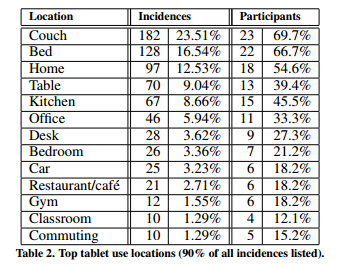
tablet-Usage-location-google-researchA new study of how people use tablets reinforces what other studies have found, namely that tablets are personal content consumption devices, not “work” devices used in “non-work” settings such as couches, beds and kitchens.

The Google researchers tracked the way 33 U.S. tablet users interacted with their devices, and found that tablets primarily are used for personal purposes and to play games and check email.

Tablets also are “lean back“ devices used in bed, on couches and while cooking, for example.

A majority of tablet sessions involved multitasking. More than  60 percent of the participants watched TV while using their tablets. About 40 percent used their tablets while eating and drinking, while 27 percent used their tablets while cooking.

The Google study also found that many of the participants just used TV as background noise while checking their email and doing other things completely unrelated to watching TV.

Across all reports of tablet use, the most frequent activities were  checking emails (with light responding), playing games, social networking, looking up and searching information, listening to music, shopping (browsing and purchasing), lightweight content creation (notes, lists,
forms), reading a book, checking the weather, reading news, watching TV/movies/videos, and conducting a local search.

Tablets were used for more activities during a typical weekday as compared to a typical weekend day: 61 percent of usage (1.86 incidences) occurred on a typical weekday and 39 percent (1.21 incidences) occurred during a typical weekend day.

Weekdays showed more frequent email checking, managing of calendars, and checking the weather, but also included longer activities such as listening to music or social networking.  

Activities such as watching videos, playing games, reading and shopping were more frequently done on weekends.


Firms Using Social Media for Marketing Will Have to Use Social for Customer Replies

By 2014, organizations that refuse to communicate with customers by social media will face the same level of wrath from customers as those that ignore today's basic expectation that they will respond to emails and phone calls, Gartner argues. 

For organizations that use social media to promote their products, responding to inquiries by social media channels will be the new minimum level of response expected by consumers, Gartner predicts. 

“The dissatisfaction stemming from failure to respond via social channels can lead to up to a 15 percent increase in churn rate for existing customers,” says Carol Rozwell, Gartner VP and distinguished analyst. 

U.S. Consumer Mobile Share of "Online" Attention Doubles

According to new estimates by eMarketer, time spent using mobile devices for activities such as Internet and app use, gaming, music and others has more than doubled in the past two years among U.S. consumers. 

In 2012, the amount of time consumers spent using mobile devices—excluding talk time—will grow 51.9 percent to an average 82 minutes per day, up from just 34 minutes in 2010, eMarketer estimates. 

This year, eMarketer estimates time spent online will grow 3.6 percent to an average 173 minutes per day, compared to 7.7 percent growth in 2011 to 167 minutes per day. 


89% of App Store Downloads are "Free"

Free apps will account for 89 percent of total downloads in 2012, according to Gartner, Inc. Worldwide mobile app store downloads will surpass 45.6 billion in 2012, with free downloads accounting for 40.1 billion, and paid-for downloads totaling 5 billion.

"In terms of the apps that consumers are buying, 90 percent of the paid-for downloads cost less than $3 each," says Sandy Shen, research director at Gartner. "Similar to free apps, lower-priced apps will drive the majority of downloads. Apps between 99 cents and $2.99 will account for 87.5 percent of paid-for downloads in 2012, and 96 percent by 2016." 

Gartner expects Apple's App Store to have more than 21 billion downloads in 2012, which is an increase of 74 percent over 2011 and indicates continued strong demand for mobile app content. 

"Apple's market share is the largest, considering its App Store accounts for 25 percent of available apps in all stores," said Brian Blau, research director at Gartner. Demand for apps overall will still be dominated by Apple, Google and Microsoft sites, though important third party stores will operate. 

Mobile App Store Downloads, Worldwide, 2010-2016 (Millions of Downloads)
2011
2012
2013
2014
2015
2016
Free Downloads
22,044
40,599
73,280
119,842
188,946
287,933
Paid-for Downloads
2,893
5,018
8,142
11,853
16,430
21,672
Total Downloads
24,936
45,617
81,422
131,695
205,376
309,606
Free Downloads % 
88.4% 
89.0% 
90.0% 
91.0% 
92.0% 
93.0%
Source: Gartner (September 2012)
"Amazon will become a powerful competitor," says Shen. "In China, there is a boom market of independent Android stores, due to the lack of presence of Google Play and 'weak' stores" operated by the mobile service providers.

As you might guess, giving away apps implies some other revenue model, and these days that largely means in-app sales of content goods or products. 

In-app purchases will drive 41 percent of the store revenue in 2016, Gartner expects.

Gartner expects the number of downloads featuring in-app purchase will increase from five percent of total downloads in 2011 to 30 percent in 2016, and its contribution to the store revenue will increase from 10 to 41 percent in the same period. 

Every Budget is Becoming an IT Budget

Twelve years ago technology spending outside of IT was 20 percent of total technology spending; it will become almost 90 percent by the end of the decade, according to Gartner

Much of this change is being driven by the "digitization" of companies’ revenue and their services, meaning that social, mobile, cloud and other "content," marketing, customer and partner support, plus research and developing operations have to be supported. 

To address these changes, organizations will create the role of a Chief Digital Officer as part of the business unit leadership, which will become a new seat at the executive table. Gartner predicts that by 2015, 25 percent of organizations will have a Chief Digital Officer.

381 Million Mobile Money Users in Emerging Markets by 2017

According to a new research report by Berg Insight, the number of active mobile money users in emerging markets will grow from 61 million in 2011 to 381 million by 2017, a compound annual growth rate (CAGR) of 36 percent. 

Several of the most successful mobile money services are today in use in Africa, but Asia-Pacific is expected to become the most important regional market, accounting for nearly two thirds of the active user base in 2017. 

The total value of mobile money transactions is projected to grow from US$ 44 billion in 2011 at a CAGR of 44 percent to US$ 395 billion in 2017

Sales of Low-Cost Smart Phones Will Double Every Year


The low-cost smartphone segment, defined as models with a selling price of less than $150, report. Low-cost smartphone shipments are forecast to double every year from 2010 to 2016, increasing from 4.5 to 311.0 million, NPD predicts
Those pricing trends are crucial for adoption of smart phone technology in emerging regions. 
About 60 percent of the demand will come from the Asia Pacific region, where a large majority of component suppliers and manufacturing factories are located—providing both time and cost savings, NPD notes. 
Android is the most popular operating system for low-cost smart phone designs, NPD says. 
                   Android-Based Low Cost Smart Phone Shipments by Region
Source: NPD DisplaySearch Smartphones: Displays, Designs and Functionality report
The penetration rate of Android-based low-cost smart phones is increasing, with NPD DisplaySearch forecasting Android share to grow from two percent of total smart phone shipments in 2012 to 29 percent in 2016. 
                                          Penetration of Low-Cost Smart Phones
undefined

13 Billion Years of Galaxy History, in 2 Minutes

NASA has created a simulation of how a spiral (disc shaped)  galaxy such as the Milky Way forms, over 13.5 billion years. It's two minutes for your inner geek. 

The simulation ran on the Pleiades supercomputer at NASA's Ames Research Center in Moffett Field, Calif., and required about one million CPU hours.


Cloud Computing in Europe Could Provide €250 Billion EU GDP Growth in 2020

According to a new IDC study conducted on behalf of the EU, removing barriers to adoption of cloud services would have a strong impact on adoption in the EU, increasing the value of spending on public cloud services from €35.2Bn to €77.7Bn by 2020.

According to the model developed by IDC, if the EU adopts a 'no intervention' policy towards cloud adoption, cloud could generate up to €88 billion of contribution to the EU GDP in 2020. However, if the EU follows a proactive a “policy-driven" scenario towards cloud, it would generate up to €250 billion GDP in 2020, corresponding to an increase of €162 billion over the 'no intervention' scenario. 

"We estimate that the cumulative impact for the period 2015 to 2020 will be €940 billion in the “policy-driven” scenario, compared to €357 billion in the “no intervention” one," said Giuliana Folco,  IDC research vice president, European Industry Solutions.

That might be a bit optimistic, though, as there seem to be other reasons for resistance to cloud computing

The fear of a US-owned cloud company turning over personal data of a European citizen to U.S. authorities, plus a less positive view of outsourcing in general, are retarding the growth of cloud computing in Europe, according to Christian Echeyne, director of IT infrastructure technologies and engineering for Orange Business Services. 

Of course, some might simply argue that U.S. cloud computing adoption also lags behind Asia-Pacific and Latin America adoption as well. 

Is Private Equity "Good" for the Housing Market?

Even many who support allowing market forces to work might question whether private equity involvement in the U.S. housing market “has bee...