Control of the Internet must be stopped from falling into the hands of the International Telecommunication Union (ITU), the European Parliament has warned.
The resolution calls on the E.U. member states to prevent any changes to the International Telecommunication Regulations that would be harmful to the openness of the Internet, net neutrality and freedom of expression.
Thursday, November 22, 2012
European Parliament Says:Stop the ITU taking over the Internet"

 Gary Kim was cited as a global "Power Mobile Influencer" by Forbes, ranked second in the world for coverage of the mobile business, and as a "top 10" telecom analyst. He is a member of Mensa, the international organization for people with IQs in the top two percent.
European Mobile Industry is Contracting
Globally, telecom revenue is growing. But not in Western Europe, it appears. The mobile industry’s combined revenues from voice, messaging and data services in the EU5 economies (United Kingdom, France, Germany, Spain and Italy) will drop by nearly 20 billion Euros, or four percent a year, in the next five years, and by 30 billion Euros by 2020, according to STL Partners.
The obvious implication is that mobile service providers in the United Kingdom, France, Germany, Spain and Italy will have to create new revenue streams worth 30 billion Euros, just to stay where they are, by 2020.
That is roughly in line with a rule of thumb I use that suggests service providers in just about every developed market will need to replace about 50 percent of current revenue in 10 years.

The obvious implication is that mobile service providers in the United Kingdom, France, Germany, Spain and Italy will have to create new revenue streams worth 30 billion Euros, just to stay where they are, by 2020.
That is roughly in line with a rule of thumb I use that suggests service providers in just about every developed market will need to replace about 50 percent of current revenue in 10 years.
Gary Kim was cited as a global "Power Mobile Influencer" by Forbes, ranked second in the world for coverage of the mobile business, and as a "top 10" telecom analyst. He is a member of Mensa, the international organization for people with IQs in the top two percent.
Mobile Operator VoIP Revenues Remain Paltry
For mobile service providers, the fundamental problems with over the top voice and messaging services have to do with the business model, for obvious reasons.
Since mobile service providers do not own the over the top apps, they do not participate in the revenue. But if they try and offer their own OTT apps, priced competitively with the over the top providers, they make little money, and potentially disrupt their own more-lucrative voice and messaging services.
In fact, mobile VoIP is still worth less than 0.5 percent of overall mobile voice revenues, according to ARCchart.
ARCchart sees similar issues for mobile service provider messaging. ARCchart expects that instant messages will exceed text messaging volumes by 2014 and continue growing rapidly, accounting for 65 percent of all message traffic pushed over mobile networks by 2016.
As with voice, OTT messaging will cannibalize mobile operator services. In 2012, global mobile VoIP service revenues might be about $2.5 billion. But mobile voice revenue overall could be in the range of roughly $1 trillion.
Since mobile service providers do not own the over the top apps, they do not participate in the revenue. But if they try and offer their own OTT apps, priced competitively with the over the top providers, they make little money, and potentially disrupt their own more-lucrative voice and messaging services.
In fact, mobile VoIP is still worth less than 0.5 percent of overall mobile voice revenues, according to ARCchart.
ARCchart sees similar issues for mobile service provider messaging. ARCchart expects that instant messages will exceed text messaging volumes by 2014 and continue growing rapidly, accounting for 65 percent of all message traffic pushed over mobile networks by 2016.
As with voice, OTT messaging will cannibalize mobile operator services. In 2012, global mobile VoIP service revenues might be about $2.5 billion. But mobile voice revenue overall could be in the range of roughly $1 trillion.
Gary Kim was cited as a global "Power Mobile Influencer" by Forbes, ranked second in the world for coverage of the mobile business, and as a "top 10" telecom analyst. He is a member of Mensa, the international organization for people with IQs in the top two percent.
Mobile Roaming Revenues to exceed $80 Billion by 2017
Mobile roaming, with growth powered especially by use of data services out of region, will grow to more than $80 billion by 2017, compared to $46 billion in 2012.
Mobile data will provide most of the growth, if not the absolute greatest volume of revenue, generating about $35 billion in revenue by 2017, when data roaming revenues will represent about eight percent of total mobile service provider revenues, says Juniper Research.
Still, that means voice roaming will account for $45 billion in 2017. Western Europe will continue to be the region where roaming revenue is the most significant revenue contributor.
Lower roaming fees, often mandated by regulators, actually will help. As any economist might say, lowering the price of any product tends to increase consumption of those products.
Mobile data will provide most of the growth, if not the absolute greatest volume of revenue, generating about $35 billion in revenue by 2017, when data roaming revenues will represent about eight percent of total mobile service provider revenues, says Juniper Research.
Still, that means voice roaming will account for $45 billion in 2017. Western Europe will continue to be the region where roaming revenue is the most significant revenue contributor.
Lower roaming fees, often mandated by regulators, actually will help. As any economist might say, lowering the price of any product tends to increase consumption of those products.
Gary Kim was cited as a global "Power Mobile Influencer" by Forbes, ranked second in the world for coverage of the mobile business, and as a "top 10" telecom analyst. He is a member of Mensa, the international organization for people with IQs in the top two percent.
Wednesday, November 21, 2012
Children Want Their Gadgets
Approximately half of children six to 12 surveyed by Nielsen say they want a full-sized iPad and 36 percent want an iPad Mini.
The iPod Touch and iPhone are also coveted devices among these young consumers (36% and 33%, respectively).
Kids are also likely to ask for dedicated gaming hardware for the Christmas and holiday season, with 39 percent wanting Nintendo’s Wii U.
About 29 percent say they want a portable DS. About a quarter say they want Microsoft’s Xbox 360 and a similar percentage want a Sony PlayStation 3.

Among consumers aged 13 and older, tablets and full-sized computers were the top electronics choices, with roughly one in five indicating they want to acquire the iPad, another tablet brand or a computer.
Gary Kim was cited as a global "Power Mobile Influencer" by Forbes, ranked second in the world for coverage of the mobile business, and as a "top 10" telecom analyst. He is a member of Mensa, the international organization for people with IQs in the top two percent.
NTT cuts FTTH Prices: LTE Competition to Blame
Japan's NTT is finding consumers are shifting demand from fixed networks to Long Term Evolution mobile networks, which is a real world test of whether LTE 4G networks really can compete with fixed network high speed Internet access.
As a result, NTT has cut fixed network broadband access prices by 34 percent, from JPY5,460 (USD67) to JPY3,600, TeleGeography says.
So there is now serious evidence that Long Term Evolution is viewed as a suitable replacement for fixed network service, with the greatest danger emerging where you would expect, with younger users. .

As a result, NTT has cut fixed network broadband access prices by 34 percent, from JPY5,460 (USD67) to JPY3,600, TeleGeography says.
So there is now serious evidence that Long Term Evolution is viewed as a suitable replacement for fixed network service, with the greatest danger emerging where you would expect, with younger users. .

NTT East and NTT West’s "fiber to the home" subscriber growth has significantly slowed down.
National FTTH household penetration was about 46 percent in the second quarter of 2012.
Net subscriber additions for the year ending June 2012 falling to 1.2 million, down from 1.7 million in the year to end-June 2011 and from two million in the year to June 2010.
Executives at NTT East and NTT West say the biggest, single reason for the slowdown in FTTH subscriber growth is the fact that many young subscribers now prefer to have their own personal LTE-based high speed broadband service, rather than paying for a FTTH service.
That also seems especially true when those customers have to pay for a mobile broadband connection anyhow. Some might question the long-term viability of that approach, if users start to watch lots of longer form streaming video.
As usual, consumers are rational. Users in Japan who have abandoned fiber to the home seem to be watching short form video, but avoiding streaming or downloading long form video that would put pressure on their mobile data plans.
Once again, we see that consumers are smart, and will alter their behavior and spending plans to gain the optimal value from the range of services available to them, deliberately choosing not to watch long form streaming video if it means saving money.
Although there were only nine million LTE subscribers worldwide in late 2011 compared to 220 million FTTx subscribers (88 million for FTTH/B and VDSL alone), momentum is rapidly growing in favor of mobile, according to IDATE.
In 2016, IDATE predicts that the number of LTE subscribers will exceed 900 million, compared to nearly 230 million for fixed ultrafast-broadband (FTTH/B and VDSL).
Gary Kim was cited as a global "Power Mobile Influencer" by Forbes, ranked second in the world for coverage of the mobile business, and as a "top 10" telecom analyst. He is a member of Mensa, the international organization for people with IQs in the top two percent.
3 Small Cells for Every Macrocell?
By 2017, Ericsson expects each macro base station in urban areas will be supplemented by about three small cells.
Today, there are about five million macro base stations deployed worldwide and those in metro areas account for about 15 percent of the total, or about 750,000. That suggests a total of perhaps 2.25 million small cells.
It always is difficult to predict the deployment of small cells because that category sometimes includes virtually all cell sites smaller than a macrocell, including potentially large numbers of consumer grade units used inside homes or offices, plus larger small cells deployed as part of the public mobile network.
Today, there are about five million macro base stations deployed worldwide and those in metro areas account for about 15 percent of the total, or about 750,000. That suggests a total of perhaps 2.25 million small cells.
It always is difficult to predict the deployment of small cells because that category sometimes includes virtually all cell sites smaller than a macrocell, including potentially large numbers of consumer grade units used inside homes or offices, plus larger small cells deployed as part of the public mobile network.
Gary Kim was cited as a global "Power Mobile Influencer" by Forbes, ranked second in the world for coverage of the mobile business, and as a "top 10" telecom analyst. He is a member of Mensa, the international organization for people with IQs in the top two percent.
Mobile Subscriber Growth Will be Lead by Asia, 2012-2018
If you want to know where the great volume of new mobile subscribers is coming from between now and 2018, look to Asia, says Ericsson. That especially will be true of China and the rest of Asia aside from India. Elsewhere, new subscribers will be hard to find in Western Europe, North America and Central and Eastern Europe.

 Gary Kim was cited as a global "Power Mobile Influencer" by Forbes, ranked second in the world for coverage of the mobile business, and as a "top 10" telecom analyst. He is a member of Mensa, the international organization for people with IQs in the top two percent.
France Telecom Joins T-Mobile, Telefonica in Embracing Carrier-Owned OTT VoIP
Orange is betting on carrier-owned over the top VoIP as a strategy for competing with Skype, WhatsApp and Viber. "Libon" offers free calling between Libon users, but charges for calls to landline and mobile numbers.
At some level, the determination is simply that Orange needs to remain relevant as a supplier of communications services, whatever the danger of cannibalizing at least some of its own voice and messaging revenue. T-Mobile has taken a similar approach.
In principle, supplying its own over the top voice app also means Orange can supply people with communications outside the areas of the world where Orange operates its own facilities.
The main reason service providers do not like “over the top” services and applications is that they generally represent direct competition. In other words, over the top apps are substitutes for key products service providers sell.
But that is one key to how things will change in the future. If a major reason over the top apps and services are disliked is that they pose a threat to revenue, then a major reason for adopting an over the top approach is if doing so can create new revenue opportunities.
The business decisions are tricky. In some ways, over the top apps always will represent some danger of cannibalizing existing revenues. But service providers already understand and have embraced other ways of building new revenue streams by going “over the top.” They just haven’t used the term.
Instead, it has been more common for service providers to go “out of region,” as when acquisitions are made in areas where a given firm does not already provide service. European telcos buying assets in Africa provide examples. Cable companies buying other firms in different regions is another example.
The point is that buying assets out of region is similar in principle to some forms of over the top service. Incumbent local exchange carriers have created competitive local exchange carrier operations to sell services “out of region,” for example.
Over the top is trickier for the simple reason that customers and non-customers can use the apps or services, so there always is some risk of substitution for existing services a provider sells. But over the top also can represent an “out of territory” growth strategy.
Think of it as a shift of focus from “selling services to current customers, where we have network” to “selling services to non-customers who are out of territory.” That’s a big shift, as traditionally service providers have operated on a territorial basis, with licenses or franchises that specify where they can build networks and provide services.
Over the top changes all that. As Google apps can be used by any person with web browser and broadband access, so too can a telco-owned app be used by anybody with a web browser and broadband access, in territory or outside it.
Sooner or later, service providers will figure out how to do so on a broader scale. Telefonica, T-Mobile, Deutsche Telekom and others have invested in their own over the top apps. In part, that has been a defensive move in markets where use of over the top apps are a major part of consumer behavior.
But over the top also has been viewed as a way of creating new customers out of region or out of territory.
If you think about it, the Verizon and Coinstar joint venture to create a streaming version of Redbox is part of a pattern at Verizon and elsewhere, namely that over the top services increasingly are being viewed as a way to sell services to “non-customers.”
In essence, the new streaming service will reach beyond the footprint of Verizon fixed network customers and appeal to all 30 million Redbox customers who have been renting DVDs from the Redbox kiosks.
According to Verizon Communications CFO Fran Shammo, Verizon was looking to create a streaming service that would extend “outside of just the FiOS footprint, utilizing the content that FiOS has and bringing that into the rest of the United States.”
Some think something similar will happen as Verizon’s agency agreements with Comcast, Cox Communications, Time Warner Cable and Bright House Networks develop, as well. Those efforts so far have had each of the partners co-selling cable TV, fixed network broadband access and fixed network voice, plus wireless service, outside the Verizon fixed network footprint.
In essence, Verizon is using the agency agreements to sell services to “non customers” outside the Verizon fixed network footprint.
Likewise, T-Mobile USA has found much the same results with its “Bobsled” over the top VoIP service.
Since April 2011, more than 10 million calls have been made on the over the top Bobsled application made available by T-Mobile.
Of the millions of Bobsled calls made to phone numbers, 80 percent originate from outside the United States, though messaging seems to be a U.S. phenomenon. Although Bobsled Calling has seen significant international usage, Bobsled Messaging users are predominately U.S. based, with 90 percent of messages sent domestically.
Usage statistics also show one of the key present realities of over the top apps sponsored by communications service providers, namely that usage might often be by "non-customers."
Of the more than one million Bobsled Calling users, 95 percent are not T-Mobile wireless subscribers, T-Mobile says.
That should suggest one key strategic difference between a carrier-offered app or service, and an over the top app, namely that in some cases the OTT apps do not necessarily cannibalize current customer use of carrier services, but essentially are an "out of region" service that gets used by non-customers.
At some level, the determination is simply that Orange needs to remain relevant as a supplier of communications services, whatever the danger of cannibalizing at least some of its own voice and messaging revenue. T-Mobile has taken a similar approach.
In principle, supplying its own over the top voice app also means Orange can supply people with communications outside the areas of the world where Orange operates its own facilities.
The main reason service providers do not like “over the top” services and applications is that they generally represent direct competition. In other words, over the top apps are substitutes for key products service providers sell.
But that is one key to how things will change in the future. If a major reason over the top apps and services are disliked is that they pose a threat to revenue, then a major reason for adopting an over the top approach is if doing so can create new revenue opportunities.
The business decisions are tricky. In some ways, over the top apps always will represent some danger of cannibalizing existing revenues. But service providers already understand and have embraced other ways of building new revenue streams by going “over the top.” They just haven’t used the term.
Instead, it has been more common for service providers to go “out of region,” as when acquisitions are made in areas where a given firm does not already provide service. European telcos buying assets in Africa provide examples. Cable companies buying other firms in different regions is another example.
The point is that buying assets out of region is similar in principle to some forms of over the top service. Incumbent local exchange carriers have created competitive local exchange carrier operations to sell services “out of region,” for example.
Over the top is trickier for the simple reason that customers and non-customers can use the apps or services, so there always is some risk of substitution for existing services a provider sells. But over the top also can represent an “out of territory” growth strategy.
Think of it as a shift of focus from “selling services to current customers, where we have network” to “selling services to non-customers who are out of territory.” That’s a big shift, as traditionally service providers have operated on a territorial basis, with licenses or franchises that specify where they can build networks and provide services.
Over the top changes all that. As Google apps can be used by any person with web browser and broadband access, so too can a telco-owned app be used by anybody with a web browser and broadband access, in territory or outside it.
Sooner or later, service providers will figure out how to do so on a broader scale. Telefonica, T-Mobile, Deutsche Telekom and others have invested in their own over the top apps. In part, that has been a defensive move in markets where use of over the top apps are a major part of consumer behavior.
But over the top also has been viewed as a way of creating new customers out of region or out of territory.
If you think about it, the Verizon and Coinstar joint venture to create a streaming version of Redbox is part of a pattern at Verizon and elsewhere, namely that over the top services increasingly are being viewed as a way to sell services to “non-customers.”
In essence, the new streaming service will reach beyond the footprint of Verizon fixed network customers and appeal to all 30 million Redbox customers who have been renting DVDs from the Redbox kiosks.
According to Verizon Communications CFO Fran Shammo, Verizon was looking to create a streaming service that would extend “outside of just the FiOS footprint, utilizing the content that FiOS has and bringing that into the rest of the United States.”
Some think something similar will happen as Verizon’s agency agreements with Comcast, Cox Communications, Time Warner Cable and Bright House Networks develop, as well. Those efforts so far have had each of the partners co-selling cable TV, fixed network broadband access and fixed network voice, plus wireless service, outside the Verizon fixed network footprint.
In essence, Verizon is using the agency agreements to sell services to “non customers” outside the Verizon fixed network footprint.
Likewise, T-Mobile USA has found much the same results with its “Bobsled” over the top VoIP service.
Since April 2011, more than 10 million calls have been made on the over the top Bobsled application made available by T-Mobile.
Of the millions of Bobsled calls made to phone numbers, 80 percent originate from outside the United States, though messaging seems to be a U.S. phenomenon. Although Bobsled Calling has seen significant international usage, Bobsled Messaging users are predominately U.S. based, with 90 percent of messages sent domestically.
Usage statistics also show one of the key present realities of over the top apps sponsored by communications service providers, namely that usage might often be by "non-customers."
Of the more than one million Bobsled Calling users, 95 percent are not T-Mobile wireless subscribers, T-Mobile says.
That should suggest one key strategic difference between a carrier-offered app or service, and an over the top app, namely that in some cases the OTT apps do not necessarily cannibalize current customer use of carrier services, but essentially are an "out of region" service that gets used by non-customers.
Gary Kim was cited as a global "Power Mobile Influencer" by Forbes, ranked second in the world for coverage of the mobile business, and as a "top 10" telecom analyst. He is a member of Mensa, the international organization for people with IQs in the top two percent.
Tuesday, November 20, 2012
A La Carte Entertainment Video Might Not Work, Though People Want It
Most people these days would probably agree that the ability to buy video a la carte, show by show, series by series or channel by channel, using the Internet or any other distribution method, is a good idea. Some blame the distributors for failing to meet demand. But distributors would say their programming contracts forbid such sales.
"We should be clear about something: cable companies are at the mercy of content companies on the issue of content rights and use," says Michael Powell, National Cable and Telecommunications Association president.
The licensing rights dictate most of what distributors can, and cannot do, with that licensed programming. Most consumers probably think, intuitively, that shifting to an a la carte retail regime would lead to lower costs.
Powell points out the flaw: "The a la carte model is deceptively attractive until you do the math."
People generally assume that if ESPN were sold a la carte the price would fall. But if you assume a shift to a la carte could not happen unless such a development were revenue neutral, you have the crux of the problem. With fewer customers, there would be less revenue, but programming and other costs would remain the same. So prices would rise.
Studies are inconclusive, though. Some show a sort of neutral or slightly positive outcome if a typical consumer purchased about 11 channels.
A la carte would mean fewer subscribers and fewer advertising dollars. So prices actually would rise. For "ESPN to maintain its current revenue, it would have to cost hundreds of dollars," says Powell.
"We should be clear about something: cable companies are at the mercy of content companies on the issue of content rights and use," says Michael Powell, National Cable and Telecommunications Association president.
The licensing rights dictate most of what distributors can, and cannot do, with that licensed programming. Most consumers probably think, intuitively, that shifting to an a la carte retail regime would lead to lower costs.
Powell points out the flaw: "The a la carte model is deceptively attractive until you do the math."
People generally assume that if ESPN were sold a la carte the price would fall. But if you assume a shift to a la carte could not happen unless such a development were revenue neutral, you have the crux of the problem. With fewer customers, there would be less revenue, but programming and other costs would remain the same. So prices would rise.
Studies are inconclusive, though. Some show a sort of neutral or slightly positive outcome if a typical consumer purchased about 11 channels.
A la carte would mean fewer subscribers and fewer advertising dollars. So prices actually would rise. For "ESPN to maintain its current revenue, it would have to cost hundreds of dollars," says Powell.
An economist might say the typical video bundle works because it allows distributors to apply scale and scope economics. The corollary is that most networks, which are advertising supported, want to be part of a "no choice" basic tier for business reasons of their own, namely the ability to better sell the advertising that underpins their business models.
When multichannel video distributors say a bundled approach creates economics that favor smaller, niche networks to thrive, they are right. An end to bundling would likely decimate most smaller, more-lightly-viewed networks. To the extent that content and program diversity is a desired end user benefit, "choice" in all likelihood would decline in a full a la carte environment, because most people would not buy most channels.
The possible advent of over-the-top TV viewing worries most in the current ecosystem for one compelling reason: "households view less than one quarter of the networks they are forced to buy in the bundle," the Consumers Union noted in an past analysis assuming a 50-channel offering. Even today, with hundreds of available channels, end user behavior does not seem to have changed much.
Most people watch a dozen or so channels on a regular basis.
Cable operators have argued that end-user costs might actually climb in an a la carte environment, for a number of reasons. Higher customer care costs, operating and marketing are likely, cable operators have argued. Part of the argument has been based on the need to supply new decoders to customers who did not previously need them. That is likely not much of an issue these days, as cable operators convert to largely-digital or all-digital services where customers already must be provided set-top boxes.
Operators also have argued that customer care costs would rise, and there is more substance to that argument, at least during the period where customers would be confused about the new way of buying service. The National Cable and Telecommunications Association has estimated that customer care costs increase by more than 75 percent in a pure a la carte scenario, the Consumer Union says.
Others believe a typical household might wind up paying about the same amount each month. That is likely true more for ulti-person households and for households that watch more television.
Separate studies by the Federal Communications Commission seem to have concluded that unbundling could save money, or wouldn't save money. One of the studies suggested “consumers that purchase at least nine networks would likely face an increase in their monthly bills" when buying a la carte.
Likewise, one of the studies suggested bill increases ranging from 14 percent to 30 percent under a la carte, while the other suggests a consumer purchasing 11 cable channels would face a change of bill ranging from a 13 percent decrease to a four percent increase, with a decrease in three out of four cases.
Gary Kim was cited as a global "Power Mobile Influencer" by Forbes, ranked second in the world for coverage of the mobile business, and as a "top 10" telecom analyst. He is a member of Mensa, the international organization for people with IQs in the top two percent.
ITU Internet Censorship?
Some 42 countries filter and censor content. In just the last two years, governments have enacted 19 new laws threatening online free expression, Google says.
Gary Kim was cited as a global "Power Mobile Influencer" by Forbes, ranked second in the world for coverage of the mobile business, and as a "top 10" telecom analyst. He is a member of Mensa, the international organization for people with IQs in the top two percent.
Guardian Newspaper Says: Two Years from a Mobile Tipping Point
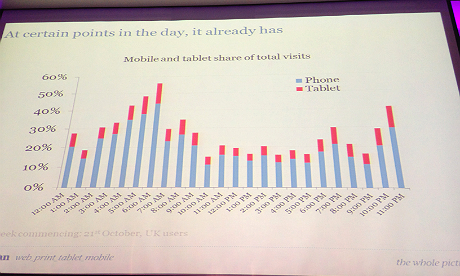
Many application providers have a "mobile first" business strategy. Some media and content companies are moving that way as well.
Anthony Sullivan, group product manager for Guardian Core products at Guardian News & Media, says mobile devices, including tablets, now represent 35 percent of all "accesses" of Guardian products.
At some times of day, mobile visits overtake desktop for Guardian products, he notes.
"If you look between 6 am and 7 am in the morning, we're now getting more visits coming from mobile devices," he said. "On Saturdays at 3 pm when the Premier League is in full flight, we also have more mobile devices than desktop."
"The way we've organised ourselves reflects that we put mobile really at the center of our planning," Sullivan notes.
Gary Kim was cited as a global "Power Mobile Influencer" by Forbes, ranked second in the world for coverage of the mobile business, and as a "top 10" telecom analyst. He is a member of Mensa, the international organization for people with IQs in the top two percent.
Spectrum Sharing Test?
It might be a bit of an experiment, but LightSquared is proposing a spectrum sharing plan as part of its effort to resurrect its business plan.
To avoid interference, LightSquared proposes to share spectrum that is currently set aside for weather balloons used by the federal government. In exchange, LightSquared said it would permanently relinquish its 10 MHz of spectrum that is directly adjacent to the frequencies used by GPS receivers.
LightSquared wants to combine the 5 MHz it uses for satellite service at 1670-1675 MHz with frequencies in the 1675-1680 MHz band.
FCC officials might want to approve the proposal just to see how it works, since there is some thinking wider sharing of spectrum might be possible in many other bands.
To avoid interference, LightSquared proposes to share spectrum that is currently set aside for weather balloons used by the federal government. In exchange, LightSquared said it would permanently relinquish its 10 MHz of spectrum that is directly adjacent to the frequencies used by GPS receivers.
LightSquared wants to combine the 5 MHz it uses for satellite service at 1670-1675 MHz with frequencies in the 1675-1680 MHz band.
FCC officials might want to approve the proposal just to see how it works, since there is some thinking wider sharing of spectrum might be possible in many other bands.
Gary Kim was cited as a global "Power Mobile Influencer" by Forbes, ranked second in the world for coverage of the mobile business, and as a "top 10" telecom analyst. He is a member of Mensa, the international organization for people with IQs in the top two percent.
Will the U.S. Cable Industry Someday Have a Broadband Monopoly?

Is the market for high-speed broadband Internet destined to become a "new monopoly?" The question might seem silly to many observers who compete in the market.
Some simply point to the consistent strength of cable provided broadband in the net new customers area as evidence cable is winning the broadband access market share battle
It is hard to refute that notion, as consistent declines for telco-provided digital subscriber line services, despite gains by fiber-reinforced services provided by telcos, are a clear trend.
So U.S. cable operators are gaining share in the fixed network access market. Also, recent marketing agreements between Verizon and top U.S. cable operators give the impression that cable has abandoned any serious effort to build its own facilities-based mobile business, while Verizon likewise has decided that, where it cannot provider FiOS, it will rely on mobile broadband.
But that's only part of the story.
Mobile broadband is beginning to represent a bigger share of total broadband access, as well.

The number of active mobile broadband subscriptions reached nearly 1.2 billion by mid-2011, representing a 45 percent increase annually since 2007, with total mobile subscriptions topping five billion By the end of 2010, there were over twice as many mobile broadband as wireline broadband subscriptions, for example.
Over the longer term, fixed broadband access share might not matter as much, overall.
Gary Kim was cited as a global "Power Mobile Influencer" by Forbes, ranked second in the world for coverage of the mobile business, and as a "top 10" telecom analyst. He is a member of Mensa, the international organization for people with IQs in the top two percent.
"Internet as Platform" Still Challenges Telcos
True, some of the quiet has to do with industry coalescence around "IP Multimedia Subsystem" and "Rich Communications Suite" as the practical answers to the question of what the industry will do about next generation networks.
The notion of "platform" comes into play in that regard. You might argue that traditional telecom networks were, albeit limited at times, "platforms" in the current sense for applications. The analogy is imperfect, but industry suppliers of switches, routers, other operating software, billing, operations support systems and so forth were the equivalent of today's third party developers.
The fundamental issue is that the public Internet has usurped much, perhaps most of the role of next generation platform. Some might go further and argue that some devices, especially smart phones, now have become application platforms as well.
In a nutshell, that is the strategic problem for telecom, cable or other access networks. The Internet, and devices that use the Internet, actually have become the next generation network platforms of choice for most apps.
That doesn't mean cable, telco, satellite, fixed wireless or other networks cannot operate as platforms. But it does mean they now have limited utility in that regard.
The difference between the public Internet and use of IP on private networks remains important, not to mention the continuing interest national regulators everywhere have in their communications infrastructure.
But it is hard not to argue that the Internet now is the next generation network platform of choice, even if what we now call the public switched telephone network continues to operate, in parallel, as a platform as well.
That might seem obvious, but it was more contentious a decade or so ago, when debates about next generation networks tended to revolve around use of protocols such as asynchronous transfer mode or Internet Protocol.
There are business implications. Platforms have tended to standardize around a single dominant provider, such as Windows in PCs, Facebook in social, Google in search.
The more dominant the platform becomes, the more valuable it becomes and the harder it becomes to dislodge, as a network effect kicks in. Developers want to create for the platform "everybody uses."
And that illustrates the problem telcos and other access providers still have. The platform of choice increasingly has become the Internet. Developers who specialize in apps for the public network are far fewer in number than those who build Internet-compatible apps.
It is still true that the public Internet is distinct from the public switched telephone network. That will remain true even after the legacy PSTN is replaced by the next-generation IP network.
The Internet has not actually become the "next generation telco network." But it is the bigger platform. And in those areas, such as mobility, where the network actually retains more relevance, the mediating role of the device now is usurping more of the actual value of the mobile platform.
Gary Kim was cited as a global "Power Mobile Influencer" by Forbes, ranked second in the world for coverage of the mobile business, and as a "top 10" telecom analyst. He is a member of Mensa, the international organization for people with IQs in the top two percent.
Subscribe to:
Posts (Atom)
-
We have all repeatedly seen comparisons of equity value of hyperscale app providers compared to the value of connectivity providers, which s...
-
It really is surprising how often a Pareto distribution--the “80/20 rule--appears in business life, or in life, generally. Basically, the...
-
Financial analysts typically express concern when any firm’s customer base is too concentrated. Consider that, In 2024, CoreWeave’s top two ...

