Wednesday, October 23, 2013

Walmart Launches Tablet Trade-In Program

Smart phone and tablet “trade in” policies are seen by mobile service providers as a way of enticing consumers to upgrade their devices. Such policies also can shift upgrade activity from mobile service provider stores to mass market retailers, with revenue implications for the retailers.

That is one reason why Walmart today announced customers can now trade in their tablets at more than 3,600 stores and Sam’s Club locations nationwide.

Similar to its new smart phone trade-in program, customers and members can receive up to $300 for their current tablet, which will then be applied toward the purchase of a new tablet.

The reason for the new policy is clear: consumers increasingly are upgrading to new devices, service providers and service plans when they can trade in their existing device. So the trade-in policies help drive traffic to retail outlets, and away from mobile service provider retail stores.

“Trade-ins, in their many variations, are the new competitive battlefield for carriers, retailers and OEMs,” said Eddie Hold, NPD Connected Intelligence VP. “The consumer may not necessarily shop at the carrier store for their next device, but instead may look to big box retailers if the trade-in price is right.”

More than 60 percent of smart phone consumers are aware of their trade-in options for a new device and 55 percent of them plan to take advantage of it the next time they upgrade, according to NPD.

In the past, only 13 percent of smart phone owners say they traded in their last mobile device, but the growing awareness and trade-in options have the potential to shift carrier and retailers loyalty.  

Among smart phone consumers, 30 percent said they would switch carriers if a different carrier offered a better trade-in deal, and almost 62 percent said they are willing to go to a different retailer (but not necessarily switch carriers) for a better trade-in price, NPD says.

The trade-in value is applied to a new tablet of their choice. If a customer’s new tablet costs less than the trade-in value of the old tablet, he or she will receive the balance on a Walmart gift card.

In part, the trade-in policies also are important as the bulk of new device sales become replacement sales.

A Lost Decade of Revenue in Europe

Despite current revenue issues, the European telecom business, including fixed line and mobile segments, will grow from 2013 to 2025, analysts at IDATE now predict. 

The challenging part of the prediction, though, is that in 2020, revenue levels only will reach 2010 levels.


By 2025, industry revenue will be at about 2009 level, which was higher than 2010 revenue.  


You might call that a “lost decade” of revenue. As you might guess, revenue growth in both fixed network and mobile segments will be driven by non-voice revenues, according to researchers at IDATE.


Of course, IDATE researchers also note that performance could be worse, leading to a negative 24 percent revenue performance, or better, in which case revenue could grow 28 percent more than the scenario IDATE considers most likely.


The most likely outcome is based on an assumption that revenue growth for the top five European markets, or EU-5 (France, Germany, Italy, Spain, United Kingdom), will start to grow again in 2016, after shrinking by about four percent in 2013.


In part, IDATE believes the worst case scenario is not the most likely, since it is a simple extrapolation of current trends, with declining voice revenues not matched by growth of new revenue sources.


The optimistic scenario assumes service providers are successful efforts to generate more money from tiered Internet access (pricing based on consumption) as well as significant new revenue sources. That optimistic scenario has revenue growth of three percent, starting in 2013, something IDATE suggests is not likely.
But even the most likely outcome would require some structural change, one might argue. If you assume new services revenue is likely to be quite modest for the next five or so years, a reversal of revenue patterns would require an ability to charge more largely for existing products.


That would tend to suggest service provider consolidation at a level that significantly reduces the amount of competition, less stringent regulation that allows service providers to raise prices, an ability to tie consumption to pricing, retail packaging policies that raise more revenue per account, growth by acquisition or some elements of each, one might argue.


Up to this point, European service providers have not have notable success boosting prices even for the latest fourth generation Long Term Evolution networks. Mobile data plan retail prices have been dropping, in many countries, since early 2013, according to ABI Research.


ABI Research now has found that Long Term Evolution 4G network tariffs also are falling, either in actual posted prices or as measured by “cost per bit.”  


Comparing mobile Internet access pricing between the second quarter of 2012 and fourth quarter of 2012, 73 percent of countries surveyed have reduced the “effective cost” of their 4G tariffs to a significant degree.


The effective cost, measured in terms of “dollar per Gigabyte,” has dropped by 30 percent. In the U.S. market, service providers generally have maintained retail prices, but  introduced larger data quotas.


In Australia, Sweden, Japan, and Saudi Arabia the operators lowered the monthly fee but have kept data quotas unchanged.


That state of affairs poses questions, such as whether mobile service providers actually will be able to drive higher revenue, in the near term, from LTE access services.


“ABI Research is concerned that a number of operators have introduced 4G pricing plans at the same, or even lower, price points than 3G,” stated Jake Saunders, VP for forecasting. “In Norway, Telenor has introduced 4G tariffs that are cheaper than 3G.


But one might argue that either the “return to growth” scenario and the “three percent annual growth” scenarios must involve something more than “acquisition by growth.”

Some amount of structural change to reduce the number of suppliers, and retail policies that allow service providers to raise prices (probably requiring regulator policies to change) also seems necessary.


Tuesday, October 22, 2013

If Airlines are Targeting Bus Travelers, What Can Communications Service Providers Do?

Every now and then, it is helpful tto ask, and answer, the question of “what business am I in?” You might say a low-cost airline is in the transportation business, which is true enough. But so are operators of bus, train, commuter rail, ferry or subway systems.


The more detailed and helpful follow-on questions start when a manager asks “who are my competitors?”


The reason is that the answers to that question can lead to new business models or sometimes even industries. In Latin America, for example, discount airlines are competing with long-distance bus service, not other airlines.


It isn’t so clear how that will play out in the communications business, but we might already argue that Skype does not so much compete with traditional carrier voice as it does with Internet messaging or email.


Google Hangouts in a similar sense does not so much compete principally with carrier voice or traditional videoconferencing as chat services. WhatsApp might not so much compete with carrier text messaging as with Facebook and other popular social networks.


The point is that new opportunities sometimes do arise by redefining the business a firm believes it is in, who its customers are, and what those customers require and want.


Most service providers think of “prospects and customers” as people who live in certain geographic areas where the provider has a license, franchise or certificate to provide services.


Other providers, especially those using cloud-based approaches, do not define prospects or customers in geographic terms, typically. Even a local telco who sells hosted IP business telephony could, in principle, create a cloud-based service sold to users outside a licensed service area for common carrier services.


The point is that as low-cost airlines in Latin America target long-distance bus travelers as their market, not “air travelers,” some clever entrepreneurs likely are going to figure out new ways to identify customers and services for communications-related services that are non-traditional. 


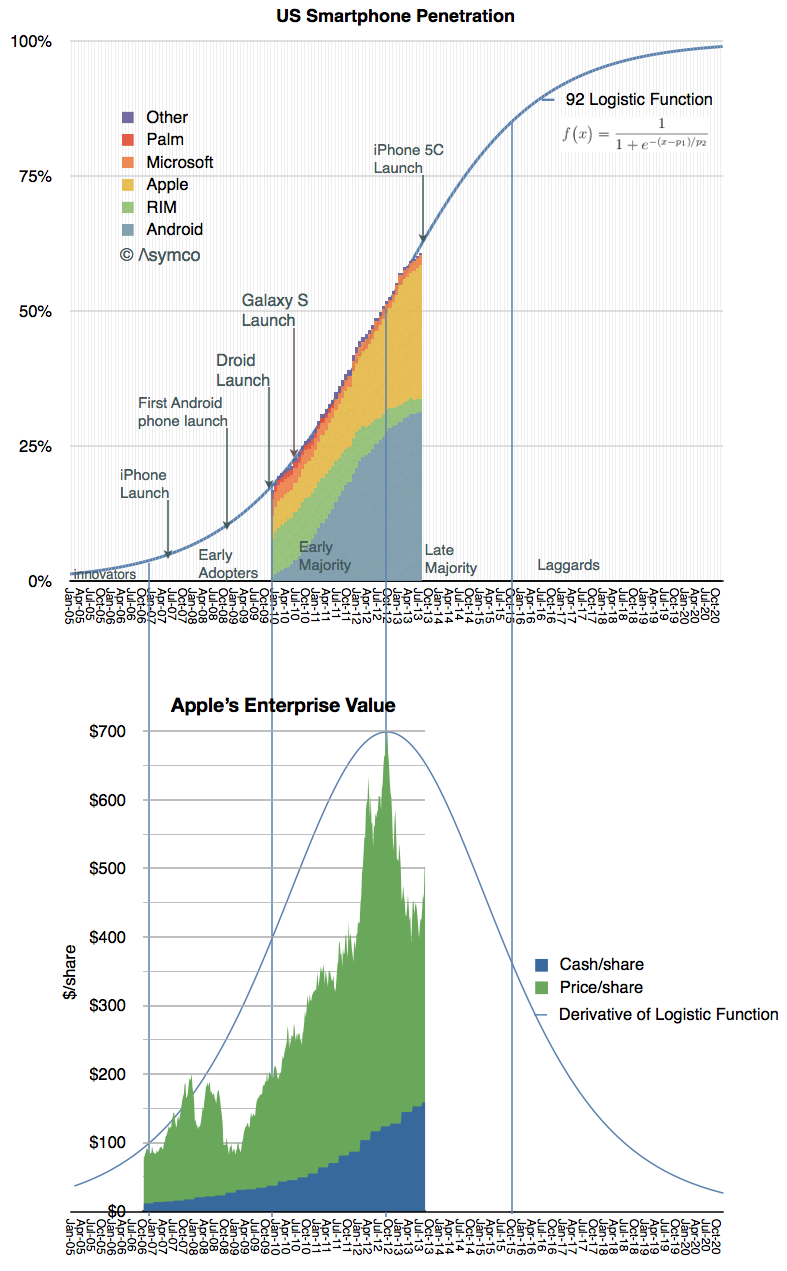
The iPhone is a Proxy for the Smart Phone Market, it Seems

Screen Shot 2013-10-17 at 10-17-4.01.35 PMThe iPhone seems, by one analysis, to be a proxy for the smart phone business, at least in terms of smart phone adoption.


iPad Drives 81% of U.S. Tablet Data Consumption

Apple iPad drives 81 percent of U.S. tablet data traffic, according to Chitika. 

North America Mobile Data Forecast: At Inflection Point

If analysts at Information Gatekeepers are correct, North American mobile data traffic has just hit a key inflection point. 

Monday, October 21, 2013

When "Carrier Class" is a Bad Idea

By definition, an Internet service provider cannot offer service to users who cannot afford to pay very much unless that ISP's costs also are low, even if that ISP might have other revenue streams than direct subscription or usage fees. 

Over the past decade, that has lead many smaller ISPs, serving hard to reach populations, to build and operate networks that are not "carrier class," on purpose. The reason is simple: carrier class networks would cost enough that end user costs could not be kept at reasonable levels.

That will be an even-tougher challenge in many parts of the world where monthly cash income is low enough that people can not afford to pay much more than cents a day. 

That is one problem Google's Project Loon is trying to solve, using some principles similar to low earth orbit satellite fleets. A LEO satellite fleet moves constantly through the sky, requiring tracking satellite dishes. 

As you might guess, that is too expensive for low-cost ISP service in many  to reach, low income areas around the world. So Project Loon is testing fleets of wind-blown balloons.

This is an early earth station, or antenna. Some of you won't be surprised if inside is found a Ubiquiti radio, which has become a mainstay of the wireless ISP business. 

Sometimes, people talk about "carrier class" as a good thing, and it is, in many communications contexts. Just as certainly, "carrier class" is not a good thing when a key objective is to provide service at historically low costs. 

When that is the objective, "carrier class" networks are in fact precisely what is not wanted. 

Despite the service issues that represents, "carrier class" also imposes cost. So one design foundation, for ISPs truly wanting to serve "underserved populations," is not to build carrier class networks, with all the reliability issues that will come with that approach.  

When will Netflix Be Bigger than HBO?

Some of us would liken Netflix to HBO, namely, that Netflix is a programming network, not a delivery mechanism. So a logical question might be “when will Netflix be bigger than HBO?”

The question is important to the extent that it sheds light on the potential value of a video streaming business, where content aggregation really is the business, not "delivery."


The answer is “it depends.” If you look only at gross revenue, Netflix already probably is bigger than HBO. If you look at net profits, or profit margin, Netflix is six to seven times smaller than HBO.


Netflix annual revenue now is on par with that of HBO, though it is likely Netflix profit margins are a fraction of HBO’s profit margins. To wit, Netflix books more than $4 billion annually, while HBO probably books about the same amount of revenue.


Netflix also is closing on HBO global subscriber figures, as well. Netflix has about 30 million paid U.S. subscribers, while HBO has about 29 million U.S. subscribers.


HBO profit margin is probably in the 33 percent range, while Netflix profit margin is in the five percent range.

So the real question is not so much “when will Netflix be bigger than HBO?” but “when will Netflix be as profitable as HBO?”

"Harvesting" and "Sowing" Define the Service Provider Business

At a high level, all mobile and fixed network service provider strategy is about harvesting legacy revenues at the highest possible rate as new revenue sources are being developed.  That has all sorts of implications, ranging from retail packaging of existing products to investments in promising new areas.

And nowhere are the strategic implications more pronounced than in the areas of applications used by smart phones and video entertainment services. As already is clear, smart phones are platforms for consumption of Internet-delivered content, messaging, voice and transactions.

And though observers and some entrepreneurs have envisioned head to head competition between Wi-Fi networks (aided by public or outdoor networks, and anchored by indoor and at-home use) for at least a decade and a half, most would agree that today, Wi-Fi networks are supplemental to, not direct replacements for, access using a mobile network.

When another decade has passed, we might be looking at dramatic structural changes in the “mobile phone” and “video entertainment” businesses, affecting revenue streams for cable TV operators, fixed network telcos and mobile service providers alike.


If past competition between telcos and cable operators has relevance, the issue will be how much core market share each contestant loses, or gains. In the past rounds of competition, telcos have lost voice share while telcos have gained video entertainment share, while splitting Internet access share unevenly (cable has gained more than have the telcos).

But those inter-segment market share wins and losses might also feature something new, namely potential losses between one cable operator and another. For the most part, U.S. cable operators politely refrain from competing with each other.

But technology and revenue pressures seem to be pointing at a future where the industry’s famous collegiality is put to the test. Over the top video is the likely facilitator, in that case.

Everybody seems to agree on the fundamental outlines of the coming revolution. Sooner or later, most of the content people want to pay for will be made available for Internet delivery.

Some ISPs, and especially mobile service providers, may well see a new opportunity to compete for those video entertainment revenues nationwide, irrespective of traditional franchised video service territories.

It also seems likely one or more entities in the cable industry might simply conclude the trend is inevitable, and, at some point, could launch a cable-owned over the top video streaming service.

Mobile service providers, on the other hand, face a place-based challenge, since some 80 percent of smart phone content already seems, in many markets, to be consumed on Wi-Fi networks.

There will remain substantial and clear value for a fully-mobile service, especially for real-time communications. But much content consumption can be handled and consumed when people are stationary. That makes public Wi-Fi a more-compelling alternative, though not a perfect substitute.

Still, those are “tomorrow” issues. Most service providers will do better, financially, to harvest legacy revenues under pressure as best they can, by staving off subscriber account losses and maintaining average revenue per account, on their core products.

No matter how successful, service providers cannot make as much gross revenue or profit from new lines of business as they can by protecting existing core services. The classic example for a fixed network telco is VoIP strategy. Some might argue telcos should have embraced VoIP fully, as the “next generation voice” product.

That has been the strategy for attacking service providers, such as cable operators and hosted IP telephony providers, since they have no legacy customer base to protect. Under such circumstances, those providers were free to package and price as they saw fit.

Telcos were in a different position. If the assumption is that a VoIP service “should cost less,” telco marketers were faced with a choice essentially of “two evils.” They could drop prices across the board to “VoIP” levels, and maintain market share. Or they could simply decide to lose market share, and maintain existing prices and feature sets.

One might argue the wiser course was to trade lower prices per account to maintain market share. It will suffice to note that many service providers, especially in the more-robust North American markets, have chosen to lose some market share rather than adopt across the board price cuts.

But markets differ. In other regions, where there is significant customer defection to VoIP services, some service providers have chosen to offer their own, lower-priced VoIP products.

Neither strategy (across the board price cuts to preserve market share, or maintaining prices while losing share) is right for every service provider in every market.

Now the issue is being addressed in the messaging market, where over the top alternatives are displacing carrier-provided text messaging. Fundamentally, the choices are the same: compete or harvest, where competing almost certainly cannibalizes high-margin text messaging and harvesting means giving up market share.

Some service providers in North America are essentially taking a middle stance, protecting a substantial portion of voice and messaging revenues by making them a feature of access service, while shifting variable consumption-related charges to Internet access service. That’s the basic approach taken by Verizon Wireless and AT&T Wireless, for example.

In other cases, mobile operators can, or must, tap into the over the top opportunity, some would argue.

The issue is that some project OTT revenues will grow from $7.9 billion in 2013 to $53.7 billion in 2017, used by 2.1 billion smart phone users by 2017, a study by mobilesquared suggests.

“Mobile operators should consider such measures as renting mobile numbers or terminating OTT traffic,” argues José Garcia, tyntec VP.

The study suggests Skype is costing the telecom industry $100 million worth of revenue each day, or about $36.5 billion a year.

That likely assumes that Skype’s 280 million active users use two billion minutes each day on Skype calling, and that nearly all those minutes represent lost telco revenues. Many would likely suggest two different processes are at work.

In some cases Skype likely does directly cannibalize usage that otherwise would have been charged on a phone account and therefore created revenue for a service provider.

But it also is the case that much of that activity simply would not have occurred at all, were Skype not available.

Still, fully 43 percent of mobile operators now say that Skype presents a major threat to their revenues.

Of the operators interviewed, 14 percent claimed that OTT services have created a loss of messaging revenue of more than 21 percent in the last year. The same sort of process undoubtedly is at work for messaging services as well.

Some traffic likely was shifted from text messaging to over the top alternatives. But much of that over the top activity likely would not have occurred if text messaging were the only alternative.

To be sure, service provider executives do predict that users will rely on OTT messaging services to a greater extent in the future. About 20 percent of service provider executives surveyed estimate that more than 50 percent of their subscribers already use over the top messaging.  

WhatsApp has grown by 233 percent in just 12 months and now has 300 million users globally, the study suggests. In that time, WhatsApp daily messages sent have increased from two billion to 10 billion.

The tyntec-sponsored study surveyed more than 40 mobile network operators and mobile virtual network operators in 68 countries as part of the study.

The number of operators reporting no reduction in messaging revenues has sharply deteriorated from 62 percent of service provider operations  in 2012 to 36 percent in 2013.

Although some mobile operators have created their own OTT  services, this option is largely losing its appeal, the study suggests. IN 2012, about 26 percent of respondents were interested in doing so. In 2013, about 21 percent of mobile operators reported they were interested in doing so.

The percentage of mobile operators interested in partnering with OTT providers grew to 36 percent of respondents, up from 32 percent in 2012.

But those efforts to harvest legacy revenues are only part of the challenge. Service providers must also find new replacement revenue sources of some size.

Precisely what will drive the next wave of revenue is the question.

Unlike revenue sources in the first three waves, it is highly likely that the discrete revenue opportunities in a fourth wave, if based on revenue earned largely from over the top app providers partnering in some way with access providers, will be highly fragmented.

Unlike the largely undifferentiated voice, text messaging and mobile Internet access revenue streams, the fourth wave might feature lots of discrete markets, none of them remotely as large as the voice, text messaging or Internet access markets.

That will put new pressure on mobile service providers to control or reduce overhead costs, and create many sophisticated new forms of value to sell to potential business partners. The over-used phrase “agile” comes to mind, but the appellation is not far from the mark. Access providers will have to be much more nimble than in the past to support the many new types of business partners.

The danger, of course, is that other providers could enter the market. Some obvious names typically bandied about include Google, Apple, Amazon, Twitter, Microsoft, Facebook, Visa or PayPal.

Will "Premium Pricing" Work Better for Some Devices than Others?

Are global device sales trends a problem or opportunity for Apple, which maintains its “premium device, premium pricing” positioning? It’s hard to tell.

Apple can make a reasonable argument that its global positioning will work, as the ranks of consumers able and willing to afford a premium device continues to grow. In other words, gaining a constant share of millions of new “premium segment” consumers across the globe is a big enough market to sustain Apple for the medium term, in its phone business.

Apple assuredly will lose overall device market share over time, but maintain its profit margins, and continue to grow, since the market segment it is targeting is growing. What worries many observers is the analogy to the old PC business. In contrast, Apple arguably took the opposite tack in the MP3 device market, creating products for every price segment.

And, in truth, Apple could change its course over time, gradually adding lower-priced products, as it did in the MP3 market, only when demand at the high end does reach saturation.

You can make your own decision about whether the “premium device, premium price” approach is a winning strategy for most suppliers, but it can, in principle, work for Apple, so long as Apple does not expect to be the volume or market share leader, in devices.

Some would argue the longer term ecosystem implications are a bit more troublesome, as user scale has direct implications for application ecosystem scale and influence. Lack of scale always had some impact in the PC market. Lack of scale never was a problem in the MP3 device business.

To the extent that a robust application and services capability is a key issue in the smart phone business, Apple has not yet encountered problems. Whether that will become an issue later is an arguable point.

Some might argue Apple’s share will be high enough to sustain a robust application ecosystem, despite the share held by other operating systems and devices. Others will worry. Already, some developers target Android first, Apple second, though hardly anybody thinks Apple is at a strategic disadvantage, at the moment.

Tablet markets might be different. Content for the MP3 player was provided by iTunes and sideloading. Content for smart phones includes both the Internet and the app stores. Content for tablets will be a mix, but similar, in principle, to that of PCs and smart phones.

The issue is the relative roles to be played by Internet accessed content and the app stores. Early on, apps have been crucial for tablet users. Over time, that might change, especially where people use tablets are substitutes for PCs.

Recent Apple iPad sales have plummeted, in terms of growth rate, for example. There are multiple explanations for that trend, but one might be that people find alternative and more affordable products satisfactory for their desired use cases.

That could be a telling trend. Some consumers might not find affordability to be an issue for any devices, smart phones, tablets or PCs. But most probably will make tradeoffs. People might be willing to spend more for one type of device, less for the others.

One might assume that, when ability to pay is an issue, people will spend on premium devices that are perceived as most personal, less on those devices whose use is less personal.

In other words, propensity to pay a premium in such cases might be highest for the smart phone, less for a tablet and least for a PC.

Global shipments of traditional PCs (desk-based and notebook) are forecast by to total 303 million units in 2013, an 11.2 percent decline from 2012, and the PC market, including ultra-mobile devices, is forecast to decline 8.4 percent in 2013, according to Gartner analysts.

Mobile phone shipments are projected to grow 3.7 percent, with volume of more than 1.8 billion units.

Tablet shipments are expected to grow 53.4 percent in 2013, with shipments reaching 184 million units.

To be sure, some consumers will not have to make any significant tradeoffs, and might well pay premium prices across the board. Most will have to make choices. And the nature of those choices will have key implications for Apple and other suppliers.

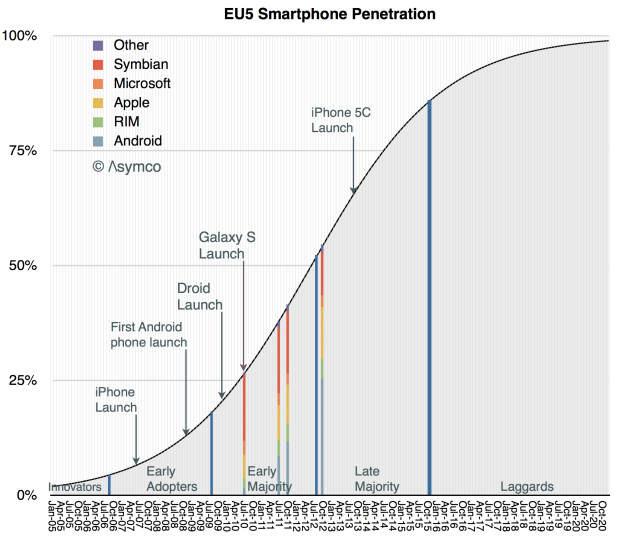
Smart Phone Saturation by 2015 in France, Germany, Italy, Spain, UK

Screen Shot 2013-10-16 at 10-16-2.02.44 PMHow much longer will it take until smart phones are used by nearly all mobile phone users in Western Europe (France, Germany, Italy, Spain and the UK)?

About 2015, according to analyst Horace Dediu.

Price's Law: 10% of People Produce 50% of Outcomes

Price's Law states that half of the literature on a subject will be contributed by the square root of the total number of authors publi...