Saturday, June 12, 2021

"The End" of Connectivity Services Revenue Model is Coming

“The end of communications services as we know them” is coming, argues the IBM Institute for Business Value. That puts the institute on one pole of an argument that never seems settled: should service providers build strategies around connectivity revenue sources, or look elsewhere for growth?”


In other words, should service providers focus horizontally on connectivity services or vertically integrate?  


In part, the study team--consultants Chad Andrews, Steve Canepa, Bob Fox and Marisa Viveros--base those recommendations on shrinking profit margins and lessened value of core connectivity services. That is what I have called near zero pricing.  


“There is evidence that connectivity may commoditize more suddenly and dramatically than expected,” the team argues. In other words, both lower prices per bit and lower demand for other legacy services will continue as a fundamental trend. 


“Margins for connectivity are likely to fall,” they note, as data consumption keeps increasing. “On the surface, exponential increases in scale would seem like a good thing for CSPs, but only if pricing keeps pace with the rate of expansion,” they say. “History and data suggest it will not.”


Near zero pricing is the term I use to describe the larger framework of connectivity provider pressures towards ever-lower prices. Others might prefer to emphasize marginal cost pricing. The point is that there is a reason the phrase dumb pipe exists. What we need to remember is that dumb pipe now is the foundation of the whole connectivity business


A caveat is that what people usually mean by “dumb pipe” is that a product has low value, is sold at low prices and generates low profit margins. That always is positioned as a bad thing. 


But think about it: industry revenue growth now is lead by broadband services (internet access), which is, by definition, a dumb pipe service. It is a way to get access to applications, not an actual application itself. Nor are profit margins always low. Broadband access now routinely has higher profit margins than entertainment subscriptions or most voice services or messaging can generate. 


The other issue is that value and revenue within the information technology and communications spheres keeps shifting away from “data access and transport.”


“In just three to four years,” sustaining growth may require “most CSPs (communication service providers)...to develop new competencies and assert themselves in new roles in value chains,” the IBM Institute for Business Value says. 


To be sure, that is not a novel bit of advice. “Think beyond connectivity” is about as standard a recommendation as one is likely to find any analyst, consultant recommending as a revenue growth strategy.  


“If CSPs are to thrive, most will need to develop new competencies and assert themselves in new roles in value chains,” the institute also says. As always, that advice runs counter to that of virtually all equity analysts, who always seem to want service providers to “stick to their connectivity roots.” 


Where the institute urges pursuit of different and new roles within the internet ecosystem, equity analysts want a focus on connectivity services. “Up the stack” or not remains a key argument. 


“CSPs should seek new ways to make money, beyond metering connectivity and access to data, as these traditional mainstays of CSP business models are likely to commoditize,” the institute says. 


“CSPs should seek new ways to make money, beyond metering connectivity and access to data, as these traditional mainstays of CSP business models are likely to commoditize,” the institute says. 


The institute identifies 5G and edge computing as key platforms, in that regard. Again, rather obvious suggestions. The institute also recommends a hybrid cloud strategy. That is not too surprising, given IBM’s commitment to hybrid cloud as its core strategy.


The institute also argues that telcos must become platforms. Again, not a novel view. The term platform is misunderstood by most, however. It has a different meaning when referring to computing than to business models. It is the former instance, not the latter, that seems generally meant by the phrase “becoming a platform.”


In the sense the institute sees matters, becoming a platform is meant in the sense of computing platforms


A platform in that sense is a group of technologies that are used as a base upon which other applications, processes, services, or technologies are developed. Platforms can be hardware (e.g., chips, devices) or software. Types of software platforms include operating systems, development environments (e.g., Java, .NET), and digital platforms. Digital platforms are highly configurable/extensible software tools that sit above traditional development platforms. 


Most observers would agree that core connectivity revenue streams are under pressure and are likely to stay that way. Where opinion really diverges is “what to do” about those circumstances. 


As wise as diversifying into new roles might be, history suggests how difficult that will prove to be for most service providers. That noted, most would also agree that opportunity exists in a number of areas including internet of things, edge computing and advanced networks. How to seize opportunities remains a subject of debate.


Telco Outsourcing Will Increase, Survey Finds

If, 20 or 30 years ago, you had asked any telecom executive what a service provider’s core competence was, you’d invariably get an answer related to “we operate quality networks” or “we understand networking” or something of that sort. 


Today, you might often get an answer that continues to emphasize the ability to build and operate communications networks. The odd thing is that most service providers are “building and operating” less these days. 


Few have gone as far as Sprint, which at one point outsourced the operation of its core network. But it is quite common for service providers to outsource towers, for example. And compared to the sourcing of core technology today, as compared to the monopoly era before 1990, telcos outsource almost all their core technology to third parties. 


To illustrate, where AT&T once developed and built all its core technology using Western Electric and Bell Laboratories, it now buys almost all its core technology from third party suppliers. 


That includes operating systems, edge computing, cloud computing, billing and operations support systems and even core networks, according to a survey of 500 telecom industry executives undertaken by the IBM Institute for Business Value and Oxford Economics.


source: IBM Institute for Business Value 


To be specific, IBM was looking at service provider willingness to use third-party cloud computing suppliers. But the general principle applies to all core network technology. 


Friday, June 11, 2021

AT&T CEO on Competition


Communications policy always is political and always has industrial policy ramifications. That is why one hears so much talk about who is "ahead" and who is "behind" in 5G. Much of that concern is industrial policy, focused on which industries, in which countries and regions, can gain leadership in infrastructure supply; applications; content or platforms. 

Private telcos and internet service providers generally, and incumbents always, loathe government-owned networks that, by definition, erode communications markets. For firms that are publicly traded equities, opposing the expansion of such competition has a genuine fiduciary duty obligation, one might note. 

The public networks business is a scale affair, made more difficult in the competitive era for many logical reasons, ranging from stranded assets to tougher growth prospects to slimmer profit margins. 

The migration of value away from "access and transport" and towards applications, services and content made possible by the internet does not help either. 

National policymakers always seem to want robust investment, quality services and low prices. Up to a point, competition tends to help. Past a certain point, with excessive competition, investment, quality and prices all suffer, as the network business model cannot be sustained. 

The balance policymakers must seek is to balance competition with sustainability. Nowhere in the world has it been possible to sustain many competitors serving the mass market using fixed facilities. 

Mobile markets have been the exception in allowing three facilities-based providers to sustain themselves. In some markets perhaps four can survive. 

The point is that nobody has yet discovered a way to sustain many suppliers, over the long term, and still obtain the benefits of competition (high rates of investment, high innovation and lower prices). 

In most markets there is rarely sustainable competition between two national, facilities-based mass market fixed network telcos. Mobile has done better, in that regard. 

We might not like all their policy positions, but firms such as AT&T understand the economics of their businesses quite well. Competition does reduce gross revenue and profits. Up to a point that is not a problem. At some point, excessive competition destroys the market. 


Revenue Leakage Afflicts All Service Providers, But at What Level?

Mobile operators worldwide lost an estimated $33 billion from security breaches and fraud in 2020 and will lose $41 billion in 2024, according to Kaleido Intelligence. Those of you with long histories in the industry might agree that keeping losses in about that range might well be as good as it gets.


Others will dispute those figures. According to the Communications Fraud Control Association, in 2021 losses from fraud--globally--will amount to about $28.3 billion. The problem for loss control staffs is that no single type of fraud dominates. 


There is simply a bit of revenue leakage cross many parts of the operation of a communications service provider business. According to CFCA, the biggest single source of revenue leakage, at $5 billion, is international revenue share fraud, something that happens between service providers. 


One might argue this is less “fraud” than “mistakes.” But most sources of revenue leakage do not amount to much more than $1 billion or $2 billion annually, on a global basis. The point is that the actual loss for any single service provider is relatively small. 


Top 10 Fraud Methods

Top 10 Fraud Types

$1.92 B – Subscription Fraud (Application)

$1.82 B – Payment Fraud

$1.82 B – PBX Hacking

$1.82 B – IP PBX Hacking

$1.82 B – Wangiri (Call Back Schemes)

$1.63 B – Abuse of network, device or configuration weaknesses

$1.44 B – Dealer Fraud

$1.34 B – Subscriber Fraud (Identity)

$1.25 B – Account Take Over

$1.15 B – Internal Fraud / Employee Theft

$5.04 B – International Revenue Share Fraud (IRSF)

$3.28 B – Arbitrage

$2.71 B – Interconnect Bypass (e.g. SIM Box)

$2.27 B – Domestic Premium Rate Service (In Country)

$2.00 B – Traffic Pumping (includes: Domestic Revenue Share, TFTP)

$1.76 B – Commissions Fraud

$1.76 B – Device / Hardware Reselling

$1.49 B – Theft / Stolen Goods

$1.17 B – Friendly Fraud

$.98B – Wholesale SIP Trunking Fraud

So the issue is how much time, effort and money can reasonably be spent to reduce the amount of such leakage. It probably is not reasonable to reduce such “fraud” or mistakes to zero. 


source: Kaleido Intelligence 


The more relevant question is how to protect most revenue from shrinkage, knowing that some shrinkage will occur, even when the best billing and other practices are in place. One might also argue that industry practices already have reduced a substantial amount of fraud and mistakes. 


In 2013, global service provider losses (fixed network plus mobile network)  from long distance alone were about $46 billion, according to Over the Wire. Others will dispute the size of the loss. 


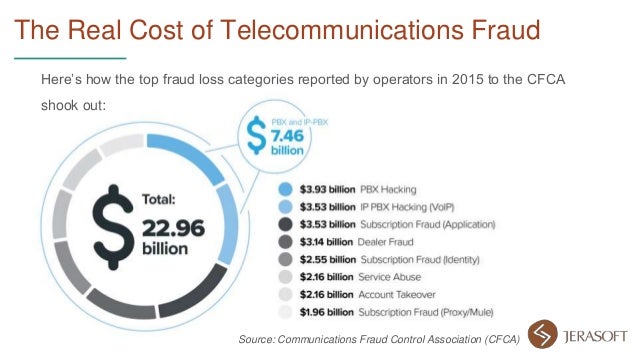
By some estimates, in 2019 the amount of long distance fraud from business phone systems was less than $3 billion.  In 2015 business phone system losses were probably in the $23 billion range. 


source: Jerasoft 


The point is that service providers should protect themselves from fraudsters and maintain other policies that reduce shrinkage caused simply by billing and other largely preventable failures. 


But stopping all revenue shrinkage might cost more than it saves.


Thursday, June 10, 2021

Middle Mile, Fronthaul, Broadband: Good Examples of how Words Change Meaning in Era of Virtualized Networks

Telecom terms change meanings over time. We used to define “broadband” as any data rate at 1.544 Mbps or faster. Now the definition is more flexible, and deliberately changes over time. The U.S. Federal Communications Commission defines “broadband” as a minimum downstream speed of 25 Mbps, with 3 Mbps upstream. 


In a mobile network, “backhaul” used to mean the trunk connection between a cell tower and a mobile switching center. These days, as networks are virtualized, we talk about fronthaul, mid-haul and backhaul. All those deployments occur within a local network, but “fronthaul” applies to the connection between a baseband site and a radio site, for example.


Mid-haul can refer to the connection between a baseband processing site and a controller. Backhaul then refers to the connection with a wide area network access point. 


So it is with “middle mile.” Classic fixed telco networks featured wide area networks for long-haul traffic, connecting tandem offices, for example. Connections from central offices to end users or remote hubs were part of the local trunking network. 


The local access network then ran from central offices or remote hubs to end user locations. We did not use the term “middle mile.”


In the context of  internet traffic, “middle mile” often refers to that portion of the network connecting internet traffic from an ISP’s servers to an internet traffic exchange point or peering location. 


Partly a physical concept and partly a business concept, the middle mile is the segment of a network between an internet peering point or collocation center and central offices, headends, or ISP data centers. 

source: Telegeography


Still, it is a somewhat-murky concept. Facebook, for example, sometimes refers to the middle mile as facilities linking its own data centers at distances of hundreds of miles. That is hard to reconcile with a definition focused on connections between internet peering locations and headends or ISP data centers or telco central offices. 


Others appear to use the term “middle mile” to refer to private networks of almost any distance that move traffic between a wide area network colo location and an ISP’s headend or data center. 


Traditional telco voice networks connecting central offices within a city or region might also be called “middle mile” instead of trunking networks. 


It might be easier to look at “middle mile” as a business concept, representing capacity costs or investments that are made to move traffic between an ISP headend and an internet traffic exchange point.


Covid Will Not Change Longer-Term Bandwidth Growth Patterns

One often hears it said that “broadband usage in 2020 rose 50 percent.” The implication is that Covid explains the change. Covid did cause a shift of consumption from office to home; from school to home; from downtown office cores to suburban homes. Home all day, gaming and video content consumption spiked. 


The issue is what happens once people are able to work substantially “at the office” again. By definition, students in school and not at home will not be playing videogames. Workers at their offices will not be watching streaming video while at the office. Work and educational traffic will shift back to school and work sites. 


Beyond some permanent changes in the balance of in-office and at-home or remote work environments, the longer-term consumer bandwidth consumption trends are mostly unchanged. 


There was an immediate step change when workers and students were kept home. But the long-term growth rates seem to have settled back to where they were before the sudden step change. 


source: Chief Martec 


That might come as a surprise, given the 25-percent to 40-percent boost in traffic caused by stay-at-home policies, in the spring of 2020, for example. 


But analysts at TeleGeography have argued the temporary change in bandwidth demand caused by stay-at-home policies will not persist. Usage levels will return to prior pre-pandemic patterns. 


Many argue that “Covid caused a year’s worth of change in a month.” But that is not the same as arguing that the rate of change is permanently altered. 


The point is that consumer data consumption routinely grows 25 percent to 50 percent per year, driven by streaming video consumption. For more than a decade, entertainment video has been the key driver of consumer bandwidth demand. In 2008, for example, video represented 99 percent of data consumption by consumers. 


Today, content consumption still is the main driver of consumer bandwidth consumption. Consider that the “average” household now subscribes to four different video streaming services. Video is far and away the most bandwidth-intensive application, so the shift to video streaming (in advance of potential widespread use of virtual or augmented reality for gaming) determines consumer bandwidth demand. 


source: Deloitte 


To be sure, consumers are connecting more devices to the internet, adding to bandwidth demands. Still, video consumption continues to drive bandwidth demand. Also, the number of users in each household also matters. But household size--on average--does not change much, year over year.  


source: Deloitte 


The reason video drives bandwidth is simply that it is the most bandwidth-intensive application. By some estimates, where voice might earn 35 cents per megabyte, connectivity providers might earn a fraction of a cent per megabyte for all other internet apps and streaming, based on the purchase of the internet access service. 


The exception is that connectivity providers who own a streaming service can monetize subscription or advertising revenue. But most internet service providers earn money only on the access subscription fees. As usage climbs while subscription fees remain relatively constant, revenue per bit falls.  


The point is that Covid-induced changes in bandwidth consumption are likely transitory, beyond a step change in consumption caused by “stay at home” policies. 


As people go back to school and back to the office, reversion to mean should occur. More traffic from school and office sites will occur, with less consumption during school and working hours at home locations. 


Yes, bandwidth consumption will keep rising, and likely at rates we have seen over the past two decades. Covid distortions will be transitory, temporary and ultimately represent “noise” in consumption curves, not a change of the curves.


Wednesday, June 9, 2021

There are "Computing Platforms" for IoT and "Business Model Platforms" That are Completely Different

Few concepts in communications are harder to define than “platform.” A computing platform is a group of technologies that are used as a base upon which other applications, processes, services, or technologies are developed. Platforms can be hardware (e.g., chips, devices) or software. Types of software platforms include operating systems, development environments (e.g., Java, .NET), and digital platforms. Digital platforms are highly configurable/extensible software tools that sit above traditional development platforms. 


An IoT platform is a type of digital platform that is used for building and managing IoT solutions.


source: IoT Business 


It is important to distinguish between a computing “platform” and a platform business model


A platform business model essentially involves becoming an exchange or marketplace. That can be contrasted with the “pipe” business model, which has a firm acting as a direct supplier of some essential input in the value chain. 


A platform functions as a matchmaker, bringing buyers and sellers together, but classically not owning the products sold on the exchange. A pipe business creates and then sells a product directly to customers. Amazon is a platform; telcos and infrastructure suppliers are pipes. 


As used by IoT Business, an IoT platform has four main layers:

  • Application management / enablement – providing the ability to rapidly develop, test, and seamlessly manage IoT applications

  • Data management / enablement – providing the ability to ingest, store, and analyze data from IoT devices

  • Telco management – providing telecommunications companies the ability to manage the connectivity to IoT devices at scale

  • Device management – providing the ability to remotely configure, monitor, and manage IoT devices, including over-the-air updates


The IoT platform ecosystem includes several key roles, according to IoT Business:

  • Applications

  • Computing infrastructure

  • System integration

  • Connectivity

  • Integrated vertical solutions


5G and other connectivity service providers having one “natural” role (connectivity) and one related role (bundling connectivity with an owned or partner IoT platform. 


  • Applications. Both platform vendors themselves and 3rd parties are monetizing the applications built on top of IoT platforms (e.g., Siemens’ Closed-Loop Foundation application for MindSphere, Edge2Web’s Director application for MindSphere)

  • Compute infrastructure. Cloud hyperscalers are realizing IaaS revenue by hosting other companies’ IoT platforms on their infrastructure (e.g., MachineMetrics on AWS, Uptake on Azure, Oden Technologies on Google Cloud).

  • Services. Platform vendors themselves as well as third party systems integrators offer services related to designing, integrating, and operating IoT platforms (see our blog post on IoT system integration services for more info).

  • Connectivity. Telco companies are bundling their own IoT platforms with connectivity services (e.g., Verizon’s network and ThingSpace) or integrating with existing IoT platforms to provide seamless connectivity (Eseye + AWS).

  • End-to-end solutions. As the platform layer becomes less differentiated, companies are increasingly offering more vertical or use case specific solutions that include hardware and software and leverage some underlying IoT platform technology (e.g., ABB Ability solutions, AWS Monitron).

Facilities-Based U.K. Independent ISPs Hope to Boost Market Share to 21% by 2025

By 2025, independent U.K. internet service providers aim to pass 30 million homes with fiber-to-home or premises service largely operating at gigabit-per-second  speeds, according to the Independent Networks Cooperative Association and PointTopic. 


Take rates are expected to be about 20.6 percent of locations passed. That would represent a gain of home broadband market share of eight percent over present levels. BT’s retail market share at the moment is about 33 percent. Cable operator Virgin has nearly 20 percent share. 


Other suppliers--mostly using wholesale access from OpenReach--have about 61 percent share. The independent ISPs have about 12 percent share. 

source: INCA

Dell Offers 5G Service Providers a Cloud-Native Ecosystem

Dell Technologies now is moving to supply a cloud-native ecosystem for connectivity service providers, especially mobile operators offering 5G. 


Service providers initially will be able to deploy:

  • Core software solutions from Affirmed Networks.

  • Private network solutions from CommScope RUCKUS.

  • Multi-access edge computing (MEC) solutions with Intel Smart Edge.

  • Dell Technologies is collaborating with Mavenir to develop 5G Open RAN software with Dell EMC PowerEdge XR11 ruggedized servers.

  • Core software solutions from Nokia


Cloud native is among the concepts associated with network virtualization. A virtualized communications network uses cloud computing (remote computing) and software that can be abstracted from hardware, some note. 


Cloud native refers less to where an application resides and more to how it is built and deployed, IBM argues, involving discrete, reusable components known as microservices that are designed to integrate into any cloud environment, often packaged in containers. All can be independently scaled, continuously improved, and quickly iterated through automation and orchestration processes. 


The moves are the latest of many. 


Dell Technologies, VMware and SK Telecom earlier partnered to supply edge computing for connectivity service providers. The OneBox MEC is a single-box way for enterprises to build a private 5G and edge computing platform, Dell says. 


Dell earlier had struck a deal with AT&T to develop open source edge computing infrastructure. 


The Dell EMC Streaming Data Platform offers real-time analytics at the edge. The Dell Technologies Manufacturing Edge Reference Architecture with PTC helps manufacturing companies derive insights from workstations, computers, mobile devices and other endpoints within the manufacturing environment.


The Apex storage as a service also is part of the portfolio of services and products supporting cloud computing in general.

How Big a Revenue Opportunity for Network Slicing?

As you might expect, telecom infrastructure firms are big believers in the potential for new services such as network slicing. Ericsson, citing Arthur D. Little estimates, has said service provider network slicing revenue upside of as much as $200 billion by 2030. 


Others suspect connectivity revenue will be quite a bit smaller, as little as less than $1 billion in annual revenues by about 2026. The other issue is that the “market” includes both sales of infrastructure to create the service provider capability, and the value of services sold by connectivity providers to customers. 


The infrastructure portion of the market is far larger than the connectivity services segment. Also, we may quibble about what constitutes “network slicing” investments, since that capability is a feature of the 5G core network. 


We might reasonably discount such figures, as those figures represent “potential” opportunities. The only issue is how large a discount is warranted.


Some of us might discount as much as 90 percent of the forecasted revenues, as it is likely mobile service providers will not, in the end, be able to become leading suppliers of most of the ecosystem value or revenue. That suggests a figure more like $20 billion by 2030. 

source: Ericsson 


Healthcare represents 21 percent of service provider addressable revenues; government 17 percent, transportation 15 percent; energy and utilities 14 percent; manufacturing 12 percent and media and entertainment 11 percent. 


Ericsson sees a $23 billion opportunity for connectivity providers, if service providers act as network developers or service creators. As a service creator the CSP would engage in activities like reselling devices, application platform provisioning, data monetization or offering support. 


The network developer role includes the supply of connectivity services and bandwidth.  

The role as service creator in automotive offers a significantly higher revenue

source: Ericsson


Healthcare represents a $6 billion opportunity for service providers in 2025 and could grow to $23 billion in 2030. 


In the energy segment, typical customers include small and medium-sized energy companies and power plants. By 2030, slicing-enabled revenue is expected to approach $46 billion and the addressable revenue for service providers will approach $20 billion.


Monday, June 7, 2021

Do Some Electrical Utilities Cross Subsidize Home Broadband, and Do Such Subsidies Increase Electricity Rates?

Cross subsidization of competitive lines of business by common carrier operations is a matter of decades-long interest with respect to home broadband services. It was an issue in the monopoly era of telecom as well, the concern being that lines of business outside the common carrier core not be subsidized. 


Over the past two decades, the issue also has been raised with respect to common carrier electrical utilities diversifying into home broadband services. 


In a detailed financial analysis of the utility-funded broadband network in Opelika, Alabama (which was recently sold after years of heavy losses), Phoenix Center Chief Economist George S. Ford found direct evidence of rate increases for the city’s electric customers to cover the broadband network debt payments.


In other words, there was clear evidence of cross subsidization.  In that city, electricity rates were increased by an average rate of $5.39 to cover a $0.8 million revenue shortfall, an amount well short of the $1.4 million in annual debt service for the broadband network placed on the electric utility’s books, Ford notes. 


Two of the nation’s largest utility-owned broadband networks are operated in the Tennessee cities of Chattanooga and Clarksville. The two cities also are ideally suited to an analysis of the electricity rate effects of a GON since both cities loaded most of the debt of the broadband network on the city’s electric utility, says Ford. 


There is strong evidence of significant electricity rate increases in cities using the utility-funded model. The average monthly increase of nearly $12 for residential and commercial users translates into millions of dollars of cross-subsidy from captive electric rate payers to the broadband networks, says Ford. 


No electricity rate increases are found for GONs funded through general obligation bonds.


"Organized Religion" Arguably is the Cure, Not the Disease

Whether the “ Disunited States of America ” can be cured remains a question with no immediate answer.  But it is a serious question with eno...