Tuesday, January 18, 2022

Not Every Acquisition Works Out

Not every acquisition works. Not every asset disposition is driven mostly by profit taking. Sometimes loss limitation is at work. And though many institutional investors or private equity firms have one business model for telecom infrastructure assets, service providers often have a different model. 


That difference in models explains why many institutional and private equity firms now are buyers of assets while many service providers are asset sellers. WindTre might be next. Lumen and Telefonica are among recent sellers. So was Cincinnati Bell.


Telecom Italia could move as well. 


Because we can” or “because we should” might explain a good deal of asset disposition behavior in the connectivity business these days. 


Optus owner Singtel, for example, is said to be mulling the sale of a stake in its Australian access facilities, a move that would allow Singtel to raise cash. 


Such opportunistic moves--as always--are driven by a combination of seller need, buyer interest and a broader rise in the value of optical fiber access and transport assets for investors in search of alternative assetshttps


Low interest rates mean lots of capital is available, while high valuations for other traditional assets also are driving investor interest in lower-valuation, higher-return financial vehicles and something more akin to a private equity approach to investing by institutional investors such as pension funds. 


Buyer interest has grown the value of optical fiber assets or the ability to create them,  while sellers are enticed by such higher valuations to monetize access network assets as they earlier monetized cell tower assets. Singtel itself sold a majority stake in its Australia cell towers in 2021. 


No doubt owner's economics still are important. But the issue is whether full ownership is required to reap that value. In a growing number of cases, partial ownership seems to be viewed favorably.  


In other areas, co-investment deals are changing the economics of optical fiber investment. 


For a number of reasons, the business model for telco and cable TV fiber to home is changing. A higher degree of government subsidy support; a desire for investment in FTTH facilities as alternative investment and competitive dynamics in the home broadband industry all mean the business case for FTTH improves. 


As one example,Cable One is part of a joint venture with GTCR LLC,  Stephens Capital Partners, The Pritzker Organization and certain members of the management team to build optical fiber to premises networks by Clearwave Fiber.


Clearwave Fiber holds the assets of Cable One’s subsidiary Clearwave Communications and certain fiber assets of Cable One’s subsidiary Hargray Communications. 


At the same time as capital investment requirements are changing, there is a shift in the assumptions about business model. 


In the late 1990s FTTH was seen as the only viable way for telcos to take market share in the linear video subscription business from cable TV operators. So the revenue upside was subscription video and internet access speeds. To be sure, video arguably was seen as the bigger revenue driver, as late 1990s telco FTTH speeds were in the 10 Mbps range. 


Bundling (triple play or dual-play) also was seen at that time as the way to compensate for competition-induced account losses. While telcos or cable each competing across the voice, business customer, internet access and video entertainment markets might have fewer total accounts, revenue per account from triple-play services would compensate. 


But something else now seems to have changed. A decade ago, independent internet service providers began to attack the market increasingly based on one service: home broadband. To be sure, many independent ISPs tried a dual-play or triple-play approach for a time. 


But nearly all eventually settled on a home broadband-only approach. Since virtually all independent ISPs face both telco and cable TV competitors, the single-product business model makes some concessions on potential revenue that necessarily must be balanced by lower capital investment and operating costs. 


The latest developments are that such tradeoffs are seen as feasible even for incumbent telcos: in other words, the business model increasingly relies on broadband as the foundation, with some contributions from voice. Video (linear or streaming) plays a lesser or no role in revenue assumptions. 


There are other changes. Subsidies have been rising for broadband deployment, and that also changes the capex requirements. Some of the investment in optical fiber also is helped by the denser optical fiber networks necessary to support 5G networks. Essentially, the payback model is bolstered by the ability to defray some optical media costs from mobile service revenue opportunities. 


Also, 5G supports home broadband using the same transmission facilities as does mobile service, often offering a chance for mobile operators to compete in the home broadband business at relatively low incremental cost. That also helps lower the cost of fixed network FTTH as more revenue is wrung from the installed assets. To the extent that higher revenue produces incrementally higher free cash flow, more capital is available to invest in additional FTTH facilities.


The incremental cost of consumer home broadband is lower once a dense trunking network must be put into place to support small cell mobile networks. 


Also, the value of FTTH facilities has changed as rival investors (institutional investors, private equity) view consumer broadband as a legitimate alternative investment. That boosts the equity value of an FTTH network and supplies new sources of investment. 


Also, the cost of FTTH construction has improved steadily over the past few decades. Also, the expected reduction of operating costs from fiber networks, as opposed to copper networks, now is well attested. So there are opex savings. 


FTTH remains a challenging investment, nonetheless. But it is noteworthy that assumptions about the business model now have changed for incumbent and new providers as well. Where it once was thought an FTTH upgrade virtually required revenue from three services, in an increasing number of cases the investment can be justified based on home broadband alone. 


In greater numbers of cases, the primary value of home broadband is supplemented by some revenues from other sources. But where a triple-play might have produced $130 per month to $200 per month revenues, home broadband might produce $50 to $80 a month. 


That projects increasingly are feasible with a $50 monthly revenue target and adoption around 40 percent to 50 percent shows how much the capex and opex assumptions have changed.


ISP Bandwidth Planning has been Remarkably Effective and Efficient

Something we learned during the Covid pandemic was that the way internet service providers engineer their networks--adding capacity in advance of demand--does work to handle unexpected demand spikes. They have been effective at building networks that can withstand even an unexpected and sudden change in the demand curve.  


On the other hand, it always also makes good business sense to invest in additional capacity only with respect to anticipated demand increases, whatever rate you believe reflects actual demand growth. AS it turns out, ISPs and their suppliers also have been good at "efficiency" in supplying new capacity.


This forecast by Point Topic illustrates the concept. Given expected demand growth, capacity growth is planned at a rate that stays ahead of demand, but not too far ahead. 


In other words, investment  is matched to revenue. The trick always is that customer segments exist. Some customers have higher demand than others. The geographic locations of those customer segments also is mixed. Business locations are mixed in with consumer locations. Higher-demand home worker locations are mixed in with lower-demand “average consumer” locations. 

source: Point Topic 


In other words, the whole network embeds assumptions about the minimum performance that must exist to handle the peak load by the heaviest users. At the same time, it makes sense not to “over-engineer” the network, adding cost that has no corresponding revenue upside. 


So much hinges on how fast any firm believes typical demand will increase. Is itr 50 percent per year; 40 percent per year or some lower figure? Those assumptions might also fail to account for improvements in networking infrastructure efficiency or the emergence of new bandwidth-intensive applications that change demand expectations.

Did a Covid Emergency Program Work? We Don't Really Know

It often is difficult to determine whether any specific government or private program to “fix a problem” actually worked. An emergency program  for broadband service might provide a case in point. 


The Emergency Broadband Benefit (“EBB”) Program, established by the Consolidated Appropriations Act of 2021 had nearly nine million participants by the end of 2021. The stated purpose was to keep low-income households connected at a time when Covid restrictions made it hard for people to go to work. 


So the U.S. Congress created a program providing up to a $50 monthly subsidy (more in tribal areas) for Internet connections, in addition to existing programs. 


The issue is how to interpret program success. The stated objective was to “keep people connected. 


The problem is that most of the people using the temporary program also were using the existing programs. So it is akin to trying to  “prove a negative” (proving something to be true--with certainty--in the absence of evidence).


Households on support programs did not disconnect. What we do not know is whether they would have disconnected in the absence of the emergency program. 


“My analysis suggests that in November 2021, Lifeline subscribers (households receiving discounted service) accounted for about 80 percent of EBB participation,” says George Ford, Phoenix Center chief economist. “With broadband adoption by low-income Americans being about 75 percent, it could be that only about five percent of EBB participants were not previously online.”


What we might be able to say is that the “EBB Program did not appear to be increasing broadband adoption by much, though it may be argued that was not the point,” says Ford. “The point of the EBB Program was not necessarily to expand adoption but to maintain it during the pandemic’s economic malaise, so perhaps this finding is untroubling.”


Still, we do not know what might have happened if the EBB did not exist.


Monday, January 17, 2022

Telefonica Selling Copper Lines to Macquarie

Telefónica is selling part of its copper network to the Macquarie fund for 200 million euros. 

It might seem a curious transaction, as the copper access lines are described as “obsolete infrastructure.” It is not clear how many access lines are part of the deal. 


But Macquarie plans to upgrade those copper lines with optical fiber access, betting it can assure itself a long-term stable source of cash flow, functioning as an alternative asset in its portfolio. 


Separately, many other telcos with copper assets have concluded they need to upgrade copper access to  fiber-to-home rapidly, as a matter of protecting asset value and revenues. In substantial part, all internet access providers are having to consider similar moves to keep pace with the competition, including BT and Virgin in the United Kingdom, for example. 


In May 2021, for example, 40 percent of U.K. homes (11.6 million) had access to gigabit-capable broadband, according to Ofcom. About 24 percent were covered by FTTH access facilities, according to S&P Global Intelligence. 


As BT steps up its FTTH deployments, competitors believe they must get there first, or get there to stay competitive. 


Monk Seal Visits #PTC22

I realize this looks like a piece of drift wood. It actually is a Hawaiian monk seal the hauled up on the beach in fron of the Hilton Hawaiian Villiage, where #PTC22 is being held, Sunday earcly evening.  

In more than 20-some years of attending PTC, this is the second time I've seen one on Waikiki. 


They don't do much but sleep when they come ashore. 

Some say this is just a log. The Hilton staff who surrounded it with traffic cones and barrier tape did not believe it was a log. 

The Hawaiian monk seal is one of the most endangered seal species in the world, according to the National Oceanic and Atmospheric Administration.


Marine Mammal Center

The population overall had been declining for six decades and current numbers, though increasing, are only about a third of historic population levels.

Hawaiian monk seals are found in the Hawaiian archipelago which includes both the main and Northwestern Hawaiian Islands and rarely at Johnston Atoll which lies nearly 1,000 miles southwest of Hawai'i. These monk seals are endemic to these islands, occurring nowhere else in the world. Hawaiian monk seals are protected under the Endangered Species Act, the Marine Mammal Protection Act, and State of Hawai'i law.


One Downside of Hybrid Business Events

One of the issues with hybird trade shows and buisness conferences is how to take a group photo when half the people are remotely attending. The Pacific Telecommunications Council head its first Advisory Council meeting of the year at PTC'22 and most attendees were attending virtually, including AC members, legal counsel, chair of the Board of Governors. 

Yali Liu, Bert Crinks, Felix Seda, Patricia Paoletta, Darren Yong, Gary Kim, Nico Grove, Jim Poole (sitting in for Alex Vaxmonsky, Isabel Paradis and Nakul Rege are in front of the screen. 

Secretariat members Sharon Nakama, Liane Kobayashi, Jancie Spencer and Nicole Fuertes also attended, as did Tara Giunta, John Gasparini, Sean Bergin, Stephan BeckertThomas “Tom” Cooper, Mark Dando, Joe Zhu, Brandon Amber, Mohamed Elagazy, John Garret, Heng Lu, Robert Mitchell, Francis Pereira, Masaaki Sakamaki, Muhammad Rashid Shafi and Una Zheng were others on the call, as I recall. 

We got our work done, but it really is harder than when we are all face-to-face in the same room. 


Saturday, January 15, 2022

Home Broadband Costs in U.K. are Low, But Vary by Average Monthly Income

With the caveat that entry-level home broadband is different from the typical level of service most people purchase, or the highest-performing tier of service available, entry-level broadband prices in the United Kingdom show the relative cost of entry-level  home broadband as a percentage of monthly income. 

source: Point Topic 


Those prices range from a low of 0.35 percent of monthly income in London to about 1.4 percent of monthly income in the most-costly area. Much of the disparity is caused by differences in typical monthly income. 


With fixed prices, higher income leads to lower costs as a percentage of income.


Friday, January 14, 2022

"On Demand" is the Key for Anything "As a Service"

It never is quite clear whether connectivity as a service is “something new” or simply a new way of restating an older value proposition known as outsourcing. The traditional value of outsourcing is that it converts capital and human resources investment into a managed service.


In place of enterprises owning and managing their own resources, they shifted hardware, software and human resources to a third party. The upside for enterprises was supposed to be lower capex cost, access to the latest upgrades and fewer management chores. 


The advantage for outsourcers was creation of managed services revenues with a hoped-for higher value content and therefore higher revenues in what might otherwise be a profit-challenged business. 


The traditional issue has been that outsourcing makes more sense for a smaller entity than for a larger entity, especially when license fees are set on a per-user or per-instance model. While outsourcing (or connectivity as a service) often makes sense for small entities without the resources to manage infrastructure, it typically becomes uneconomical for a large enterprise. 


The economics of owning unified communications platforms versus buying “communications as a service” provide a clear example. A small entity often can justify paying per-user license fees for a managed service rather than owning a switch. A large enterprise always does better owning its own switches, given the alternative of many license purchases. 


Small entity Wi-Fi almost always is easy to set up and own. Larger enterprise deployments entail more engineering, so a managed approach can make sense. Still, while it might make sense to contract for site engineering, it might not make sense to use a managed services contract for maintenance. 


Perhaps a better case can be made for management of more-complicated environments where connectivity has varying quality-of-service parameters, where private networks anda public network access coexist or where application customization is required, and can be provided by the “as a service” provider. 


As always, customized software requires domain expertise beyond “connectivity.” Higher-value “as a service” helps increase offer value, but also requires supplier expertise that is costly and specialized. 


But recent moves by major connectivity providers to essentially outsource or buy “computing as a service” to support core 5G networks provides another illustration of when “as a service” has perceived advantages over “do it yourself.”


One way of illustrating complexity is the difference between onboarding “cloud computing” capabilities and ensuring “connectivity” across national boundaries and usage settings. Many enterprise or business users might want to have a simple, transparent way to add connectivity of any type by clicking on an order menu, much as they can order compute services. 


That “network as a service” capability might be as much a matter of provisioning ease as anything else. The key concept is “on demand.” Ideally, customers can dial up or dial down services and features, quality of service levels, performance levels, pricing and rating options, at any location, for any service term, on demand. 


Still, it remains debatable how much value most connectivity providers can deliver, beyond core connectivity. That is simply an acknowledgement of the traditional value of scale in a connectivity provider’s business.


It makes more sense to scale functions and features horizontally (connectivity of any type, anywhere)  than vertically (customization by industry, for example).


No matter how much talk there might be of “customization,” a few key core capabilities--privacy, security, identity; quality-assured bandwidth and latency; on-demand provisioning and “connectivity anywhere I need it” are the horizontal foundations. 


The irony is that connectivity most often has been a “service” (though sometimes it is created on a “do it yourself” basis by enterprises). The really novel change here is not “outsourcing” or even “management” but the ability to order up anything “on demand.”


“On demand” has been the industry objective for five decades, no matter what we call it.


Thursday, January 13, 2022

Telefónica Colombia, KKR FTTH Deal

Telefónica Colombia and KKR have formed a new company to build a new wholesale fiber to the home (FTTH) network in Colombia, covering locations in nearly 90 cities in the country in the next three years. 


The network will cover 4.3 million Passed Property Units (PDUs).


The new company will be 60 percent owned by KKR and 40 percent by Telefónica Colombia. Telefónica will contribute its current FTTH infrastructure, which already reaches 50 cities and municipalities covering 1.2 million homes.


The new company is valued at US$ 0.5 billion, representing 20 times pro forma operating income, or US$ 410 in enterprise value per location. 


The company presently has adoption of about 32 percent of passings. KKR, it might be argued, seems to believe penetration can be increased, both by Telefónica as well as third party wholesale customers. 


Telefónica Colombia will receive a payment of US $0.2 billion and will be eligible for a performance-based consideration of up to US $0.1 billion as part of the deal. That is a minimum of $166 per location passed, assuming zero contribution from performance payments, or $250 if the performance bonus is earned. 


Of course, in addition to the upfront cash injection, Telefónica Colombia will reduce its capital investment exposure, but also presumably its revenue upside from FTTH. Telefónica Colombia has done similar investment sharing deals elsewhere in South America.

FTTH Business Case Changes

Fiber to the home seems to boost AT&T’s internet access market share by about 10 percent, AT&T has claimed. That is a big deal, as where telcos use digital subscriber line platforms, they tend to have about 30 percent installed base share, compared to cable with 70 percent. 


In an FTTH scenario, AT&T might get 40 percent of the installed base, reducing cable’s share almost immediately to 60 percent. 


Longer term, AT&T expects to reach installed base share closer to 50 percent, in areas where it uses FTTH and has been marketing for three full years. 


But that will require prodigious deployment of FTTH facilities. Traditionally, FTTH deployment by telcos has been limited enough that most cable companies still competed against DSL facilities. 


Some smaller telcos estimate it costs about $500 to $600 to pass a home with FTTH, in areas with the most-favorable economics. Costs to reach less-desirable areas might rise to as much as $1,000 per location. 


By most estimates, it costs up to $725 to connect to a subscribing customer’s location. 


So it might cost $1,325 per customer location to activate an FTTH account. The net cost could well be lower, in the future, for a number of reasons. As AT&T creates a denser optical fiber backhaul capability for its 5G network, that is likely to reduce backhaul costs for other use cases, such as business internet access and FTTH. 


Then there will be some impact from government subsidies for serving low-income customers or providing service in high-cost areas, beyond what traditionally has been available. On the demand side, internet service providers sometimes will see a $30 per month subsidy. On the supply side, there will be one-time subsidies for extending coverage, possibly in the $300 per location range. 


Also, the payback model for optical fiber access now is more complicated, with value being driven in part by non-consumer upside, such as 5G small cell transmission networks, edge computing and business broadband. 


The point is that payback for dense fiber networks is based on numerous value drivers, not just consumer broadband or commercial revenues. The subsidy regime has changed as well.


More Time Division in DOCSIS 4.0

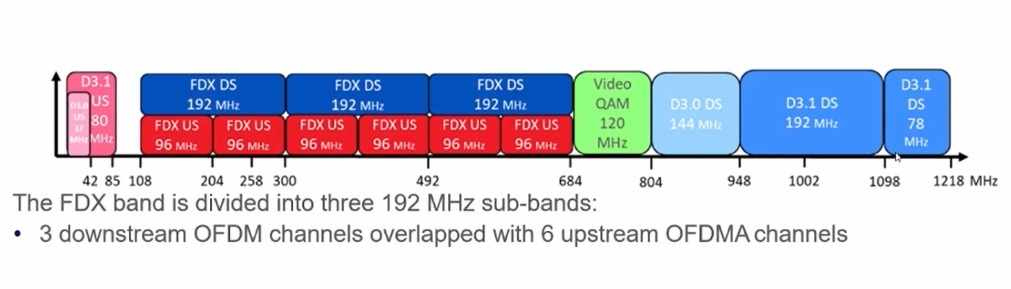
Nothing better illustrates how the cable TV business has changed than DOCSIS 4.0 spectrum plans, as tested by Comcast. Where it once was the case that almost all forward bandwidth was devoted to analog TV signals (50 MHz up to 1 GHz), 


source: Cisco, Broadband Library 


DOCSIS 4.0, as tested by Comcast, devotes most bandwidth to internet access, with just 120 MHz devoted to TV delivery, in the 684 MHz to 948 MHz region. And where traditionally frequency division was the multiplexing method, DOCSIS 4.0 will use time division as well. 

source: LightReading


Wednesday, January 12, 2022

How Big a Problem is the "Digital Divide?"

One always-present issue when looking at any particular social or economic problem is that we always face multiple problems at the same time. Drug overdoses, malnutrition, carbon and methane emissions, traffic, inflation, joblessness, homelessness, lack of medical care, uneven or inadequate educational opportunities, domestic violence, fair treatment of ehtnic, racial, religious or other minorities, corruption, crime and many other problems have to be tackled simultaneously. 


And it never is possible to rank order all of those problems in terms of allocating resources to solve the problems, in a holistic way, in real time, even assuming we have our means-ends causality chains correctly understood. 


In that vein, the “digital divide” is a bigger problem some places, compared to others, even if it can be seen as a problem no matter where we find it. 


That clearly is the case for people in many lower-income or middle-income countries, where internet access in lower-income countries exceeds four percent of monthly gross domestic product, for example. 


In most middle-income countries greater progress has been made, with costs below the International Telecommunications Union target of two percent of monthly GDP. 


In developed countries, the problems are mostly confined to rural areas or high-cost areas, as monthly recurring costs are below one percent of GDP. There still are issues to be solved, but they are relatively trivial compared to other problems we also face. 


source: ITU

Tuesday, January 11, 2022

How Far Can Fiber Asset Sales Go?

“Because we can” or “because we should” might explain a good deal of asset disposition behavior in the connectivity business these days. 


Optus owner Singtel, for example, is said to be mulling the sale of a stake in its Australian access facilities, a move that would allow Singtel to raise cash. 


Such opportunistic moves--as always--are driven by a combination of seller need, buyer interest and a broader rise in the value of optical fiber access and transport assets for investors in search of alternative assetshttps


Low interest rates mean lots of capital is available, while high valuations for other traditional assets also are driving investor interest in lower-valuation, higher-return financial vehicles and something more akin to a private equity approach to investing by institutional investors such as pension funds. 


Buyer interest has grown the value of optical fiber assets or the ability to create them,  while sellers are enticed by such higher valuations to monetize access network assets as they earlier monetized cell tower assets. Singtel itself sold a majority stake in its Australia cell towers in 2021. 


No doubt owner's economics still are important. But the issue is whether full ownership is required to reap that value. In a growing number of cases, partial ownership seems to be viewed favorably.

Monday, January 10, 2022

Streaming Does Not Change Everything

As much as video streaming has changed business models, there are some things it has not yet changed. At a high level, video entertainment and audio entertainment has been moving toward on-demand consumption for decades; virtual rather than physical media; unicast rather than multicast delivery. 

source: Statista 


But some things have not changed as much as observers say. Despite the virtually-universal description of AT&T’s ownership moves related to content, AT&T continues to own 71 percent of Discovery Warner Media. The results of that business are not fully consolidated, but AT&T reaps the reward of cash flow and profits related to that organization's success. 


In other countries different connectivity providers will have their distinct asset ownership profitles as well. But is is incorrect to say AT&T “has gotten out” of the content business. It has monetized some of its ownership and changed the way it continues to own such assets. But it still owns 71 percent of Discovery Warner Media. 


A few of us still believe that will be important, going forward, even if it is correct to say AT&T now can concentrate on its connectivity business with less distraction. 


But some things in the video content business have not changed. Subscriptions still dominate over full on-demand access. Content bundles still prevail over full a la carte access. Content catalogs still matter. 


What might be distinctively new is that the video content business has become globalized. No longer does it make as much sense for any content provider to operate in a single country, as streaming economics are vastly better on a global scale, as is true for most consumer-facing internet apps and services. The most-successful content services will operate globally. 


But bundles of content remain key, even if the delivery mechanism has changed.


Sunday, January 9, 2022

Balancing "Connecting the Unconnected" with "Faster Speeds for Many"

 The new infrastructure bill is touted as making $65 billion available for demand and supply investments in U.S. broadband access. And there is an argument to be made that both supply and demand investments will change consumer behavior. The issue is how much. 


Many people use their smartphones--on purpose--for personal internet access, and do not buy fixed network service. That is a demand issue, not a supply failure. But look only at supply issues. 


About 44,198 Hawaii households (10 percent) are said to have “no internet access.” It never is completely clear what definition is used. Some likely define it as having no networks which provide local service. But others might use the “25 Mbps” speed as the definition of broadband. So a household might have internet access, but not broadband. 


In fact, Hawaii internet access statistics are the same as for the United States as a whole. That suggests national statistics are relevant for judging where the greatest benefit from the new demand and supply policies is to be obtained. 


There are both supply and demand issues. About seven percent of households do not own a computer. If you do not use a computer, perhaps internet access is not so relevant. Recent surveys suggest seven percent of Americans do not use the internet, by choice. 


By some estimates, 23 percent of households have internet access, but not at the 25 Mbps rate defined as “broadband.” There is, in other words, a difference between “internet access” and “broadband.”


There also are key implications for investment. A home that has internet access, but not at 25 Mbps, must be upgraded. But the cost to do that often is far less than building brand-new facilities to a location without existing access. 


For the United States as a whole, only about two percent of households or less literally have no fixed network access. That two percent is where costs will be greatest, and also the most-isolated, cases. It might only be feasible to use satellite or some other wireless technology in those cases. 


For most locations, upgrades are called for, not necessarily greenfield construction. Most of the households “not buying or not able to buy” internet access are “upgrade” situations. To be sure, telcos will have to consider ripping out copper plant and switching to optical fiber, which might require new construction. 


So the issue there is the degree of benefit an average subsidy of $339 per location represents. 


Income almost certainly affects demand as well. About 19 percent of households with an annual income less than $75,000 have no internet subscription.


As always, educational attainment also matters. Some 10 percent of individuals without a high school diploma or equivalent do not buy internet access. 


Assume that total funding to affect demand and supply is about $300 million for the state. If half  the funds were spent on supply and half on demand, that implies $150 million to build new facilities. 


If 44,200 households need to be connected, that also implies capital investment and construction support of about $339 for each “non-subscribing” or “high cost”  location. Some might argue that is a helpful, but relatively small change in the business case for upgrades. It might be deemed generally insufficient to incentivize new construction in very high-cost areas.  


If one assumes a monthly cost of $50 for internet access, the $30 subsidy cuts costsof such plans 60 percent. 


source: Broadband Hui 


Again, however, many existing programs provide 25 Mbps broadband access at relatively low prices for low-income customers. It is not clear how much change the $30 a month additional subsidy will change buying behavior. But it certainly is reasonable to argue that the main impact is to create incentives for purchasing of higher-priced and faster-speed plans by customers now choosing to buy 25-Mbps service. 


On the supply side, since one big pool of money in the bill is allocated for “unserved” areas, we should expect to see incremental investment in such areas. Since another pool of money is allocated for “high-cost” areas, we similarly should see additional investment in such areas. But the actual additional lines added should be more modest than some expect, simply because such access lines are so hugely expensive. 


For practical political reasons, we are likely to see significant effort to show “big numbers” where it comes to improvement. And those results can be obtained mostly in cases where speed upgrades are possible for a wide number of lines. 


So it might be reasonable to expect a relatively small improvement in total “connected homes,” but a significant increase in homes able to buy service at speeds from 50 Mbps up to a gigabit per second. 


Not only is the impact likely to be wider for such incremental upgrades, but the total impact, compared to investment, will be highest as well. Assume two thirds of the supply-focused money will be spent on unconnected or hard-to-connect locations. Still, the third of funds spent to upgrade existing facilities will likely show the biggest numbers of locations that benefit.


Butterfly Effect: 100% Deterministic and Yet 0% Predictable

Maybe you have been puzzled by the butterfly effect , the idea that a tiny flap of a butterfly's wings in one part of the world can fund...