Monday, May 22, 2017

5G: The Downside

There is growing consensus that 5G could well mark a fundamental turning point in telecom industry history. If matters develop as hoped, a huge new wave of revenue growth, apps and services will be enabled.

And the biggest change of all is that the growth will come because computing actually becomes pervasive or ubiquitous, precisely as futurists have been predicting would eventually happen.

But 5G might also mark a historic change in industry dynamics for other reasons, perhaps not so welcome. It already is possible to argue that mobile data revenues and profits will follow the same path as earlier mobile services, such as voice and text messaging.

That is to say, gross revenue eventually will peak, while profit margins contract. If that happens with 4G, and if 5G represents only “more of the same,” clear problems could develop.

The biggest problem is that mobile data increasingly features a market requirement for supplying faster speeds and greater consumption, with incremental revenues that lag the increased supply.

For decades now, we have seen that average revenue per megabyte or gigabyte has fallen, dramatically. That will not change in the 5G era. Not a problem, some might argue. We will simply sell more units. Up to a point, that argument has merit.

It is the same argument suppliers have used in the voice business, and in the capacity business. It works for a while. Eventually, though, the revenue per unit sold does not compensate for the fact that consumers simply require fewer units. In other cases, usage quotas rise, while prices remain flat.

In the voice business, that shows up as declining minutes of use, declining numbers of fixed network subscriptions and declining prices per unit as well. In the capacity business, that shows up as higher usage allotments or higher speeds, at the same or lower prices.

And if that problem shows up in the 4G business, it arguably will get worse in the 5G era, in part because 5G is a more expensive network, and in part because the incremental new revenues do not justify the incremental new cost.

In other words, t is conceivable 5G actually will mark the end of a profitable business model for many mobile operators whose only real option is “access” services.

The problem is that we already can foresee a time when all current revenue streams (voice, text mesaging, mobile internet access) have past their peak, in terms of users, accounts and revenue generation. 5G is not automatically going to fix that.

For many mobile operators,, 5G will be a more-expensive platform that helps supply much-higher data consumption for human users, but at rates that lag unit growth. And though new revenue opportunities should develop in the area of machine communications, much of the upside will be reaped by platform, app, device or system suppliers, not connectivity suppliers.

So 5G is not just “the next generation of mobile.” It might be a generation of mobile that sees much of the industry disappear.

What Will the Future "Former Telco" Sell?

If Steelcase is not a furniture manufacturer, and Ford wants to stop being an “auto” manufacturer and become some kind of “mobility” company, one naturally wonders what it will take for former “telcos” to become something else, and what term we will eventually create that captures the nature of the change.

One framework is that telos become enablers of services and apps, more so than the creators of apps and services, more on the model of a “platform” than a provider of vertically-integrated services.

“I think the technology is probably already there. What isn’t yet there are the business models and the market structures and the ecosystems that need to cooperate with each other, need to be orchestrated in order to turn these things into a real business,” says Martin Creaner, corporate strategy advisor for Huawei.

All that is one other way of illustrating why the “don’t be a dumb pipe” argument is so important. Even if and when a telco “becomes something else,” that “something else” will still involve use of a network to create a business model and value for customers of some type.

Steelcase, for example, describes itself as providing “architecture, furniture and technology products and services designed to unlock human promise and support social, economic and environmental sustainability.” But its $3 billion in annual sales still revolve around what we call furniture.

In the same way, it is hard to imaging at least some telcos creating revenue streams where communications networks are not embedded or underpinning elements.

Sunday, May 21, 2017

Has Mobile Price Competition Driven Half of U.S. Inflation Drop in 2017?

This probably is a first: low U.S. inflation rates might well be driven in substantial part by new competition in the mobile business.

Nearly half of the  decline in core consumer price index inflation in 2017 can be traced to a single item: mobile services, according to Paul Ashworth, Capital Economics chief economist.  

Mobile service plan prices dropped seven percent  in March 2017 and fell an additional 1.7 percent  in April 2017, according to Labor Department data.

From April 2016, mobile service prices were down 12.9 percent the largest decline in 16 years.

Core inflation—prices excluding the volatile categories of food and energy—rose just 1.9 percent in April 2017 from a year earlier, decelerating from 2.3 percent growth in January 2017, as measured by the U.S. Labor Department’s consumer-price index.


Saturday, May 20, 2017

Uber Applies Artificial Intelligence to Create Pricing System for Uber Pool

Practical uses for artificial intelligence continue to proliferate. Uber Technologies, for example, now uses machine learning (a type of artificial intelligence that provides computers with the ability to learn without being explicitly programmed) to predict how much a particular rider is likely willing to pay for a specific trip, on a specific route.

In fact, Uber has used AI to create a new fare system based on machine learning. Called “route-based pricing,” the system charges customers based on what it predicts they’re willing to pay.

In the past, Uber calculated fares using mileage, time and multipliers based on passenger demand at a particular moment.

The change likely is related to the “upfront pricing” system Uber introduced in 2016, where riders are guaranteed a set fare before they book. That obviously places a premium on any intelligence Uber can use to incorporate willingness to pay in a more granular way, since the whole business model is premised in substantial part on variable pricing.

The trick is optimizing market clearing transactions, essentially matching what a rider is willing to pay and what a driver is willing to accept.

The value of such machine learning is one reason why Uber launched its artificial intelligence laboratory.  Though AI will be needed as Uber moves into the era of automated vehicles, the lab’s work apparently already has paid off in terms of using machine learning to tweak the far offering system.

Beyond that, the researchers will be working on developing forms of machine learning that need less data. That obviously would allow greater use of AI, with faster learning. Faster learning means AI can be applied in a wider range of cases.

The labs also are said to be working on machine learning systems that can explain the reasoning behind decisions. For a firm under much scrutiny, that makes sense. Uber itself, and others watching the company, will want explanations for “why” pricing rules are set the way they are.

Uber’s existing business apparently already benefits, as in the case of price predictions for the Uber pool service, where the new machine learning system is in use.

Friday, May 19, 2017

Three or Four? It Will Not be an Easy Decision

source: FCC
It likely still is true that the top four U.S. mobile service providers have about 98 percent market share.


Perhaps just as significant, from a market structure perspective, is the way antitrust regulators typically quantify the conditions that suggest a market is “concentrated,” which is a warning sign about the potential competitive impact of market consolidation.


This already has been an issue twice in the last decade regarding consolidation among the top-four providers, and obviously there is talk between Sprint and T-Mobile US about trying again, for a third time in a decade, to consolidate the ranks of the leaders from four to three.


Some believe a change of presidency is going to mean better prospects for any such effort. By most accounts, the U.S. mobile market has been “highly concentrated,” using the Department of Justice methodology, since 2005, and has grown more concentrated over the last decade.


So the issue, in the U.S. and many other markets, is what regulators believe is necessary to sustain competition. By definition, any combination of Sprint and T-Mobile US makes the U.S. market more concentrated.
source: FCC


There is an argument that more concentration can lead to more competition, though that clearly is not what virtually all analysts looking at the matter seem to believe. The reason equity analysts generally are in favor of such a merger is that it strengthens pricing power and reduces competition.


Since that leads to an ability to raise prices, consolidation arguably strengthens all the surviving three firms for the long term. In that view, higher profits for the survivors ensures survival, and therefore three leaders, not a duopoly.


Though some argue that the new merged Sprint-T-Mobile US would be in better position to challenge Verizon and AT&T more vigorously, there is an equally-strong case to be made that a stronger Sprint-plus-T-Mobile US would not want to rock the boat, and would back off its challenges.


That can--and arguably does happen--in stable markets because it is deemed advantageous to maintain the stability of a market that deters new attackers but also allows reasonable margins for each of the top-three providers.


Logically, even in that scenario, having three choices is better than having just two choices.


And, in the U.S. market, it is possible that a relatively-stable duopoly in the fixed network business still has delivered significant consumer benefit. So it cannot be dismissed, out of hand, that a three-provider market representing 98 percent market share would still deliver some competitive benefits, and possibly could work as well as the fixed network duopoly.


But it is hard to say what actually would happen. Optimists might point to market entry by the likes of Comcast, Charter and other cable companies, plus other forays by new entities with different business models that could provide new competition.


Pessimists will point to the low degree of consumer benefit under the old duopoly conditions before Sprint and others entered the market using 2-GHz spectrum.


Optimists will point to T-Mobile US success as an example of what might happen in a three-leader market.


Some might say that, yes, there will be less competition in a three-provider market, but that this is required to maintain profitable competition, rather than ruinous competition. Some might point to Sprint’s “nn-profitable” status as an example that four profitable providers are not possible in the U.S. market.


The rejoinder is that there are other ways to envision a stronger mobile market that still has four providers, including participation by Comcast or even other new owners with different business models, able to bring new assets to bear.


It is hard to say what might be allowed. But the U.S. mobile market will continue to be deemed “highly concentrated” by antitrust authorities, that much is clear.


Displaying Screenshot 2017-05-19 at 3.13.16 PM - Display 1.png

5G is All About the "Next Big Thing"

The hottest buzzword in telecommunications in 2017 is 5G. And a relative handful of service providers are racing to be first to deploy, for reasons that sometimes are not so obvious.  

First mover advantage is why “speed” (time to market) is driving mobile operators in the United States, South Korea, Japan and China.

“Getting to market first with LTE gave North American first-mover operators an extra 6.6 billion U.S. dollars in revenue over the second mover within five years,” says Amit Mukhopadhyay, partner at Nokia’s Bell Labs Consulting. “The same will be true with 5G, if not more so.”

What sometimes is less clear are the business motivations for 5G deployment, beyond the breathy slideware that has routinely been produced in advance of 3G and 4G, and now 5G. It is always, one way or the other, about “the next big thing.”

That might really the case this time, for some glaring reasons. Most significantly, all existing mobile revenue streams are either declining or about to decline. So the next leg of industry growth has to come from something other than voice, text messaging, mobile data or even video services, as important as that latter source is shaping up to be.

The problem is not especially new. After voice, text messaging drove revenue growth. Then mobile internet access came to the fore. Video subscriptions might help next, perhaps more on the scale of text messaging than mobile internet access.

But as the core voice and mobile data revenue streams drop away, the industry will have huge holes to fill, and there is universal belief that those big new revenue sources are going to come--broadly speaking--from selling services for use by machines, not humans.

Not for the first time, but with new urgency, the business model is key, not the network. As was the case for 3G, then 4G, the valuable new applications driving revenue growth had to be discovered. They were not obvious. The same will be true with 5G, with the new twist that it is applications and services for machines (sensors and servers) that will likely be key.

“With 5G, it is all about the use cases and your business strategy,” says Claudio Mattiello, Nokia network planning and optimization service product Manager,
 
There are other noteworthy changes. For the first time, the core networks themselves must be transformed to support the expected 5G end user applications.

“Network elements that are implemented in the telco cloud environment must enable the key concept of network slicing, in which services can be configured to different needs using the same underlying infrastructure,” says Ashok Rudrapatna, Bell Labs Consulting principal consultant.

All of that will be subject of the Spectrum Futures conference, to be held 18/19 September in Bangkok.

AT&T Activates LTE-M Network for IoT

AT&T has deployed its nationwide LTE-M network intended to support IoT, about a year ahead of schedule, which provides some idea of the faster tempo of network deployment to support both internet of things applications and 5G.


The LTE-M network is live across the United States on AT&T’s  4G LTE network.


AT&T also says it is deploying LTE-M across Mexico by the end of 2017 to create a North American LTE-M footprint covering 400 million people.


LTE-M rate plans start at $1.50 per month per device.  Further discounts will be available for yearly and multi-year plans, as well as volume commitments, AT&T says. That pricing illustrates one important facet of IoT connection revenue: it will be far less than connections for human devices such as phones.


LTE-M modules will be available for as low as $7.50 each, including a SIM card. That is half the cost of the LTE Cat-1 module AT&T launched in 2016. That fact also illustrates an ongoing process where mobile operator IoT retail costs plunge. That has been touted as an advantage for specialized IoT networks, but as promised and expected, mobile IoT retail costs are dropping to ranges at least equivalent to those of rival and specialized IoT networks.

At a high level, the specialized IoT networks arguably have a market window before mobile operator IoT networks are ubiquitous. After that happens, many expect advantage to shift to the mobile suppliers, for reasons of scale (marketing, capital resources and relationships).

Spectrumfutures postcard v5 final print

Mobile Internet Access Now Makes a Big Difference in "Access" Domain

If there are any certainties, it is that "everyone" agrees internet access, and faster access, are good things that "everybody" should have. That typically means "most people" approve of measures to improve access and speeds in rural areas and for poorer people.

One recent example: Tennessee Gov. Bill Haslam has signed the Tennessee Broadband Accessibility Act into law, releasing $45 million, to be disbursed over the next three years, in the form of grants and tax credits for Internet Service Providers (ISPs) making broadband service available to unserved homes and businesses.

internet_usage_2009_2016_ww
source: StatCounter
Connected Nation says the plan allows Tennessee’s private, non-profit electric cooperatives to provide retail broadband service and make grant funding available to the state’s local libraries to help residents improve their digital literacy skills.

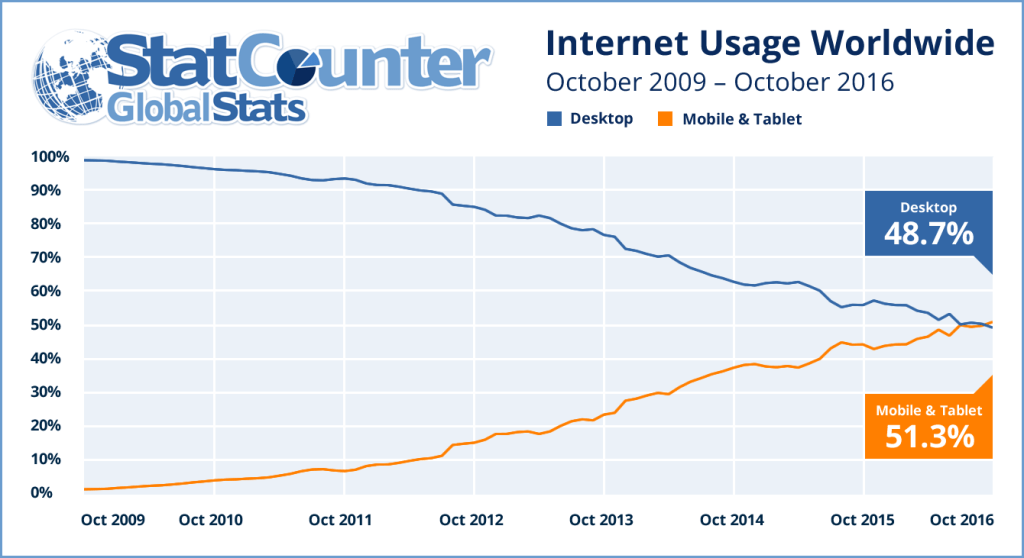
Observers can applaud the new efforts, while also noting that consumer preferences appear to be changing. It appears that virtually all the growth in broadband usage since about 2013 has come either from mobile or some other method of gaining access, based on a reported decline in home internet access purchasing since 2013.

There was a seven percent net gain in internet usage between 2013 and 2014, even as fixed network access dropped two percent. That suggests consumers are opting increasingly to use the internet significantly or primarily on their mobiles.

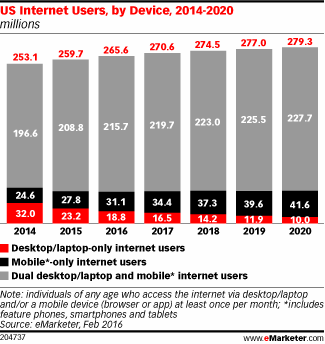
In the U.S. market, about 12 percent of all internet users relied solely on mobile only for internet access.

About six percent of Tennessee homes are unserved, studies have concluded. The bigger problem is the percentage of homes that do not have access at speeds at least 25 Mbps.


Perhaps 17 percent of Tennessee homes apparently did not have 25 Mbps access in 2014, while 66 percent did have such access.


Fixed network adoption in Tennessee seems to have peaked about 2013, even as internet access adoption climbed to 81 percent.  


That trend, reported in other earlier studies, suggests that mobile internet now is what is driving incremental subscription growth.

A related trend--faster speeds--could also affect our statistics. Some access lines using digital subscriber line could shift to fixed wireless as Verizon and AT&T turn to fixed wireless, including 5G variants, to boost access speeds.

How those lines are counted also could affect fixed access adoption figures. There is a logic to counting a fixed wireless connection as a "fixed" connection. There also is a logic to counting it as a "mobile" connection, if supplied by a mobile operator's network.

The point is that all things related to use of the internet, its apps and devices change with time. It almost does not make sense to distinguish between "broadband" access and ""internet access." It no longer makes sense to ignore the huge amount of internet access that happens in the mobile domain.

Nor, where it comes to measuring "broadband" or "internet access" progress, can be ignore the role played by mobile internet access.

AI No Longer a "Science Project"

source: Tata Consultancy Services
Some technologies are in development for such a long time it seems as though they always will be “science projects,” not commercial realities. That actually is not true for artificial intelligence, which is being used to reduce electrical use at data centers or expedite customer service interactions.


Amazon Web Services uses a compute capacity forecasting model driven by machine-learning (artificial intelligence), AWS CEO Andy Jassy said.


For example, AWS uses sales team efforts (who they visit, when)  to forecast demand. The company also has used AI to predict where it has to store excess components, he adds.


All that helps AWS control its capital spending.


AWS also uses AI to reduce fraud, bad debt, and the number of customers who didn’t get their goods and suppliers who didn’t get their money.


AI has been important for content and search activities. Bing uses AI to support search operations, for example. Other firms use AI to personalize content for discrete users.


Also, sales automation, an older trend, now is being boosted by application of AI to allow more predictive value, not so much “what happened?” but “what will happen next?”


Insurance payments are another area where AI is applied to streamline operations. Others use AI to automate chatbot interactions.


Uber uses AI to personalize rider interactions, such as offering suggested destinations based on your current location and past habits. Expedia uses AI for fraud detection and better travel recommendations.  Banks use AI for phone-based customer service interactions.


Tata Consultancy Services says enterprises it surveyed already are using AI in 63 core areas,  most frequently to detect and fend off computer security intrusions in the IT department.

Spectrum futures flyer 2017 7 final print


Thursday, May 18, 2017

Capex Estimates Hinge on Assumptions, Since it All is At the Margin

Assumptions always matter when conducting studies. But assumptions also are important when looking at levels of capital investment at aggregate levels. Firm priorities can vary. Industry segment patterns can be quite distinct. Also, "capex" includes all manner of investments not directly related to network investment. 

It is worth noting that “capex” includes lots of spending (trucks, customer premises equipment, international spending, smartphone leasing, buildings and computing gear) that might not contribute to our assessment of “network” investment.

Also, big mergers and acquisitions, plus spending on customer premises equipment, can skew reported capex. When total spending is deemed to have changed in low single digits, such nuances can make the difference between growth or decline, on a reported basis.

USTelecom’s seventh annual report on U.S. broadband investment numbers is not available yet, but “our initial analysis strongly suggests that investment in 2016 continued to trend downward following the Federal Communications Commission’s (FCC) adoption of the 2015 Open Internet Order,” says Patrick Brogan, UST VP.

Data compiled from internet service providers representing 90 percent to 95 percent of annual industry capital expenditures, suggests the dip in broadband investment UST reported on in 2015 was not a one-off occurrence.

In 2016, capital expenditures was $71 billion, down from $73 billion in 2015 and $74 billion in 2014, UST says, an amount $2.5 billion to $3 billion lower in 2016 than it was in 2014, the year before the FCC adopted Title II utility regulations.

The amount of U.S. capital investment  is highly contested. Clearly, cable TV operator capex was up; fixed network capex was down and mobile capex was up, though one has to adjust for the impact of handset subsidy accounting rules. Financing of smartphone handsets is “capex” under accounting rules, but does not help us understand changes in network capex.

That noted, some studies suggest higher capex under common carrier rules, while others argue the opposite case.  

For others, what would have happened is the key issue.


Claims by some that broadband provider capex increased in 2015 and 2016 ignore accounting adjustments for certain non-material items like leased cellphones and acquisitions, such as AT&T’s merger with DirecTV and a Mexican wireless operation, UST argues.

The crucial question is what would have capex been if Title II had not been imposed, controlling for other factors.

IoT Connectivity: "All of the Above"

By most estimates, device connectivity revenue might represent as little as five percent or perhaps 10 percent of the new revenue to be created by most internet of things applications and services. Among the reasons is that existing connectivity solutions could well play a part

Short-range access methods such as Bluetooth, Wi-Fi, and 802.15.4, for example, could be device connectivity options that leverage existing network access services. To the extent that happens, nearly zero incremental access revenue is created.

ABI Research forecasts IoT will represent 15 percent of Wi-Fi, 27 percent of Bluetooth, and over 60 percent of 802.15.4 device shipments by 2022.

LPWAN and legacy M2M cellular technologies are set to ship nearly 575 million chipsets by 2022, growing faster than any short-range connectivity solution across IoT verticals.

ABI Research finds that cellular and LPWAN technologies, often perceived as more reliable than short-range connectivity solutions, require less intermediary gateways, can support greater distances between end nodes, and scale from the very smallest to the largest number of end devices, while providing a battery life that exceeds 10 years.

It is reasonable to assume widespread use of existing short-range access methods to support consumer wearable apps. It might not be so much the case for enterprise and business apps, which might require higher perceived reliability or reach.

“These technologies are specifically designed for IoT and are arguably much better matches for outdoor, larger-scale IoT applications due to their abilities to target greater coverage areas, their ease of deployment, and their greater scalability,” says says Andrew Zignani, Senior Analyst at ABI Research.

Wholesale is Among AT&T's Smart Cities Revenue Opportunities

There seems to be growing recognition that internet of things will create incremental revenue opportunities for access providers, but not as much incremental revenue as will applications in a number of vertical settings, ranging from water and lighting grids to urban transportation and parking.

Connectivity alone accounts for between five percent and 10 percent of the smart cities value chain, says Mike Zeto, general manager of AT&T's smart cities business unit. Among the opportunities AT&T sees is the chance to license its platforms to other telcos, providing a wholesale applications capability that is subscriber information module based, and can then be bundled with the access services partners already operate.


Business Case is the Big Issue for 5G

Bob Everson, mobility domain leader for Cisco’s Global Service Provider segment, points out that a  clear business case as their most significant service provider concern about 5G. That is logical, considering that the big new use cases for 5G are more about internet of things and non-human users, than new use cases for humans. Fixed wireless would seem to be the big new opportunity, near term. 

Advanced 4G Underpins 5G, Says AT&T Director Brian Daly

Brian Daly, AT&T director of core and government/regulatory standards, emphasizes not only that 4G will underpin 5G for a long time, but also that 5G is about both fixed and mobile access. 

Yes, Follow the Data. Even if it Does Not Fit Your Agenda

When people argue we need to “follow the science” that should be true in all cases, not only in cases where the data fits one’s political pr...