AT&T’s new plan to throttle access speeds of customers on grandfathered “unlimited” service plans seems to have been withdrawn. AT&T had planned to throttle users in the top-five percentile of usage at any specific location.
But AT&T now says it will now throttle 3G network users after 3 GBytes of usage and LTE users after 5 GBytes of usage. The former plan meant users could not tell whether they would face throttling. Under the new plan, they in principle will know when the throttling kicks in.
The rules do not affect customers on AT&T’s current tiered service plans.
The change came after significant pushback from customers who properly objected that the rules did not allow people to protect themselves. Even lighter users might find themselves in a coverage area where their usage put them, temporarily, into the “top five percent of users.”
Essentially, users complained that there was no way to modify and regulate their own behavior and consumption to comply with the guidelines. AT&T now seems to agree.
Just an observation: sometimes users can help their service providers figure out fair ways to manage networks. Most users are not unreasonable about usage limits. But they do understand rule clarity and fairness. In this case, users helped AT&T craft a "better" policy, in the sense that users agree it is fair.
Sunday, March 4, 2012
Users Help AT&T Figure Out "Throttling"
Gary Kim was cited as a global "Power Mobile Influencer" by Forbes, ranked second in the world for coverage of the mobile business, and as a "top 10" telecom analyst. He is a member of Mensa, the international organization for people with IQs in the top two percent.
Will Telcos Be Pipes or Service Providers?
Almost no question is strategically more important for any cable TV company or telco than the issue of what future is possible, or desirable. Telcos and cable TV companies always have been "service" providers, where applications and access were tightly bundled.
Broadband access was the first consumer service to break from that mold, and private line services were the first big change in the business customer segment.
So the big issue now is what "should" be the strategy in a business environment where virtually every application can, in principle, be delivered to users "over the top."
Broadband access was the first consumer service to break from that mold, and private line services were the first big change in the business customer segment.
So the big issue now is what "should" be the strategy in a business environment where virtually every application can, in principle, be delivered to users "over the top."
Deutsche Telekom CEO Rene Obermann said the cloud was an opportunity for telcos to “make the most of our assets” and transform themselves into "smart pipes."
Still "pipes," mind you, but pipes that have features.
“Most people expect us to become dumb pipes, but that’s wrong," says Obermann. "The question of whether we will be dumb pipes or smart pipes will be a thing of the past.”
In areas such as traffic management and quality of service, network access and transport providers will essentially make substantial money providing various traffic management functions sold to third parties that have a business interest in the end user quality of experience.
That assumes regulators will let access providers provide quality of service measures that end users can buy, or that application and service providers can buy. It also assumes customers are willing to pay.
In areas such as traffic management and quality of service, network access and transport providers will essentially make substantial money providing various traffic management functions sold to third parties that have a business interest in the end user quality of experience.
That assumes regulators will let access providers provide quality of service measures that end users can buy, or that application and service providers can buy. It also assumes customers are willing to pay.
Though both over the top and owned apps, services and features are likely to be staples of any long-term future to some degree, the pipe function is going to be more important over time. Nor is it clear that the revenue contributed by the smart features ever will be quite so substantial as the "dumb" access feature.
One is hard pressed to think of any "value-added" feature in the mobile or fixed network businesses that provides as much gross revenue as the "basic" service. In other words, do the security features offered to consumers as part of their broadband access subscription drive as much revenue as the access?
Wll QoS mechanisms drive as much revenue as access and transport, for business customers?
To be sure, one might argue that a content delivery network so blends a transport function with a value add that it is difficult to compare the incremental revenue provided by the "content acceleration," compared to "simple transport."
The point is that the value adds probably never will be driving as much revenue as the "base" access products. The issue is to find the exceptions to the rule.
If a mobile service provider sells a stand-alone personal Wi-Fi Hotspot feature for a smart phone subscription, is the incremental cost likely to approach the retail price of the smart phone's data plan? Probably not.
But could the personal Wi-Fi Hotspot plan drive incremental revenue that is up to 50 percent of the cost of the basic smart phone access? That is possible, and highly significant.
One is hard pressed to think of any "value-added" feature in the mobile or fixed network businesses that provides as much gross revenue as the "basic" service. In other words, do the security features offered to consumers as part of their broadband access subscription drive as much revenue as the access?
Wll QoS mechanisms drive as much revenue as access and transport, for business customers?
To be sure, one might argue that a content delivery network so blends a transport function with a value add that it is difficult to compare the incremental revenue provided by the "content acceleration," compared to "simple transport."
The point is that the value adds probably never will be driving as much revenue as the "base" access products. The issue is to find the exceptions to the rule.
If a mobile service provider sells a stand-alone personal Wi-Fi Hotspot feature for a smart phone subscription, is the incremental cost likely to approach the retail price of the smart phone's data plan? Probably not.
But could the personal Wi-Fi Hotspot plan drive incremental revenue that is up to 50 percent of the cost of the basic smart phone access? That is possible, and highly significant.
Keep in mind that a personal Wi-Fi Hotspot service is still a "dumb pipe" product. But one might conceive of it as a value-added feature of the basic smart phone broadband access service.
The point is that dumb pipe, though derided, should continue to be the foundation for all the smart pipe features, and that these "smart" features will represent incremental revenue that is some percentage of the value of the "dumb pipe" access.
Nor is the underlying wholesale cost of bandwidth necessarily related in linear fashion to retail value and pricing. The value of personal Wi-Fi Hotspot bits arguably is higher than that of smart phone bits, or no rational consumer would pay extra for the feature.
The issue is how many of these enhancements to "dumb pipe" are conceivable and possible, even when the pipe remains the foundation for the rest of the business. .
Nor is the underlying wholesale cost of bandwidth necessarily related in linear fashion to retail value and pricing. The value of personal Wi-Fi Hotspot bits arguably is higher than that of smart phone bits, or no rational consumer would pay extra for the feature.
The issue is how many of these enhancements to "dumb pipe" are conceivable and possible, even when the pipe remains the foundation for the rest of the business. .
Cornelius Vanderbilt cut the price of rail freight 90 percent, Andrew Carnegie slashed steel prices 75 percent and John D. Rockefeller cut oil prices 80 percent between 1870 and 1900.
Malcom McLean, Sam Walton and Michael Dell did roughly the same for container shipping, discount retailing and home computing a century later. Such radical changes often are unwelcome by the producing community, though the consuming public benefits.
In some ways, what service providers are trying to do is sell automobiles and ships rather than steel, even as steel remains the underpinning of the business.
Service providers always built services on top of pipes. They always have sold "voice" as a retail product to end users; the pipe was only a means to create the service.
What is is different now is that the pipe is becoming the foundation product for the future. Users will buy access to the Internet and apps, whether they buy apps and services from the "pipe services" provider, or not.
That's the new strategic challenge: to build the whole new business around pipe services.
In some ways, what service providers are trying to do is sell automobiles and ships rather than steel, even as steel remains the underpinning of the business.
Service providers always built services on top of pipes. They always have sold "voice" as a retail product to end users; the pipe was only a means to create the service.
What is is different now is that the pipe is becoming the foundation product for the future. Users will buy access to the Internet and apps, whether they buy apps and services from the "pipe services" provider, or not.
That's the new strategic challenge: to build the whole new business around pipe services.
Gary Kim was cited as a global "Power Mobile Influencer" by Forbes, ranked second in the world for coverage of the mobile business, and as a "top 10" telecom analyst. He is a member of Mensa, the international organization for people with IQs in the top two percent.
Why Pay Attention to Mobile Payments?
It isn't always completely clear why people who care about the mobile business should necessarily pay attention to "mobile payments," not a subject that represents the most-popular subject on this site.
The reason is that "mobile payments" is an answer to several key questions. "What business are you in?" is one such important question. "Where will you find future sources of revenue?" is another key question. "How will you do that?" is a third important question mobile and fixed network executives have to ask themselves, and answer.
One of the by-now clear implications of the Internet is that it enables competition on a different scale than in the past. In other words, "people who aren't in our business" can get into your business.
The other salient observation is that new industries tend to get created when attackers use the Internet to disrupt an existing business. It isn't simply that the legacy industry is changed; sometimes an entirely new industry emerges.
Mobile payments is akin to a massive collision of galaxies. Banking, telecom, retailing and marketing are huge industries in their own right, but find themselves colliding in new ways around the use of mobile to shop and pay.
So the humble thesis is that when industries that big collide, something equally big is going to emerge. Hence, the coverage of mobile payments.
nevertheless keeps getting talked about. It's a strategic
The reason is that "mobile payments" is an answer to several key questions. "What business are you in?" is one such important question. "Where will you find future sources of revenue?" is another key question. "How will you do that?" is a third important question mobile and fixed network executives have to ask themselves, and answer.
One of the by-now clear implications of the Internet is that it enables competition on a different scale than in the past. In other words, "people who aren't in our business" can get into your business.
The other salient observation is that new industries tend to get created when attackers use the Internet to disrupt an existing business. It isn't simply that the legacy industry is changed; sometimes an entirely new industry emerges.
Mobile payments is akin to a massive collision of galaxies. Banking, telecom, retailing and marketing are huge industries in their own right, but find themselves colliding in new ways around the use of mobile to shop and pay.
So the humble thesis is that when industries that big collide, something equally big is going to emerge. Hence, the coverage of mobile payments.
nevertheless keeps getting talked about. It's a strategic
Gary Kim was cited as a global "Power Mobile Influencer" by Forbes, ranked second in the world for coverage of the mobile business, and as a "top 10" telecom analyst. He is a member of Mensa, the international organization for people with IQs in the top two percent.
Saturday, March 3, 2012
What Comes Next Will Reshape Mobile Marketing, the Issue is "How?"
While delivering a speech at the San Diego Social Media Symposium, hosted by Nuffer, Smith, Tucker, the question of “what comes next,” or “who comes next,” in terms of computing industry leadership, came up.
The reason for the question is that technology enables new forms of marketing at the same time technology changes the potential effectiveness of existing channels. Among the best examples is use of social networks for marketing.
Facebook finally has figured out how to use display marketing in a PC context. It is just now exploring how to do advertising and marketing in a mobile device context. Twitter has developed the promoted tweet, a new form of marketing messaging.
At least 40 percent of all Facebook activity, for example, now occurs on mobile devices. And though all channels used in a PC context can, in principle, also be used on tablets and smart phones, there are key contextual challenges.
The substitution of a touch and swipe user interface rather than keyboard and mouse are examples. The amount of screen real estate are other key issues.
Beyond that, the use case for each device tends to be distinct. Smart phones are the “best” device for “on the go” apps and messaging. Smart phones are best suited to location apps and communications.
Tablets are less “mobile,” and suited to content consumption activities, though the setting is more “couch” than “on the go.” It is nevertheless true that smart phones get used at home or at the office more than “in transit.”
PCs increasingly are being “relegated” to work or desktop settings.
The truthful answer is that nobody knows yet how computing, and marketing possibillity will change in the next era. Part of the indeterminacy is that it is hard to figure out what era, epoch or age is coming. We all sense that mobile and Internet will be foundational, as will the pervasiveness of computing.
But that doesn’t help refine one’s search for the “next big thing” or the characteristics of firms or enabling technologies that might lead the next era, epoch or age. It seems clear, in retrospect, that virtually nobody, or almost nobody, could have foreseen the power of “search” or “social networking.”
Few seem to have recognized the importance of the “browser” or visual computing. Many would be surprised that Apple could be called the most important technology firm on the planet, or that a technology firm as large as Google could be funded by advertising.
Asked to speak about mobile marketing, one has to acknowledge the immediate difficulty. Mobile is many things, including discrete devices ranging from notebook PCs to tablets to smart phones to game players to music players. In principle, any current form of digital or online marketing can be applied to any Internet-connected device with a screen.
So email, text messaging, display advertising, promoted tweets, promoted stories, content marketing, social networks, blogs and websites all are channels that can be used across all screens, whether mobile or stationary. So too are tactics including earned media, paid media and owned media.
What isn’t yet so clear is which approaches will ultimately emerge as ideally suited to each category of screen, type of user interface or application setting. Mobile is a bunch of things, marketing is a bunch of things and so is “digital” or “online.”
A 2008 Microsoft paper described eras largely in terms of the relationship between computers and people. In the mainframe era, one computer served many people. In the PC era (for analytical purposes, Microsoft apparently did not see the mini-computer era as qualitatively significant) there was one PC per person. In the 2000s, which Microsoft describes as the mobility era, there are several devices per user. In the coming ubiquity era there will be thousands of computing devices for every user.
You might therefore represent the change quantitatively. But it is the notion of pervasiveness that probably gets to the heart of the matter. In any era where computing is literally embedded widely into the fabric of life, “computing” itself fails to stand out. It becomes something like electricity, an underpinning more than a discrete pursuit.
Nobody would call the present era the “era of electricity,” as one might have spoken of the “age of the automobile.
In fact, geologic time is the polar opposite of computing or Internet time, where the taxonomy of eonothem (eons) , erathem (eras), system (period), series (epoch), and stage (age) are used to refer to the layers of rock that correspond to these periods of geologic time. On a scale where the most-granular measure of time is “millions” of years, the entire history of computing occurs on a time scale too short to measure.
To the extent that one can apply the geologic taxonomy, the Internet eon and pre-Internet eon might make sense, as use of the Internet spans multiple computing eras.
Perhaps we are have mistaken eras for ages or epochs, though. Mainframe, PC and mobile “eras” might be better seen, from a longer time frame as ages, epochs or periods within the broader framework of tool use.
The point is that people might instinctively sense that Internet, broadband, web and apps have some significance in the history of computing that we’ve not had time to digest and put into perspective. Clearly something important has happened with the Internet, and clearly something important is coming in terms of mobility and mobile devices. Precisely how that fits with the taxonomy of computing is not so clear.
The reason for the question is that technology enables new forms of marketing at the same time technology changes the potential effectiveness of existing channels. Among the best examples is use of social networks for marketing.
Facebook finally has figured out how to use display marketing in a PC context. It is just now exploring how to do advertising and marketing in a mobile device context. Twitter has developed the promoted tweet, a new form of marketing messaging.
At least 40 percent of all Facebook activity, for example, now occurs on mobile devices. And though all channels used in a PC context can, in principle, also be used on tablets and smart phones, there are key contextual challenges.
The substitution of a touch and swipe user interface rather than keyboard and mouse are examples. The amount of screen real estate are other key issues.
Beyond that, the use case for each device tends to be distinct. Smart phones are the “best” device for “on the go” apps and messaging. Smart phones are best suited to location apps and communications.
Tablets are less “mobile,” and suited to content consumption activities, though the setting is more “couch” than “on the go.” It is nevertheless true that smart phones get used at home or at the office more than “in transit.”
PCs increasingly are being “relegated” to work or desktop settings.
The truthful answer is that nobody knows yet how computing, and marketing possibillity will change in the next era. Part of the indeterminacy is that it is hard to figure out what era, epoch or age is coming. We all sense that mobile and Internet will be foundational, as will the pervasiveness of computing.
But that doesn’t help refine one’s search for the “next big thing” or the characteristics of firms or enabling technologies that might lead the next era, epoch or age. It seems clear, in retrospect, that virtually nobody, or almost nobody, could have foreseen the power of “search” or “social networking.”
Few seem to have recognized the importance of the “browser” or visual computing. Many would be surprised that Apple could be called the most important technology firm on the planet, or that a technology firm as large as Google could be funded by advertising.
Asked to speak about mobile marketing, one has to acknowledge the immediate difficulty. Mobile is many things, including discrete devices ranging from notebook PCs to tablets to smart phones to game players to music players. In principle, any current form of digital or online marketing can be applied to any Internet-connected device with a screen.
So email, text messaging, display advertising, promoted tweets, promoted stories, content marketing, social networks, blogs and websites all are channels that can be used across all screens, whether mobile or stationary. So too are tactics including earned media, paid media and owned media.
What isn’t yet so clear is which approaches will ultimately emerge as ideally suited to each category of screen, type of user interface or application setting. Mobile is a bunch of things, marketing is a bunch of things and so is “digital” or “online.”
A 2008 Microsoft paper described eras largely in terms of the relationship between computers and people. In the mainframe era, one computer served many people. In the PC era (for analytical purposes, Microsoft apparently did not see the mini-computer era as qualitatively significant) there was one PC per person. In the 2000s, which Microsoft describes as the mobility era, there are several devices per user. In the coming ubiquity era there will be thousands of computing devices for every user.
You might therefore represent the change quantitatively. But it is the notion of pervasiveness that probably gets to the heart of the matter. In any era where computing is literally embedded widely into the fabric of life, “computing” itself fails to stand out. It becomes something like electricity, an underpinning more than a discrete pursuit.
Nobody would call the present era the “era of electricity,” as one might have spoken of the “age of the automobile.
In fact, geologic time is the polar opposite of computing or Internet time, where the taxonomy of eonothem (eons) , erathem (eras), system (period), series (epoch), and stage (age) are used to refer to the layers of rock that correspond to these periods of geologic time. On a scale where the most-granular measure of time is “millions” of years, the entire history of computing occurs on a time scale too short to measure.
To the extent that one can apply the geologic taxonomy, the Internet eon and pre-Internet eon might make sense, as use of the Internet spans multiple computing eras.
Perhaps we are have mistaken eras for ages or epochs, though. Mainframe, PC and mobile “eras” might be better seen, from a longer time frame as ages, epochs or periods within the broader framework of tool use.
The point is that people might instinctively sense that Internet, broadband, web and apps have some significance in the history of computing that we’ve not had time to digest and put into perspective. Clearly something important has happened with the Internet, and clearly something important is coming in terms of mobility and mobile devices. Precisely how that fits with the taxonomy of computing is not so clear.
Gary Kim was cited as a global "Power Mobile Influencer" by Forbes, ranked second in the world for coverage of the mobile business, and as a "top 10" telecom analyst. He is a member of Mensa, the international organization for people with IQs in the top two percent.
What Era of Computing are We In? What Comes Next?
Most technology historians would agree there was a mainframe era of computing, followed by the mini-computer and then PC or client-server era. Most would agree that each era of computing has been lead by different companies.
IBM in the mainframe era; Digital Equipment Corp. in the mini-computer era and Microsoft and Intel in the PC (or Cisco in the client-server era, as one might also refer to the PC era) are examples.
But here's the thing: we don't yet know whether the new era is here, or only coming. There has been a trend towards computing pervasiveness, as each era has succeeded the earlier era. Computing used to be in a "glass room." Then it could be done in a closet. With PCs computing moved to the desktop.
Certainly computing in a mobile period (we can't say yet whether it is a "mobile era") is moving beyond the desktop and into pockets and purses. We already can predict that computing has begun to become pervasive in all sorts of machinery as well.
Nor is is easy to describe even the present era. The role of software obviously has become more important over time. But, to this point, computing eras have never been defined by the key applications enabled. Perhaps we will one day see matters differently, but it would be a change to shift from "how" computing is done to "what computing does" to define the eras.
The Internet is more important, but not necessarily always because that is where the "computing" is done. Cloud computing is becoming more important, and does shift the locus of computing activities.
We all sense that a new era is coming, and that the Internet, mobile devices and applications will be more important. But there is not any agreement on whether we have "arrived" or are still only approaching the new era.
Most would agree that a new era--one we cannot yet even name--is coming. Most think the Internet and mobile devices will have something to do with that new era, but we can't be completely sure yet whether that is the right way to look at what is coming.
But there are signs. Apple's market capitalization topped $500 billion for the first time in February 2012. Apple's valuation is notable in other ways as well.
Apple is in a class by itself, both financially and in terms of its leadership of the technology industry. In some ways, that is a return to the older pattern, where IBM made computers, as did DEC. In the PC era, neither Microsoft nor Intel did so.
That isn't to say Apple is now the dominant firm in tomorrow's era, but simply to note that, if there are epochs within eras, then right now Apple best exemplifies leadership of computing. Paradoxically, Apple has dropped the word "Computer" from its name, which further indicates change.
We certainly are leaving the PC era. That's why former Apple CEO Steve Jobs always insisted the iPad was not a PC. In fact, many would insist that it is the tablet's optimization for content consumption that makes it distinctive.
We can't yet say that the next era of computing is defined by mobile devices, tablets, the Internet or cloud computing or even the fact that leadership is shifting more in the direction of applications and activities than computing appliances. But all of that hints at the shape of what might be coming.
But there are other signs. Google is the first really-big technology company with an advertising revenue model. In the past, it has been software or hardware sales that were the revenue driver.
Nor is it so easy to clearly separate dominant firms that are built on the existence of the Internet (which might be an epoch within the PC era, or a name for the next era, or a way of creating and using applications that could span eras) from the actual era itself.
Some might say that among the changes is that the mode of computing matters less than the applications enabled by computing. Though "a machine" has been the exemplar of past computing eras, maybe that will not be the case next time, or in eras to follow. Perhaps something else will be the defining element.
It would be reasonable to say that, although the PC is the dominant device, mobile phones and tablets are being added to the device mix. Nor would it be incorrect to say that the Internet has become the key network used by all the devices.
But neither is it easy to sort out the relationship between Internet as network, devices and applications. People do all sorts of things on the Internet, but it wouldn't make sense to say we are in the era of Internet-enabled shopping, searching, viewing, listening, game playing or communicating. We do all those things, and more, but the activities themselves do not seem to make sense as a way of describing the era.
Perhaps we now are entering a phase of such pervasive computing, embedded widely in so many areas of everyday life, that we will not be able to describe an era by the dominant way computing is done, but only by some other indicator.
Consider that Amazon and Barnes & Noble now appear on rankings of tablet market share, for example. That itself hints at a shift. And Apple is something of an anomaly. Though it began life in the PC era, it never "lead" that era. Only now, as it has dropped the word "computer" from its name, and only as devices other than computers have driven its business (iPods), and now drive its business (mobile phones, tablets), has Apple become perhaps the dominant force in "computing." It's a paradox.
Consider that Apple represents a 3.8 percent weighting in the Standard & Poors 500 Index.
In the fourth quarter of 2011, S&P 500 firms grew earnings 6.6 percent. But remove only Apple from the index and S&P 500 and the index grew at only a 2.8 percent rate. In other words, Apple performs so much better than most other firms that it distorts perceptions of the market.
Also, some would note, Apple, in terms of market valuation is bigger than that of Google and Microsoft combined. Microsoft is valued at about $257 billion and Google at about $197 billion.
In the product area, though many firms "compete" against Apple, few can approach it. In very real terms, there is not yet so much a "tablet" market as there is an "iPad" market, as Apple holds a 62-percent share of unit sales.
In smart phones, the story is not so much unit shipments as profit. In the third quarter of 2011 Apple earned about 61 percent of total smart phone profits, globally, all by itself.
Although soaring sales of Amazon’s Kindle Fire and other low-priced tablets trimmed Apple Inc.’s media tablet market share in the fourth-quarter, it was Apple’s own newly introduced iPhone 4S that proved to be the strongest competitor for the iPad during the final three months of 2011.
IBM in the mainframe era; Digital Equipment Corp. in the mini-computer era and Microsoft and Intel in the PC (or Cisco in the client-server era, as one might also refer to the PC era) are examples.
But here's the thing: we don't yet know whether the new era is here, or only coming. There has been a trend towards computing pervasiveness, as each era has succeeded the earlier era. Computing used to be in a "glass room." Then it could be done in a closet. With PCs computing moved to the desktop.
Certainly computing in a mobile period (we can't say yet whether it is a "mobile era") is moving beyond the desktop and into pockets and purses. We already can predict that computing has begun to become pervasive in all sorts of machinery as well.
Nor is is easy to describe even the present era. The role of software obviously has become more important over time. But, to this point, computing eras have never been defined by the key applications enabled. Perhaps we will one day see matters differently, but it would be a change to shift from "how" computing is done to "what computing does" to define the eras.
The Internet is more important, but not necessarily always because that is where the "computing" is done. Cloud computing is becoming more important, and does shift the locus of computing activities.
We all sense that a new era is coming, and that the Internet, mobile devices and applications will be more important. But there is not any agreement on whether we have "arrived" or are still only approaching the new era.
Most would agree that a new era--one we cannot yet even name--is coming. Most think the Internet and mobile devices will have something to do with that new era, but we can't be completely sure yet whether that is the right way to look at what is coming.
But there are signs. Apple's market capitalization topped $500 billion for the first time in February 2012. Apple's valuation is notable in other ways as well.
Apple is in a class by itself, both financially and in terms of its leadership of the technology industry. In some ways, that is a return to the older pattern, where IBM made computers, as did DEC. In the PC era, neither Microsoft nor Intel did so.
That isn't to say Apple is now the dominant firm in tomorrow's era, but simply to note that, if there are epochs within eras, then right now Apple best exemplifies leadership of computing. Paradoxically, Apple has dropped the word "Computer" from its name, which further indicates change.
We certainly are leaving the PC era. That's why former Apple CEO Steve Jobs always insisted the iPad was not a PC. In fact, many would insist that it is the tablet's optimization for content consumption that makes it distinctive.
We can't yet say that the next era of computing is defined by mobile devices, tablets, the Internet or cloud computing or even the fact that leadership is shifting more in the direction of applications and activities than computing appliances. But all of that hints at the shape of what might be coming.
But there are other signs. Google is the first really-big technology company with an advertising revenue model. In the past, it has been software or hardware sales that were the revenue driver.
Nor is it so easy to clearly separate dominant firms that are built on the existence of the Internet (which might be an epoch within the PC era, or a name for the next era, or a way of creating and using applications that could span eras) from the actual era itself.
Some might say that among the changes is that the mode of computing matters less than the applications enabled by computing. Though "a machine" has been the exemplar of past computing eras, maybe that will not be the case next time, or in eras to follow. Perhaps something else will be the defining element.
It would be reasonable to say that, although the PC is the dominant device, mobile phones and tablets are being added to the device mix. Nor would it be incorrect to say that the Internet has become the key network used by all the devices.
But neither is it easy to sort out the relationship between Internet as network, devices and applications. People do all sorts of things on the Internet, but it wouldn't make sense to say we are in the era of Internet-enabled shopping, searching, viewing, listening, game playing or communicating. We do all those things, and more, but the activities themselves do not seem to make sense as a way of describing the era.
Consider that Amazon and Barnes & Noble now appear on rankings of tablet market share, for example. That itself hints at a shift. And Apple is something of an anomaly. Though it began life in the PC era, it never "lead" that era. Only now, as it has dropped the word "computer" from its name, and only as devices other than computers have driven its business (iPods), and now drive its business (mobile phones, tablets), has Apple become perhaps the dominant force in "computing." It's a paradox.
In the fourth quarter of 2011, S&P 500 firms grew earnings 6.6 percent. But remove only Apple from the index and S&P 500 and the index grew at only a 2.8 percent rate. In other words, Apple performs so much better than most other firms that it distorts perceptions of the market.
Also, some would note, Apple, in terms of market valuation is bigger than that of Google and Microsoft combined. Microsoft is valued at about $257 billion and Google at about $197 billion.
In the product area, though many firms "compete" against Apple, few can approach it. In very real terms, there is not yet so much a "tablet" market as there is an "iPad" market, as Apple holds a 62-percent share of unit sales.
In smart phones, the story is not so much unit shipments as profit. In the third quarter of 2011 Apple earned about 61 percent of total smart phone profits, globally, all by itself.
Although soaring sales of Amazon’s Kindle Fire and other low-priced tablets trimmed Apple Inc.’s media tablet market share in the fourth-quarter, it was Apple’s own newly introduced iPhone 4S that proved to be the strongest competitor for the iPad during the final three months of 2011.
In other words, Apple's biggest competition, in some ways, is itself.
Perhaps the reason for our current perplexity is that, in the future, we won't be able to define eras by devices at all. That itself would be a huge change.
Gary Kim was cited as a global "Power Mobile Influencer" by Forbes, ranked second in the world for coverage of the mobile business, and as a "top 10" telecom analyst. He is a member of Mensa, the international organization for people with IQs in the top two percent.
Friday, March 2, 2012
Mobile Web Traffic Has a Distinct Pattern, Compared to PC Web Use
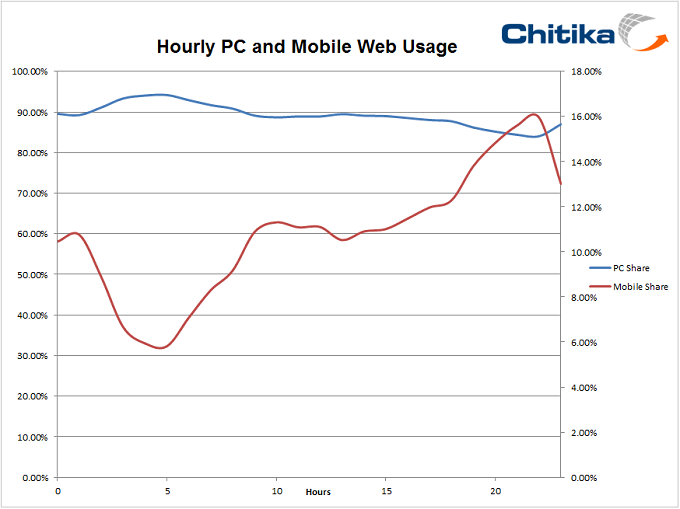
Web traffic from mobile devices sees a sharp drop off overnight, and then gradually grows over waking hours in the US, finally peaking at the end of the day, eastern standard time, generally around 8 pm to 10pm.
The data suggests that users start to use their smart phones and tablets at about 5 am, with traffic building through the day until about 10 p.m.
PC web usage is much more constant across the day. Mobile Web Traffic Up 35% in Under a Year
Gary Kim was cited as a global "Power Mobile Influencer" by Forbes, ranked second in the world for coverage of the mobile business, and as a "top 10" telecom analyst. He is a member of Mensa, the international organization for people with IQs in the top two percent.
FCC Won't Expedite Dish Network Spectrum Request
The Federal Communications Commission has refused to issue a waiver that would allow Dish Network Corp. to quickly re-purpose some of its satellite spectrum to build a terrestrial Long Term Evolution fourth generation network.
Dish wants to use spectrum acquired when Dish bought satellite operators DBSD and TerreStar Networks out of bankruptcy.
The waiver, had it been granted, would have allowed Dish to begin operational activities. Instead, the FCC wants a formal review that will take the balance of 2012. The caution on the part of the FCC probably was influenced by criticism of the perceived "hastiness" about approving a similar request by LightSquared. FCC delays Dish plans
There has not been concern that Dish will have the interference issues that so far have blocked LightSquared's plans, but the FCC probably wants to insulate itself from charges that it has not allowed a full vetting of any potential issues to other wireless users.
Gary Kim was cited as a global "Power Mobile Influencer" by Forbes, ranked second in the world for coverage of the mobile business, and as a "top 10" telecom analyst. He is a member of Mensa, the international organization for people with IQs in the top two percent.
Bigger Screens Drive More Transactions
To the extent that larger screens are more conducive to many types of commerce operations and transactions, it is not surprising that actual transactions seem to happen more frequently on tablets than smart phones.
Tablet and smart phone ads seem to lead to later transactions conducted on PCs. There are differences, though. Tablet and smart phone owners in Germany, Italy and the U.K. are more likely than American device owners to make a purchase online using a PC, after viewing an ad on their tablet or smart phone, according to new research from Nielsen.
Italian device owners are the most likely to click on an ad to seek out further information on a product advertised on their tablet or smart phone.
Americans are the least likely to make a purchase on their smart phone after viewing an ad.
But U.S. tablet owners are more likely to click on a mobile ad or search for more information after viewing a mobile ad than U.S. smart phone owners.
Gary Kim was cited as a global "Power Mobile Influencer" by Forbes, ranked second in the world for coverage of the mobile business, and as a "top 10" telecom analyst. He is a member of Mensa, the international organization for people with IQs in the top two percent.
AT&T Caps Unlimited Data Plans
Some 17 million AT&T subscribers might be affected by new AT&T bandwidth caps that end unlimited smart phone plans, even for customers that had been grandfathered under older plans.
Subscribers who were grandfathered into $30-a-month unlimited plans will find that their download speeds will be cut back if they use more than three gigabytes of data a month. It also appears the new limits will apply to users on family plans as well.
Gary Kim was cited as a global "Power Mobile Influencer" by Forbes, ranked second in the world for coverage of the mobile business, and as a "top 10" telecom analyst. He is a member of Mensa, the international organization for people with IQs in the top two percent.
Retailers Want Their Own Mobile Payment System
As if the mobile payments business were not complicated enough, a consortium of about 24 major retailers, including Wal-Mart Stores and Target, are developing their own mobile payments system.
That move illustrates the complex nature of the mobile payments business, where formerly distinct industries strive to grab leadership in a new business that necessarily has to include retailers and end users, but remains unsettled in terms of the roles of banks, transaction processors, devices, application and service providers. Retailers Join Payment Chase
Gary Kim was cited as a global "Power Mobile Influencer" by Forbes, ranked second in the world for coverage of the mobile business, and as a "top 10" telecom analyst. He is a member of Mensa, the international organization for people with IQs in the top two percent.
Google: Wallet expanding to 10 more Sprint devices this year - FierceMobileContent
Sprint Nextel will introduce "at least 10 additional phones" with support for Google Wallet in 2012. That's important since mobile payments is a scale game, and limited availability of Google Wallet on specific and popular handsets inhibits attainment of scale. Google Wallet on 10 more Sprint devices
Some 22 of the largest U.S. retail chains now support the Google Wallet, Google says, implying a base of 300,000-plus MasterCard PayPass-enabled merchant terminals able to accept Google Wallet.
Still, there is some element of the dot com frenzy to "get bigger faster."
Gary Kim was cited as a global "Power Mobile Influencer" by Forbes, ranked second in the world for coverage of the mobile business, and as a "top 10" telecom analyst. He is a member of Mensa, the international organization for people with IQs in the top two percent.
Thursday, March 1, 2012
U.S. Smart Phone Ownership 46%
Some 46 percent of American adults are smartphone owners as of February 2012, an increase of 11 percentage points over the 35 percent of Americans who owned a smartphone in May 2011, according to the Pew Internet and American Life Project.
Some 20 percent of cell owners now describe their phone as an Android device, up from 15 percent in May 2011. About 19 percent of cell owners now describe their phone as an iPhone, up from 10% in May 2011.
Some six percent of mobile device owners now describe the phone as a Blackberry, down from 10 percent in May 2011.
The proportion of cell owners describing their phone as a Windows (two percent) or Palm (one percent) device is unchanged since the last time we asked this question in May 2011.
Gary Kim was cited as a global "Power Mobile Influencer" by Forbes, ranked second in the world for coverage of the mobile business, and as a "top 10" telecom analyst. He is a member of Mensa, the international organization for people with IQs in the top two percent.
Wednesday, February 29, 2012
What's the "Best" Way to Charge for Bandwidth?
Comcast recently reiterated that it has no current interest in usage-based billing for consumer broadband access. Time Warner Cable has tended to support the notion. Telco executives tend to favor usage-based billing, as that is the industry legacy and mainstay.
But there are differences. Tier one service providers tend to be much more strongly favor in favor of charging customers for data on a usage basis than tier two and tier three service providers.
In large part, such discussion of retail packaging is happening because volume growth for broadband access services, especially on mobile networks, threatens to outstrip supply.
That's one compelling reason why mobile service providers might like to manage peak-hour traffic more gracefully, possibly by using charging mechanisms to create incentives for off-peak consumption.
In principle, one might argue that capacity upgrades “solve” the problem. That might be true, but only to the extent that capital investment is offset by revenue gains. If not, service providers ultimately will fail. And consumers have proven highly resistant to price hikes.
Mobile service providers almost universally are moving to data usage caps, as one immediate step.
If data caps do not work to manage mobile network peak hour traffic loads, what does? The answers will vary from country to country, and are different on mobile and fixed networks.
U.S. mobile operators have different tools, including Wi-Fi and small-cell offload, policy, content optimization and QoS-based tiering. Those tools are not available to fixed-network operators, at least if current “network neutrality” rules survive legal challenge.
In some markets, “transparency” is required, but traffic management, including traffic shaping, can be employed. Ofcom rules
In Canada, both fixed line and mobile service providers have more freedom than U.S. ISPs. Though regulators say “the best remedy for network congestion is investment in new infrastructure,” the second choice is economic incentives.
Internet traffic management practices such as charging more for higher speeds, are one way to generate incremental revenue to support incremental investment, says Konrad von Finckenstein, Canadian Radio-television and Telecommunications Commission chairman. But other tools likely will be required, as well.
Eventually, to fully benefit from traffic management tools, mobile operators will have to move to real-time, cell-level traffic management in the radio access network, Monica Paolini of Senza Fili Consulting argues. Policy-based management will be needed
U.S. network neutrality rules do not absolutely prohibit such measures in the mobile network, though fixed-line operators basically are stuck with rules that mandate complete “best effort only” access.
Paolini argues that mobile operators will need to actually act ahead of time, using predictive data to prevent congestion, especially when due to unexpected traffic spikes. That sounds appealing in principle, but adds new cost and complexity to carrier operations
“Most mobile operators I talked to would rather avoid this and reasonably so,” she says. “Tracking and acting traffic in real-time at the cell level inevitably adds complexity.”
Such are the tensions between the desire for operational simplicity, consumer friendly pricing and packaging, and the desire for more-sophisticated end-user features. Likewise, there is a tension between the ability to manage networks simply, and the desire to manage them with greater sophistication.
In truth, consumers, regulators and service providers are “conflicted” to some degree about balancing simplicity and variety. Users want understandable plans, fair pricing and clear billing statements. But they also might want differentiated experiences.
Service providers want simpler operations, but also greater sophistication in terms of ability to create and package new and existing products. The tension probably cannot be eliminated.
But there are differences. Tier one service providers tend to be much more strongly favor in favor of charging customers for data on a usage basis than tier two and tier three service providers.
In large part, such discussion of retail packaging is happening because volume growth for broadband access services, especially on mobile networks, threatens to outstrip supply.
That's one compelling reason why mobile service providers might like to manage peak-hour traffic more gracefully, possibly by using charging mechanisms to create incentives for off-peak consumption.
In principle, one might argue that capacity upgrades “solve” the problem. That might be true, but only to the extent that capital investment is offset by revenue gains. If not, service providers ultimately will fail. And consumers have proven highly resistant to price hikes.
Mobile service providers almost universally are moving to data usage caps, as one immediate step.
If data caps do not work to manage mobile network peak hour traffic loads, what does? The answers will vary from country to country, and are different on mobile and fixed networks.
U.S. mobile operators have different tools, including Wi-Fi and small-cell offload, policy, content optimization and QoS-based tiering. Those tools are not available to fixed-network operators, at least if current “network neutrality” rules survive legal challenge.
In some markets, “transparency” is required, but traffic management, including traffic shaping, can be employed. Ofcom rules
In Canada, both fixed line and mobile service providers have more freedom than U.S. ISPs. Though regulators say “the best remedy for network congestion is investment in new infrastructure,” the second choice is economic incentives.
Internet traffic management practices such as charging more for higher speeds, are one way to generate incremental revenue to support incremental investment, says Konrad von Finckenstein, Canadian Radio-television and Telecommunications Commission chairman. But other tools likely will be required, as well.
Eventually, to fully benefit from traffic management tools, mobile operators will have to move to real-time, cell-level traffic management in the radio access network, Monica Paolini of Senza Fili Consulting argues. Policy-based management will be needed
U.S. network neutrality rules do not absolutely prohibit such measures in the mobile network, though fixed-line operators basically are stuck with rules that mandate complete “best effort only” access.
Paolini argues that mobile operators will need to actually act ahead of time, using predictive data to prevent congestion, especially when due to unexpected traffic spikes. That sounds appealing in principle, but adds new cost and complexity to carrier operations
“Most mobile operators I talked to would rather avoid this and reasonably so,” she says. “Tracking and acting traffic in real-time at the cell level inevitably adds complexity.”
Such are the tensions between the desire for operational simplicity, consumer friendly pricing and packaging, and the desire for more-sophisticated end-user features. Likewise, there is a tension between the ability to manage networks simply, and the desire to manage them with greater sophistication.
In truth, consumers, regulators and service providers are “conflicted” to some degree about balancing simplicity and variety. Users want understandable plans, fair pricing and clear billing statements. But they also might want differentiated experiences.
Service providers want simpler operations, but also greater sophistication in terms of ability to create and package new and existing products. The tension probably cannot be eliminated.
Gary Kim was cited as a global "Power Mobile Influencer" by Forbes, ranked second in the world for coverage of the mobile business, and as a "top 10" telecom analyst. He is a member of Mensa, the international organization for people with IQs in the top two percent.
Mobile Search is Universal, Local Shopping is Going to Be
Google is big on mobile commerce, for any number of reasons, Mobile represents the biggest advertising revenue stream nobody yet dominates. And mobile commerce represents potentially the biggest change in retailing since the advent of online shopping.
Across most of six markets, including the United States, United Kingdom, France, Germany, Spain and Japan, roughly 60 percent of smart phone users are searching because of an ad they’ve seen offline or in a store.
Another reason is big on mobile and smart phones is that mobile users search while on smart phones.

Some 99 percent of smart phone users in Japan have used a search engine on mobile.
This means that practically everyone who’s gone online on mobile has searched on their phone.
Mobile search is a frequent activity. In most of these six countries more than 75 percent of smartphone Internet users search at least once a week.
The study suggests 92 percent of Americans use their smart phones to look for information about local businesses or services.
More to the point, those searchers take action. Some 81 percent of French smart phone users who’ve looked for local information then acted on it with a quarter (26 percent) having called the business and 43 percent having visited the business.
Globally, one out if five smartphone users in all six countries made a purchase after looking for local information, whether in-store or online. Mobile commerce study
Gary Kim was cited as a global "Power Mobile Influencer" by Forbes, ranked second in the world for coverage of the mobile business, and as a "top 10" telecom analyst. He is a member of Mensa, the international organization for people with IQs in the top two percent.
We Don't Have a Mobile Payment Problem; We Have a Mobile Shopping Problem
“Consumers don’t really have a mobile payment problem,” says Jack Stephenson, director of mobile, e-commerce and payments at JP Morgan Chase. “Ninety-five percent of the time, paying with cash and credit cards actually works pretty well. Consumers have a mobile shopping problem. There’s a difference. ” Mobile Shopping Problem
You might say roughly the same for retailers. They don't have a mobile payment problem, either. Retailers only have a mobile sales problem. And though it is a legitimate argument that no mobile payment scheme really succeeds without consumer adoption, neither does mobile payments succeed without retail merchant adoption.
On the other hand, all existing stakeholders in the payments revenue stream are trying to figure out how to make themselves indispensable in a new mobile payments value chain, so that the risk of being relegated to a smaller role, or no role, is minimized.
That's one reason JPMorgan Chase & Co. might have invested in GoPago, a provider of a free smart phone application that allows consumers to browse, order, and pay for local goods and services.
Businesses benefit by being able to easily set up mobile storefronts and the rich data and analytics GoPago provides helps them better target special offers to drive sales. The problem Chase is trying to solve, in other words, is brick and mortar retailer need to increase online sales.
The point here is that Chase is not trying to solve a "how do I pay by mobile phone in the store" problem. It is trying to solve a "how do I extend my retail sales into the online realm" problem.
Later in 2012, Chase’s customers will have the opportunity to create a free mobile storefront through GoPago, extending their reach to a broader audience and providing business tools once only afforded by large companies. In addition to the standard benefits of GoPago, Chase cardholders that use GoPago will receive exclusive offers and discounts from Chase merchants.
“Online commerce offers a number of opportunities to local business,” said Leo Rocco, CEO and founder, GoPago. The point here is that Chase is not trying to solve a "how do I pay by mobile phone in the store" problem. It is trying to solve a "how do I extend my retail sales into the online realm" problem.
.
Gary Kim was cited as a global "Power Mobile Influencer" by Forbes, ranked second in the world for coverage of the mobile business, and as a "top 10" telecom analyst. He is a member of Mensa, the international organization for people with IQs in the top two percent.
Tuesday, February 28, 2012
HTC Jewel for Sprint?
Some speculate the device is codenamed the "HTC Jewel."
Presumably the Sprint version will feature the large screen Evos have sported, with the same high-definition display.
Sprint has tended to release a new Evo model every year, about March, so it might not be unusual if any new "One" device appeared about that time. HTC Jewel
Gary Kim was cited as a global "Power Mobile Influencer" by Forbes, ranked second in the world for coverage of the mobile business, and as a "top 10" telecom analyst. He is a member of Mensa, the international organization for people with IQs in the top two percent.
Facebook, 30 Companies Want to Create Web Platform for Mobile Apps
A coalition of 30 technology companies hopes to turn the Web into a competitive platform for building mobile applications. They have launched a Core Mobile Web Platform (coremob) community group through the W3C to provide a venue for collaborating on next-generation mobile Web standards.
Facebook and Mozilla are among the leading members of the group. The effort to make the mobile Web a competitive app platform represents one more challenge to service provider and app store "control" or influence over mobile applications.
Facebook also announced the release of Ringmark, a test suite for evaluating the capabilities of mobile Web browsers.
The tests will help developers make informed decisions about what features they can safely use in various mobile Web environments. Facebook hopes such information will help developers create browser-based apps that run as fast, and as well, as native apps.
The business implications are clear enough. Mobile apps need app stores to succeed. App stores are run by "somebody else." By creating fast-executing mobile apps, application developers gain freedom from app stores, service providers or device manufacturers.
Facebook and Mozilla are among the leading members of the group. The effort to make the mobile Web a competitive app platform represents one more challenge to service provider and app store "control" or influence over mobile applications.
Facebook also announced the release of Ringmark, a test suite for evaluating the capabilities of mobile Web browsers.
The tests will help developers make informed decisions about what features they can safely use in various mobile Web environments. Facebook hopes such information will help developers create browser-based apps that run as fast, and as well, as native apps.
The business implications are clear enough. Mobile apps need app stores to succeed. App stores are run by "somebody else." By creating fast-executing mobile apps, application developers gain freedom from app stores, service providers or device manufacturers.
Gary Kim was cited as a global "Power Mobile Influencer" by Forbes, ranked second in the world for coverage of the mobile business, and as a "top 10" telecom analyst. He is a member of Mensa, the international organization for people with IQs in the top two percent.
Will IMS Fail? In Other Words, Does OTT Win?
If you have been in the telecom business long enough, you have seen a few different "next generation networks" come and go with somewhat mixed market success.
ISDN was, for some, the first such network. Then there was B-ISDN, known better as "asynchronous transfer mode."
Then there is IP Multimedia Subsystem, whose ultimate success seems yet uncertain, if its fundamental architecture and goals certainly will be a foundation of future networks.
And now there is Rich Communications Suite, which builds on IMS. Observers might further note that picture messaging, essentially a broadband version of text messaging, likewise has failed to garner much success.
Pessimists might point out that, so far, none of the would-be "next generation networks" has been a raging success.
To be sure, the functions often are accomplished, but sometimes in other ways. Who would have guessed that a "legacy" protocol such as IP would become, as much as anything else, the "next generation network," in large part.
Optimists keep trying, as standards, whether created by the market, or by standards bodies, are crucial for the global telecom business.
Tyntec is the company Thorsten Trapp formed to provide products based on the mobile industry’s Signalling Connection Control Part protocol used by GSM networks.
Apparently, Tyntec's software is what allows Pinger to provide over the top text messaging services. And Trapp apparently doesn't have much confidence that some of the newer proposed architectures are going to succeed.
Specifically, he is doubtful that IMS or RCS will succeed. The issue is why he believes that. Without widespread handset support it’s not going to become ubiquitous, and even if it does, users will be hit by roaming costs and interoperability issues.
But OTT players merely need an IP connection for their apps.Will RCS Fail? It's a challenging notion, but not historically unprecedented.
There will be standards. The only issue is which standards, and how they eventually take hold. In recent decades it has been "the market" more than the standards bodies that have succeeded.
ISDN was, for some, the first such network. Then there was B-ISDN, known better as "asynchronous transfer mode."
Then there is IP Multimedia Subsystem, whose ultimate success seems yet uncertain, if its fundamental architecture and goals certainly will be a foundation of future networks.
And now there is Rich Communications Suite, which builds on IMS. Observers might further note that picture messaging, essentially a broadband version of text messaging, likewise has failed to garner much success.
Pessimists might point out that, so far, none of the would-be "next generation networks" has been a raging success.
To be sure, the functions often are accomplished, but sometimes in other ways. Who would have guessed that a "legacy" protocol such as IP would become, as much as anything else, the "next generation network," in large part.
Optimists keep trying, as standards, whether created by the market, or by standards bodies, are crucial for the global telecom business.
Tyntec is the company Thorsten Trapp formed to provide products based on the mobile industry’s Signalling Connection Control Part protocol used by GSM networks.
Apparently, Tyntec's software is what allows Pinger to provide over the top text messaging services. And Trapp apparently doesn't have much confidence that some of the newer proposed architectures are going to succeed.
Specifically, he is doubtful that IMS or RCS will succeed. The issue is why he believes that. Without widespread handset support it’s not going to become ubiquitous, and even if it does, users will be hit by roaming costs and interoperability issues.
But OTT players merely need an IP connection for their apps.Will RCS Fail? It's a challenging notion, but not historically unprecedented.
There will be standards. The only issue is which standards, and how they eventually take hold. In recent decades it has been "the market" more than the standards bodies that have succeeded.
Gary Kim was cited as a global "Power Mobile Influencer" by Forbes, ranked second in the world for coverage of the mobile business, and as a "top 10" telecom analyst. He is a member of Mensa, the international organization for people with IQs in the top two percent.
Monday, February 27, 2012
Vodafone, Visa Form Mobile Payment Partnership
Vodafone, the world's largest telecom company by revenue, said the companies will work together to develop Vodafone-branded services to the U.K. company's base of 398 million customers in more than 30 countries.
These services will be launched later this year in Germany, the Netherlands, Spain, Turkey and the U.K., with rollouts elsewhere in Vodafone's global portfolio to follow.
NFC-enabled phones currently on the market include Samsung Electronics Co. Ltd.'s (005930.SE) Galaxy S II and Nokia Corp.'s (NOK) 700 model. Vodafone, Visa Form Mobile Payment Partnership
Gary Kim was cited as a global "Power Mobile Influencer" by Forbes, ranked second in the world for coverage of the mobile business, and as a "top 10" telecom analyst. He is a member of Mensa, the international organization for people with IQs in the top two percent.
Mobile Banking Grows, Fiserv Finds
As other studies also have shown, consumer use of mobile banking, and willingness to use mobile banking services, continue to grow, a new study sponsored by Fiserv has found.
When asked if they had used a mobile banking service in the past month, one out of four online households stated they had, and those that use other digital services such as online banking, bill pay or e-bills, were even more likely to have used a mobile banking service.
Some 30 percent of both online banking and bill pay users had used mobile banking while 44 percent of e-bill recipients had used the service.
The majority (60 percent) of mobile bankers used the mobile browser on their phone to access their mobile banking service; 41 percent used a downloadable application (app); and 32 percent accessed the service through text messaging.
According to the survey, 40 percent of mobile banking users have paid a bill using their mobile phone as compared to 28 percent in 2010. Some 32 percent used their mobile phone to transfer money versus 25 percent in 2010.
As some other surveys have found, many users trust their financial institutions more than other entities. Some 40 percent of mobile phone users said they would trust their bank or credit union to handle mobile payments, followed by PayPal at 35 percent and Visa at 33 percent.
Nearly one in five consumers currently owns a tablet and this figure is expected to increase rapidly, which means tablets soon will be a bigger factor in mobile banking and transactions, the study found.
According to the survey, 19 percent of online households currently own a tablet and another 20 percent expect to purchase a tablet, which means almost 40 percent of online households could own a tablet by mid 2012. In addition, multiple tablet households are emerging, with 37 percent of households that already own a tablet stating that they plan to buy another.
According to the survey, both current and future tablet owners are interested in using their tablet to access financial services. About 44 percent of existing tablet owners have used their tablet to access online banking, already.
In addition, 45 percent of existing tablet owners and future owners are interested in using their tablet for banking.
When asked if they had used a mobile banking service in the past month, one out of four online households stated they had, and those that use other digital services such as online banking, bill pay or e-bills, were even more likely to have used a mobile banking service.
Some 30 percent of both online banking and bill pay users had used mobile banking while 44 percent of e-bill recipients had used the service.
The majority (60 percent) of mobile bankers used the mobile browser on their phone to access their mobile banking service; 41 percent used a downloadable application (app); and 32 percent accessed the service through text messaging.
According to the survey, 40 percent of mobile banking users have paid a bill using their mobile phone as compared to 28 percent in 2010. Some 32 percent used their mobile phone to transfer money versus 25 percent in 2010.
As some other surveys have found, many users trust their financial institutions more than other entities. Some 40 percent of mobile phone users said they would trust their bank or credit union to handle mobile payments, followed by PayPal at 35 percent and Visa at 33 percent.
Nearly one in five consumers currently owns a tablet and this figure is expected to increase rapidly, which means tablets soon will be a bigger factor in mobile banking and transactions, the study found.
According to the survey, 19 percent of online households currently own a tablet and another 20 percent expect to purchase a tablet, which means almost 40 percent of online households could own a tablet by mid 2012. In addition, multiple tablet households are emerging, with 37 percent of households that already own a tablet stating that they plan to buy another.
According to the survey, both current and future tablet owners are interested in using their tablet to access financial services. About 44 percent of existing tablet owners have used their tablet to access online banking, already.
In addition, 45 percent of existing tablet owners and future owners are interested in using their tablet for banking.
Gary Kim was cited as a global "Power Mobile Influencer" by Forbes, ranked second in the world for coverage of the mobile business, and as a "top 10" telecom analyst. He is a member of Mensa, the international organization for people with IQs in the top two percent.
Subscribe to:
Posts (Atom)
AI Model Pricing Eventually Moves to a Cloud Model
So far, language model pricing based on usage closely mirrors the early patterns of cloud computing , . Which matured into a massive, lower-...
-
We have all repeatedly seen comparisons of equity value of hyperscale app providers compared to the value of connectivity providers, which s...
-
It really is surprising how often a Pareto distribution--the “80/20 rule--appears in business life, or in life, generally. Basically, the...
-
Financial analysts typically express concern when any firm’s customer base is too concentrated. Consider that, In 2024, CoreWeave’s top two ...