Wednesday, April 8, 2015

IoT, Big Data, Cloud Computing are One Trend Pointing to Next Era of Computing

It increasingly is going to be hard to separate the Internet of Things from cloud computing from big data, since the value of all those sensors and apps will be the ability to pluck trends and meaning from a bewildering amount of raw sensor data.

Think about Waze, the social driving app that crowd sources the observations of drivers about traffic, for example.

The sensors now are smartphones, but the value is the insight about traffic slowdowns and jams. That requires use of sensors (smartphones as the “things,” in this case), the global positioning satellite system, the Waze and Google Maps apps, the cloud computing infrastructure and the ability to process tons of data in real time.

If you wanted to start looking for leaders in the next era of computing, you would do much worse than to look for firms that will dominate the horizontal roles in IoT-centric computing.


IoT Requires Lower Latency, Probably Fog Computing

The Internet of Things is going to add so many connected devices, appliances and sensors that the architecture of computing to support IoT operations will necessarily have to rely on more edge processing than has been useful up to this point.

Both latency issues and the sheer volume of data generated by all those devices will require more distributed computing closer to the edge, instead of the relatively more centralized computing that has been typical of cloud computing.

At least as some envision it, fog computing would pre-process raw data using an edge server, before forwarding a summarized set of data to cloud data centers.

So aside from additional bandwidth, latency considerations will become more important as IoT services, devices and applications proliferate.

In a real sense, the objective for fog computing is to produce latency more like that of a LAN than traditionally has been associated with cloud computing.

Is AT&T Wrong about DirecTV?

It is not hard to find critics of the business strategy AT&T has in buying DirecTV. Subscription TV is a mature business, in decline, even if DirecTV is a well-run company throwing off lots of cash flow.

Critics say the other satellite provider, Dish Network, also sees the danger inherent for a satellite video provider, and is itself potentially aiming to become a mobile service provider, in some way. Dish Network CEO Charlie Ergen has said that, if  he were entering the subscription video entertainment business today, he might well not use satellite for delivery.

Instead, he’d do something like Sling TV, an over the top, Internet-delivered service.

AT&T has argued it gains a nationwide video footprint, adds scale efficiencies in its purchasing of content and creates a national triple play or quadruple play capability (video, Internet access, mobile voice and messaging).

Some of us would say those are helpful, but not decisive. Instead, DirecTV is an important tactical move. First of all, AT&T alway has grown primarily by acquisition.

So DirecTV grows free cash flow and revenue.

But what if the gains are not necessarily permanent? No problem. Nothing is permanent, for any service provider. In the meantime, AT&T gains needed free cash flow, while it is in the process of building the new lines of business to replace declining voice, messaging and eventually video revenues.

Transitions matter, especially for large firms such as AT&T that have been through large transitions before, such as the shift from long distance voice to mobility as the strategic growth driver.

But those transitions can take a decade to play out fully. During the transition, cash flow matters.

Gigabit Speeds Don't Improve Experience, Content Delivery Networks and Caching Does

According to a study by Mike Belshe, “if users double their bandwidth without reducing their Round Trip Time (RTT), the effect on Web browsing will be a minimal improvement (approximately five percent).”


“However, decreasing RTT, regardless of current bandwidth always helps make web browsing faster,” Belshe argues.


Faster local Internet access connections do help, up to a point. After about 10 Mbps, no single user is likely to see much improvement, if at all, in page load times, for example. The U.S. Federal Communications Commission and U.K. Ofcom agree: beyond 10 Mbps per user, experience is not measurably improved--if at all--by faster Internet access speeds.


Bandwidth (in Mb/s)
Page Load Time via HTTP
1
3106
2
1950
3
1632
4
1496
5
1443
6
1406
7
1388
8
1379
9
1368
10
1360


Although there is a considerable jump in the early bandwidth speed increases, the returns as the pipe gets bigger continue to diminish until they are almost negligible.


The important observation is that the measure of a digital experience isn’t just--or primarily--about the speed of download.


Latency, or round trip delay, is more fundamental, beyond a minimum amount of access speed.

That is one reason so many large application providers use content delivery networks that place content closer to end user locations, in principle improving round trip delay.

Shockingly, and all marketing claims notwithstanding, end user experience of Internet apps is primarily a matter of latency, not access bandwidth. That is because "non-network" sources of delay generally represent an order of magnitude more impairment than local access speed, or even all network delay, taken together.

Connecticut Cities and Towns Ask for Gigabit Speeds; Are Likely to Get Most of What They Want

A gigabit Internet access network serving “targeted commercial corridors as well as in residential areas with demonstrated demand is the goal sought by a consortium of 46 Connecticut cities and towns.

In the end, the municipalities are likely to get what they want, either because incumbents step up, to protect their existing businesses, or because new suppliers, able to operate with lower operating costs, enter the markets.

That doesn't necessarily mean a full potential gigabit at every location. Functionally, the communities will get what they want when anchor institutions and enterprises can buy a full gigabit or even hundreds of megabits per second and consumers in neighborhoods can buy hundreds of megabits per second.

The immediate value of such speeds is most clear for large organizations with lots of users. Individual small businesses or consumers cannot actually gain much.

For incumbents, skinnier profit margins are likely, one way or the other. For at least some would-be attackers, it might be possible to gain entry into the Internet access market.

But a fierce response might be coming. In that instance, the municipalities will succeed in their goal of stimulating investment in faster Internet access. Comcast, which operators in Connecticut, already has said it will upgrade virtually all of its networks to gigabit speeds by the end of 2016.

Whether other major Internet service providers will go that far, or not, is not yet clear. But it would be reasonable to suggest upgrades to hundreds of megabits will be forthcoming, especially where the municipalities really want it: commercial corridors and some residential neighborhoods willing to pay more for higher speeds.

Ignore for the moment the fact that, today, speeds available per user beyond 10 Mbps have negligible to zero additional utility. That is a matter of science. “Gigabit” is about marketing, perceived economic advantage for communities or states and perceived advantages for anchor institutions.

A betting person would guess those demands will be rather swiftly met by firms that face clear threats.

Tuesday, April 7, 2015

Cable TV Will Take Hybrid Strategy to Make Transition to Streaming

At this point, it is likely a “no brainer” to argue that incumbent providers of subscription TV will have to follow one clear near term strategy, and a different long term strategy. Sound advice for any business in the midst of fundamental technology change is to adopt a “hybrid” strategy, for a time, while preparing for a different future.

Decades ago, U.S. cable TV operators opted for just such a hybrid strategy when shifting to the hybrid fiber coax network architecture.

Now Comcast is on the cusp of signaling a profound shift to all-optical access with its move to make 2-Gbps all-fiber connections available to 18 million of its present customers.

To be sure, Comcast also is moving to make gigabit access services available to nearly all its 21 million customers by perhaps the end of 2016. Comcast probably will be able to provide 1-Gbps services on its existing HFC network.

But the end is in sight.

Where it comes to subscription TV, expect Comcast and other U.S. cable TV operators to use that same strategy, grafting more streaming features onto its existing linear service.

Over the top (OTT) video continues its strong growth, and should see around 26 percent total revenue growth in 2015, with 24 percent compound annual growth rates through 2019, according to ABI Research.

“Comparatively high priced pay TV bundles are losing customers to more inexpensive, IP-delivered content,” says Eric Abbruzzese, Research Analyst.

The other tack is to mimic the “lower price” feature of many OTT video subscription services by creating skinny bundles that cost less.

With a little luck, such strategies will allow more time for transition to a full, streaming only future.

Cable TV operators have used that hybrid approach before.

How to Tell When a Market is Saturated

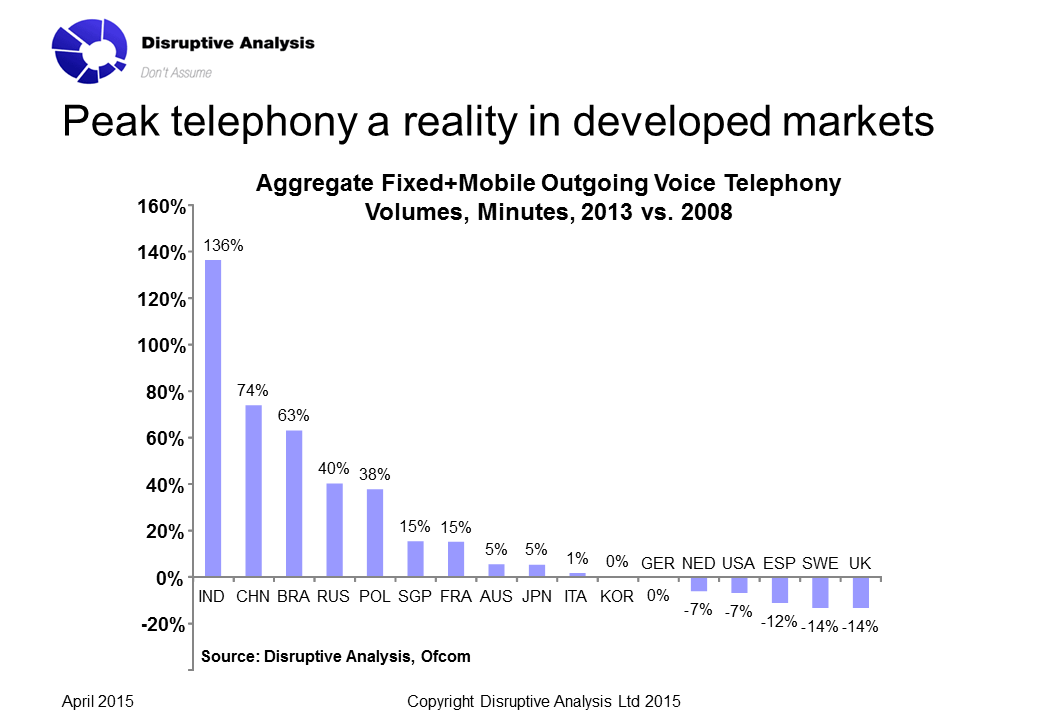
Even if call volumes still are growing in many countries, the future already is discernible. In most developed markets, “calling” as an activity is dropping. In other words, fewer calls were made in 2013 than in 2008, even as prices continued to fall.


Up to a point, usage or demand climbs for any desired product as prices are reduced. But demand can saturate, at which point not even lower price leads to higher usage. That seems clearly to be the case for voice services.

There are strategic implications. One might well argue it makes little sense to invest too much in a product line that is mature and declining. Instead, investment must be targeted to new products early in their life cycles.

That suggests investment in high definition voice will be largely ineffective as a means of restoring growth in the voice segment. Investment in voice over Long Term Evolution has a different business rationale: it allows reclaiming of spectrum used for 3G.

Only indirectly does VoLTE contribute in a direct way to new voice value.


Access Network Limitations are Not the Performance Gate, Anymore

In the communications connectivity business, mobile or fixed, “more bandwidth” is an unchallenged good. And, to be sure, higher speeds have ...