Thursday, May 28, 2015

Cable TV Leads in Consumer Markets; How Long Before it Leads in Business Market?

Regulatory structures are hard to change, especially when they have been in place for a long time, even when markets have changed.

Consider the amount of time, money and effort devoted to all manner of rules applied only to some legacy telephone companies presumed to the carriers of last resort, with obligations to “serve everyone,” even when most contestants are not required to do so.

More shocking is when the actual leading providers in markets are unregulated, when the less dominant providers are so regulated.

And we soon will face an anomaly: the supposed “leaders” of the consumer communications market will clearly have lost their leadership, yet still be highly regulated, while the new leaders, continuing to grow faster, are lightly regulated and bear no “carrier of last resort” obligations.

Should the Charter Communications bid to acquire Time Warner Cable pass regulatory muster, and some of us would bet it will, more light will be shed on the relative roles of cable TV and telephone companies in the fixed network high speed access market, and also of market power generally.

The perhaps surprising result would be that In the fixed network Internet access segment, Comcast would be number one, Charter number two, AT&T third.

Think about that: the two largest legacy telcos would rank no better than third and fourth in the core service provided by the fixed network.

Verizon would rank fourth. CenturyLink would rank fifth, Cablevision Systems sixth and Frontier Communications seventh.

In the top five spots, cable TV companies would be number one and two providers, with even the largest U.S. telcos ranking third, fourth and fifth.

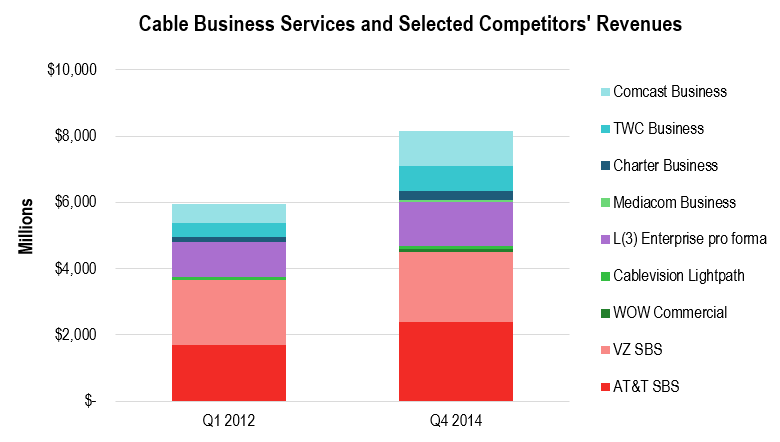
That would make cable TV operators the leaders for consumer services, though telcos would continue to lead in enterprise and business services.

Keep in mind, however, that business services are the big growth leaders for cable TV companies.

One way of illustrating the potential value of Comcast’s entry into the mobile business can be gleaned from looking at current revenue contributors, with their growth rates.

Of total 2014 Comcast revenue of $68.8 billion, $44.1 billion, or 64 percent, was generated by the cable communications business. Operating cash flow contribution from the cable communications segment was about six percent.

The consumer part of the cable communications business (triple play services) is growing primarily because of high speed access.

Video revenue for 2014 was up about one percent. Voice revenue was static at about 0.4 percent growth. High speed access was where the gains primarily were made, with growth of 9.5 percent.

Business services contribute about nine percent of cable communications segment volume, at about $4 billion in 2014.

But business services grew at a 22 percent rate in 2014. In fact, it might be correct to say the newest product segments in the cable communications segment (business services in general, and mid-market services in particular) have the highest growth rates.

Comcast estimates it has reached about 25 percent penetration of the small business addressable market, but only about five percent of the addressable mid-market opportunity, according to Neil Smit Comcast Cable president and CEO.

The point is that, having taken the lead in consumer services, cable TV operators are preparing to take the lead in the small and mid-sized business segment. And some might argue it is only a matter of time and experience before cable TV operators build on their success in the smaller business segment to move up to enterprise services.


  source: Telco2research.com

Net Neutrality is Industrial Policy

All communications regulatory frameworks--indeed all regulatory frameworks without exception--have direct business implications, in addition to any number of foreseeable and unforeseen indirect implications.

So you might ask what it means if “strong” network neutrality rules are instituted in the U.S. market, while Europe, which many would have predicted was more likely to do so, seems clearly to be backing away from the concept.

By “strong” we mean not simply the principle that lawful apps cannot be blocked but that all consumer applications are delivered “best effort,” with no packet prioritization permitted in the access network.

It can be suggested that network neutrality is no longer on the agenda in Europe for one simple reason: regulators understand there is a connection between network neutrality and capital investment, in the European setting.

Strongly desirous of high levels of new investment in communications networks--fixed and mobile--European regulators are willing to take a relaxed view of net neutrality in hopes of spurring higher investment levels.

And the reason higher investment levels are expected--when there are no net neutrality rules--is that a whole range of business models and revenue streams are available to service providers.

Such models might include various quality of service options, sponsored app usage, peak and off-peak bandwidth pricing or quality plans, or even app-specific plans based on bandwidth consumption.

European regulators are making an explicit choice to create incentives for faster and more robust capital investment in access networks, by allowing service providers to potentially create new revenue streams based on those investments.

U.S. regulators arguably are less concerned about investment, as multiple facilities-based providers compete across the fixed and mobile segments of the business, and many more third party entrants are getting into the new business of gigabit connections.

U.S. regulators, at some level, might also have concluded that innovation will come from the application side of the business, and that if app providers say network neutrality is required for high innovation, then even if access providers are disadvantaged, app providers should be favored.

That might be an indirect form of industrial policy, but presumably has the effect of aiding app firms to thrive. If one believed the health and financial growth of U.S.-based app firms was important, then network neutrality, aside from its immediate communications industry impact, is an indirect form of industrial policy.

European regulators might be said to do the same.

Telenor Pakistan Launches Internet.org Bundle

Telenor Pakistan has launched Internet.org in Pakistan, making available to Telenor Pakistan's customers free access to 17 basic online services including Accuweather, BBC, BabyCenter &MAMA, Malaria No More, UNICEF Facts for Life, Bing.com, ESPN Cricinfo, Mustakbil, ilmkidunya, Telenor News, Urdupoint Cooking, OLX, Facebook, Messenger, Wikipedia and Telenor WAP MobilePortal, using either the 2G or 3G platforms.

Consumers can use Internet.org aps directly from Internet.org or by downloading the Android app.

Internet.org is a Facebook-led initiative bringing together technology leaders, nonprofits and local communities with the goal of making internet access available and affordable to the two-thirds of the world that is not yet connected and bringing the same opportunities to everyone that the connected world has today.

Internet.org was first launched in July 2014 in Zambia and in less than a year it made valuable online services accessible without data charges for millions of people in Tanzania, Kenya, Colombia, Ghana, India, Philippines, Guatemala, Indonesia, Bangladesh, Malawi and now in Pakistan.


SPECTRUM FUTURES
The M Hotel Singapore  |  10-11 September 2015
M Hotel Singapore

Will Internet.org be allowed to provide value, or will regulators ban the practice?


Spectrum Futures 2015 will look at the ways Internet.org and other initiatives are trying to bring Internete access to billions of people who do not yet use the internet.

Spectrum Futures 2015will bring together regulators and service providers from throughout the Asia-Pacific region to allow the exchange of ideas about key policies to help emerging markets like India, the Phillipines, Thailand, Indonesia, Cambodia and Myanmar connect to their populations to the Internet within the next decade.


Join the conversation at Spectrum Futures 2015.
www.spectrumfutures.org

FOLLOW US ON
FacebookTwitterLinkedInVimeo
Pacific Telecommunications Council
914 Coolidge Street | Honolulu, HI 96826-3085 | +1.808.941.3789 | spectrumfutures.org |spectrumfutures@ptc.org


"More Spectrum Than You Can Imagine" is Coming

"More new spectrum than everything else we now can use" is the promise of commercialized millimeter wave frequncies, used in conjunction with small cell architectures, to support mobile and untethered applications.

Such abundance will have many business implications. It might change thinking about the scarcity value of spectrum overall. It definitely should lower the cost of bandwidth for billions of people using the Internet.

But fundamental decisions must be made: how to release the spectrum; what spectrum to release; when to release and how to allow access are key issues. 

We will discuss then at Spectrum Furures.


SPECTRUM FUTURES
The M Hotel Singapore  |  10-11 September 2015
M Hotel Singapore

Regulators Face Unprecedented Challenge: Licensing More New Spectrum Than Everything Else We Now Use


  • Licensing use of spectrum impossible to use in the past
  • Sharing spectrum without clearing existing users
  • Releasing 10 to 100 times more bandwidth than presently in use
Spectrum Futures 2015will bring together regulators and service providers from throughout the Asia-Pacific region to allow the exchange of ideas about key policies to help emerging markets like India, the Phillipines, Thailand, Indonesia, Cambodia and Myanmar connect to their populations to the Internet within the next decade.
Join the conversation at Spectrum Futures 2015.
www.spectrumfutures.org

FOLLOW US ON
FacebookTwitterLinkedInVimeo
Pacific Telecommunications Council
914 Coolidge Street | Honolulu, HI 96826-3085 | +1.808.941.3789 | spectrumfutures.org |spectrumfutures@ptc.org

Wednesday, May 27, 2015

Customers Do Not Care About, Will Not Pay for 99.999% Availability

Verizon Communications says “very few” of its customers purchase battery backup features for fixed network phone service. With widespread use of cordless telephones, that also means that when local electrical power is interrupted, so is phone service.

Consumers do not seem very bothered by that state of affairs, in part because of widespread mobile phone use, and also because they long ago discovered that unless they use corded phones, they lose use of the phone service when power goes out, even if the circuit stays up.

For those of you with long memories, that is a big change. Fixed line phone service used to be required to function in the event of local power outages, with availability at the old 99.999 percent uptime standard.

These days, in practice, most communication services probably have availability of only one nine.

Devices crash and need to be rebooted with some frequency. And there are more devices to fail, with operating systems and apps that crash rather frequently. So whatever the reliability of circuits, end user experience is affected by all the devices in the delivery chain, with cascading impact on system reliability end to end.

In fact, most people assume some degree of instability, and have protocols to compensate. “I’ll call you back;” “I’ll switch to landline;” I’ll switch to another app” or I’ll reboot” are all ways of compensating for less reliability--of apps, devices, operating systems or networks.

The same applies to user expectations about app quality. Now used to mobile audio quality, VoIP audio wasn’t a shock.

Without battery backup, most devices will fail with local power outages. Few consumers seem to care, anymore. Most apps, devices and operating systems are assumed to be a little flaky. People know what to do in the case of momentary failure.

The point is that customers do not experience, do not especially mind, and will not pay for, 99.999 percent availability. “Good enough” seems to be the new standard for most products.

You Cannot Predict the Future

The reason we all use so much bandwidth these days: video represented 64 percent of all consumer Internet traffic and 55 percent of all mobile traffic in 2014.

And that trend is going to increase. In the U.S. market, time spent interacting with digital media has been growing on mobile, if flat on PCs and other devices, since 2008.

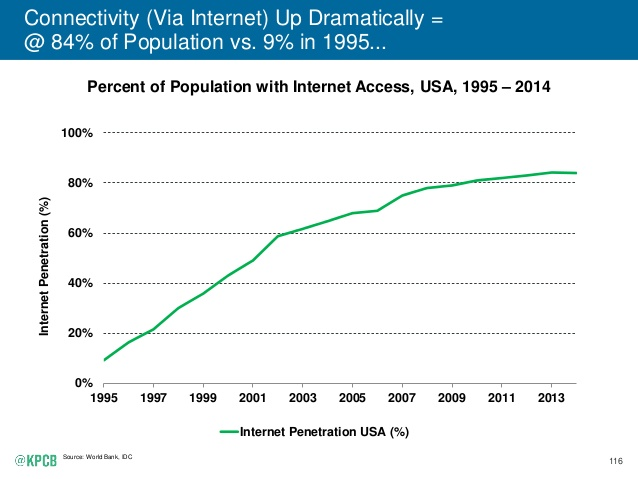
Of course, it sometimes helps to remember where we have come from. In 1995, the year before the Telecommunications Act of 1996, the first major reform of U.S. communications law since 1934, only about 10 percent of Americans used the Internet at all.

At the time, the key to spurring innovation and competition was thought to be allowing access into the voice business. It might sound crazy, but that’s what people thought.

The point is that some of us learned from that experience. And what we learned was that it is hard to impossible to predict the future, because the framework one is using is going to be proven wrong.

Imagine you are in 1995, and assigned to a research project, as I was, in 1995. The task was to examine the impact of a range of new technologies on communications pricing and therefore industry revenue.

Consider the challenges. This was a time when only 10 percent of people used the Internet, a time when mobile usage was about the same.

We were making forecasts three years before the founding of Google. The web browser many of us were using was “Alta Vista.” We were about a year after the creation of what became the Netscape Mosaic browser.

It wasn’t clear whether voice over frame relay, voice over ATM or voice over IP was going to become widespread, at least in the business markets.

We were two years from the start of the Internet bubble and five years before the top of the Internet bubble, six years before the crash, which ultimately destroyed $5 trillion in telecom asset value.

The Telecommunications Act of 1996 had not yet been passed.

And we were just nine years after the AT&T monopoly had been broken up, creating eight firms, none of whose brand names--with the exception of AT&T-- continue to be used today. And the firm using AT&T’s name is not the former AT&T.

We were forecasting 17 years before the iPhone and 15 years before the iPad.

The main point is that our forecasts were based on an extrapolation of present trends. We could not correctly model the Internet, ubiquitous mobile adoption, smartphones, applications using Internet Protocol.

We could not model an unprecedented wave of telecom  investments and then massive destruction of communications wealth and assets, within just a few years.

The clear lesson some of us learned was that things we are not looking at are going to have more impact on the future course of things than the things we are looking at. We also learned the futility of linear forecasts.

Messaging Apps are Becoming Hubs

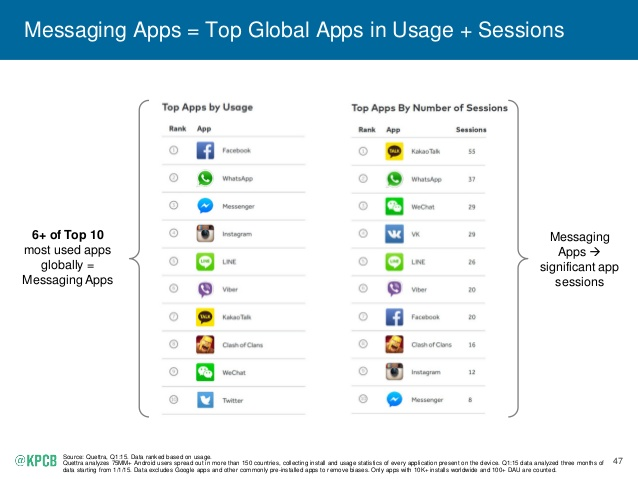
Messaging apps are trying to become communications “hubs” for commerce, identity applications and context-driven actions, argues Mary Meeker, Kleiner Perkins Caufield Byers general partner.

Meanwhile, mobile service providers are trying to protect “messaging” revenue by dropping prices, bundling messaging and voice as a “network connection” fee and in some cases creating branded over the top messaging apps.

That is “fighting the last war.” The messaging apps already have moved on.


On the Use and Misuse of Principles, Theorems and Concepts

When financial commentators compile lists of "potential black swans," they misunderstand the concept. As explained by Taleb Nasim ...