Monday, August 10, 2015

Video Streaming Might Anchor 80% of Global Bandwidth Demand by 2019

Nothing shapes mobile, fixed or global undersea traffic like video. In fact, by about 2019, perhaps 80 percent of all traffic on global networks will be video, and as much as 85 percent of traffic on U.S. networks, for example.

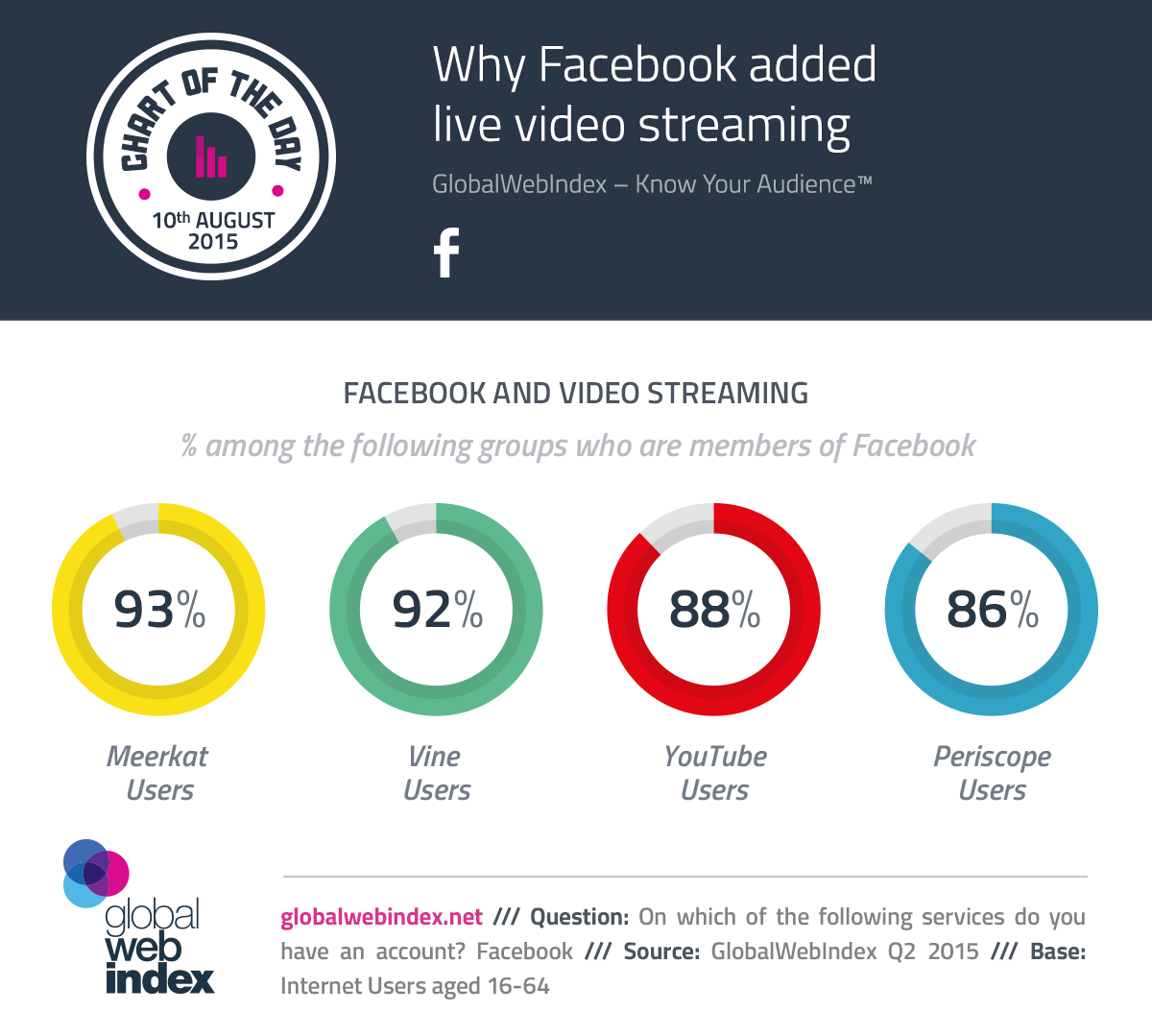
In Latin America about 60 percent of all mobile traffic is driven by Facebook and Google. Overall, a majority of Facebook traffic is generated from mobile devices.

That is driving Facebook’s revenue growth (mobile advertising), and also illustrates why bandwidth demand in the mobile realm keeps growing so fast. Consumers simply are using more video.

According to Ooyala, 38 percent of online video plays in the fourth quarter of 2014 happened on a tablet or smartphone, double the activity of the same quarter of 2013.

10th-Aug-2015-Why-Facebook-added-live-video-streaming


Sunday, August 9, 2015

Two Polar Opposite Views of Incumbent Market Power

There arguably are two polar opposite views about large incumbent service providers of all types. One view is that they are unrepentant monopolists retaining their market power.

The other view: maturation or decline of every key revenue segment, plus growing competition and new digital product substitutes, are hollowing out many, if not most of the leading contenders.

The proper approach to policy obviously hinges on which general view one holds. Some argue the major telco business model, for example, is under high stress.

The truth is probably someplace in between. The old model is slipping away. Large incumbents still have lots of market power, because they lead their markets. But challenges have emerged at every turn.

“The large incumbent telephone companies do not earn attractive returns in their wireline businesses,” said Craig Moffett Partner and Senior Analyst, MoffettNathanson. “For example, a decade after first undertaking their FiOS fiber-to-the-home buildout to eighteen million homes, Verizon has not yet come close to earning a return in excess of their cost of capital.”

In other words, Verizon FiOS has actually lost money.

AT&T also has earned poor returns on its fixed network.  AT&T return on invested capital has been declining for a decade and is, like Verizon’s, well below the cost of capital, Moffett said.

In 2014  aggregate fixed network telecommunications businesses earned a paltry 1.2 percent return, against a cost of capital of roughly five percent, Moffett argues.

“For the non-financial types in the room, that’s the equivalent of borrowing money at five-percent interest in order to earn interest of one percent,” said Moffett.

“That’s a good way to go bankrupt,” Moffett said.

Former Rural Telcos Now Drive Revenue from Business Customers

Of $4.4 billion in CenturyLink second quarter 2015 revenue, business revenues represented $2.7 billion while consumer revenues were about $1.5 billion. In other words, the business segment represents 61 percent of company revenue.

That is a huge transformation for a firm that once mostly got its revenue from subsidies and consumers.

What is interesting in that regard is the transformation of revenue sources at CenturyLink, Windstream and Frontier Communications, all legacy rural telecom service providers who have turned to business customer segments to drive growth.

Since about 2010, both Windstream and Frontier have earned most of their money in the business segment, despite the continuing preponderance of consumer accounts.

In its second quarter of 2015, Windstream had revenues of $1.4 billion. Consumer revenues  represented just $314 million--about 22 percent--of total revenues.

Frontier Communications total revenue of about $1.4 billion as well, with consumer revenue of about Total residential revenue was stable at $615 million for the second quarter of 2015, while total business revenue was $621 million. So a bit more than half of revenue was generated by business customers.

Saturday, August 8, 2015

Fixed LInes Fall 15% in India

The number of fixed network phone connections in India fell more than 15 percent in the last 2.5 years, the Ministry of Communications and Information Technology reports, even as the total number of connections has grown.

As you might expect, mobile has been the growth driver.  In fact, the mobile segment represents 97 percent of total telephone subscriptions.

The Indian telecom services market is expected to grow at a CAGR of 10.3 percent compound annual growth rate from 2015-2020, mainly driven by mobile services.


The number of landline phone connections declined to 26.15 million at the end of June, 2015 from 30.79 million as on December 31, 2012, Minister of Communications and Information Technology Ravi Shankar Prasad said in a written reply to the Rajya Sabha.

The number of connections have declined steadily to 28.89 million (December, 2013), 27 million (December, 2014) to 26.15 million at the end of June, 2015, he added.

Bharti Airtel Extends 4G Network, Prices Same as 3G

Bharti Airtel, in extending coverage of its Long Term Evolution fourth generation (4G) network to about 296 additional towns,  has had to again directly confront the matter of pricing: should LTE, as a fastest network, be priced at a premium to existing 3G networks?

The decision, likely dictated by the coming market entry of Reliance Jio into the mobile and LTE businesses, is to offer 4G at the same prices as 3G.

“Airtel customers can enjoy 4G at 3G data prices with packs starting at Rs 25,” Bharti Airtel said. Airtel also is offering other adoption inducements, such as six months of unlimited music streaming and downloads on ‘Wynk Music’ and five free movies per month for six months on the Wynk Movies” service, the company said.

Initially, most had hoped it would be possible to do so. Today, most are finding that equivalent to slightly-higher prices is required.

In the past, the launch of a next generation network has allowed higher pricing, as was the case for 3G. In some cases, the premiums were substantial.

By 2013, 4G price premiums over 3G had begun to narrow, globally. When 4G was launched in the U.S. market, for example, there was generally no price premium for 4G, compared to 3G.

Some observers also noted that 4G pricing models also did not represent significant innovations in pricing strategies, either.

Bharti Airtel seems to be only the most recent example of those trends. New 4G networks do generate more revenue for mobile service providers, but not because they feature higher prices per bit.

Instead, the benefits come because customers consume much more data than they did on 3G networks. In other words, 4G increases sales volume, rather than price per unit.

The other benefits for mobile operators likewise come in relatively indirect ways, such as reducing churn or spurring handset upgrades that allow new features to be supported.

But, as Bharti Airtel also has concluded, it often is not possible to price LTE 4G at a premium to 3G.

Friday, August 7, 2015

When Counting Anything, Methodology Matters

Methodology always matters, when conducting Internet speed tests or most any other phenomenon. So it is that Ookla apparently is taking some heat from small Internet service providers over a change of methodology by Ookla.

Specifically, Ookla now measures access speeds for the providers that serve most customers in any area. That is unfair, some small ISPs say, since, by definition, they do not serve many of the customers in any given city or state, and will not be included in speed indexes any longer.

The complaint is understandable. But Ookla’s methodology also makes sense. As somebody who routinely tracks the size and composition of markets, there are some realities. If you want to know what is happening in the U.S. mobile or fixed network market, you pretty much only need to know what is happening at the four biggest mobile providers, not “all” mobile providers, or only the few largest telco and cable TV companies.

The smaller providers do not have enough mass to affect the basic trends, one way or the other. It’s sort of the same reality as looking at “North American” trends in any area (Canada and the United States, for example).

Canada tends to represent about 10 percent of “U.S. plus Canada” activity in any area.

So to know the fundamental trend in “North America,” one basically must know what is happening in the U.S. market, as all of Canada only represents 10 percent.

A similar situation exists in other intra-U.S. markets, such as fixed network markets. In the past, all independent telcos collectively have represented up to 10 percent of total U.S. “telco” activity.

Today, with the emergence of cable TV providers as major providers, the rural and independent segment arguably represents an even smaller share of total local access activity.

To know a trend, one must know what is happening at the relatively small number of largest providers. The rest is nuance.
Verizon Wireless Radically Restructures Service Plans

Verizon Wireless is radically simplifying its consumer mobile service plans, creating just four service plans, of 1 Gbyte of data; 3 GB; 6 GB and 12 GB. All plans offer shared data, so the incremental decisions are simply to choose a device and the number of devices.
The 1 GB plan costs $30 a month; the 3 GB plan $45 a month; the 6 GB plan $60 a month and the 12 GB plan $80 a month.
Verizon also is further simplifying its “monthly line-access” charges (the price to use voice and messaging on a device).
On the new plan, every smartphone line is $20 per month, tablet and Jetpack lines are $10 per month, and connected device lines for devices like smart watches are $5 per month.
New Verizon customers who want to take advantage of the new plan may do so by buying a new smartphone using Verizon’s device payment option, formerly known as Verizon Edge, or by paying the retail price.  
Current customers can keep their existing plan or move to the new plan, with some restrictions.
Apparently larger data plans are available, but they do not seem to be emphasized or promoted, at the moment.

Aside from the impact Verizon Wireless hopes will occur, namely simplifying buying decisions, the shift to “installment or buy outright” policies for devices will allow consumers to easily identify the actual cost of their devices, as separate from the service.

That has advantages. Verizon Wireless can market “lower prices.” Device costs will be more transparent, and Verizon arguably will gain a measure of independence from device suppliers.

---------------------------------------------------------------------------------------------------------------------------------

5G, Wi-Fi sharing with LTE, LTE sharing with LTE, new Internet access platforms will be featured at the  Spectrum Futures conference, Sept. 10 and 11, 2015, in Singapore.

At the same time, the intimate relationship between applications (Internet of Things), core networks (SDN. NFV, cloud computing, fog computing) and all access networks will be examined.

In the coming next generation network, clearly separating spectrum and mobile networks from Wi-Fi and fixed network access, core networks and cloud infrastructure, will be nearly impossible.

Since I am the conference convener, I have a few no-charge passes to attend the event. Email me at garykim.denver@gmail.com if you want to attend. 


As a believer in the value of marginal cost pricing, a few passes will be made available at our marginal cost!


SPECTRUM FUTURESM Hotel Singapore


On the Use and Misuse of Principles, Theorems and Concepts

When financial commentators compile lists of "potential black swans," they misunderstand the concept. As explained by Taleb Nasim ...