Friday, August 21, 2015

Investors Seem to Expect Reliance Jio to Damage Incumbents

When any well-heeled and experienced new competitor enters a market, especially with a business plan that includes offering big discounts and a different platform,  other contestants are likely to face some disruption.

That appears to be the case in India, where Reliance Jio is launching its mobile service. Equity values for Bharti Airtel and Idea Cellular, a couple of the incumbent service providers, have been dipping since July 2015.

Investors might signaling an expectation that Reliance Jio will cause revenue and profit damage at the incumbent firms.
source: livemint

China Mobile, China Telecom, China Unicom Revenue Growth Slows, Profits Dip

Maturing markets now are a growing problem for China’s mobile operators. Mobile revenue growth has slowed and profits are negative, even as subscribers are added, at China Mobile and China Telecom, in the first half of 2015.


In part, that is because China Mobile is investing heavily in the Long Term Evolution network. In part,  “severe challenges from intensified competition” also are key.


For China Mobile, first half operating revenue grew 4.9 percent, year over year, for the whole company. Revenue from telecommunications services grew 0.5 percent, mostly from the fourth generation networks and mobile data operations.


In fact, China Mobile says, revenue from wireless data traffic grew by 40.1 percent, year over year “and was the primary driver of the growth of revenue.”


China Telecom service revenues for the first half of 2015 were flat, while operating revenue was down, though mobile service revenues were slightly higher. Cash flow was slightly positive, but profts dipped four percent.

China Unicom does not seem to have fared better, either. In the first half of 2015 China Unicom revenue dipped mroe than three percent, while mobile service revenue dropped nearly 10 percent. Despite that, China Unicom grew its profits, however.

Financial Performance in H1 2015 (RMB Billions)

Total revenue
YoY change
Mobile service revenue
YoY change
Net profit
YoY change
China Mobile
340.7
4.90%
299.5
0.50%
57.3
-0.80%
China Telecom
165.0
-0.60%
62.3
0.60%
11.0
-4.00%
China Unicom
144.7
-3.30%
73.5
-9.70%
7.0
4.50%
Source: companies.


Customer Growth in H1 2015 (Millions)

Mobile customer adds
Total mobile customers
4G adds
Total 4G customers
China Mobile
10.57
817.20
99.60
189.66
China Telecom
5.82
191.44
22.00
29.00
China Unicom
-9.8
289.30
N/A
N/A
Source: companies.


The point is that every product sold in the telecommunications industry now has a product life cycle. That was not so obvious in the former monopoly environment.


So even in former high-growth regions, mobile services, which have been the global growth driver, have reached the mature phase. In many markets, voice and messaging services are starting to decline, while growth is coming from mobile Internet access.


That explains why there is such intense interest in the telecommunications industry, especially the mobile segment, about the Internet of Things and machine-to-machine services.


Markets built on sales of services and things to humans are reaching a limit. At some point, nearly every human who wants to use mobile services, mobile devices and connections will have become a customer.


To sustain growth, brand new markets have to be created or discovered. That is why services sold to enterprises operating sensor and command and control networks are seen as the next big wave of development.


Internet of Things might not turn out to be as big as executives hope. If so, some other equally important new revenue contributors will have to be found.


China Mobile, China Telecom Profits Dip
Firm
Profitin RMB
YoY change
Mobile Revenue (RMB)
YoY change
2015 Capex (RMB)
4G sub add
4G Subs
Subscribers
China Mobile
57.3 bln
-0.80%
299.5 bln
0.50%
199.7 b
99.6 mln
189.66mln
817.2 mln
China Telecom
11 bln
-4%
62.3 bln
0.60%
107.8 bln
22 mln
29 mln
191.44 mln

Thursday, August 20, 2015

Cable TV Entry into Telecom is the Most Significant Fruit of the Telecom Act of 1996

It might soon be possible to conclude that the most-significant fruit of the Telecom Act of 1996, which legalized competition in the U.S. local telephone business, was the emergence of cable TV as a facilities-based supplier of competition for incumbent local exchange carriers (“telcos”).

While the Telecom Act also underpins the ability of efforts such as Google Fiber and other independent Internet service providers, it is the cable TV industry (especially Comcast and Charter Communications, which now has emerged as the Verizon and AT&T of the cable TV segment) that represents the main challenge to telco providers.

The last remaining support for that thesis is cable TV’s entry into the top ranks of the mobile business. But that will come, and likely in the form of a Comcast acquisition of T-Mobile US, argues Tim Horan, Oppenheimer analyst.

Sprint and Dish Network would be the wild cards, in that event. Many have speculated that Dish Network ultimately would sell its spectrum, with Verizon being the most logical buyer.

That would still leave Dish Network with a basically untenable future, leading to a sale. If Dish Network really decides to make a go of the mobile business, and if T-Mobile US were a part of Comcast, it might decide to source wholesale capacity from either Sprint or Verizon, in an effort to build a branded mobile business.

Some of us cannot see a long term independent future for Sprint, either, so one way or the other, another provider could enter the top ranks of the U.S. mobile business.

Telco entry into entertainment video, one might argue, has had, and will have, far less impact on the overall communications business, even if, by mid-1998, the old Ameritech had gotten video franchises in some 75 communities and the old BellSouth had gotten video franchises in 18 or so markets. GTE, meanwhile, also had entered the video business.

The telco move into video had begun, on a national scale, as early as 1993, the year that Bell Atlantic and TCI almost merged.

Most have forgotten that AT&T once owned Tele-Communications Inc., then the largest U.S. cable TV company. TCI executives at the time (1998) argued that the new firm would “redefine the telecommunications industry.”

So perhaps you can say cable executives were right about the redefinition, just not the role of AT&T as an owner of TCI assets.

Once Comcast enters the mobile business, the transformation will be complete. The leading cable TV and telco entities will compete, on a facilities basis, across the full range of services sold to consumers and businesses, though the relative revenue and market shares in various product lines will remain unequal.

5G is About Intelligent Network, Intel Says

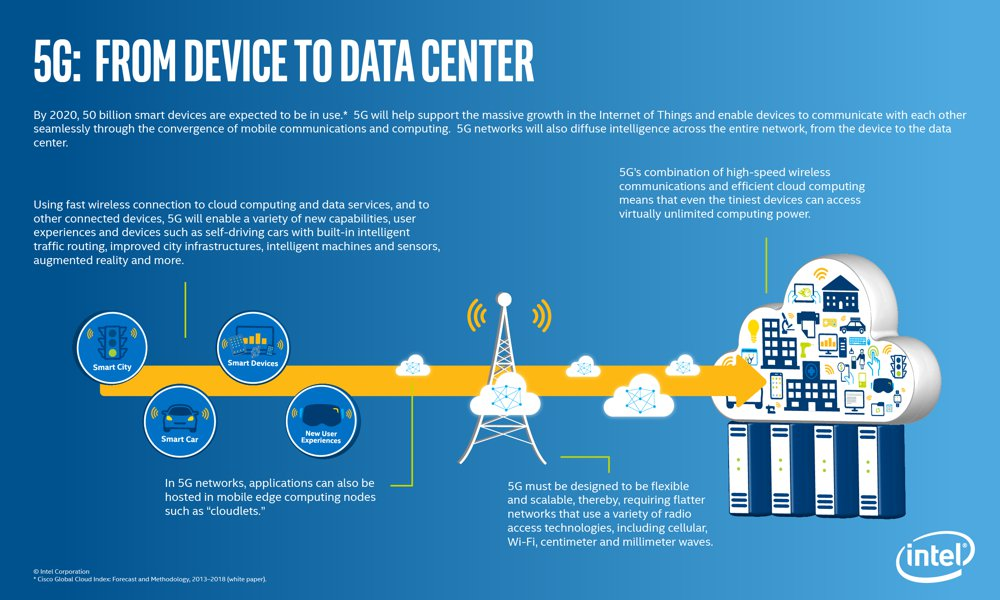
“Client to cloud” is one way Intel talks about coming fifth generation mobile networks. But Intel’s language also shows the intimate connections between core network architecture, end user devices, access networks, what we used to call “big data” and mobile networks.

Where earlier mobile networks were primarily about air interfaces and support for data,  5G breaks the mold.

As Intel sees it, “5G will not be about simply increasing speed and capacity, but will also be about intelligence throughout the network to enable devices and the network to communicate more efficiently, transport data and content more quickly, and share computing resources.”

In practical terms, 5G requires that devices, the network and the computing resources in the cloud will work together to establish intelligent service awareness.

Actions will be prioritized based on level of importance and be flexible enough to accommodate many devices that have widely varying connectivity, processing, power and latency requirements.

Devices will evolve in size, form, function and computing capability on the road to 5G. More significantly, networks and devices will need to intelligently manage connections as users move in to, out of and between cell coverage areas, as well as suppress interference from neighboring cells.

The networks and devices also will take a greater role in sharing contextual information, creating opportunities for developing new breeds of video, web browsing, gaming and interactive cloud-based applications.

None of that can happen without simultaneous changes in the core network. “Increasingly, networks must be designed to be flexible, efficient and scalable,” Intel notes. That means the core networks will be much more virtual, using network functions virtualization and software defined networks.


Intel says it already is working with Nokia, NTT DOCOMO and SK Telecom as part of its 5G development efforts.

Adtran Supplies Gigabit Platforms to 200 U.S. Communities

Even if some might argue most claims of “gigabit” deployments are overblown, Adtran itself reports it has supplied gigabit access solutions for Internet service providers in more than 200 communities as part of its Enabling Communities, Connecting Lives program.

Comcast, the largest U.S. ISP, will be upgrading its services to gigabit levels across 26 million U.S. households in early 2016, so the movement is real.

Comcast’s plan to offer all its consumer customers gigabit speeds over hybrid fiber coax networks has strategic implications for cable operators, compared to most telcos and other independent Internet service providers using either fiber to neighborhood or fiber to home networks.

CableLabs, the U.S. research and development entity, predicts 2016 will be the year that most U.S. cable customers potentially could get gigabit connections over DOCSIS 3.1 platforms.

At the risk of seeming overly bearish about prospects for fixed network telcos, consider one key difference between the hybrid fiber and copper networks used by both telcos and cable companies, in recent decades.

Assuming a typical 500-home serving area from a single optical node, Comcast uses a fiber to neighborhood design that is structurally similar to the fiber to neighborhood design favored by AT&T, for example. The difference is that Comcast should ultimately be able to wring downstream speeds up to 10 Gbps from that same network, using DOCSIS 3.1 technology.

A typical fiber to the node architecture might have a single optical node serving a “few hundred” homes, making it roughly comparable to Comcast’s access network, in terms of use of optical fiber for transport and then copper for distribution to customer locations.

The difference in end user capacity is related to the differences between coaxial cable and twisted pair copper in terms of bandwidth, plus the difference between cable “broadband” and telco “baseband” modulation methods.

The differences are huge, allowing Comcast to upgrade with slight, if any changes, to the distribution plant, and upgrading to a gigabit by switching to new modems now, and up to 10 Gbps over time.

A telco fiber to neighborhood network cannot upgrade that much by switching out customer premises gear.

So cable has a clear advantage, in terms of scaling investment to reach higher bandwidth.

Of course, the alternative is to replace the hybrid network with an all-fiber approach. Comcast itself has chosen to do so for about 85 percent of its customers who might prefer to buy a symmetrical 2 Gbps connection instead of 1 Gbps.

Axiata Struggles in Malaysia, Indonesai; Grows Strongly Elsewhere

Axiata Group Berhad revenue year to date in 2015 was described as “improved” in its most-recent financial report.

Year-to-date (YTD) revenue for the Group was up 2.3 percent to RM9.5 billion from RM9.2 billion a year ago. Earnings before interest, tax, depreciation and amortization (EBITDA) of RM3.5 billion was slightly lower than the year-ago period.

Group profit after tax improved 2.8 percent. After-tax profit was up 34.2 percent year over year.

Axiata serves about 12.3 million customers in Malaysia, down from 13.4 million in the second quarter of 2014, but still generates about 38 percent of its revenues in Malaysia.

Competition is a major issue. Currently Indonesia's third-biggest mobile operator, Axiata’s XL unit lost subscribers. In the second quarter, XL had 46 million customers, down from 62.9 million in the same period last year.

In local currency terms, revenues have dropped from 6.1 trillion Indonesian rupiahs ($439 million) to IDR5.6 trillion ($403 million) over the same period.

Axiata's performance in the much smaller markets of Sri Lanka and Cambodia stood in sharp contrast to the setbacks at home and in Indonesia.

Sri Lanka's Dialog grew revenues to 17.7 billion Sri Lankan rupees ($130 million), from SLR16.7 billion ($120 million) in the second quarter of 2014, and saw its customer base grow from 9.3 million to 10.1 million subscribers over the same period.

In Cambodia, revenues grew from MYR270 million ($65.4 million) in the first six months of 2014 to MYR420 million ($101.7 million) in the same period this year.

Axiata was also boosted by the performance of Idea Cellular Ltd. , one of India's biggest mobile operators, in which it owns a stake of about 20 percent.

Fueled by growth in India's burgeoning mobile data market, Idea reported a 14% percent year-over-year increase in revenues in the April-to-June quarter.

In its home market, Celcom data revenue grew 28 percent year to date. Mobile internet revenue grew 60 percent. Service revenue dipped slightly mainly due to the decline in voice and SMS revenue, however.

Sri Lanka Dialog posted strong year to date  revenue growth of 6.3 percent, EBITDA growth of nearly 20 percent and profit growth of nearly 33 percent.

Robi6 in Bangladesh recorded 4.9 percent year to date  revenue growth to BDT25.1 billion, mainly driven by data revenue and device sales.

The Smart operation in Cambodia saw revenue growth of  39.1 percent. Voice revenue increased 15 percent while data revenue grew 115 percent. T

India Idea saw 16.4 percent growth for its YoY revenue to INR88.0 billion. EBITDA grew nearly 29 percent while profits after taxes grew nearly 28 percent.

In Singapore M1 operating revenue grew 19.1 percent to SGD571.7 million YTD while EBITDA gained 1.4 percent, while profit after taxes grew  3.8 percent.

India Confronts Internet Backhaul Challenge

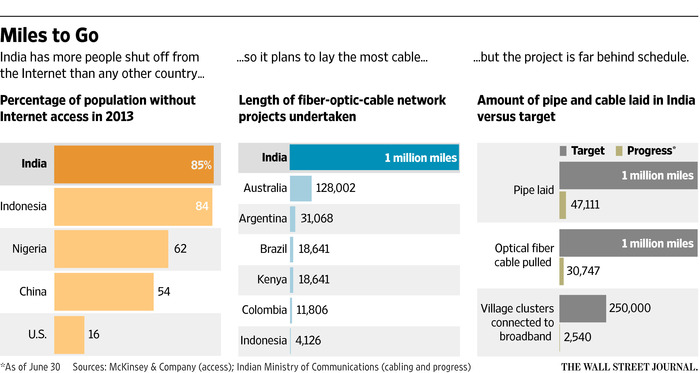
Since 2011, India’s government has been committed to extending optical fiber backhaul to some 600 million potential users in rural areas. So far, it has made slow progress, having installed about five percent of the planned million miles or so of backhaul facilities.

In 2013, 1.06 billion Indians were still without Internet access, according to a report by McKinsey & Co. In 2013, Internet penetration was 15 percent in India, compared with 46 percent in China.

Availability of backhaul facilities is part of the problem. About a million miles of backhaul fiber is required to reach 250,000 village clusters in India to the Internet. The original plan estimated that 370,000 miles of cable would allow connection of community centers, hospitals and schools as part of the National Fiber Optic Network  launched in 2011.

Full completion is expected to cost about $11.2 billion, about four times what was originally planned.

source: Wall Street Journal

When Was the Last Time 40% of all Humans Shared Something, Together?

I miss these sorts of huge global events where 40 percent of living humans share a chance to build something for others.