Sunday, August 23, 2015

Internet of Things Venn Diagram, Sort Of

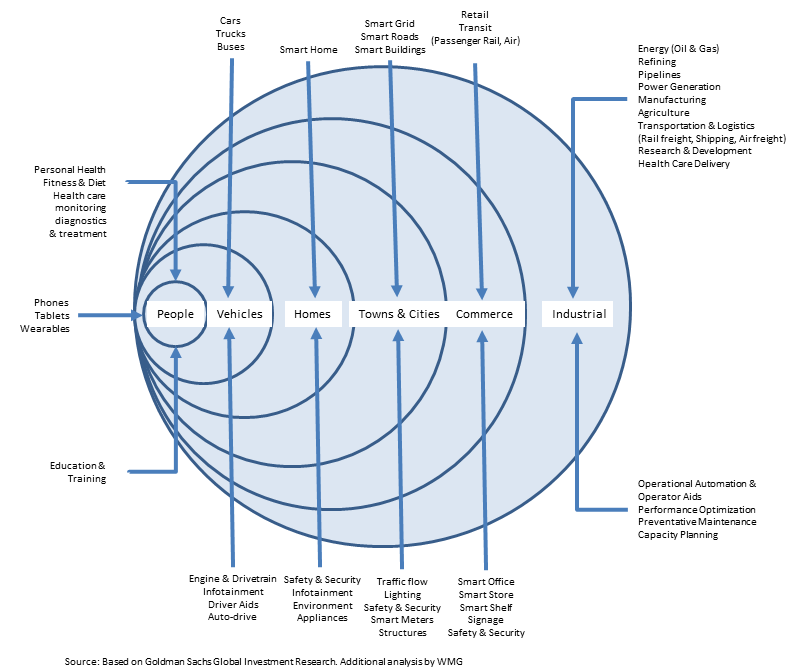
Here's a sort of Venn diagram of Internet of Things potential connected devices. Caveat: the surface areas are not strictly indicative of revenue size or installed devices base. It’s just illustrative.

But some estimate there could be 50 billion "things" connected to networks by perhaps 2025.


Spectrum Futures, Singapore, Sept. 10-11, 2015

What will it take, who will lead, and what new opportunities will develop as part of the effort to connect a billion or more new Internet users across South Asia? That is focus of Spectrum Futures, a conference sponsored by the Pacific Telecommunications Council.

Hear from executives at Facebook, Ericsson, Qualcomm, Cisco, Ciena and other leading firms about the immense changes that will enable widespread and powerful access.

Discover from Reliance Communications and Global Cloud Xchange how mobile, access, data centers and computing architectures are now a seamless fabric, and what that means.

Learn about new backhaul platforms that will allow mobile and other ISPs to serve new customers affordably.

Understand how ISP, mobile and capacity suppliers, networks and revenue streams will evolve.

Find out how 5G, SDN, cloud computing, new backhaul networks and app promotions play a role.

Listen as innovators in spectrum and business models share their thoughts on what will drive Internet adoption.

See who wins, and why.

Those are a few of the reasons to attend the Spectrum Futures conference, to be held 10-11 September 2015 at the M Hotel in Singapore.

Attendance is strictly limited to 150 attendees, with priority for national communications regulators and their staffs. Register here.

Regulators and sponsors will gather on 9 September for dinner. The conference officially begins on 10 September with an all-day program and evening reception open to all registered attendees, and continues on 11 September with a half-day program followed by a regulators-only symposium. View the complete agenda here.

Can you afford to miss it?

Saturday, August 22, 2015

India Remains Flashpoint for Zero Rating

India remains one of the hotspots where it comes to policies on zero rating. Aside from governmental action that could happen, the Internet and Mobile Association of India also is considering what public stand to take on policies that encourage sampling of Internet apps by allowing access without the requirement to buy a mobile Internet access subscription, for an introductory period.

The Indian Department of Telecom is preparing regulations on network neutrality, and some believe zero rating should be banned as part of network neutrality rules, on the grounds that zero rating does not “treat all bits, or all applications, alike.”

Both Facebook and Google believe such promotional efforts have a direct and substantial impact on mobile Internet access adoption in markets across South Asia and Southeast Asia.

Google has done zero rated deals in India, notably with Airtel (the proponent of zero rated Airtel Zero service), as well for Free Zone (free Gmail, Google Search, Google+).

Google also has offered 200 MB free data for use of Google Play apps, and no data charges for over-the-air updates on Android One handsets.

Google reportedly was planning to roll out its own Zero Rated service in India, but put plans on hold after the net neutrality protests, especially those against Airtel Zero.

Both firms appear to believe that such promotional policies are helpful tools to boost Internet access across the region--Facebook perhaps more visibly than Google--and both also have joined the Cellular Operators Association of India.

As always, valid public policy concerns and perceived private financial interests both are in play. Google and Facebook have good reasons for believing they benefit disproportionately as hundreds of millions of new Internet users are added.

Smaller app providers might have their own vested interests in seeing that Google and Facebook do not gain access to that many new potential users. For few application providers is the direct link between “number of Internet users” and “our revenues” so clear.

In that sense, there is alignment between the interests of mobile service providers and ISPs and Google and Facebook. All gain directly from each incremental user or subscriber.

That is not so true for thousands of smaller app providers, who might well believe they are better off essentially slowing Facebook and Google influence.

Spellchecking in 3 Languages Simultaneously, on Chrome Canary

Image result for translatorsThe developer version of Google's Chrome operating system (Chrome Canary) includes a feature allowing spellchecking of three different languages, simultaneously.

It's now enabled in the experimental Chromium Canary Chrome Canary 
browser on Windows, ChromeOS or Linux. 

Friday, August 21, 2015

Can 5G Fix Profit Per Bit Per Hertz Problem?

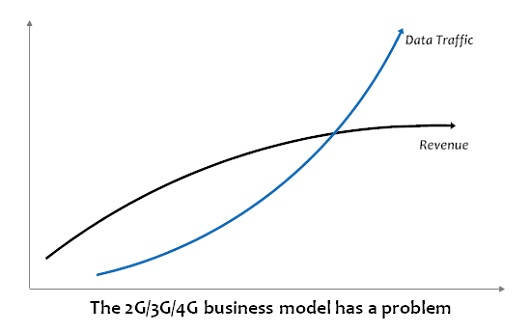
Mobile operators have faced a rather persistent problem where it comes to profit margins on Internet access services. Simply, revenue generation has lagged consumption.

Is that the sort of problem fifth generation networks can solve? In some ways, yes. Each generation of mobile networks tends to be more efficient, in terms of bits per Hertz, than the earlier generation, and that likely will be true for fifth generation networks as well.

Still, as we already have seen, perhaps it is ability to shift access to Wi-Fi that most accounts for greater efficiency. In other words, the radio networks become more efficient, and generate more revenue per bit, when significant traffic demand is offloaded to the fixed network.

Not surprisingly, that is expected to be a big feature of 5G networks. Still, the issue is whether data access actually can be priced so that revenue exceeds the cost of supplying demanded bandwidth.

That will remain a big challenge. For starters, people seem to use more data with each passing year, and video consumption is a huge driver of that trend. That is an issue.

Video consumes so much bandwidth, and yet video content is priced so low, relative to the consumption, that there are limits to what mobile operators can charge.

Consider the example of a Netflix subscription costing $8 a month and offering the ability to stream movies that consumer up to a gigabyte per movie. If you assume a mobile gigabyte of usage costs between $7 a gig and $15 a gig, you see the problem.

Any significant amount of usage will drive data charges beyond the consumer’s willingness to pay, unless offload to Wi-Fi is readily available.

Fixed Internet access networks with effective usage limits in the hundreds of gigabytes are one thing. Mobile allowances typically in single digits are another matter.

The point is that it might never actually be possible to price consumed Internet capacity in a way that closely associates price and consumed bits, in a linear manner, and with consistently satisfactory profit margins.

Ironically, the more success mobile operators are with low-bandwidth Internet of Things applications and sales, the better the odds profit margins can be sustained. Narrowband applications (voice, messaging) traditionally have had the highest profit margins in the mobile business, in a bits per Hertz sense.

And that likely is key to 5G and future profit margins, on a profit per bit per Hertz basis. Sell the apps, not the access.
Ericsson, SK Holdings to Collaborate on IoT Apps

Ericsson and SK Holdings have signed an agreement to collaborate on creating global Internet of Things platforms for industry sectors including healthcare and transportation.


In addition, the partners said they will work on solutions for disaster recovery related to IoT as well as IoT authentication and security in the Asia Pacific area.


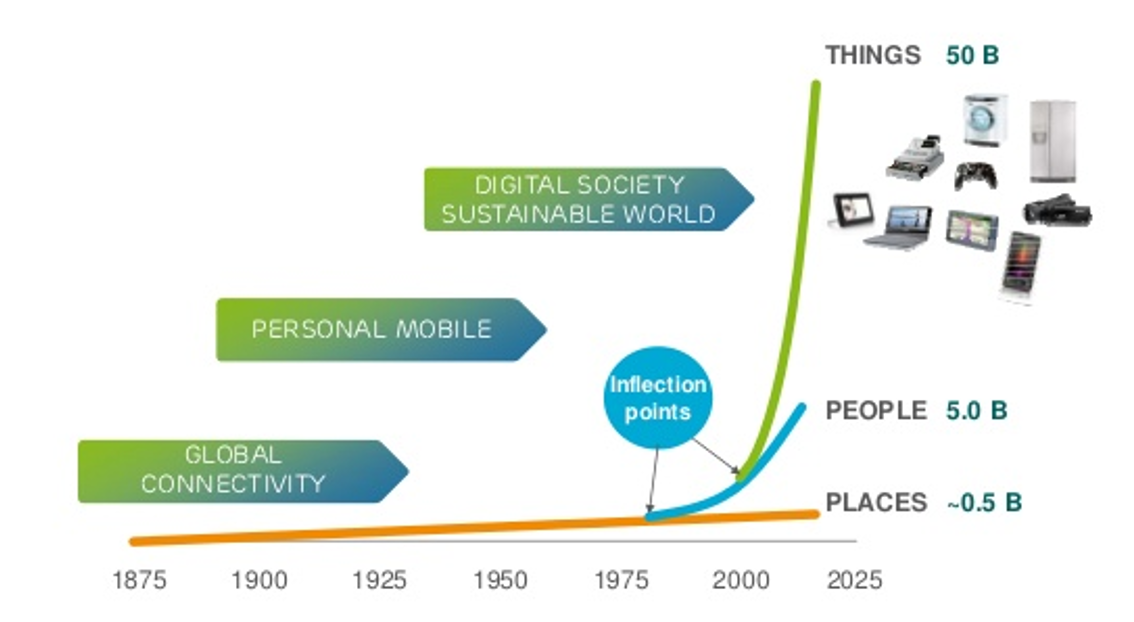
There is a reason for the interest. Fixed networks connected places. Mobile connected people. IoT will connect objects. Each new segment represents a market an order of magnitude larger than the former.


So connected places might represent a universe of about a half billion places. Connecting people represents a potential market of five billion. Internet of Things might represent 50 billion objects.


How Much of $152 Billion in Connected Car Revenues Will Mobile Ops Get?

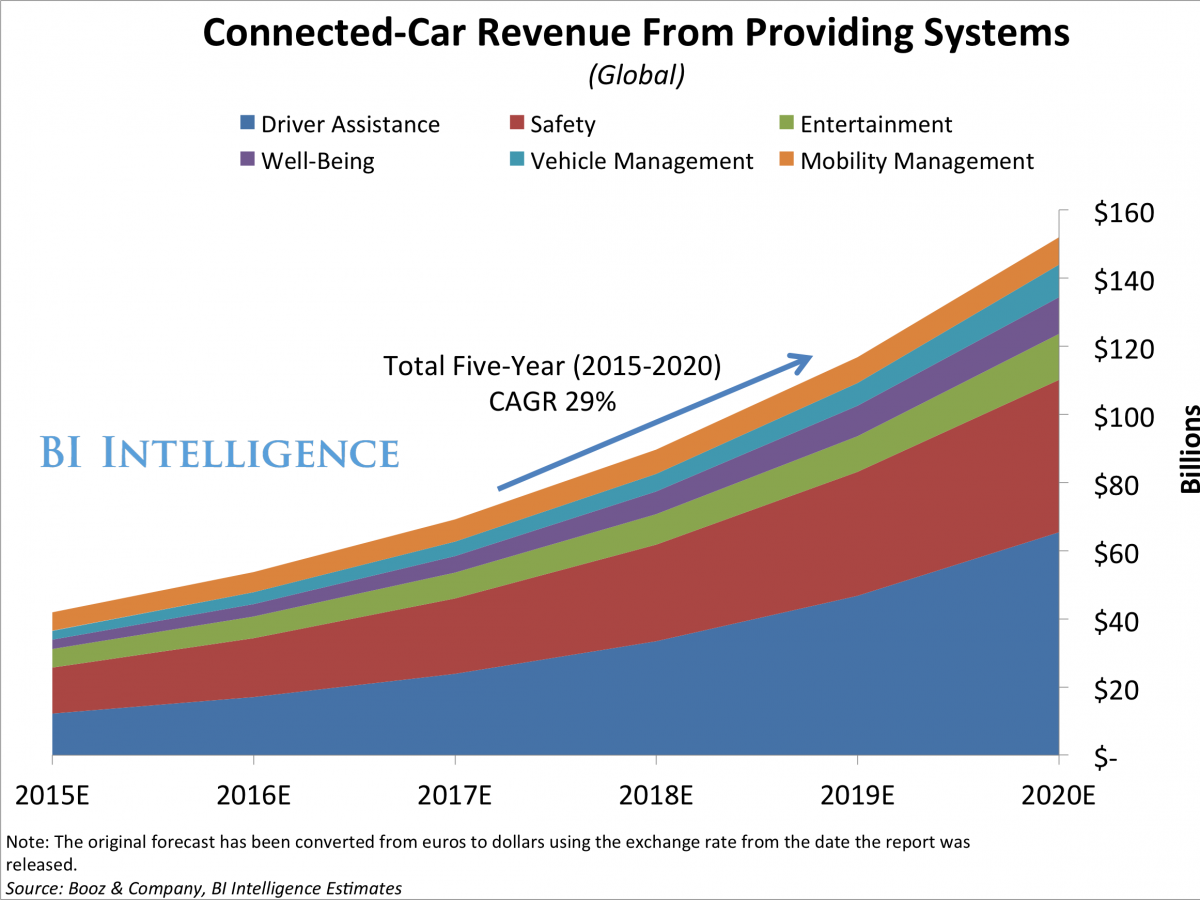
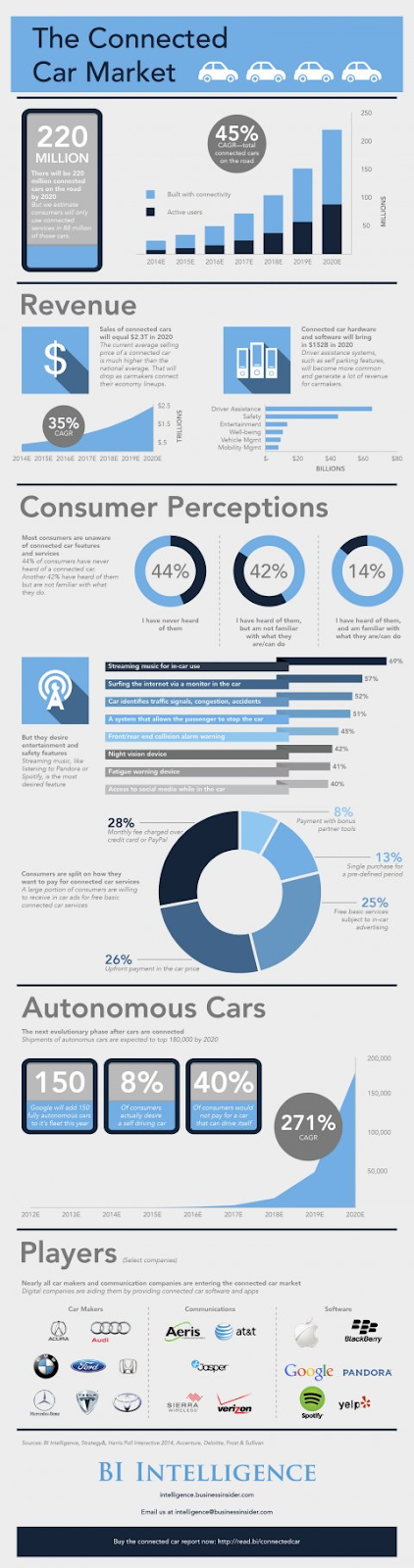
Services related to the connected car market will generate as much as $152 billion by 2020, including the value of hardware and software, according to Business Insider Intelligence.

Relatively little of the total revenue is likely to be generated by the “access” function (the equivalent of a mobile or fixed network Internet access subscription). Most of the revenue will be reaped by providers of services or apps, which suggests the direction mobile service providers are likely to continue taking in the connected car markets.

One reasonable hypothesis is that auto industry related firms are in position to win most of the revenue, as the biggest categories are vehicle management and safety. In those market segments, mobile service providers are likely to be supplies of access, more than the actual application or service providers.

Mobile providers logically should do best in the mobility management area, and could be significant providers in the driver assistance, entertainment or well being apps categories, to mention a few possible segments.


When Was the Last Time 40% of all Humans Shared Something, Together?

I miss these sorts of huge global events where 40 percent of living humans share a chance to build something for others.